Challenges 20% Time Encountered As Google Scaled and Went Public
Although Google’s 20% Time Program produced massive ROI for the organization, it was never a formalized policy that was included in employee handbooks or actual company documentation.
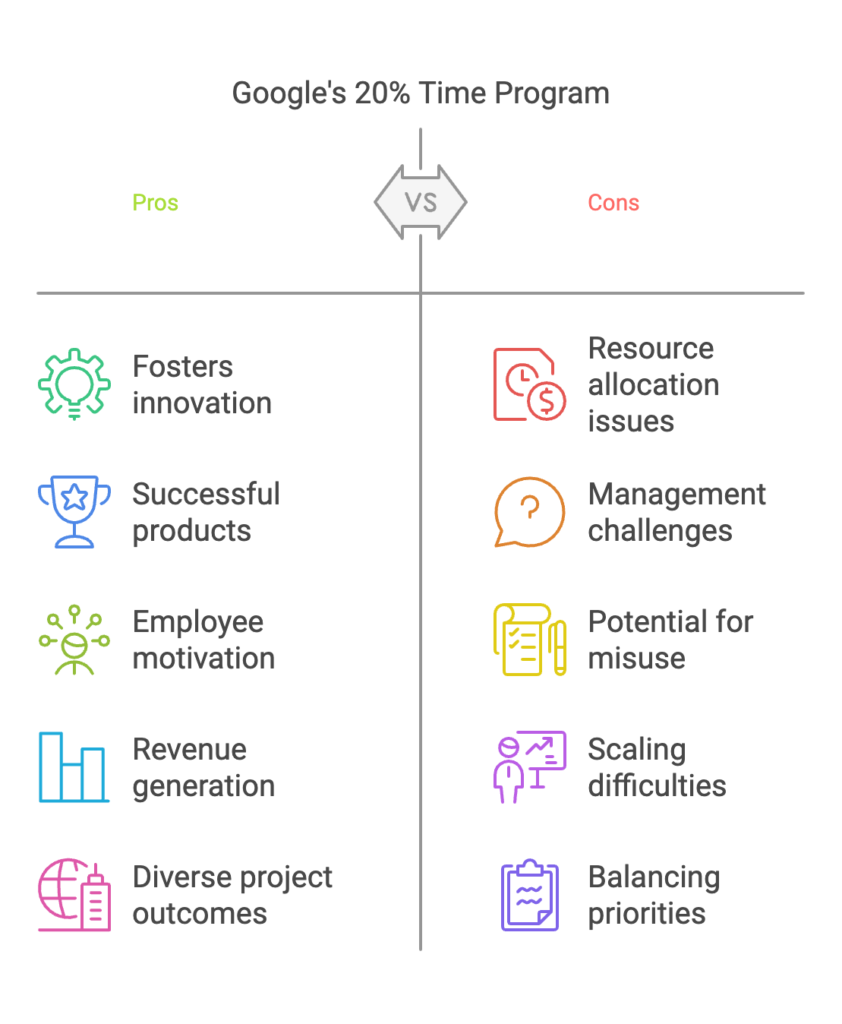
As the company scaled and went public, quarterly earnings and a short-term focus started to conflict with the cultural mindset and norms of allowing employees 20% of their time to work on side projects.
Initially, this resulted in employees coining the program as “120% Time” since they had to fulfill all of their regular work responsibilities and work on their side projects outside of normal working hours. Ultimately, this resulted in the program naturally becoming less utilized and championed over time.
What is Google’s 20% Time Rule?
In Google’s 2004 IPO letter, co-founders Larry Page and Sergey Brin stated that employees could spend 20% of their paid time working on personal side projects they believed would benefit the company. Inspired by 3M’s “15% Time” model, this initiative was designed to empower employee-driven innovation by granting autonomy within the structure of corporate work.
Unlike rigid innovation programs, 20% Time wasn’t a formal policy but rather an ethos—an encouragement embedded in the culture. Employees were trusted to manage their responsibilities while pursuing high-potential ideas on the side.
Innovations Born from Google’s 20% Time
Some of Google’s most transformative products emerged from this policy:
- Google Suggest – Autocomplete search feature born from an engineer’s 20% side project.
- AdSense – One of Google’s largest revenue generators, launched by Susan Wojcicki during 20% time.
- Google News – Created by Krishna Bharat to improve news access after 9/11.
- Orkut – An early social network, developed during discretionary project time.
- Google Translate, Talk, and Sky – Internal tools that started as personal experiments by engineers.
Clarification: Gmail, while often associated with 20% Time, was actually developed as part of Paul Buchheit’s regular role—not officially under the program.
These innovations underscore how structured freedom can yield high ROI, encouraging companies to give employees the bandwidth to solve real-world problems creatively.
Implementation and Challenges
While 20% Time helped shape Google’s innovation culture, it had critical limitations:
- No formal tracking or resource allocation: There was no official process for documenting projects or progress.
- Time constraints: Engineers struggled to balance side projects with primary responsibilities. The result? The phrase “120% Time” emerged—employees often worked extra hours to pursue their innovations.
- Adoption was uneven: Only about 10% of engineers consistently used 20% time, according to internal reports.
Former Google HR chief Laszlo Bock described it as a cultural value that “waxed and waned,” depending on team dynamics and leadership support. As pressure to deliver quarterly results grew after Google went public, fewer employees had the bandwidth or encouragement to explore passion projects.
The Current State of Google’s 20% Time Program Today
In recent years, Google has utilized more traditional methods for engaging and enabling employee ideas that were spun off of the concept of The 20% Time Program, including:
- Area 120 & Google Labs – This was Google’s in-house incubator where employees could work on experimental products full-time. It operated as a more formalized version of the original 20% time concept, though it was more selective.
- Innovation Weeks – Some Google teams implemented designated periods where employees could focus entirely on creative projects and new ideas.
- Hackathons and Fixits – Regular events where employees could dedicate time to passion projects or fixing existing issues.
Organizations that want to give employees room to innovate without losing structure can use innovation challenges to focus ideas around specific business priorities, evaluate the strongest opportunities, assign ownership, and track results through implementation.
Although these initiatives are great (it’s what we power at Ideawake after all 😊), it seems like Google took several steps backwards. Hindsight is 2020, but we believe that the cultural shift that stifled the utilization of programs like 20% Time was one of the big drivers that caused Google to be caught flat-footed when OpenAI released ChatGPT to the world, which many argue is the biggest threat to Google’s global search dominance in its 25+ years of existence.
Other Companies and Programs Inspired by 20% Time
Google’s model has influenced organizations across industries. Some notable adaptations include:
- 3M’s 15% Time – Preceded Google’s initiative, leading to the invention of the Post-it Note. Still part of 3M’s culture.
- Atlassian’s ShipIt Days – Quarterly one-day hackathons with funding for projects. Atlassian once allocated $1M toward internal innovation projects.
- LinkedIn’s InCubator – Requires engineers to pitch ideas and secure approval to work on them during company time.
- BBC and Apple – Ran limited experiments offering ~10% of time or “focus weeks” for side projects.
Each of these variations reflects different levels of structure, oversight, and executive sponsorship, showing that innovation time must be adapted to fit a company’s operational reality.
20% Time in Education
The spirit of Google’s 20% Time has entered the classroom through initiatives like Genius Hour, where students use a portion of class time to pursue passion projects.
- Benefits reported by educators include:
- Increased engagement and ownership
- Deeper learning through self-directed inquiry
- Higher motivation and creative problem-solving
According to Edutopia, giving students time to explore personal interests leads many to exceed learning goals and develop stronger critical thinking skills. This shows that autonomy and trust can boost creativity at any age or level.
Idea Management Made Simple
Turn Your Team’s Ideas Into Measurable Impact
Capture ideas, streamline evaluation with AI, and turn promising opportunities into action. See how Ideawake can support your innovation or continuous improvement program.
Free trial includes onboarding. No credit card required.
3 Things You Can Learn from the Journey of Google’s 20% Time Program
The success of Google’s 20% Time Program is an inspirational story that also serves as a cautionary tale. Here are a few things you can take away from today as you start to build or continue to foster a culture of innovation at your organization –
- Formalized Policies for Innovation Are a Must – There are always going to be competing priorities that result from growth, internal politics, and personnel changes. In order to cement a successful program like Google’s 20% Time Program in place, it must be formalized in both policies and how frontline team members (as well as their managers) are measured in annual performance reviews.
- No Program is Safe without Continuous ROI Justification – Any internal program, regardless of past success needs to have it’s importance justified to leadership in terms of dollars and cents early, often, on on repeat.
- You Can Often Become a Victim of Your Own Success – Google’s unimaginable success (in some cases driven by the very projects that came from The 20% Time Program), caused it to be focused maximizing short-term growth and profit at the expense of the transformational innovations that gave it its throne in the first place.
Improve Workplace Innovation with Smart Idea Management
Many successful companies encourage employees to share creative ideas and collaborate on innovation initiatives. Using an advanced platform like IdeaWake helps businesses organize, evaluate, and implement ideas more efficiently across teams. Organizations looking to streamline innovation workflows can explore the full range of tools available through the IdeaWake product platform for better collaboration and engagement. Businesses interested in modern automation and smarter decision-making can also discover the benefits of AI-powered innovation solutions designed to enhance idea management processes. To choose the best option for their company size and goals, teams can review the flexible IdeaWake pricing plans before getting started.
FAQs for Google’s 20% Time Program – A Massive Success and a Cautionary Tale
1. Why did Google’s 20% Time become less effective over the years?
Although highly successful in its early days, competing priorities, quarterly performance pressures, and lack of formal structure made it harder for employees to dedicate time to side projects as Google scaled.
2. Did every Google employee actually get to use their 20% Time?
No. Reports suggest only around 10% of engineers consistently used the program. Many employees felt pressure to meet core responsibilities first, making it difficult to take advantage of the initiative.
3. How is Google’s Area 120 different from the original 20% Time?
Area 120 was a structured internal incubator where selected employees could work full-time on experimental projects, unlike the informal and self-directed approach of 20% Time.
4. What lessons can startups learn from Google’s 20% Time Program?
Startups can embrace structured freedom but must also build clear policies, align innovation programs with measurable ROI, and ensure leadership supports long-term innovation, not just short-term gains.
5. How has Google’s approach to innovation changed since the 20% Time era?
Instead of freeform side projects, Google now relies on structured hackathons, innovation weeks, and dedicated labs that balance creativity with accountability and business objectives.
6. Are there risks for companies trying to copy Google’s 20% Time model?
Yes. Without structure, clear expectations, and leadership support, employees may feel overworked or that innovation efforts are undervalued. Each company must adapt the model to its own culture and size.
7. Can 20% Time work in non-tech industries?
Absolutely. Companies in healthcare, manufacturing, education, and even public service have adapted similar models to encourage problem-solving and continuous improvement.