
The most common reason that companies we talk to don’t move forward with an employee ideas program is centered around “we have other critical projects and priorities” to implement over the next 6 – 12 months.
What this really means 90% of the time is that leadership perceives the ROI of these other projects and initiatives to be higher than implementing an employee ideas program. Today, we’re sharing several heavy-hitting statistics from reputable sources to help increase the perceived ROI of launching an employee ideas program at your organization.
Employees Have Ideas to Improve Their Organizations
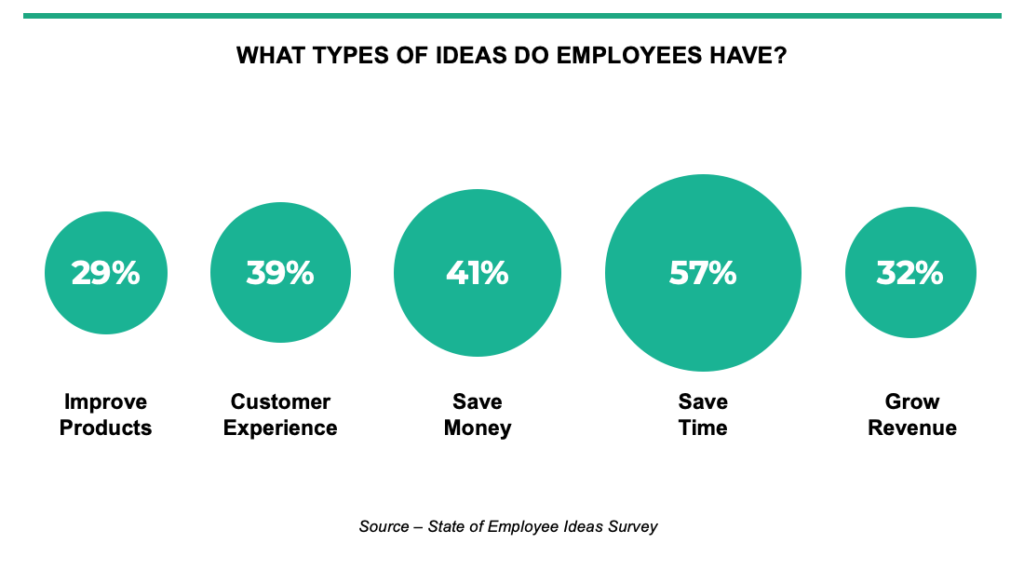
I think that everyone reading this agrees, but employees have ideas to improve their organizations that go beyond simple HR improvements. Based on Ideawake’s State of Employee Ideas Survey, which surveyed 700 full-time employees across the continental USA, 62% of employees had ideas to make their organization better which spanned several categories – below is a visual of the top 5 categories from respondents.
Want to Learn More or Test Drive Ideawake?
Start enabling a culture of improvement today. Start testing whether Ideawake is right for you in the next 5 minutes, or contact sales to schedule a demo.
We hope these resources help you build out a stronger business justification for getting an employee ideas program rolled out or expaned upon at your organization in 2025! If you want some additional resources as you develop your case, reach out to our team, we’re here to help!
FAQs
1) How do these stats translate into bottom-line ROI?
Higher participation (often 50–80% vs. 5–15% with forms) surfaces more implementable ideas, which typically drives 2–5× more cost-savings/revenue wins. Tie each approved idea to savings, revenue, or risk avoided to show hard dollar impact.
2) How do I present ROI to leadership in one slide?
Use: ROI = (Annual Benefits − Program Costs) ÷ Program Costs. Example: $300k savings + $150k revenue − $75k costs = 5× ROI (500%). Add time-to-value (first 90 days) and a pipeline of “next best” ideas.
3) What’s the realistic timeline to first wins?
Most teams launch in 2–4 weeks and see first implemented ideas in 30–90 days (challenge live, review, pilot, implement). Ideawake’s workflows, duplicate detection, and AI scoring shorten review cycles.
4) How many people and hours does this actually take?
Plan for 1 program owner and challenge sponsors spending ~1–2 hours/week each. Automations (routing, reminders, dedupe) and integrations (Teams, Slack, JIRA, Asana) cut admin time roughly in half vs. manual tools.
5) How do we beat the low engagement we saw with forms/Teams?
Built-in gamification (leaderboards, prizes), anonymous posting, mobile access, and in-channel submissions via Teams/Slack reliably lift participation into the 50–80% range.
6) How do we prove impact after launch?
Use Ideawake’s analytics to track participation, idea quality, cycle time, implementation rate, and verified financial impact (savings, revenue, risk reduction). Exportable reports make monthly and quarterly updates board-ready.