
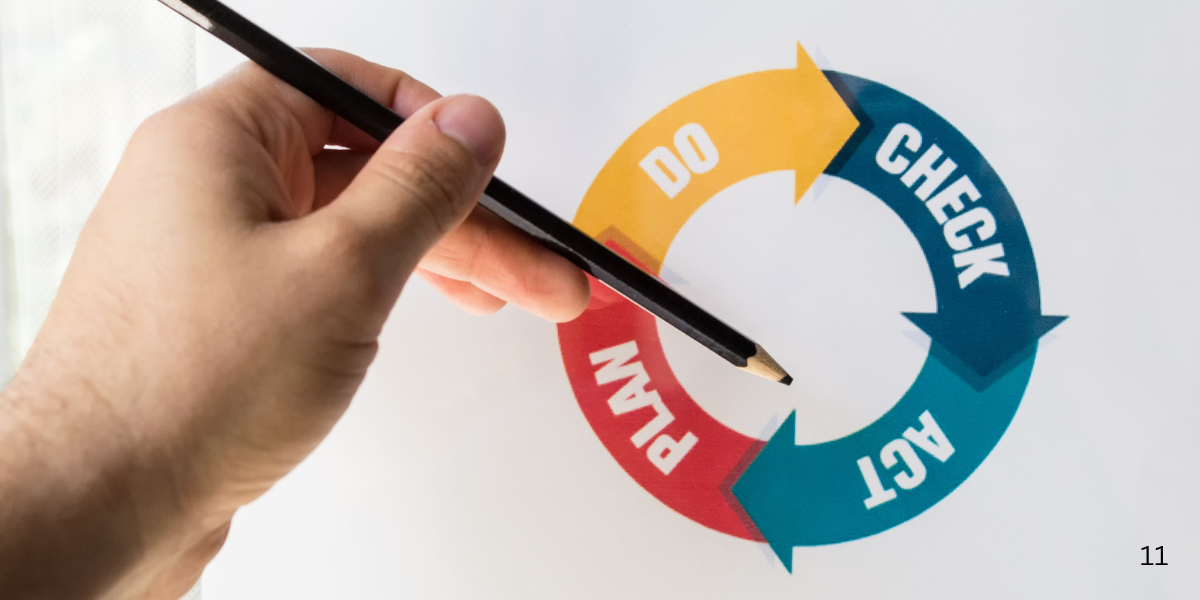
Continuous improvement isn’t a one-time project—it’s a cycle. It’s about taking small, smart steps that add up to big, lasting change. Whether you’re improving customer service, reducing process waste, or launching new ideas, success comes from having a clear, repeatable system. That’s where the four phases of continuous improvement—Plan, Do, Check, Act (PDCA)—come in.
At Ideawake, we’ve seen hundreds of teams use this framework to turn ideas into measurable outcomes. Let’s explore what each phase means, how they connect, and how Ideawake helps you make it happen in one streamlined platform.

Phase 1: Plan – Identify, Diagnose, and Design
Every improvement starts with clarity. In the Plan phase, you identify a problem or opportunity, gather data, and set a direction. This is where you define what success looks like before taking action.
Start by asking: What’s not working as it should? What’s our target state? How will we measure progress? Then, design a small-scale experiment that’s easy to test. Planning isn’t about creating a massive strategy deck—it’s about aligning your team on one focused, testable change.
Inside Ideawake, this phase comes to life through idea collection and evaluation. Employees, teams, or departments can submit ideas tied to business goals. You can tag, categorize, and score them by impact and effort, giving leaders a clear picture of where to focus first. Once an idea is approved, it becomes an actionable “pilot” with defined owners, timelines, and success metrics.
Planning done right means everyone understands the “why,” the “what,” and the “how” before moving forward.
Want to Learn More or Test Drive Ideawake?
Start enabling a culture of improvement today. Start testing whether Ideawake is right for you in the next 5 minutes, or contact sales to schedule a demo.
Phase 2: Do – Test the Change in a Controlled Way
The Do phase is where ideas move from concept to reality. But instead of rolling out big changes across your entire organization, this step is all about testing small and learning fast.
Run your pilot on a limited scale—maybe one department, one location, or one customer segment. Observe how the process performs and document what happens. Don’t aim for perfection; aim for learning. Continuous improvement thrives on momentum.
Ideawake helps teams execute faster with built-in project tracking. You can assign tasks, set deadlines, and monitor progress in real time. Team members can leave updates, attach notes, or upload files directly in the platform, keeping everything centralized. No more chasing updates in endless spreadsheets or email threads.
The goal of this phase is to see how your idea performs in the real world. Even small wins provide valuable data for the next step.
Phase 3: Check – Review the Results and Learn from Them
Once your pilot is complete, it’s time to see what worked and what didn’t. The Check phase is where reflection meets measurement. You compare the results against your original goals to understand whether the change made a positive impact.
Look at your data, but also listen to the people involved. Did the new process make work easier? Did it improve outcomes or create new issues? Numbers tell part of the story, but feedback completes it.
In Ideawake, this phase is powered by impact dashboards. Each initiative displays measurable outcomes—cost savings, efficiency gains, engagement levels—and allows you to capture qualitative insights. You can document lessons learned, attach before-and-after visuals, and record team feedback.
This structured reflection helps organizations avoid repeating mistakes and ensures that valuable insights don’t get lost. The key question is simple: Should we scale it, modify it, or let it go?
Phase 4: Act – Standardize, Scale, or Start Again
The final step is Act—turning learning into lasting change. If your pilot succeeds, standardize it. Update your processes, train your teams, and make it the new normal. If it falls short, don’t scrap the effort—adjust your plan and start another PDCA cycle.
Continuous improvement is iterative. Each cycle brings new insight and refines your approach over time. The real power of PDCA isn’t just fixing one process—it’s creating a culture that learns continuously.
Ideawake helps you close the loop with implementation tracking and knowledge sharing. You can mark ideas as “implemented,” record verified outcomes, and publish playbooks for future use. The platform’s portfolio view helps leaders see what’s working across departments, so successful improvements can be scaled across locations or teams.
When the Act phase is built into your culture, you never run out of ways to improve.
PDCA vs. DMAIC: What’s the Difference?
You might hear PDCA mentioned alongside another improvement framework—DMAIC (Define, Measure, Analyze, Improve, Control). While they sound similar, they serve different purposes.
- PDCA is lightweight and fast. It’s perfect for daily problem-solving, employee ideas, and quick iteration.
- DMAIC is more data-heavy, used in Six Sigma projects where detailed analysis is required before making changes.
In simple terms: use PDCA when you need speed and flexibility; use DMAIC when precision and analytics matter most. Many organizations actually use both—PDCA for everyday improvements and DMAIC for strategic, complex challenges.
Ideawake bridges both worlds by making it easy to capture data-driven insights while keeping the process simple enough for anyone to participate.
Examples of PDCA in Action
Continuous improvement isn’t limited to one department or industry. Here’s how teams use PDCA across different functions:
- Operations: A manufacturing team runs a two-week pilot to reduce machine changeover time. The pilot works, so they standardize the new setup sequence across all shifts.
- Customer Service: A support team tests a callback workflow to reduce hold times. After seeing higher satisfaction scores, they expanded it across regions.
- IT and Product: A software team rolls out a new feature to a small group of users. Based on engagement data, they refine the experience before full release.
Each example follows the same rhythm: plan, do, check, act—and repeat. The structure builds confidence while minimizing risk.
What to Measure at Each Phase
Knowing what to measure keeps your improvement cycles grounded. Here’s how metrics align with each phase:
- Plan: Baseline metrics, target outcomes, and clarity of the problem statement.
- Do: Pilot completion rate, early indicators of success, cycle time.
- Check: Actual vs. target results, root-cause insights, feedback volume.
- Act: Implementation rate, adoption level, and sustained performance over time.
Ideawake lets you visualize all of this in one dashboard. You can see which ideas drive measurable outcomes, which need refinement, and which should be scaled. Over time, these insights reveal patterns—helping leadership prioritize high-value initiatives.
Building a Culture Around Continuous Improvement
The PDCA cycle isn’t just a framework—it’s a mindset. It works best when it’s embedded in your company’s DNA. When teams know that their ideas will be heard, tested, and recognized, engagement naturally increases.
That’s where Ideawake stands out. The platform transforms employee ideas into business improvements through a structured, transparent process. It connects every step—submission, testing, validation, and scaling—under one system of record.
Ideawake’s continuous improvement solution helps organizations capture employee ideas, manage improvement initiatives, and track measurable results in one structured system. Organizations use Ideawake not only to collect ideas but to run full improvement portfolios. Leaders can see progress across teams, measure financial impact, and sustain a rhythm of innovation. The result? A company that learns faster, adapts quicker, and stays ahead of the curve.
Continuous Improvement Through Structured Innovation and Smart Tools
The phases of continuous improvement become much more effective when organizations use a structured system to manage ideas, track progress, and implement changes consistently. Platforms like Ideawake help teams build a culture of continuous improvement by turning employee insights into actionable outcomes.
To support this process, exploring the product suite allows organizations to manage idea intake, collaboration, and execution in one place. Companies can also choose from flexible pricing plans that match their size and innovation needs. For more advanced capabilities, such as automated idea evaluation and smarter decision-making, AI-powered innovation tools can further enhance continuous improvement efforts.
Common Questions About Continuous Improvement
What are the 4 phases of continuous improvement?
The four phases are Plan, Do, Check, and Act—known as the PDCA cycle. It’s a structured way to test and refine ideas continuously.
How is PDCA different from PDSA?
They’re almost identical. PDSA replaces “Check” with “Study,” emphasizing deeper reflection, but the purpose remains the same.
Is PDCA the same as DMAIC?
No. PDCA is more flexible and suited for iterative learning, while DMAIC is data-intensive and used for complex process improvement.
How long should a PDCA cycle take?
There’s no fixed rule. Many teams run one cycle in two to four weeks. The key is consistency—small, frequent cycles beat long, one-off projects.
What’s the connection between PDCA and Kaizen?
Kaizen is the philosophy of continuous improvement. PDCA is the engine that drives it. You can think of Kaizen as the “why” and PDCA as the “how.”
Ready to Start Your First Cycle?
Continuous improvement doesn’t have to be complicated. With Ideawake, you can turn the PDCA framework into a living system that connects people, processes, and measurable results. From idea collection to implementation, every phase happens in one intuitive platform—making improvement part of your daily rhythm.
Start your first PDCA cycle today. Request a Demo and see how Ideawake helps you plan, test, check, and act with speed and confidence.