

Traditional brainstorming often feels like shouting into the void. Everyone throws out “good ideas,” but many sound the same, stay safe, or never get implemented. Reverse brainstorming flips that on its head—literally. Instead of asking “How can we solve this problem?”, you start with “How could we make this problem worse?”
It sounds counterintuitive, but that’s the point. By thinking in reverse, you uncover obstacles, assumptions, and blind spots that normal brainstorming misses. Then, by flipping those negative ideas into positives, you get practical, creative solutions that actually address root causes.
At Ideawake, we’ve seen innovation teams, HR leaders, and operations managers use reverse brainstorming to unlock fresh ideas fast. Let’s look at what it is, how it works, and how you can run one inside your organization using Ideawake.
What Is Reverse Brainstorming?
Reverse brainstorming is a creative problem-solving technique that encourages teams to think about how to make a situation worse instead of better. It’s also called negative or headstand brainstorming. The logic is simple—when you explore ways to fail, you surface risks and weaknesses that help you understand the real problem more deeply.
Once you’ve identified all the ways things could go wrong, you flip those ideas into solutions. The process creates a safe space for honesty and humor, which reduces fear of criticism and helps people think more freely. It’s especially useful when your team feels stuck, ideas are repetitive, or everyone is being too polite to say what’s actually wrong.
Reverse brainstorming works best when you need to:
- Overcome creative blocks
- Anticipate risks or failures before launch
- Identify weak points in a process or experience
- Spark new thinking in teams that are too solution-focused
It’s a mindset shift: stop searching for “the best idea” and instead reveal the “worst-case scenario.” Then, invert it.
Want to Learn More or Test Drive Ideawake?
Start enabling a culture of improvement today. Start testing whether Ideawake is right for you in the next 5 minutes, or contact sales to schedule a demo.
Reverse vs. Traditional Brainstorming
Traditional brainstorming asks people to come up with as many solutions as possible. It’s focused on output—lots of ideas, fast. But it often falls short because people self-censor. Nobody wants to say something that sounds negative or unrealistic.
Reverse brainstorming flips the script. Instead of chasing positive ideas, it deliberately explores how to make things fail. This gives teams permission to be honest about what frustrates them or what could break a process. Ironically, those “negative” insights often lead to the most practical and innovative solutions.
Here’s a quick comparison:
- Traditional brainstorming: “How can we improve customer onboarding?”
- Reverse brainstorming: “How can we make our onboarding experience as frustrating as possible?”
By listing ways to make it worse—long wait times, unclear emails, too many steps—you immediately see what needs fixing. Reverse brainstorming doesn’t replace traditional brainstorming; it enhances it by creating psychological safety and a fresh perspective.
The 5-Step Reverse Brainstorming Flow
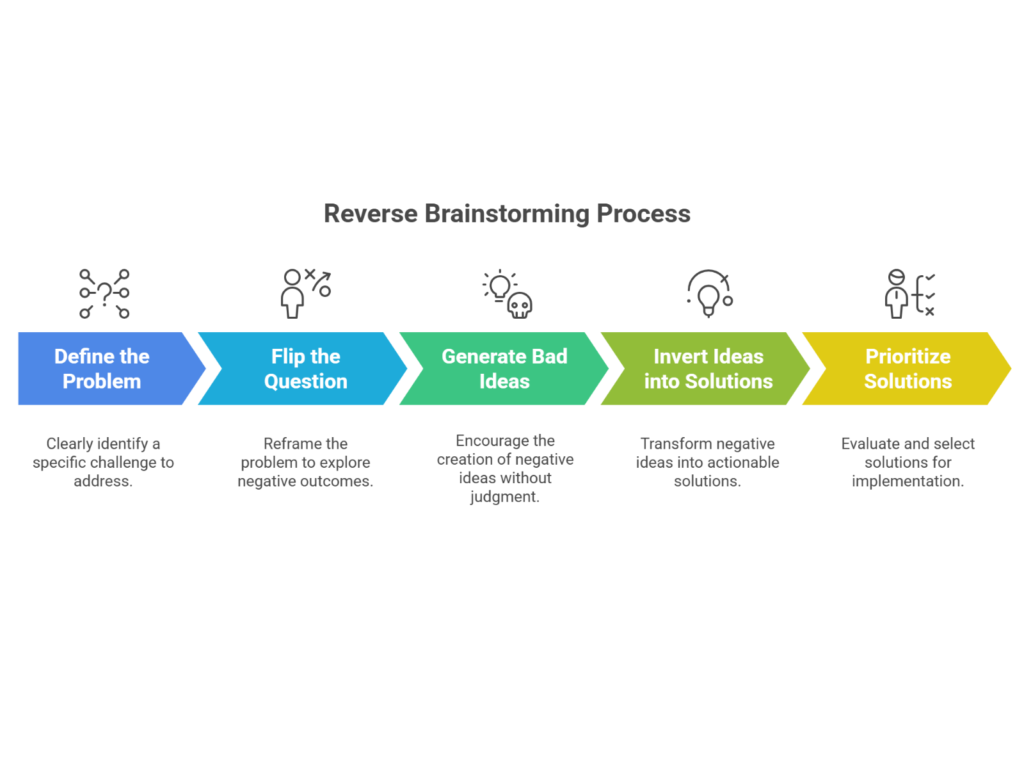
You can run a reverse brainstorming session in as little as 30 minutes. Here’s how:
Step 1: Define the problem clearly.
Start with one focused challenge. Avoid vague topics like “make customers happier.” Instead, pick something specific: “reduce support ticket volume by 20%” or “increase sign-ups for our webinar.” Clear problems lead to clearer reversals.
Step 2: Flip the question.
Turn the problem upside down. Instead of asking “How do we improve X?”, ask “How could we make X worse?” or “What would cause this to completely fail?” The goal is to provoke creativity by shifting your team’s mindset.
Step 3: Generate ‘bad’ ideas freely.
Encourage the group to come up with as many negative ideas as possible. Don’t filter or judge. The funnier or more exaggerated, the better. This step often loosens up the room and surfaces honest feedback about what’s broken.
Step 4: Invert each idea into a solution.
Once you’ve listed all the negative ideas, start flipping them. If someone says “Make customers wait on hold forever,” the inverted solution might be “Reduce average wait time by introducing a callback option.” This inversion turns problems into actionable solutions.
Step 5: Prioritize what to act on.
After flipping the ideas, evaluate which ones have the biggest impact with the least effort. These become your short-term experiments or improvement projects.
Inside Ideawake, you can move through these five steps digitally—creating a challenge, collecting “negative” ideas, tagging themes, flipping them to solutions, and assigning owners for next actions—all in one place.
Examples of Reverse Brainstorming in Action
Reverse brainstorming works across teams and industries. Here are a few real-world examples:
Product & UX:
Instead of asking, “How can we improve user onboarding?”, ask “How could we make onboarding a nightmare?” The list might include too many sign-up steps, unclear instructions, or slow load times. Invert those and you have a roadmap for a smoother, faster onboarding flow.
Marketing:
Ask “How could we ensure nobody opens our emails?” Common answers—boring subject lines, poor timing, unclear value—become the basis for better campaign testing and audience segmentation.
Operations:
Ask “How could we create maximum downtime?” The inverted actions—better maintenance scheduling, redundancy systems, and real-time alerts—reduce risk and improve efficiency.
Customer Service:
Ask “How could we guarantee customer frustration?” The inverted ideas might include training support teams, improving scripts, and simplifying knowledge bases.
Every team has hidden pain points. Reverse brainstorming brings them to light so you can fix them before they turn into bigger issues.
Common Pitfalls (and How to Avoid Them)
Like any workshop, reverse brainstorming can go off-track if not guided well. Here’s how to keep it productive.
Don’t get stuck in negativity. Time-box the “make it worse” portion so it stays energizing, not demoralizing. Move quickly to inversion mode once ideas slow down.
Avoid personal blame. Make sure the tone is light and focused on systems, not people. It’s about improving processes, not criticizing performance.
Turn insights into actions. The biggest mistake is stopping after the brainstorm. Always follow through with inverted ideas, owners, and next steps.
Keep outcomes practical. Some inverted ideas will be funny or unrealistic, but that’s fine. Use impact-versus-effort scoring to decide what’s truly worth testing.
With these ground rules, your team will feel safe enough to be bold—and honest.
How Ideawake Powers Reverse Brainstorming
Ideawake takes the reverse brainstorming process from a whiteboard exercise to a structured, repeatable system. Here’s how the platform makes it easier to run and scale:
Set the challenge: Create a new innovation challenge with a flipped question. Add context, data, and success metrics so participants know what to focus on.
Collect ideas: Open it to specific teams or the entire organization. Employees can submit “make it worse” ideas anonymously if desired, encouraging full honesty.
Cluster and analyze: Ideawake’s AI-powered tagging groups similar ideas and highlights recurring themes, giving you a data-driven view of what needs fixing most.
Invert and prioritize: Once you’ve captured all the negative ideas, use Ideawake to flip them into potential solutions. Add impact and effort scores to prioritize what to test first.
Pilot and measure: Convert top solutions into improvement projects. Assign owners, track progress, and capture results in Ideawake’s dashboards.
Share learnings: Save successful reversals as playbooks for future use, so your organization builds a living knowledge base of what works.
Reverse brainstorming can also support continuous improvement by helping teams repeatedly uncover process weaknesses, test solutions, and apply what they learn.
Metrics That Matter
When you track reverse brainstorming outcomes, you start seeing tangible value. Measure:
- Number of ideas submitted per challenge
- Diversity of contributors
- Percentage of “negative” ideas converted into actionable solutions
- Pilot success rates
- Total impact (cost savings, engagement, NPS, efficiency gains)
Ideawake helps you measure all of this automatically. Over time, you’ll see which teams contribute most, what kinds of challenges drive impact, and where to focus your next round of improvement.
Facilitation Tips for Better Sessions
Want to get more from your next session? Keep these quick tips in mind.
Start with provocative questions like “How could we lose every customer in a week?” It breaks the ice and sparks creative energy.
Encourage silent brainstorming before group sharing to avoid anchoring. It helps quieter voices contribute.
Limit the “make it worse” phase to 10–15 minutes to keep energy high.
Always end with ownership. Every good idea should have someone accountable for testing or following up.
Reverse brainstorming thrives on momentum. The faster you move from ideas to action, the more valuable the process becomes.
Common Questions About Reverse Brainstorming
What is reverse brainstorming?
It’s a creative technique where you intentionally think about how to make a problem worse, then invert those ideas into solutions.
How do you run one step-by-step?
Define the problem, flip the question, list negative ideas, invert them, and prioritize solutions.
When should I use it?
When teams are stuck, preparing for launches, or identifying process risks.
Is it better than traditional brainstorming?
Not better—complementary. Reverse brainstorming helps uncover blind spots and adds depth to traditional idea generation.
Can I use it for remote teams?
Absolutely. Platforms like Ideawake make it easy to run asynchronous sessions and gather ideas from multiple locations.
Turn Problems into Opportunities
Reverse brainstorming proves that sometimes, the best way to find a great idea is to start with a terrible one. By flipping challenges on their head, teams uncover what’s really standing in their way—and discover smarter solutions faster.
With Ideawake, you can make this process part of your innovation rhythm. From framing the challenge to measuring results, every step happens in one simple platform built for collaboration, transparency, and measurable outcomes.
Ready to flip your next problem? Request a Demo and see how Ideawake helps teams think differently, solve faster, and innovate continuously.
Use Ideawake to Improve Your Reverse Brainstorming Process
Reverse brainstorming is a powerful problem-solving technique that helps teams uncover hidden risks and generate more effective solutions by thinking in reverse. With platforms like Ideawake innovation platform, organizations can easily structure collaborative ideation sessions and turn negative thinking into actionable insights. Businesses can explore advanced features through Ideawake product features, which are designed to streamline idea collection, evaluation, and implementation. For teams looking to scale innovation efforts efficiently, flexible pricing plans make it easy to choose the right solution. Additionally, companies interested in smarter decision-making can leverage AI-powered ideation tools to enhance reverse brainstorming with data-driven insights and automation.
FAQs
What is reverse brainstorming?
Reverse brainstorming is a creative problem-solving method where instead of finding solutions, you identify ways to cause or worsen a problem, then reverse those ideas into solutions.
How does reverse brainstorming work?
It works by flipping the problem. Teams first think of all possible causes of failure, then convert those negative ideas into practical solutions.
What are the benefits of reverse brainstorming?
It helps uncover hidden risks, encourages creative thinking, improves team collaboration, and leads to more robust solutions.
When should reverse brainstorming be used?
It is best used when traditional brainstorming fails, or when you want to identify potential risks and weaknesses in a plan or process.
How is reverse brainstorming different from normal brainstorming?
Normal brainstorming focuses on solving a problem directly, while reverse brainstorming focuses on creating problems first to better understand how to solve them.
Can AI tools help in reverse brainstorming?
Yes, AI-powered platforms like Ideawake can help structure ideas, analyze inputs, and generate smarter solution pathways from reverse thinking sessions.