

Enterprise innovation management software is supposed to do one thing brilliantly: turn ideas from employees, customers, and partners into implemented improvements with measurable results. In real life, many tools stop at collection.
Ideas pile up. Innovation managers get buried. Department leaders cherry-pick a few promising concepts, take them “offline,” and collaboration dies right when it should get stronger.
In 2026, enterprise buyers are looking for platforms that manage the entire lifecycle—from targeted idea capture through assessment, validation, implementation, and ROI measurement—without losing momentum or visibility.
This guide reviews leading enterprise innovation management platforms and explains how to choose the right one for your program.
What is enterprise innovation management software?
At its core, enterprise innovation management software is a system for running innovation and improvement programs at scale. That “enterprise” part matters because the challenges aren’t just volume. They’re governance, accountability, and speed across departments, locations, and time zones.
A strong platform supports a repeatable lifecycle:
- Capture ideas with enough context to evaluate them
- Collaborate to refine ideas into workable solutions
- Evaluate using scorecards and reviewer groups
- Implement with ownership, stages, and handoffs to delivery teams
- Measure outcomes, participation, and pipeline health
Idea management vs innovation management vs portfolio management
These terms get blended together, but there’s a practical distinction:
- Idea management is mainly intake plus early refinement.
- Innovation management covers the full journey from intake to implementation and tracking results.
- Innovation portfolio management is the strategy layer—balancing bets, funding, risk, and outcomes across a portfolio of initiatives.
Most enterprise platforms blend these to some degree. What matters is whether your organisation can keep ideas moving forward without breaking visibility and collaboration.
The 4 criteria we used to review platforms
You’ll see a lot of “feature lists” in software comparisons. They rarely explain why programs succeed or stall. We use four criteria because they map directly to enterprise failure points.
1) Entire lifecycle support
If the platform mainly collects ideas, you’re going to rebuild the rest of the system elsewhere. The best tools keep the idea connected to decisions, owners, and outcomes.
2) Configurable assessment workflows
Different idea categories need different paths. A continuous improvement idea should not go through the same stages as a new product, HR policy change, or business model experiment. If a platform forces one workflow, teams will take work offline.
3) Collaboration depth (not shallow voting)
Enterprises win when they use the creative brainpower of the whole organisation. People need visibility into ideas and a way to improve them—through feedback, discussion, and structured critique—throughout the lifecycle.
4) Measurement & ROI visibility
Enterprise programs live or die by credibility. Leaders want answers fast: What’s in the pipeline? What’s stuck? What’s been implemented? What value did it create? Without strong analytics, innovation becomes a black box.
Bonus enterprise filters we considered (without letting them dominate the review): integrations (Teams/Jira/Slack), permissions and governance, adoption support, and multi-region readiness.
Quick comparison of enterprise innovation management platforms (2026)
| Platform | Best For | Standout Strength | Common Watch-Out |
| Ideawake | Fast adoption + measurable outcomes | End-to-end workflows + ROI focus + engagement design | Confirm best-fit workflow templates for your program types |
| InnovationCast | Workflow-driven implementation discipline | Challenge-led ideation + workflow depth | Heavily workflow-oriented; ensure it matches your program style |
| HYPE Innovation | Large programs needing modules + services | Modular approach + consulting-led onboarding | Pricing and scope typically quote-based; define what’s included |
| Wazoku | Innovation + tech scouting + networks | Scouting/network features alongside internal challenges | Validate reporting depth for your specific ROI requirements |
| Planbox | Structured programs across CI + venturing | Broad program support (CI, challenge-based, venturing) | Clarify pricing, packaging, and admin overhead early |
| Brightidea | Big enterprise innovation ecosystems | Established suite with multiple program modes | Make sure workflows/reporting match how your org executes |
Reviews: Top enterprise innovation management software platforms
Below, we review platforms using the same lens: lifecycle support, workflow flexibility, collaboration, and measurement.
1 Ideawake (Best for fast adoption + measurable outcomes)
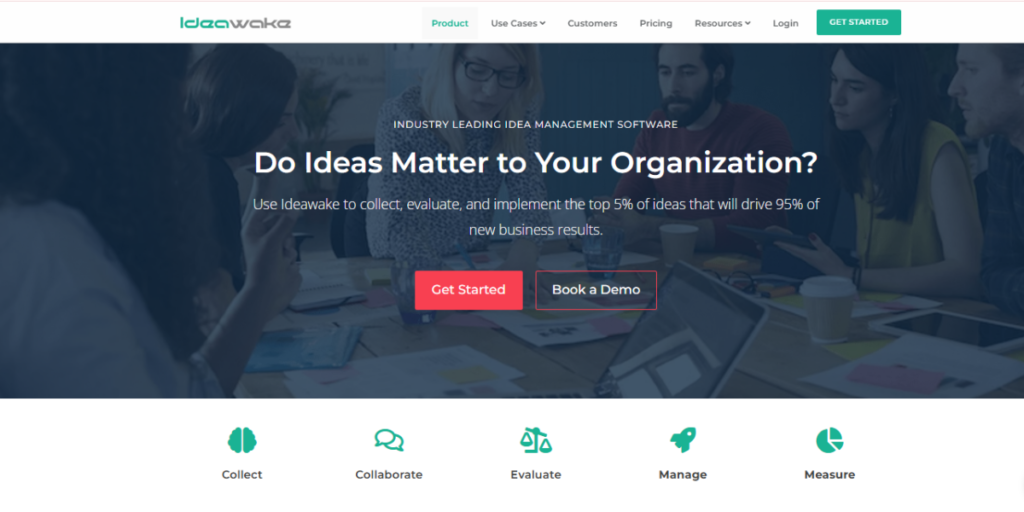
Best for: Organisations that want strong participation, structured evaluation, and a clear path from ideas to measurable outcomes—without building a complex system from scratch.
Ideawake is designed around a simple but enterprise-critical goal: keep ideas moving all the way to implementation while maintaining visibility and collaboration. The platform supports targeted idea collection, structured evaluation, configurable workflows, and reporting that connects activity to impact.
What Ideawake does well is balance engagement with execution discipline. Many tools can boost idea volume; far fewer help teams prioritise, assign ownership, and track outcomes in a way leadership will trust.
What it does well
- Supports the end-to-end lifecycle: capture → collaborate → evaluate → implement → measure
- Configurable workflows and stages so different idea types can follow different paths
- Participation design that encourages engagement without relying on “random suggestion boxes”
- Analytics that help innovation managers understand pipeline health and outcomes quickly
- Integrations and accessibility across devices to support enterprise usage patterns
Where it can fall short
- Like any enterprise tool, results depend on how well governance and workflows are set up. If you don’t define ownership and decision cadence, any platform will feel slow.
Enterprise fit: Ideawake is a strong fit for enterprises that want measurable innovation outcomes, higher participation, and a clear mechanism for turning ideas into action—especially when they’re replacing fragmented processes across forms, spreadsheets, and disconnected tools.
Ideal use cases: Continuous improvement, operational efficiency, cross-functional problem solving, service delivery improvements, customer experience ideas, and structured innovation challenges.
Verdict: If your priority is adoption plus measurable outcomes, Ideawake is built for that reality.
2 InnovationCast (Best for workflow-driven implementation)
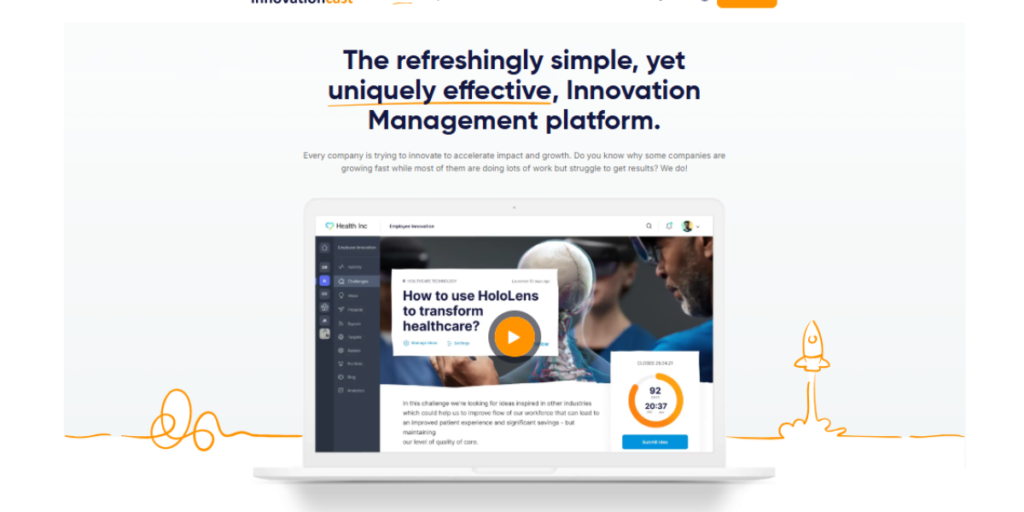
Best for: Enterprises that want a workflow-heavy approach to move ideas into implementation without losing structure.
InnovationCast positions itself against the “ideas stuck in spreadsheets” problem and emphasises challenges (time-bound campaigns) rather than always-open suggestion boxes. It also puts a lot of focus on configurable workflows by idea category, and on keeping collaboration alive across stages.
A notable part of InnovationCast’s approach is the idea that innovation tools fail when they only collect ideas. Their platform leans into assessment stages, experimentation, and portfolio visibility.
What it does well
- Strong emphasis on lifecycle beyond ideation
- Multiple workflows for different idea categories
- Collaboration mechanics that encourage feedback and iteration
- Tools that support validation/experimentation for uncertain ideas
Where it can fall short
- Buyers should validate how much configuration is needed to match internal processes, and whether teams will embrace the workflow depth.
Enterprise fit: InnovationCast is a fit for organisations that value structured stage gates and want a platform that reinforces process discipline.
Verdict: Strong for enterprises that want to standardise how ideas move into execution—especially across diverse idea types.
3 HYPE Innovation (Best for enterprise programs needing modules + services)
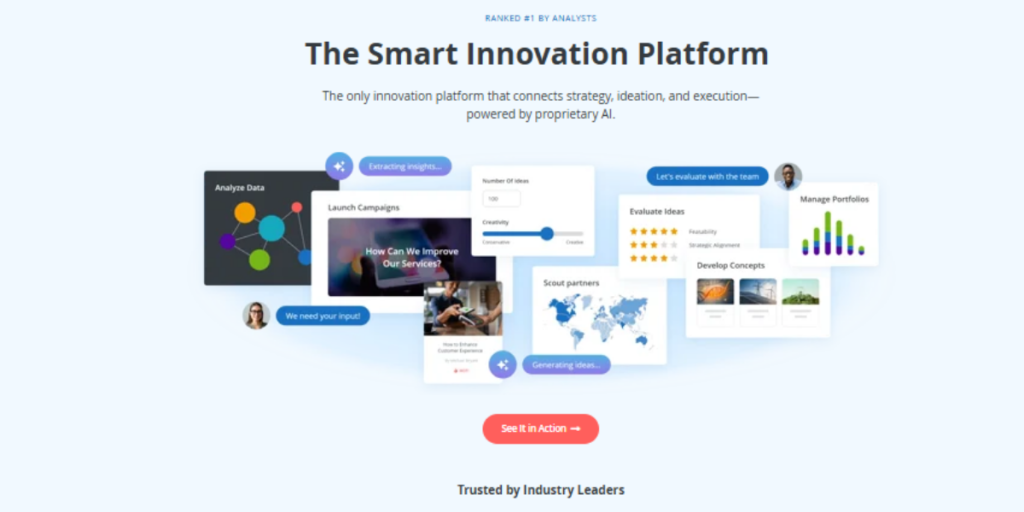
Best for: Larger organisations that want a modular innovation system and are open to a more consultative onboarding experience.
HYPE Innovation is often associated with enterprise-scale programs and typically approaches onboarding with discovery around goals, challenges, and workflow needs. The platform is commonly described in modules—strategy, ideation, partnering, and projects—so organisations can align the tooling with how they run innovation.
What it does well
- Modular structure that can map to program maturity
- Often paired with services/consulting to shape workflows and rollout
- Supports a broader “innovation operating model” approach
Where it can fall short
- Packaging and pricing are usually quote-driven, so you’ll want clarity on what is included and how quickly you can iterate workflows.
Enterprise fit: HYPE fits enterprises that want a platform plus guidance to formalise their innovation approach across business units.
Verdict: A solid option for organisations that want a structured, services-supported enterprise rollout.
4 Wazoku (Best for tech scouting + networks alongside internal innovation)
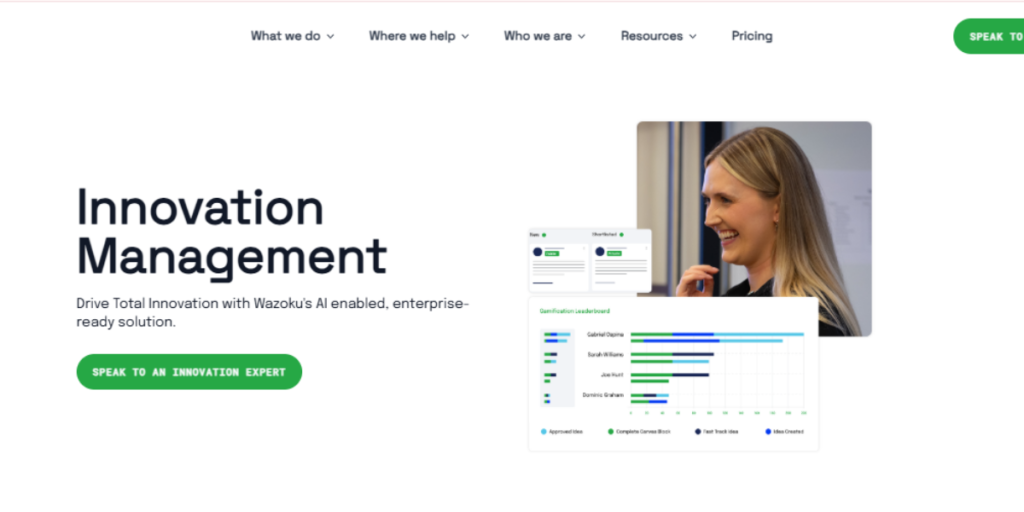
Best for: Enterprises that want internal innovation programs plus technology scouting and broader innovation networking capabilities.
Wazoku is commonly positioned as a platform that can support internal challenges while also providing tools to help teams track emerging technology and connect to broader innovation ecosystems. If your innovation function does more than internal ideation—such as scouting and partnerships—this category of functionality matters.
What it does well
- Combines internal innovation programs with scouting/networking capabilities
- Often tailored during onboarding to match organisational needs
- Supports enterprise collaboration and program structure
Where it can fall short
- Buyers should validate reporting granularity and how outcomes/ROI are tracked in the way leadership expects.
Enterprise fit: Best for innovation teams that sit close to strategy and want tools for both internal ideation and external signal scanning.
Verdict: Strong when your innovation mandate includes scouting and ecosystem work, not just employee ideation.
5 Planbox (Best for structured programs across challenge-based innovation and continuous improvement)
Best for: Organisations running multiple innovation “modes,” from continuous improvement to broader innovation initiatives.
Planbox is typically described as supporting challenge-based innovation and continuous improvement, with additional areas like scouting or corporate venturing in some implementations. For enterprises that want to run different program types under one umbrella, this matters—especially if you have both “small improvements” and “bigger bets.”
What it does well
- Supports multiple program types and structured initiatives
- Emphasises collaboration and participation across stakeholders
- Can fit organisations that want a broader innovation program toolkit
Where it can fall short
- Clarify packaging, pricing, and administrative overhead early, especially if you’re rolling out globally.
Enterprise fit: Good for enterprises looking to run structured innovation programs across departments with consistent governance.
Verdict: A strong option when you need breadth across program types, but do your due diligence on rollout complexity.
6 Brightidea (Best for large innovation ecosystems and established programs)

Best for: Large enterprises that want a suite-style platform to support multiple innovation programs and ecosystems.
Brightidea is often associated with big enterprise logos and long-running innovation programs. Buyers typically look to Brightidea when they want multiple modes—idea boxes, labs, structured programs, and transformation initiatives—within a broader innovation ecosystem.
What it does well
- Suite approach that supports different innovation program styles
- Built for larger ecosystems and enterprise-scale participation
- Often aligns well with established innovation functions
Where it can fall short
- Enterprises should validate workflow flexibility and ROI reporting against their specific governance model.
Enterprise fit: Best for mature programs that need a platform to support multiple innovation motions across the organisation.
Verdict: A recognised enterprise choice when you’re building or expanding a broad innovation ecosystem.
Which platform should you choose? Shortlist by scenario
If you’re stuck between options, match your choice to your primary constraint.
If you’re replacing spreadsheets and need adoption quickly
Prioritise ease of use, challenge-based participation, clear feedback loops, and dashboards that prove the program is moving. Engagement without credibility doesn’t last, and credibility without engagement doesn’t scale.
If you have too many ideas and not enough review bandwidth
Look for duplicate detection, structured triage, reviewer groups, and scoring templates. The platform should reduce decision fatigue, not add it.
If ideas keep going offline during implementation
Workflow flexibility and ownership are non-negotiable. Also confirm integrations with delivery tools so execution teams can work in familiar systems without breaking traceability.
If leadership demands ROI reporting
Choose a platform that can connect ideas to outcomes, track pipeline health, and show projected versus actual impact. Reporting should be a built-in capability, not a manual spreadsheet exercise.
How to evaluate a platform (a practical pilot plan)
A good enterprise evaluation doesn’t require a six-month committee process. Run a pilot that forces the platform to prove the hard parts.
Step 1: Launch one focused challenge (30 days).
Pick a real problem with a defined owner, reviewers, and a decision cadence.
Step 2: Use two workflows.
One for continuous improvement and one for larger initiatives. If a platform struggles here, you’ll feel it early.
Step 3: Track five pilot metrics.
Participation rate, time-to-first-feedback, reviewer throughput, ideas moved into execution, and estimated impact captured.
Step 4: Standardise what worked.
Turn your best challenge setup, scorecards, and workflows into templates so rollout doesn’t restart from zero each time.
Common pitfalls that kill enterprise innovation programs
Enterprise innovation programs don’t fail because people stop having ideas. They fail because the system loses momentum.
The most common pitfalls are predictable: collecting unlimited ideas with no triage, forcing one workflow for everything, leaving contributors without feedback, losing ownership during implementation, and reporting activity instead of outcomes. A platform should reduce these risks by design.
FAQs
What is enterprise innovation management software?
It’s software that manages the full innovation lifecycle at scale—capturing ideas, enabling collaboration, structuring evaluation, supporting implementation, and measuring outcomes.
What features matter most for enterprise innovation programs in 2026?
End-to-end lifecycle support, configurable workflows by idea category, collaboration tools that keep visibility high, and reporting that tracks pipeline health and ROI.
What’s the difference between idea management and innovation management?
Idea management is mainly about collecting and refining ideas. Innovation management includes evaluation, implementation, and measurement.
How do you prevent ideas from dying after submission?
Use challenge-based collection, structured evaluation, clear ownership, stage-based workflows, and ongoing communication so contributors see progress and outcomes.
Can innovation management software integrate with Teams, Jira, and Slack?
Many enterprise platforms support integrations, which help adoption and prevent teams from duplicating work across tools.
How do you measure ROI from innovation programs?
Track estimated value, implementation cost, and time-to-impact, then compare projected outcomes to actual results delivered after implementation.
Final takeaway
In 2026, the best enterprise innovation management software isn’t the tool that collects the most ideas. It’s the one that reliably turns the best ideas into implemented outcomes—while keeping collaboration open, workflows flexible, and reporting credible.
If your organisation wants fast adoption and measurable impact, shortlist platforms that prove they can manage the full lifecycle, support multiple workflows, and show ROI without manual reporting. That’s how innovation becomes a system—rather than a once-a-year event.