
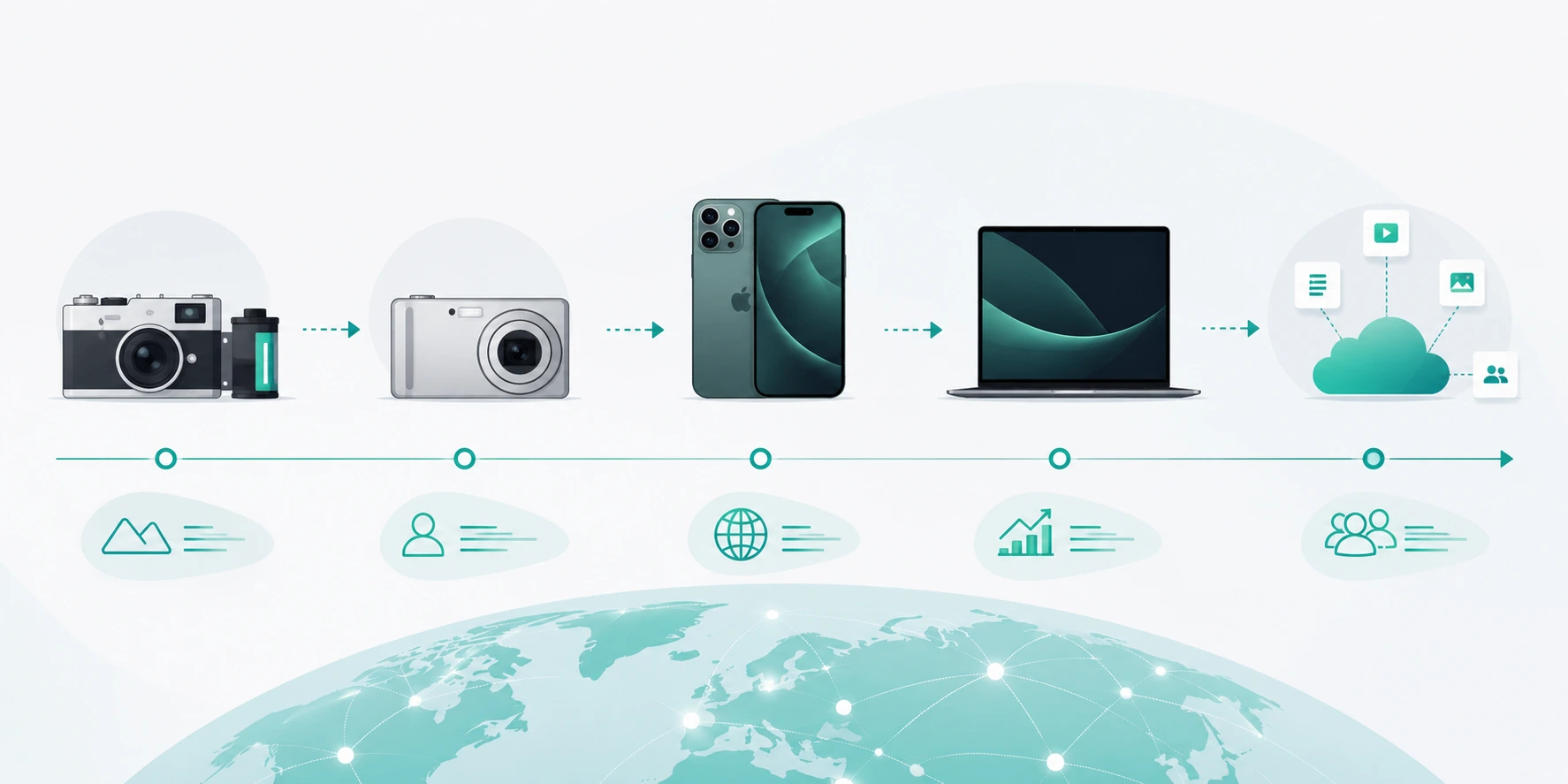
Some products do more than sell well. They change how people live, work, communicate, travel, and make decisions. A truly innovative product solves a real problem, creates new behavior, and often becomes the foundation for more innovation. The best examples are rarely finished on day one. They evolve through better design, stronger infrastructure, lower costs, and wider adoption.
Below are 10 innovative product examples that changed the world, along with how each one evolved and what businesses can learn from them.
1. The Smartphone
The smartphone is one of the strongest examples of product innovation because it combined several devices into one. Before smartphones became mainstream, people used separate tools for calls, photos, music, email, maps, and internet access. The modern smartphone brought those functions into a single touchscreen device.
The 2007 iPhone became a major turning point because it made mobile computing simple for everyday users. It was not just a phone with extra features. It created a new interface, a new app economy, and a new expectation that digital services should be available anywhere.
Over time, smartphones evolved into pocket computers. They now include advanced cameras, biometric security, 5G connectivity, mobile payments, AI assistants, health tracking, and location-based services. They changed industries including banking, photography, retail, transportation, education, and media.
The business lesson is clear: the strongest product innovations often connect multiple needs into one simple experience.
2. The Personal Computer
The personal computer moved computing power from large institutions to individuals. Early computers were expensive, massive, and used mainly by governments, universities, and large companies. The PC changed that by making computing accessible for offices, schools, and homes.
Companies like Apple, IBM, and Microsoft helped bring computers into daily work. Word processing, spreadsheets, databases, design software, and email changed how people created and managed information.
The PC evolved from desktop machines into laptops, tablets, hybrid devices, and cloud-connected workstations. Even as mobile devices grew, the personal computer remained essential for professional work, software development, design, research, and business operations.
Its biggest lesson is accessibility. A product can become world-changing when it turns a specialist tool into something regular people can use.
3. The Internet
The internet is both a product of technical innovation and a platform for almost every modern business model. It began as a research network and evolved into the global infrastructure behind communication, commerce, cloud computing, entertainment, and remote work.
Its original innovation was the ability to connect computers across distance and exchange information quickly. Once the World Wide Web made the internet easier to navigate, adoption accelerated. Websites, search engines, email, online stores, social media, and SaaS platforms followed.
Today, the internet supports digital payments, video calls, online learning, streaming, logistics tracking, telehealth, and AI systems. It changed how businesses reach customers and how people access knowledge.
The key lesson is that infrastructure innovation creates secondary innovation. Once a strong platform exists, new products and companies can be built on top of it.
4. Tesla Electric Cars
Electric vehicles existed long before Tesla, but Tesla changed how people viewed them. Earlier electric cars were often seen as slow, limited, or practical only for short trips. Tesla made EVs desirable by focusing on performance, range, software, design, and charging infrastructure.
The innovation was not just the battery-powered vehicle. It was the full product ecosystem: the car, the charging network, the connected software, and the brand promise of clean performance.
Modern electric vehicles now include long-range battery packs, regenerative braking, over-the-air updates, driver assistance features, connected dashboards, and expanding charging networks. Tesla also pushed traditional automakers to accelerate their own EV programs.
The lesson for businesses is that innovation can reshape a category by changing expectations. Tesla helped move EVs from “alternative vehicle” to serious automotive competitor.
5. 3D Printing
3D printing, also called additive manufacturing, changed how physical products are designed and produced. Instead of cutting or molding material through traditional manufacturing, 3D printing builds objects layer by layer from digital files.
At first, it was mainly used for rapid prototyping. Engineers and designers could test parts faster without waiting for expensive tooling. That alone made product development more efficient.
Over time, 3D printing expanded into medical devices, prosthetics, dental products, aerospace components, industrial tooling, custom consumer goods, and even construction experiments. It allows complex shapes, small-batch production, and personalization that traditional methods often struggle to support.
The business lesson is speed. When teams can move from digital design to physical prototype quickly, they can test more ideas and reduce development risk.
6. Amazon Echo And Voice Assistants
Amazon Echo helped make voice assistants part of everyday life. Before smart speakers, voice technology existed but was often limited to basic commands or phone-based assistants. Echo made voice interaction feel natural inside the home.
The original innovation was a voice-first device that could play music, answer questions, set timers, control smart-home devices, and connect to online services through Alexa. It reduced the need to open an app or type a command.
Voice assistants evolved into smart-home hubs, in-car systems, accessibility tools, voice commerce interfaces, customer service bots, and workplace productivity tools. They also helped normalize conversational computing, where users interact with technology through natural language.
The lesson is that the interface matters. Sometimes innovation is not only about what a product does, but how easily people can use it.
7. CRISPR Gene Editing
CRISPR is one of the most important biotechnology innovations of the modern era. It gave scientists a faster, more accurate, and more affordable way to edit DNA compared with earlier gene-editing techniques.
The core innovation was precision. Researchers could target specific genetic sequences and make changes with far greater efficiency. That opened new possibilities in medicine, agriculture, diagnostics, and biological research.
CRISPR has evolved from a research tool into a foundation for therapies, crop improvement, disease modeling, and drug discovery. It is being studied for genetic disorders, cancer treatments, infectious disease research, and climate-resilient agriculture.
Unlike a consumer product, CRISPR is more of a platform technology. Its value comes from enabling many future products and treatments. The business lesson is that some innovations are powerful because they become tools others can build with.
8. GPS
GPS changed how the world understands location. Originally developed for military use, GPS became a civilian technology that now powers navigation, logistics, mapping, emergency response, agriculture, and mobile apps.
The original innovation was satellite-based positioning. It allowed users to determine location with far greater accuracy than traditional maps or manual navigation methods.
GPS evolved from specialized receivers into a standard feature in smartphones, cars, watches, drones, shipping systems, farming equipment, and fleet management platforms. It enabled ride-sharing, food delivery, real-time tracking, route optimization, and location-based marketing.
The lesson is that embedded infrastructure can create new markets. Once location became digital and reliable, businesses could build services that were previously impossible.
9. LED Lighting
LED lighting transformed one of the most basic daily products: the light source. Early LEDs were used mainly as small indicator lights. They were efficient but limited in brightness and color.
The major breakthrough came when LEDs became bright, reliable, and practical for general lighting. Compared with incandescent and fluorescent lighting, LEDs use less energy, last longer, and require less maintenance.
LEDs now power homes, offices, streetlights, vehicle headlights, digital displays, smart bulbs, horticulture systems, and industrial lighting. They also support lighting controls, color customization, and energy management systems.
The lesson is that incremental improvement can become disruptive. LEDs did not change the idea of lighting. They changed performance, efficiency, cost, and control until the older technology became less competitive.
10. Streaming Services
Streaming services changed entertainment by replacing ownership and scheduled access with instant, on-demand availability. Netflix and Spotify are two of the clearest examples. They shifted users away from DVDs, CDs, downloads, and traditional rental models.
The innovation was both product and business model. Users could access large libraries through a subscription without needing physical storage or individual purchases.
Streaming evolved into personalized recommendations, original content, podcasts, live streaming, creator platforms, and direct-to-consumer media. It changed how content is produced, distributed, priced, and measured.
The lesson is that business model innovation can be as powerful as product innovation. Streaming did not simply improve entertainment access. It changed customer expectations across many industries: people now expect instant, flexible, personalized service.
What These Innovative Products Have In Common
These products are different, but they share several patterns. They solved clear problems, reduced friction, and changed behavior at scale. Smartphones reduced the need for multiple devices. GPS reduced uncertainty in navigation. Streaming reduced the hassle of physical media. 3D printing reduced the time between design and prototype.
They also created ecosystems. Smartphones needed apps. EVs needed charging networks. Streaming needed content libraries. GPS needed devices and software that could turn location data into useful services.
Most importantly, these products evolved. The first version was rarely the final version. Adoption grew because the products improved through user feedback, better infrastructure, lower costs, and stronger integration with daily life.
What Organizations Can Learn From Product Innovation
Product innovation is not only about having a clever idea. Many companies have good ideas that never become real outcomes. The difference is process: how ideas are captured, tested, prioritized, funded, and improved.
Strong innovation teams validate before they scale. They test whether the problem is real, whether users care, whether the product can be adopted, and whether the business model works. This reduces wasted effort and helps teams focus resources on ideas with the strongest evidence.
Cross-functional input also matters. Breakthrough products usually involve product teams, engineers, designers, operations, marketing, finance, and customers. When those groups work separately, innovation slows down. When they share context and evidence, better decisions happen faster.
How Ideawake Helps Teams Turn Product Ideas Into Results
Ideawake helps organizations manage innovation more systematically by giving teams a clear way to capture, evaluate, and move ideas forward. For companies trying to build better products, improve operations, or run internal innovation challenges, the platform helps replace scattered suggestions and inbox-based decision-making with a structured innovation pipeline.
This is directly related to product innovation because great ideas need a path to execution. Ideawake supports idea submission, collaboration, scoring, prioritization, workflow tracking, and reporting, so teams can see which opportunities are worth testing and which ideas are ready for implementation. Instead of letting strong suggestions get buried, organizations can use Ideawake to turn employee, customer, or partner input into measurable business impact.
FAQs
What Are Examples Of Innovative Products?
Examples of innovative products include smartphones, personal computers, electric vehicles, 3D printing, GPS, LED lighting, CRISPR gene editing, voice assistants, streaming services, and the internet. Each one changed behavior, created new markets, or improved daily life at scale.
What Makes A Product Innovative?
A product is innovative when it solves a meaningful problem in a better way. It may improve performance, reduce cost, simplify access, create a new user experience, or open a new market. The most successful innovative products are adopted widely and continue evolving.
What Is The Difference Between Product Innovation And Invention?
An invention creates something new. Product innovation turns an idea into something usable, valuable, and adopted by a market. Invention is the starting point. Innovation includes development, commercialization, user adoption, and continuous improvement.
Why Do Innovative Products Evolve Over Time?
Innovative products evolve because technology improves, user expectations change, competitors respond, and companies learn from real-world use. Early versions often prove the concept, while later versions improve performance, usability, cost, and scale.
How Can Companies Create Innovative Products?
Companies can create innovative products by identifying real customer problems, collecting ideas from employees and users, testing assumptions early, prioritizing based on impact and feasibility, and tracking progress from concept to implementation.