
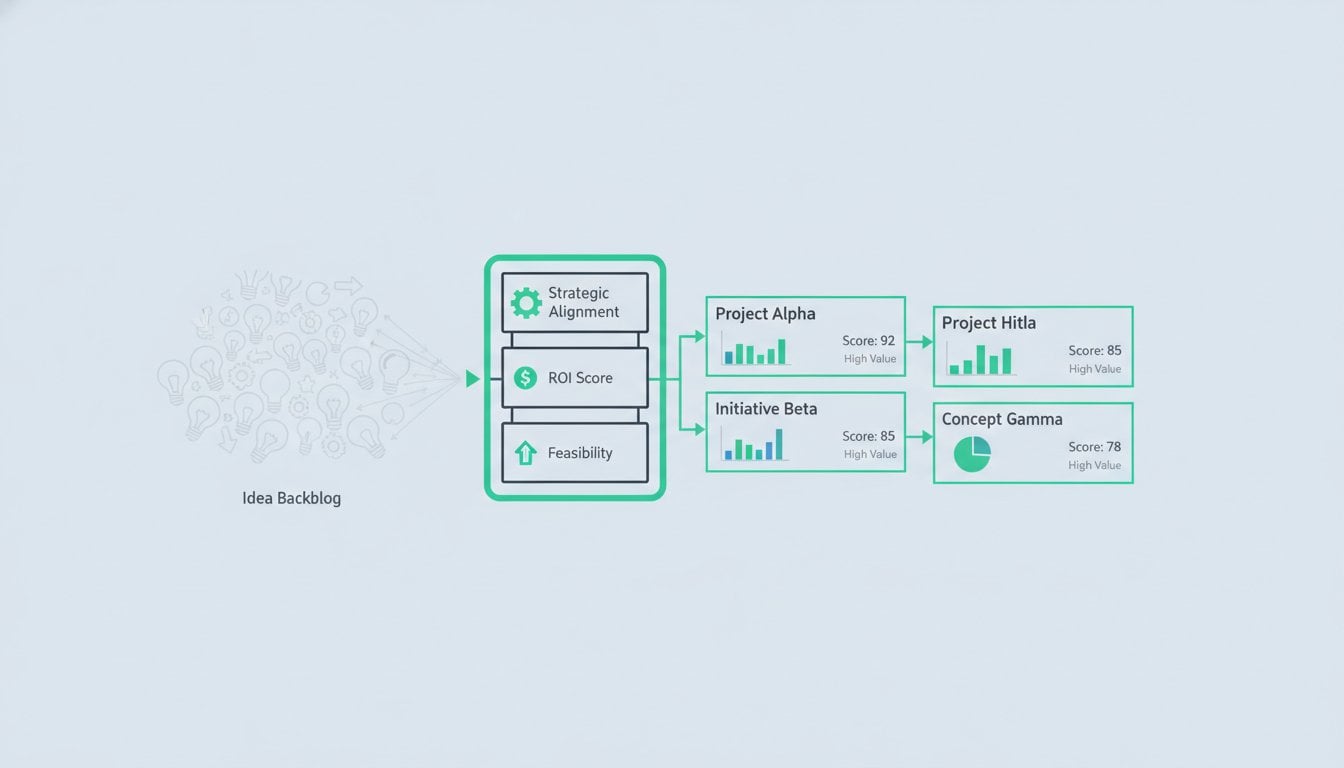
While global AI spending is projected to hit $2.52 trillion in 2026, a January 2026 PwC survey revealed that 56% of CEOs have seen zero revenue growth or cost savings from these significant investments. The problem isn’t a lack of technology; it’s a failure of selection. Most innovation pipelines are currently clogged with low-value “pet projects” that survive on executive whim rather than data-backed potential. You’ve likely felt the frustration of watching high-potential concepts stall while mediocre ideas drain your resources and damage your credibility with the board.
It’s time to move beyond the “gut-feel” voting that turns innovation into a gamble. You’ll master the objective idea selection criteria for innovation and the weighted scoring tools necessary to filter noise and identify the high-impact ideas that drive measurable enterprise ROI. We’ll break down the 2026 framework for multi-dimensional evaluation, ensuring your process aligns with the new ISO 56001:2024 certifiable standards while removing the subjective bias that kills performance. By the end of this guide, you’ll have a repeatable system to transform your pipeline from a chaotic backlog into a strategic driver for growth.
Key Takeaways
- Solve the “signal-to-noise” problem by identifying the high-impact concepts that deliver measurable enterprise value rather than just volume.
- Establish objective idea selection criteria for innovation to eliminate executive bias and ensure every project aligns with your 2026 corporate objectives.
- Master weighted scoring mechanics to objectively rank ideas based on their potential ROI versus the technical complexity of implementation.
- Replace error-prone spreadsheets with dedicated scoring tools that provide real-time visibility and automated reporting across your entire innovation pipeline.
- Leverage AI-enhanced evaluation to automatically detect duplicates and predict implementation success based on historical performance data.
What is Idea Selection Criteria and Why Does It Matter in 2026?
In 2026, the primary bottleneck for enterprise growth isn’t a lack of ideas; it’s the inability to identify the winners. Idea selection criteria for innovation are the objective benchmarks used to assess the viability, scalability, and strategic value of a concept before a single dollar is committed to development. Without these filters, organizations fall into the “Signal-to-Noise” trap. While AI tools have made it easier to generate thousands of suggestions, a high volume of ideas often leads to less actual innovation because the truly transformative concepts get buried under a mountain of low-value noise.
Successful enterprises have abandoned popularity-based voting systems. Likes and comments are social metrics, not business ones. Instead, high-performing leaders now rely on evidence-based scoring that requires a structured idea submission process to ensure every entry contains the data points necessary for a rigorous evaluation. This transition turns the selection engine from a black box into a transparent, high-performance filter that prioritizes outcomes over optics.
The High Cost of Subjective Innovation
When selection is left to intuition, the “HiPPO” (Highest Paid Person’s Opinion) effect dominates the room. This hierarchy-driven decision making silences diverse perspectives and favors “safe” projects that align with an executive’s personal preferences rather than market reality. Research into organizational behavior consistently shows that cognitive biases lead teams to choose incremental improvements over radical breakthroughs because they feel less risky. This subjectivity is expensive. The Innovation Gap is the measurable distance between the volume of ideas generated and the percentage of those ideas that successfully reach implementation.
Transitioning from Intuition to Data-Driven Decisions
The Weighted Scoring Model: A Framework for Objective Evaluation
Stop treating every metric as if it carries the same weight. In a high-performance innovation ecosystem, an idea’s potential market impact must always outweigh its ease of implementation. If you prioritize “low-hanging fruit” simply because it’s easy to do, you’ll inevitably build a portfolio of mediocrity that fails to move the needle on corporate strategy. A weighted scoring model corrects this by assigning a percentage of importance to each of your idea selection criteria for innovation, ensuring that the most transformative concepts rise to the top.
The mechanics are straightforward but powerful. For every idea, evaluators provide a raw score for specific criteria, which is then multiplied by a predetermined weight (Score x Weight = Total Value). This mathematical approach creates a single, undeniable ranking of your pipeline. To maintain high standards, organizations should implement a “Threshold” concept. This is a minimum aggregate score an idea must achieve to move from the discovery phase into prototyping. If a concept doesn’t hit the mark, it’s archived, preventing your team from wasting cycles on projects that lack the “DNA” of a winner. Tracking these scores requires a centralized innovation database rather than disconnected documents to ensure historical data informs future decisions.
Defining Your Evaluation Scales
Precision starts with your scale. While a 10-point scale offers more nuance, it often leads to “score creep” where evaluators struggle to distinguish a 7 from an 8. A 5-point scale is typically the sweet spot for enterprise evaluation because it forces more decisive choices. To ensure consistency across different departments, you must define “anchor points.” For example, a “5” in Strategic Alignment should mean the idea directly addresses a top-three corporate KPI for the current fiscal year. Choosing an odd-numbered scale like 1 to 5 allows for a middle ground, but be careful. Including “Neutral” options in evaluation scales often leads to decision paralysis because it allows stakeholders to avoid taking a definitive stance on high-potential risks.
Balancing Qualitative and Quantitative Inputs
Numbers provide the structure, but expert commentary provides the soul. A robust framework integrates numerical scores with qualitative feedback to give leadership a holistic view of an idea’s potential. This is particularly important when weighing “Strategic Alignment” against “Technical Feasibility.” An idea might score perfectly on alignment but poorly on feasibility; the qualitative input explains whether that feasibility gap is a temporary resource issue or a permanent technological barrier. Remember that evaluation is a multi-stage process. You shouldn’t demand a detailed ROI projection in the early funnel. Use broader criteria for initial screening and save the intensive, data-heavy scoring for the final few candidates. To see how these models look in action, you can explore a live evaluation framework designed for enterprise scale.
Idea Evaluation and Scoring Tool: Spreadsheets vs. Dedicated Platforms
Many organizations start their innovation journey with a spreadsheet. It’s accessible and familiar. However, once your pipeline expands beyond a handful of concepts, manual tracking becomes a primary driver of “Innovation Overhead.” Spreadsheets suffer from chronic version control issues and lack the real-time collaboration required for cross-functional teams. When your idea selection criteria for innovation are trapped in a static document, the process slows to a crawl, often leading to the very “pet projects” you’re trying to avoid. Manual data entry isn’t just tedious; it’s a liability that introduces human error into your most critical investment decisions.
Transitioning to a dedicated idea evaluation and scoring tool changes the game. These platforms automate the complex math and reporting that consume hours of administrative time. By shifting from manual calculations to automated systems, innovation managers can focus on strategy rather than logistics. Data from the Ideawake vs Spreadsheets comparison shows that organizations can reduce the time spent on administrative tasks by up to 80%, allowing teams to move from submission to implementation at a significantly faster pace.
The Hidden Complexity of Manual Scoring
Manual tools fail the moment you scale. Handling 100 or more ideas from diverse departments creates a logistical nightmare in Excel. Data silos form quickly, as insights from one evaluator are rarely visible to another in a meaningful way. Legacy innovation software often replicates these silos by offering rigid structures that don’t adapt to your specific needs. Modern platforms solve this by enabling “Blind Scoring.” This feature hides the identity of the idea submitter and other evaluators’ scores until the process is complete, which is a critical step in neutralizing the cognitive biases discussed earlier. For organizations ready to move beyond these limitations, a collaborative idea management platform provides the cross-functional visibility and structured workflows needed to evaluate ideas at enterprise scale.
Features to Look for in a Modern Scoring Platform
5 Essential Idea Selection Criteria for Maximum ROI in 2026
- Strategic Alignment: Does the idea directly solve a problem identified in your 2026 corporate roadmap?
- Customer/Market Impact: Will this fundamentally solve a pain point for the end-user, or is it just a “nice-to-have” feature?
- Technical & Financial Feasibility: Do we possess the internal expertise to execute this, and is the cost-to-benefit ratio favorable?
- Scalability: Can this solution be expanded across other departments or global markets without a linear increase in resource consumption?
- Risk Level: What are the regulatory hurdles, and could a failure cause significant reputational or financial damage?
Strategic Alignment: The Ultimate Filter
Alignment is the difference between genuine progress and “Innovation Theater.” You will frequently encounter “great” ideas that are technically brilliant but completely irrelevant to your company’s current focus. You must have the discipline to reject these. Pursuing projects that look good on paper but lack strategic depth drains your resources and creates a “drift” that confuses stakeholders and investors. To quantify the value of staying on track, use an Ideawake ROI calculator to model how tight alignment correlates with long-term financial outcomes.
Feasibility vs. Desirability
The “Sweet Spot” of innovation exists where high user desirability intersects with organizational capability. If you find an idea that customers crave but your team cannot build, it is a hallucination. Conversely, building something your team excels at that no one actually wants is a waste of capital. Use a 2×2 matrix to visualize your pipeline, separating “Low Hanging Fruit” from “Big Bets.” Involve your technical leads early in the feasibility scoring phase to prevent “zombie projects” from eating your budget before they’re even prototyped. To see how these idea selection criteria for innovation are built into a high-performance workflow, you can book a free demo of our evaluation framework today.
Beyond Human Bias: Leveraging AI in the Selection Process
The human element is both the greatest asset and the largest liability in the evaluation process. Even with the most robust idea selection criteria for innovation, human reviewers are susceptible to fatigue, departmental favoritism, and subconscious “safe” choices. By 2026, the pivot toward AI accountability requires more than just human intuition to justify capital allocation. Integrating Ideawake AI into your workflow provides a neutral layer of analysis that identifies patterns humans often miss. Automated duplicate detection immediately flags redundant concepts, while sentiment analysis helps gauge the underlying enthusiasm or skepticism within the workforce before a project is even greenlit.
These AI tools for innovation managers serve as a force multiplier for stretched teams. They can summarize thousand-word proposals into actionable executive briefs, allowing for a faster review of complex technical concepts. However, it’s vital to remember that AI is designed to assist, not replace, the final human decision. The technology provides the data-backed “why,” but leadership provides the strategic “how.” By using machine learning to cross-reference new ideas with historical data, organizations can better predict implementation success and avoid the ROI disconnect that currently plagues 56% of enterprise AI investments.
Mitigating Cognitive Bias with Machine Learning
Machine learning models excel at identifying the subtle patterns of bias that skew human scoring. Whether it is a preference for certain departments or a gender-based tilt in project approval, AI can audit historical scoring data to flag inconsistencies. This ensures that your idea selection criteria for innovation are applied with total objectivity across the entire enterprise. Looking ahead, “Predictive Scoring” is becoming the standard. By cross-referencing new submissions with real-time market trends and internal performance metrics, AI can predict implementation success with higher accuracy than a traditional committee. It can even suggest diverse “Review Committees” by identifying subject matter experts across the organization who possess the specific knowledge required to evaluate a niche concept.
Accelerating the Review Cycle
The traditional innovation funnel is often where high-potential concepts go to die. Slow decision-making kills enthusiasm and allows competitors to move first. Leveraging automated workflows can reduce the time-to-decision from months to mere days. When an idea is submitted, the system can provide instant feedback or request missing data points immediately, maintaining a high-energy culture of participation. This speed isn’t just about efficiency; it’s about competitive survival. In a market where 57% of leaders report AI is already embedded in core processes, the ability to filter and fund winners faster than the competition is the ultimate differentiator. Ready to see data-driven selection in action? Sign up for a demo of Ideawake and transform your innovation pipeline today.
Transforming Your Pipeline into a Strategic Growth Engine
The era of “innovation theater” is over. Success in 2026 requires a shift from gut-feel voting to rigorous, weighted scoring models. By establishing objective idea selection criteria for innovation, you eliminate the cognitive biases that lead to mediocre “safe” projects and instead prioritize concepts with the highest potential for enterprise ROI. Moving beyond manual spreadsheets allows your organization to scale without the administrative burden that typically stalls early-stage concepts. It’s time to stop gambling on intuition and start investing in proven winners.
Ideawake provides an end-to-end platform used by Fortune 500 companies to transform their innovation culture into a measurable financial driver. Our AI-driven insights reduce administrative overhead by 80%; this allows your team to focus on implementation rather than data entry. Master your innovation pipeline with Ideawake’s evaluation tools and secure your organization’s competitive edge. Your next breakthrough is waiting for a better filter.
Frequently Asked Questions
What are the most common idea selection criteria for enterprise innovation?
The most common criteria include strategic alignment, customer impact, technical feasibility, scalability, and financial risk. These benchmarks ensure that a concept isn’t just creative but actually viable within the organization’s current resource constraints. By using these five pillars, leaders can filter out noise and focus on concepts that deliver a measurable return on investment.
How do you weigh different criteria in an innovation scoring model?
You weigh criteria by assigning a percentage value to each category based on your current corporate priorities. For example, a growth-focused firm might weight “Market Impact” at 40% while keeping “Ease of Implementation” at 10%. This ensures that high-impact ideas aren’t penalized simply because they require more effort to execute. The total weight across all categories must always equal 100%.
Can an idea management platform really remove human bias?
While no tool can eliminate human bias entirely, a dedicated platform significantly mitigates it through features like “Blind Scoring” and AI-driven sentiment analysis. These tools hide the identity of the submitter and prevent evaluators from seeing each other’s scores until the process is complete. This forces reviewers to focus on the objective data rather than personal or departmental favoritism.
What is the difference between idea evaluation and idea selection?
Idea evaluation is the analytical process of scoring a concept against specific benchmarks; selection is the final decision to allocate resources or fund the project. Evaluation provides the data-backed evidence needed to make an informed choice. Selection is the strategic action that moves an idea from the “Value Pipeline” into active development or prototyping.
How many people should be involved in the scoring process?
Most high-performing organizations involve 3 to 5 subject matter experts per idea to ensure a balanced perspective. Including too few reviewers increases the risk of individual bias; including more than five often leads to administrative bottlenecks and decision paralysis. The goal is to gather diverse insights from technical, financial, and market-facing leads without stalling the review cycle.
Why is strategic alignment considered the most important criterion?
Strategic alignment is the most critical idea selection criteria for innovation because it ensures that every project directly supports the organization’s long-term roadmap. Even a technically brilliant idea is a waste of capital if it doesn’t solve a problem the company is actually trying to fix. Alignment prevents the “Innovation Theater” that drains budgets without producing a strategic advantage.
How often should we update our selection criteria?
You should review and update your selection criteria at least once a year or whenever your corporate strategy undergoes a major shift. As market conditions change, what was considered a “high impact” project last year might be irrelevant today. Keeping your filters updated ensures your innovation pipeline remains responsive to new competitive threats and market opportunities.
What is the “weighted scoring” method exactly?
The weighted scoring method is a mathematical formula where you multiply a raw score by a predetermined weight to reach a final value. If “Strategic Alignment” has a weight of 0.5 and the idea scores an 8, the weighted value is 4. This method provides a clear, numerical ranking that makes it impossible for subjective opinions to override your data-backed priorities.