
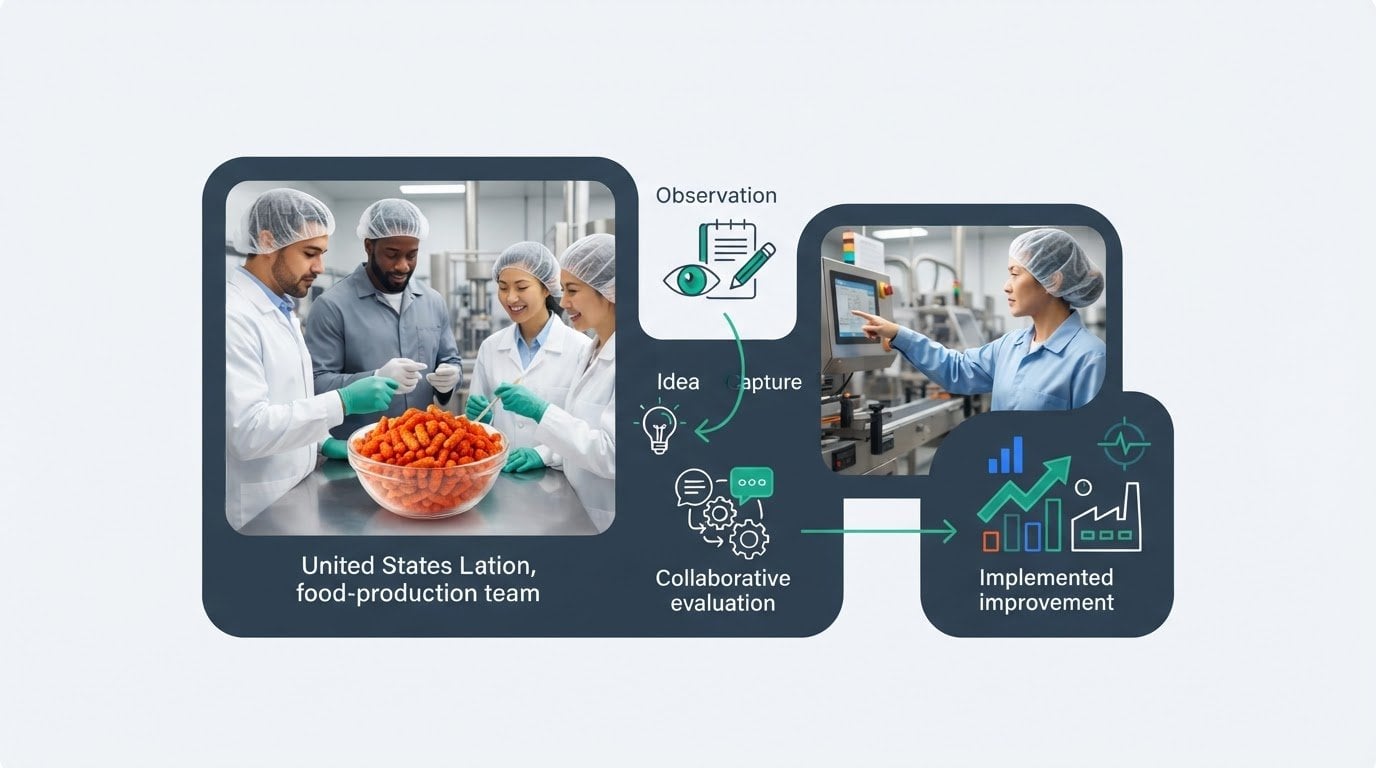
A frontline idea can become a meaningful improvement, but only if it moves from observation to action. That’s the challenge at the heart of frontline innovation: employees closest to the work often spot unmet needs first, yet their insights can stall before decision-makers assess them or explain what happens next.
The Flamin’ Hot Cheetos story is memorable, but it is not settled proof that one person invented a blockbuster product. Richard Montañez has described pitching a spicy Cheetos idea; Frito-Lay has disputed his role in creating the product line, saying it was developed by a team in Texas. The Los Angeles Times reported on the conflicting accounts. The distinction matters: an inspiring story can spark interest, but organizations need a repeatable way to capture, assess, and implement employee ideas.
This article considers what the story can teach without treating a contested origin as settled fact. You’ll learn what helps frontline observations progress, why clear feedback matters, and how to connect idea submissions with evaluation, implementation, and measurable results.
Key Takeaways
- Learn how frontline innovation moves from an employee’s observation to a change put into practice.
- Explore what the Flamin’ Hot Cheetos story can and can’t show about employee ideas and organizational innovation.
- Use problem relevance, feasibility, expected value, and evidence to assess promising suggestions.
- Build a repeatable process for inviting ideas, capturing context, evaluating proposals, responding to employees, and learning from outcomes.
- See how an innovation platform can connect idea intake with evaluation, implementation, and ROI measurement.
What frontline innovation means, and why everyday work insights matter
Frontline innovation is a new or improved product, service, or work process shaped by insight from employees close to day-to-day operations and put into use. This working definition adapts the OECD’s Oslo Manual definition of innovation, which distinguishes an implemented change from an idea that has not yet been used. The distinction is important: an observation can reveal an opportunity, but it becomes an innovation only when a change is adopted.
Consider a warehouse employee who notices that a frequently used item is stored far from the packing area. The observation is the extra movement that happens repeatedly. A possible improvement is to relocate the item. If the organization assesses the proposal, tests the change, and adopts it, that implemented change is innovation. Collecting the initial comment alone doesn’t complete the journey.
Who counts as a frontline innovator?
Frontline innovators include customer-facing employees, operational staff, and others who work close to everyday processes. Their job titles may differ, but they share a useful perspective: they see how work actually unfolds. A customer support agent may hear the same point of confusion repeatedly; a technician may spot a maintenance step that causes delays; an administrative employee may notice duplicate data entry.
Repeated tasks give employees a practical vantage point. They can see where instructions don’t match reality, where workarounds become routine, or where customers’ needs aren’t being met. Job title alone doesn’t determine who can contribute. What matters is proximity to the process, interaction, or recurring problem, along with a way to explain what they see.
Frontline innovation versus employee suggestion collection
Collecting ideas is a starting point, not evidence that an organization has innovated. A suggestion still needs evaluation against the problem it addresses, its feasibility, and the value it may create. Someone must own the next steps, communicate a decision, and, where appropriate, support implementation. Reviewing the result helps teams refine the change or apply the insight elsewhere.
A structured process makes participation more meaningful by showing employees how an observation can move forward instead of disappearing into an inbox. The practical test is straightforward: can employees share useful context, understand what happens next, and see whether a proposal leads to action?
That follow-through turns frontline innovation from an occasional insight into a repeatable approach. A clear path from observation to implementation gives decision-makers better information and gives employees a reason to keep contributing. Practical guidance on implementing innovative ideas can help teams put that path into practice.
The Flamin’ Hot Cheetos story: an example to examine, not oversimplify
The Flamin’ Hot Cheetos origin story is often told as an example of an employee close to the work spotting a product opportunity. In Richard Montañez’s account, he was a Frito-Lay employee who recognized an opportunity to appeal to Hispanic consumers and pitched a spicy Cheetos idea. The story has become a popular illustration of how insight from within an organization might reach product decision-makers. However, the central claim about who created the product line is disputed.
In 2021, Frito-Lay said its records showed the product was developed by a team in Texas in 1989 and that Montañez wasn’t involved in creating the Flamin’ Hot line. The company also recognized his contributions and insights into Hispanic consumers. The Los Angeles Times reported on the conflicting accounts. Ideawake’s earlier account of the story offers another retelling, which should be considered alongside the company’s response and independent reporting.
What the story can illustrate about employee insight
Set aside the unresolved question of individual authorship, and a useful organizational lesson remains: an employee may notice a customer need or market opportunity that isn’t obvious from a central office. A frontline observation can become a product possibility when it reaches people with the authority and resources to assess it. That doesn’t mean every suggestion will succeed. It does mean relevant ideas need a route to be heard and considered.
How to handle disputed innovation origin stories
Innovation stories are compelling, but polished retellings can compress a complex process into a single-hero narrative. For an accurate account, distinguish what a person has said from what a company states and what independent reporting has established. Avoid presenting disputed authorship, chronology, or business impact as settled fact. This care strengthens the lesson: recognize employee insight while examining the evidence.
That balance matters for organizations, too. Crediting ideas clearly and recording how proposals develop can make contributions visible without simplifying teamwork or overstating results. The broader lesson of frontline innovation isn’t that one person always creates a breakthrough alone. It’s that organizations need a credible route for observations to reach decision-makers, be assessed on their merits, and inform what happens next.
A structured idea process can connect employee input with review and follow-through. Explore Ideawake’s idea management platform to see how teams can organize that process.
What separates a promising frontline idea from an implemented improvement?
A frontline suggestion isn’t an implemented improvement just because someone submits it. The organization must investigate the problem, evaluate a response, assign responsibility, and put a change into practice. Each stage calls for different information, so teams can make better decisions by distinguishing an early observation from a proposal that’s ready for action.
- Raw observation: An employee notices a recurring issue, such as customers repeatedly needing to correct the same detail in an order.
- Actionable idea: The employee describes the issue and proposes a possible response, such as changing how that detail is collected.
- Evaluated proposal: Relevant stakeholders assess the problem, evidence, feasibility, risks, and expected value of the change.
- Implemented change: An owner puts the approved response into practice, then reviews whether it addressed the original issue.
These stages don’t mean every proposal should be approved. They help teams review ideas consistently and explain what happens next. Submission counts show participation, not implementation or impact.
Evaluate the problem before judging the proposed solution
Start with the need, not the employee’s first proposed fix. Who encounters the issue? How often does it arise? What happens when it does? Evidence might include examples from daily work, recurring customer feedback, process records, or a small test. The right evidence depends on the problem: a repeated inconvenience and a safety concern call for different levels of scrutiny.
Then assess the proposal against criteria that fit the organization’s goals and the issue itself. Consider problem relevance, feasibility, expected value, available evidence, and potential risks. An idea intended to reduce customer effort may need a different evaluation from one intended to shorten internal processing. A clear set of criteria helps teams make consistent judgments without treating every suggestion as if it had the same purpose.
Make progress and outcomes visible
Once a proposal is under review, assign an owner who can coordinate evaluation and communicate its status. Contributors should hear whether an idea is being explored, approved, declined, or deferred, with a clear reason and next step where possible. Even when an idea can’t move forward, a considered response is more useful than silence. It shows that participation leads to a decision.
Measure the journey, not just the intake. Submission volume and participation indicate activity. Proposals evaluated, changes implemented, and results tied to the original problem show progress beyond activity. For example, a team testing a revised order form might track whether customers need fewer corrections, using a suitable baseline for comparison. Teams planning next steps can use a practical framework for implementing innovative ideas to connect decisions with ownership and action.
How organizations can make frontline innovation repeatable
Good intentions don’t create a reliable idea process. Employees need clear ways to contribute, while managers need a consistent method for understanding suggestions, deciding what happens next, and sharing the outcome. A practical sequence makes the work visible without implying that every submission will be adopted.
The OECD’s Oslo Manual defines innovation around a product or process that has been made available or brought into use. That distinction supports a useful operating principle: inviting and reviewing ideas are important steps, but they aren’t the same as implementing a change or learning from its results.
- Invite input: Focus on a real operational or customer challenge, and explain what kinds of observations would be useful.
- Capture context: Ask contributors to describe where the issue occurs, who experiences it, and what they’ve observed. Keep the questions brief enough to answer during a normal workday.
- Assess: Route submissions to people with relevant knowledge and decision-making authority. Review them consistently against the challenge’s purpose.
- Respond: Tell contributors whether an idea is under review, moving forward, or not being pursued, and explain the next step.
- Learn: Record what happened after a test or implementation, then use employee and operational feedback to improve the process.
Design participation around real work
A submission route only helps if employees can use it within the realities of their roles and work patterns. A desk-based form may suit some teams; others may benefit from a short facilitated discussion or a shared digital channel. Use clear prompts tied to a defined challenge, such as “Where do customers encounter avoidable delays?” Inviting input across teams can also bring different perspectives to a problem.
Close the loop from submission to action
Make responsibility explicit. An idea owner can keep a proposal moving, coordinate the right reviewers, and update the contributor when its status changes. If an idea is selected, clarify who will lead a test or implementation and what the team hopes to learn. If it isn’t selected, a concise explanation helps employees understand the decision and offer more relevant input next time.
Review both the process and its outcomes. Look for points where employees abandon submissions, decisions stall, or contributors don’t receive updates. Then adjust prompts, review routes, or communication practices. A repeatable process doesn’t promise that every idea will succeed; it provides a dependable way to hear input, make informed decisions, and learn from what follows.
Turn frontline insight into organized innovation with Ideawake
Once employees have a clear way to share observations and understand what happens next, the next challenge is keeping ideas organized as they move through review and action. An innovation management platform can give submissions, evaluation, implementation, and results a shared structure, helping teams follow progress rather than rely on scattered forms, emails, and spreadsheets.
Ideawake supports the innovation lifecycle, from idea submission through ROI measurement. Teams can use AI-driven insights to support their work, along with engagement features such as voting, leaderboards, and prizes to encourage participation. These capabilities can help organize a process, but they don’t replace leadership decisions. People still need to review proposals, assign owners, communicate outcomes, and assess results.
Where an innovation management platform can help
When employee ideas arrive through different channels, it can be difficult to see which ones need review, who is responsible, or what has already happened. A shared workflow can make submissions and their progress easier to manage while reducing administrative complexity. The process should fit the organization’s goals and help decision-makers act on relevant input.
Keep the workflow practical. For example, a team might define stages for new submissions, initial review, further evaluation, implementation, and results tracking. These stages clarify what information is needed and who takes responsibility as an idea progresses. Employees can then see that submitting an idea starts a process, rather than sending a suggestion into an untracked queue.
Start with a focused frontline innovation challenge
Choose a specific problem employees recognize from their work, such as a recurring service delay or a confusing handoff between teams. Invite perspectives from employees who encounter it, and explain how proposals will be assessed. Clear criteria help reviewers compare ideas fairly; regular feedback gives contributors context on decisions and next steps.
Start with a focused challenge that gives the team room to learn. After reviewing submissions, identify a suitable proposal to explore or test, assign an owner, and decide what evidence would help judge its usefulness. Record what happens, including where the process creates friction for contributors or reviewers. Then refine the challenge, evaluation questions, or workflow before inviting input on another problem. This keeps the technology in service of a human-led process.
Organizations can use Ideawake to support a structured path from frontline insight to evaluation, implementation, and ROI measurement. See how that workflow could support your approach.
Put the next frontline idea in motion
Frontline innovation can start with one recurring point of friction. Choose a problem employees recognize, identify whose experience can shed light on it, and decide what evidence would help determine whether a proposed change is useful. A focused starting point makes it easier to learn from real work instead of relying on assumptions.
Before inviting ideas, clarify who will review them and how contributors will hear about decisions. That commitment makes participation a meaningful exchange, even when a suggestion isn’t selected. Use what employees share, and what happens after a change is tried, to shape the next challenge. Progress comes from making the process more responsive over time.
Your employees already see opportunities in the work they do every day. Give those insights a clear path forward, and a useful improvement could begin with a conversation you make room to hear.
Frequently Asked Questions
What is frontline innovation?
Frontline innovation is a product, service, or process idea informed by employees’ direct experience of daily work. An employee might notice that a handoff repeatedly creates confusion and suggest a clearer checklist. That suggestion is an idea, not yet an implemented improvement. It becomes an innovation when the organization puts a change into use. This distinction helps teams recognize useful insight while tracking whether it leads to action.
Why is frontline innovation important?
Frontline innovation can help organizations notice needs that are less visible in reports or planning meetings. A service employee may hear customers describe the same obstacle, while an operations worker sees where a process breaks down during a busy shift. These perspectives give decision-makers practical context for investigating problems and considering improvements. They don’t guarantee a successful change, but they can help teams ask better questions about how work happens.
What is an example of frontline innovation?
The Flamin’ Hot Cheetos story is often told as an example of a frontline employee’s product idea, but authorship is disputed. Richard Montañez has said he pitched a spicy Cheetos concept. Frito-Lay said in 2021 that a Texas team developed the product line in 1989 and that Montañez wasn’t involved in its creation. The Los Angeles Times reported on the competing accounts.
How can companies encourage frontline employees to share ideas?
Make it easy to understand what kind of input is useful. Instead of asking for “big ideas,” a manager might ask, “Which step in the customer returns process causes the most confusion?” Offer a way to respond that fits employees’ work, such as a short digital form or a team discussion. Explain who will review submissions and provide updates, so employees can see that contributing leads to consideration, not silence.
How do organizations evaluate frontline ideas?
Start by clarifying the problem and who experiences it, then examine whether the proposed response fits the organization’s goals. Consider feasibility, likely value, available evidence, and practical risks. For example, a suggestion to change a service script might be reviewed against customer feedback and tested with a small group before broader use. Criteria should reflect the decision at hand, rather than forcing every proposal through the same assumptions.
Can frontline employee ideas be measured?
Yes. Track participation and submissions to understand whether employees are engaging with the process, but don’t treat those counts as proof of impact. Also record how ideas progress, including which are evaluated, tested, or implemented. For an adopted change, select an outcome connected to its purpose, such as fewer repeat questions after a revised instruction. Comparing relevant results before and after implementation can help teams assess what changed without overstating causation.
What happens after a frontline employee submits an idea?
A submitted idea should enter a defined review process. A reviewer can clarify the problem, assess the proposal, and decide whether it needs more information, a test, or no further action. An assigned owner can coordinate next steps and tell the contributor what was decided. If a change is approved, the organization can plan implementation and review its results. A clear response matters even when a proposal isn’t selected.