

Innovation doesn’t come from adding more software to an already crowded stack. Enterprise innovation software helps employees capture ideas, use AI to explore and refine them, and collaborate across departments, while Microsoft tools can support the day-to-day work of sharing and developing those ideas. The key is connecting the tools to a clear process, so promising suggestions move beyond conversation and into evaluation and action.
It’s reasonable to expect familiar workplace tools to make collaboration easier, but access alone won’t create a repeatable innovation process. This article explains how to connect Microsoft tools with idea-sharing practices, where AI and generative AI can assist, and how cross-functional teams can evaluate ideas against business priorities. You’ll also learn what to consider when choosing enterprise innovation software and how to build a practical approach that employees can use across the organization.
Key Takeaways
- Set clear business goals and a transparent evaluation process so employees can see how ideas move from submission toward action.
- Use AI and generative AI to help organize and develop ideas, with human review and safeguards for sensitive information.
- Choose tools that support collaboration across departments and make ownership, progress, and outcomes visible.
- Assess software against your workflows, governance needs, and ability to manage ideas through implementation.
- Connect familiar Microsoft tools with a dedicated idea management process when everyday collaboration alone isn’t enough.
How can companies encourage employees to contribute more innovative ideas?
Employees are more likely to contribute when leaders make participation useful, visible, and worth their time. Gallup’s 2024 State of the Global Workplace report found 23% of employees globally were engaged, 62% were not engaged, and 15% were actively disengaged. These figures underline why idea programs need more than an open submission form: leaders must make contribution part of meaningful work.
Middle managers shape that experience through everyday choices. Gallup reports that managers account for 70% of the variance in team engagement. Give managers a practical role: make space for suggestions during existing team routines, explain what happens after submission, and recognize useful contributions. For example, a manager can invite staff to describe a frustrating task and share the team’s response to the suggestions at a later meeting.
Make participation easier to sustain by linking ideas to outcomes employees can see. Gallup’s Q12 meta-analysis found that teams in the top engagement quartile had 23% higher profitability and 18% higher productivity than teams in the bottom quartile. These comparisons do not prove that an idea program alone creates those outcomes. They do show why leaders should connect employee participation with real organizational priorities.
Organizational change management should clarify what is changing, who will review ideas, and how decisions will be communicated. If employees submit suggestions but hear nothing back, they have little reason to contribute again. Enterprise innovation software can support a consistent process, but managers still need to explain its purpose and reinforce it in daily work. A clear response, including why an idea is deferred, helps maintain trust.
Managing Large Idea Volumes
Managing large volumes of ideas means organizing submissions so reviewers can spot patterns and assess proposals efficiently. Use topic labels such as safety, customer experience, or process improvement, then assign review responsibility by subject. This makes recurring concerns easier to identify and helps teams find related suggestions. Enterprise innovation software supports this work when its categories reflect how the business operates.
Selecting Enterprise Innovation Software
Choosing enterprise innovation software means matching a platform to your organization’s goals, workflows, and governance needs. Compare requirements for submission, review, access, reporting, and integrations. Test a realistic suggestion from intake through decision, and note where users need clarification. This practical evaluation reveals fit beyond a feature checklist.
Idea Management Software
Idea management software provides a dedicated place to submit, assess, and follow suggestions. It helps when email threads or spreadsheets make ownership difficult to track. For example, a team could collect proposals to reduce rework, group similar submissions, and route them to the relevant reviewers. Explore corporate innovation tools by considering how each supports that process.
AI and generative AI applications
AI can help teams examine employee ideas, surface themes, and develop early concepts. Generative AI can also draft summaries or suggest questions for reviewers. These capabilities support innovation work, but they don’t replace business judgment. Start with one defined challenge, such as reducing repetitive service requests, and decide which task AI should assist with.
For example, an AI system could group submissions about confusing customer handoffs, then summarize common causes for a human review team. Generative AI could help turn a rough suggestion into a clearer problem statement or propose follow-up questions that reveal assumptions. Reviewers can then compare the refined idea with operational priorities. This assistance makes submissions easier to scan, without treating generated content as proof.
Choose an AI model based on the task and the data involved. A model that summarizes approved submissions has different requirements from one processing sensitive employee or customer information. Before deployment, define permitted inputs, access controls, retention practices, and who can see generated outputs. Keep external data sources separate from internal records unless their use has been approved. Clear boundaries reduce the risk of useful automation creating new information risks.
Generative systems can produce inaccurate statements, omit context, or present assumptions as facts. Human supervision is essential for decisions about funding, feasibility, safety, and customer impact. Ask reviewers to compare AI summaries with original submissions before advancing an idea. Monitor output quality, access patterns, and operational costs after deployment. If errors recur or results drift, refine the prompt, change the workflow, or pause that use case.
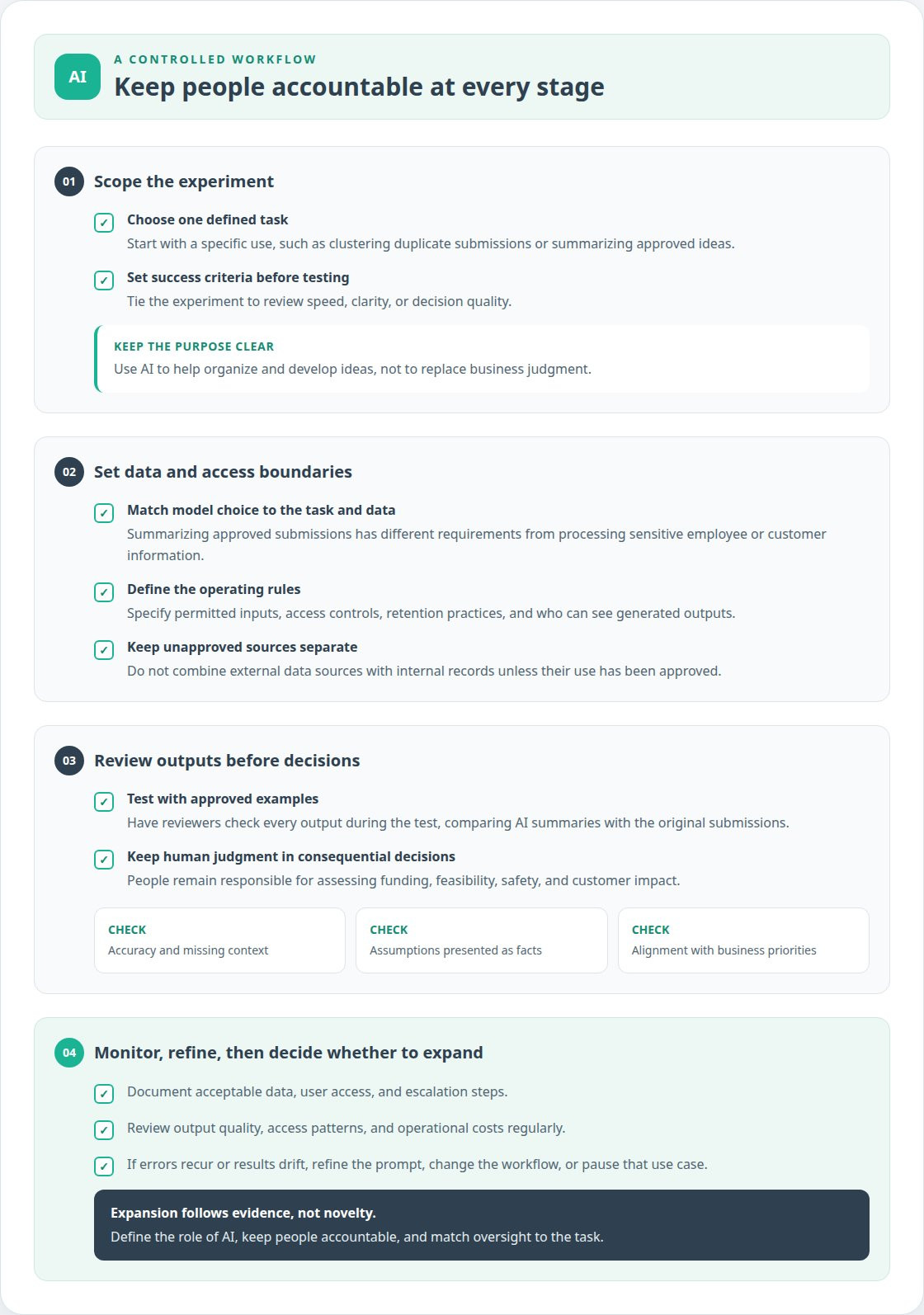
Move from experiment to practice through a controlled workflow:
- Choose one specific task, such as clustering duplicate submissions.
- Set success criteria tied to review speed, clarity, or decision quality.
- Test with approved examples and have reviewers check every output.
- Document acceptable data, user access, and escalation steps.
- Review performance regularly before expanding automation.
This approach helps teams learn where AI adds value without letting novelty drive adoption. The same discipline applies to AI agents that assist with analysis, design, testing, or delivery: define their role, keep people accountable, and create oversight that matches the task. For practical examples of AI use in innovation workflows, explore AI tools for innovation managers. Well-scoped experiments can strengthen idea development while preserving human control and clear ownership.
AI adoption in enterprise software
AI adoption works best as a focused business transformation, not a technology add-on without a clear goal. An operations team might use AI to identify recurring production delays, while a service team could analyze common customer handoff problems. In either case, leaders should name the decision or workflow they want to improve before selecting a system. This keeps the project grounded in business needs.
Enterprise software has evolved through waves such as cloud computing and software as a service. AI represents another shift because it can assist with analysis, content creation, and workflow execution. For example, an innovation team might use AI to summarize employee submissions, then ask reviewers to validate the themes against original ideas. Technology supports the work, but accountable people still make decisions.
Build governance into the design rather than treating it as a late approval step. Define which information AI may process, who can access its outputs, and which decisions require human review. For example, separate general process suggestions from submissions that contain customer or employee details. Assign an owner to monitor output quality, access, and operational performance. Clear responsibility helps keep promising experiments from becoming unmanaged systems.
Data infrastructure and security determine whether an AI use case can move beyond a prototype. A team analyzing service feedback needs reliable input data, controlled access, and a way to review model performance over time. Organizational change matters too. Explain how AI affects existing roles, train employees on the revised workflow, and give them a way to flag errors. Without adoption planning, a tool can add steps instead of reducing friction.
Use a practical adoption sequence:
- Choose a specific workflow and state the business outcome it should support.
- Identify the data, users, and systems involved before configuring AI.
- Set review rules for generated summaries, recommendations, or actions.
- Test the workflow with real users and collect examples of errors.
- Track performance and adjust governance before expanding its scope.
These steps connect technical delivery with daily work. For example, a department can start with AI-assisted idea categorization, review whether the categories help staff find relevant proposals, and refine the process before applying automation elsewhere. Keep the target narrow enough to measure but meaningful enough to matter. That balance gives leaders evidence for their next decision.
AI-enabled innovation workflows also need a clear operating model: named owners, review criteria, and a process for handling exceptions. Organizations planning that foundation can explore AI-powered innovation management as one approach to connecting AI with idea development. The priority is deliberate adoption, where governance, people, and technology advance together.
Cross-departmental collaboration
Cross-departmental collaboration brings people with different expertise together to solve a shared business problem. A customer handoff challenge, for example, may involve operations, sales, service, and technology. Each team sees a different part of the workflow, so working together can reveal causes one department might miss. Shared ownership matters: without it, ideas can stall between teams as each waits for another to act.
Microsoft Teams can support discussion, while SharePoint can provide a shared space for project materials. These tools help teams communicate, but collaboration still depends on clear decisions, owners, and handoffs. Define who frames the challenge, contributes expertise, assesses feasibility, and approves implementation. For a recurring service issue, operations might map the process, customer service could identify pain points, and technology staff could assess system dependencies.
Build engagement by giving each department a specific contribution instead of inviting everyone into a broad, undefined discussion. A useful working agreement identifies the problem, decision-maker, information needed, and how progress will be shared. During a process-improvement effort, frontline employees can describe workarounds, managers can explain performance targets, and analysts can examine available data. This division uses existing capabilities without letting one department dominate.
Manual handoffs can weaken otherwise strong ideas. Reduce that friction by recording decisions, assigning next steps, and setting a shared review point. For instance, when a proposal affects employee training and a customer-facing process, the training lead and service owner should review the same recommendation. Governance clarifies who resolves competing priorities. Continuous improvement then becomes part of the workflow, rather than a separate investment that fades after kickoff.
Use this collaboration checklist before launching a cross-functional effort:
- Name the business problem and the outcome teams are working toward.
- Include people with relevant frontline, operational, and technical expertise.
- Assign one accountable owner for decisions and action tracking.
- Agree how Microsoft Teams discussions and shared documents will support the work.
- Review progress together and communicate decisions to contributors.
These practices connect engagement with action. A focused innovation challenge can give departments a common target, such as improving onboarding or reducing repeated service questions. Its value depends on participation, clear criteria, and follow-through, not just the number of submissions. Teams can use innovation challenge examples to shape a cross-functional effort around a specific need.
Leaders should recognize that collaboration takes time away from employees’ existing responsibilities. Make the work visible in planning, clarify which decisions need group input, and let specialists complete independent tasks between reviews. When departments understand their roles and see how decisions progress, they can combine their capabilities without creating another disconnected workflow.
What is enterprise innovation software and what features does it include?
Enterprise innovation software gives organizations a structured way to collect, assess, develop, and track ideas. Unlike a Microsoft Teams conversation or shared document, it can connect submissions to review stages and decisions. For example, an employee suggestion about reducing repeat customer questions can be recorded, assigned for review, and tracked through implementation. The system supports the process; leaders still set priorities and make decisions.
Think of the platform as a workflow from idea intake through follow-through. Employees submit proposals, reviewers assess them against shared criteria, and owners record what happens next. A proposal might move from “submitted” to “under review,” then to a decision and an implementation owner. These stages create visibility across departments and help teams see whether an idea needs clarification, further analysis, or action.
For a large organization, useful capabilities typically include:
- Idea capture: forms or portals collect a problem, proposed change, and supporting context.
- Review workflows: criteria and assigned reviewers make assessment more consistent.
- Collaboration: comments and discussion help contributors build on proposals.
- Portfolio visibility: dashboards show status, themes, and ownership across initiatives.
- Reporting: records connect activity with decisions and documented outcomes.
- Integrations: connections to workplace systems can reduce manual handoffs when configured for organizational workflows.
Microsoft tools can remain part of the working environment. Teams can host discussions, while a dedicated innovation system organizes submissions, evaluation, and progress. Enterprise innovation software distinguishes informal conversation from a managed process by recording an idea’s owner, status, decision, and next action. Before selecting tools, map an example from initial suggestion to final decision, then identify where information currently gets lost.
Feature lists alone don’t determine fit. Compare each platform with your organization’s governance model, access needs, review criteria, reporting requirements, and existing workflows. Ask how employees submit proposals, managers handle duplicates, reviewers document decisions, and implementation owners report progress. Enterprise innovation software should meet these requirements in daily use, not just during a product demonstration. A guided evaluation of innovation management software selection can help teams compare real workflows with platform capabilities.
Keep the first rollout focused on a defined use case, such as frontline suggestions for reducing rework. Set clear ownership, test the review path with real submissions, and see whether employees understand each stage. Then refine fields, criteria, and reporting based on where reviewers encounter friction. The right platform makes work visible from idea to decision, while a sound operating process turns that visibility into accountable action.
Ideawake: Innovation Management Platform
Ideawake provides an Innovation Management Platform for capturing, evaluating, and advancing employee, customer, and partner ideas. It’s a natural next step when Microsoft tools support everyday conversations but your teams need a dedicated process to manage ideas through their lifecycle.
The Idea Management Platform supports structured idea review, while Continuous Improvement helps teams organize improvement efforts. Ideawake AI can assist innovation work, and engagement features such as voting, leaderboards, and prizes can encourage participation. Together, these capabilities bring submissions into a shared process, reduce administrative complexity, and make progress easier to follow.
If your organization is ready to give ideas a clearer path from submission to action, visit ideawake.com to explore how Ideawake can support your innovation program.
Make innovation part of how work gets done
Connect your innovation priorities with the routines, owners, and measures your organization already uses. Choose a business challenge, define who will guide the work, and decide how progress will be reviewed. This gives employees a clear path to contribute and helps leaders assess whether enterprise innovation software fits their operating model.
Ideawake offers an Innovation Management Platform, an Idea Management Platform, and Continuous Improvement to help organizations build this process. Each can structure the management of ideas and improvement initiatives around your program’s needs.
Start with a focused next step, then give your teams the space and direction to turn useful insight into progress.
Frequently Asked Questions
How Does Software Help?
Software helps teams organize information and apply analytical tools to work that would otherwise remain scattered. McKinsey’s 2024 State of AI report found that 72% of respondents said their organizations used AI in at least one business function, up from 55% in 2023. The same report found regular generative AI use rose from 33% to 65%. These figures offer context for assessing software that supports analysis, not proof that a particular platform will deliver results.
How can enterprises identify which innovation opportunities are worth pursuing?
Enterprises can distinguish opportunities by asking whether they address an emerging need, improve an existing operation, or open a different path to growth. Keep these categories visible during review, since each may require different evidence and decision-makers. For example, a service improvement could be tested within an existing process, while a new market concept may need research before operational planning. This helps leaders avoid judging unlike opportunities by identical expectations.
How do large companies maintain innovation momentum over time?
Large companies sustain momentum by developing employee skills alongside their innovation programs. The World Economic Forum’s Future of Jobs Report 2023 projects that 44% of workers’ skills will be disrupted within five years, and 60% of workers will require training before 2027. Leaders can use these findings to plan learning around new workflows, emerging technology, and changing roles. Regularly updating those learning plans helps teams keep pace as priorities shift.
Why do innovation initiatives sometimes lose executive support?
Executive support can fade when an initiative competes with urgent operational demands and its sponsors can’t explain the trade-off. Connect each initiative to a current priority, then make a clear decision about whether it deserves continued attention. For example, if a strategic shift makes a project less relevant, leaders can pause or redirect it instead of continuing by default. Explicit decisions protect focus and trust.
What are the best platforms for enterprise innovation in 2026?
There is no universal best platform for every organization in 2026. The right fit depends on whether the program centers on employee suggestions, continuous improvement, challenges, or portfolio oversight. Start by defining the primary use case and the people who will administer it. Then evaluate how well each option supports that program’s governance, adoption, and reporting needs. A strong fit should support the organization’s operating model, not force teams into an unsuitable one.
How do innovation platforms compare by features and use cases?
Compare platforms by examining how each handles the specific needs of a use case. A challenge program may need participant communications and review criteria, while continuous improvement may depend more on recurring operational input and status tracking. For programs using AI, assess how people review generated outputs and maintain oversight. A comparison matrix can record these requirements alongside administration, access, and reporting, making meaningful differences easier to discuss.
What are the leading platform vendors and their customer reviews?
Customer reviews can help buyers understand common user experiences, but they shouldn’t determine the decision alone. Look for detailed comments about the program type, implementation context, administrator workload, and employee experience. Check whether reviews describe recent, firsthand use or broad impressions, and compare recurring themes with your requirements. Use this evidence to shape internal evaluation questions, then assess the product against your workflows and governance needs.
How do companies choose an innovation platform?
Companies can choose an innovation platform by involving the people who will use and administer it before procurement. Include an employee contributor, a reviewer, a program owner, and an IT or security representative in the evaluation. Ask each person to complete tasks relevant to their role, then record friction points, missing information, and access concerns. This cross-functional assessment can reveal practical adoption issues that a feature checklist or executive review might miss.