Tag Archives: corporate innovation

Innovation Lifecycle Management: From Raw Concept to Measurable ROI in 2026

Innovation Lifecycle Management: From Raw Concept to Measurable ROI in 2026
Coby Skonord|
June 10, 2026

Stop pretending that a “suggestion box” is a strategy. Most organizations treat innovation as a creative hobby rather than a high-velocity engine, watching helplessly as their most transformative concepts vanish into an administrative black hole. You’ve likely felt the sting of a brilliant idea stalling out because of manual tracking, slow approval loops, and low employee engagement. It’s frustrating, it’s expensive, and in a market where 88% of companies are already weaponizing AI to accelerate their growth, it’s a recipe for obsolescence.

You’re here because you’re tired of average results and ready to master a discipline that actually moves the needle. This article provides the definitive framework for innovation lifecycle management, designed to transform your chaotic ideation into a streamlined, high-impact pipeline. We’ll show you how to leverage the latest ISO 56001 standards and automated workflows to slash your time-to-market. You’ll learn to bridge the gap between a raw concept and measurable ROI, turning your organization into a relentless innovation machine that leaves the competition behind. It’s time to stop guessing and start engineering success.

Key Takeaways

  • Shift from accidental innovation to a disciplined, end-to-end system that captures and scales high-value concepts with total precision.
  • Deploy a high-velocity 5-stage innovation lifecycle management framework that uses clear gate criteria to stop resource waste before it starts.
  • Eliminate the “Innovation Black Hole” and administrative chaos that kill momentum and drain employee engagement across your enterprise.
  • Weaponize AI and automated workflows to strip away manual grunt work, leaving your team free to focus on driving massive organizational transformation.
  • Learn how to achieve a dramatic reduction in implementation time by adopting a modern architecture built for speed and measurable ROI.

What is Innovation Lifecycle Management?

Stop crossing your fingers and hoping for a breakthrough. Most companies suffer from “accidental innovation,” a lucky strike that they can’t repeat. True innovation lifecycle management is the aggressive, end-to-end system for capturing, vetting, and scaling value. It’s the difference between a one-hit wonder and a high-impact engine. If you aren’t engineering your success, you’re just waiting for a miracle that might never come. This is about taking control of the chaos and turning it into a predictable, repeatable revenue driver.

This discipline moves beyond abstract concepts. It is grounded in the broader field of Innovation Management; however, it focuses specifically on the flow of an idea from a raw spark to a line item on your balance sheet. Without a structured lifecycle, you’re stuck in “innovation theater.” That’s the dangerous trap where you have plenty of brainstorming sessions and colorful sticky notes but zero market impact. Modern leaders are ditching manual spreadsheets and fragmented emails. They are moving toward dedicated innovation management platforms to gain total visibility over their pipeline and ensure every dollar spent is an investment, not a gamble.

The Strategic Core: Why Structure Wins

Structure isn’t a cage; it’s a launchpad. Effective innovation lifecycle management aligns every frontline suggestion with your top-down corporate goals. It ensures that your team isn’t wasting energy on “cool” projects that don’t serve the bottom line. Transparency is the secret weapon here. When employees see a clear, visible path for their ideas, trust skyrockets. They stop feeling like their contributions are falling into a void. Structure protects the creative process by providing the resources and roadmap needed to turn a vision into reality. It gives you the power to say “no” to distractions so you can say “yes” to disruption.

Linear vs. Iterative Lifecycles

Forget the old myth of the straight line. In 2026, the idea that you move perfectly from “Step A” to “Step B” is dead. Modern development requires high-velocity “fail fast” loops. You need a cyclical approach where you test, break, and refine concepts in real-time. This iterative flow is the heart of continuous improvement. It allows you to kill low-value projects early before they drain your budget. This isn’t just about speed. It’s about building a resilient system that learns from every failure to ensure the final output is bulletproof. You don’t just launch; you evolve.

The 5 High-Velocity Stages of the Innovation Lifecycle

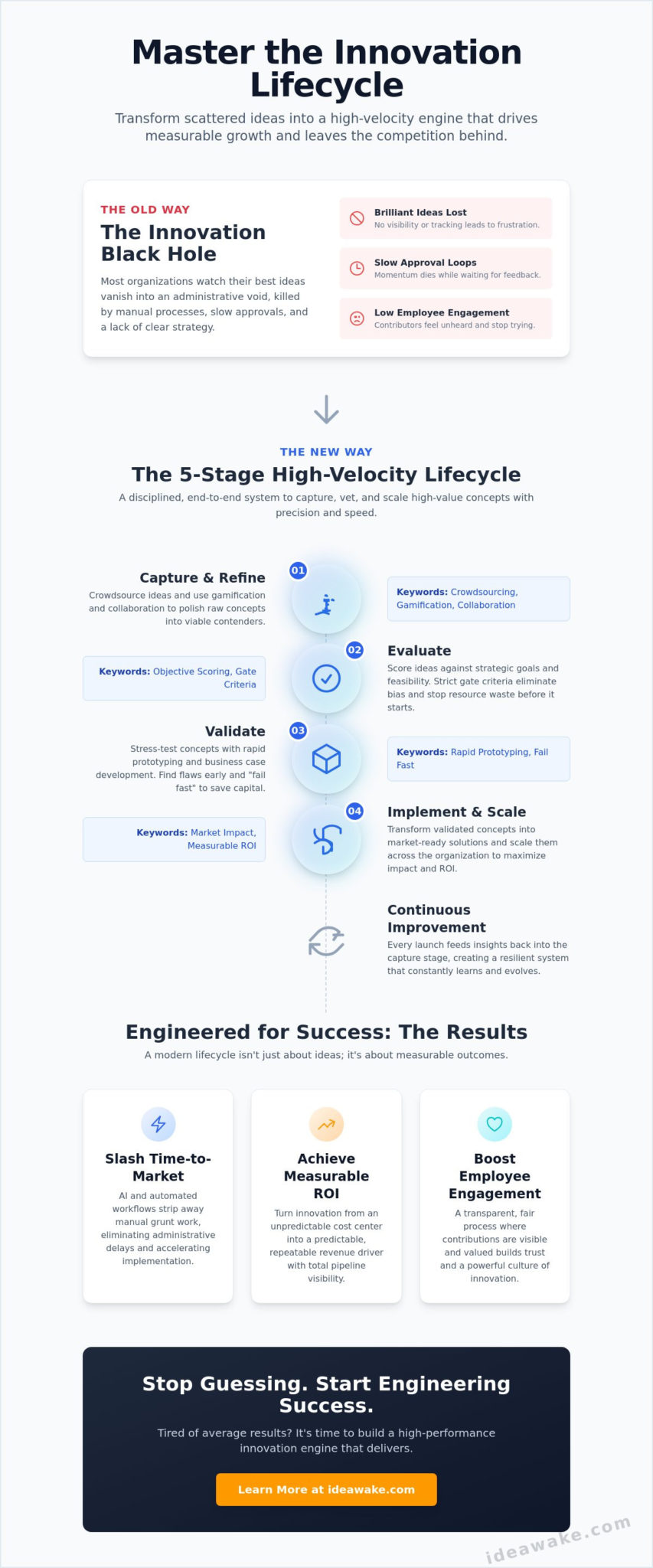
Stop treating your innovation pipeline like a dumping ground. Most organizations fail because they lack a filter, allowing low-value “noise” to drown out the billion-dollar breakthroughs. A high-performance innovation lifecycle management system acts as a rigorous sieve, designed for speed and absolute accountability. You need a model that moves fast but refuses to compromise on quality. Each stage must have strict “gate” criteria to stop resource waste before it starts. If a concept can’t prove its worth at the gate, it dies. This isn’t cruelty; it’s a competitive necessity. This lifecycle is a continuous loop that feeds back into your continuous improvement efforts, ensuring that every launch informs the next spark.

Stage 1 & 2: Capture and Refine

Innovation is a team sport, not an executive privilege. You must crowdsource ideas from your employees, customers, and partners simultaneously to gain a 360-degree view of your potential. Raw ideas are often messy. Use collaborative refinement to let your community polish those concepts into something viable. This is where gamification becomes your best friend. Use voting and leaderboards to spark healthy competition; it’s the fastest way to drive high-quality participation. When the stakes are visible, the best ideas naturally rise to the top. If you want to see this in action, consider how an automated idea management platform can handle this volume without breaking a sweat.

Stage 3 & 4: Evaluate and Validate

Remove the “who you know” bias from your selection process. You need objective scoring models that weigh ideas against your strategic goals, technical feasibility, and market demand. This keeps the process fair and results-driven. These stages serve as the ultimate stress tests. Use rapid prototyping and business case development to find the cracks in a concept before you commit serious capital. For a deeper look at how to structure these gates, the Innovation Management Framework provides a research-backed approach to balancing risk and reward. You can also run targeted innovation challenges to solve specific, high-stakes problems with laser precision.

Stage 5: Implement and Measure ROI

This is where the rubber meets the road. Successful concepts must transition seamlessly from the innovation pipeline to your project management office for full-scale execution. ROI tracking is the only true metric of innovation success. If you can’t measure the financial impact, you’re just playing around. You must link every implemented idea back to hard financial or operational KPIs, such as cost savings, new revenue streams, or hours of labor recovered. This data doesn’t just justify your program; it fuels the next cycle of growth by proving that innovation is a profit center, not a cost center.
Innovation Lifecycle Management: From Raw Concept to Measurable ROI in 2026

Stop the Chaos: Why Most Innovation Lifecycles Fail

Most innovation programs are dead on arrival. They quickly devolve into a “Black Hole” where brilliant ideas go to die, swallowed by bureaucratic silence and indecision. This is the ultimate failure of innovation lifecycle management. When your best people realize their contributions vanish without a trace, they stop contributing entirely. You can’t run a high-performance engine on an empty tank. If your intake process isn’t followed by immediate, visible action, you aren’t managing innovation; you’re just hosting a digital graveyard.

Subjectivity is the enemy of ROI. Far too often, the “HIPPO”, which is the Highest Paid Person’s Opinion, dictates which projects move forward. This ego-driven selection process ignores market data and technical feasibility, leading to massive resource waste on vanity projects. Worse yet, a lack of executive visibility means leadership can’t see the value being created. Without clear dashboards and real-time reporting, innovation looks like a nebulous expense. When the next budget cycle hits, these invisible programs are the first to be gutted. You need data to defend your seat at the table.

The Administrative Overhead Trap

Administrative Paralysis is the #1 killer of enterprise innovation. If your process relies on a chaotic mess of emails and spreadsheets, you’re bleeding time and money. Consider the hidden financial drain of manual tracking. Managers spend countless hours updating status reports and chasing approvals through fragmented channels. This friction leads to inconsistent evaluations and missed opportunities. High-impact concepts stall in the pipeline while mediocre ideas stay on life support simply because no one has the data to kill them. Manual “Email and Spreadsheet” innovation isn’t just slow; it’s a recipe for total stagnation.

The Engagement Gap

Top-down mandates fail because they ignore the goldmine of frontline insights. The most dangerous failure in the lifecycle is the broken feedback loop. When a contributor is left in the dark, the psychological fallout is devastating. They don’t just stop submitting ideas; they lose faith in the organization’s mission. A non-transparent process breeds a culture of cynicism where employees feel like their expertise is irrelevant. You don’t just lose a single idea; you lose the very spirit of innovation across your workforce. To dominate in 2026, you must replace this “Black Hole” with radical transparency and automated updates that keep every contributor in the loop.

Modernizing the Workflow: AI and Automation in 2026

Manual innovation is a dead end. In 2026, AI is the ultimate force multiplier, turning innovation managers into strategic architects rather than data entry clerks. With 88% of companies already deploying AI in at least one business function according to February 2026 data from Zapier, the baseline for competition has shifted. You aren’t just managing ideas; you’re orchestrating an intelligent innovation lifecycle management system that operates at a scale humans can’t touch. Automation strips away the soul-crushing grunt work. It allows your team to focus on high-stakes execution while predictive analytics identify market shifts before your competitors even wake up. This is how you move from reactive survival to proactive dominance.

AI-Powered Idea Evaluation

Stop drowning in a sea of duplicate submissions and fragmented data. AI now automatically categorizes and deduplicates hundreds of entries in seconds, ensuring your pipeline remains lean and relevant. It uses sophisticated sentiment analysis to gauge community excitement, identifying the “hidden gems” that resonate most with your workforce. By leveraging historical data, AI-driven scoring models flag high-potential concepts with surgical precision. This removes human bias and ensures that the most impactful winners get the attention they deserve. It’s not just about efficiency. It’s a total reimagining of how we value and prioritize human creativity.

Automating the Implementation Pipeline

The transition from a winning idea to a live project is usually where momentum dies. Automation fixes this by triggering workflows the moment a “gate” approval is granted. You don’t need to send another “status update” email ever again. These systems keep every stakeholder informed through automated notifications, ensuring absolute accountability across the board. By integrating your innovation lifecycle management platform directly with execution tools like Jira or Trello, you bridge the gap between inspiration and implementation. If you’re ready to weaponize these tools and eliminate administrative friction, explore how the Ideawake Idea Management Platform can automate your entire workflow from spark to scale.

Predictive analytics are the final piece of the 2026 puzzle. Instead of reacting to market changes, you use AI to forecast them. This proactive stance allows you to launch targeted challenges that address future pain points before they impact your bottom line. You aren’t just keeping up with the industry. You’re setting the pace that everyone else is forced to follow.

The Ideawake Edge: Innovation Lifecycles Built for Scale

Stop settling for fragmented tools that only handle half the job. Most platforms are nothing more than glorified digital suggestion boxes that leave you stranded when it’s time to actually execute. Ideawake is the modern architecture built for high-impact results. It provides a relentless, end-to-end framework that takes you from the first raw spark to a definitive ROI calculation. This is the only innovation lifecycle management solution designed to eliminate administrative friction and maximize output. It’s built for leaders who demand speed and refuse to accept mediocrity. By automating the grunt work, you can dramatically slash implementation time and focus your energy on scaling the winners.

End-to-End Visibility and Accountability

Chaos is the enemy of growth. Ideawake provides a “Single Source of Truth” that brings every stakeholder into alignment. No more chasing updates across multiple departments or losing track of high-potential concepts in buried email threads. Our executive dashboard turns your innovation pipeline into a predictable line item, giving leadership the real-time data they need to make bold decisions. We don’t just ask for participation; we engineer it. Our gamification features ensure total engagement from the frontline, turning the ideation process into a high-energy competition where everyone is invested in the outcome. This isn’t just software. It’s a culture shift.

ROI Measurement That Numbers Don’t Lie About

Innovation without measurement is just a hobby. Ideawake provides specialized tools that track the hard financial impact of every implemented idea. Whether it’s direct cost savings or new revenue streams, you’ll have the data to prove exactly how much value your program is generating. This level of transparency is your strongest weapon during budget season. Use our data-driven analytics to justify your spend and expand your innovation initiatives with total confidence. You aren’t just guessing anymore. You’re operating with a level of precision that makes success inevitable. See how Ideawake turns ideas into ROI today and stop leaving your organization’s future to chance.

Dominate the Future of Innovation

The era of “hoping for the best” is over. You’ve seen how a high-velocity innovation lifecycle management framework replaces administrative chaos with a streamlined engine for growth. By leveraging AI-driven innovation insights and gamified participation engines, you can finally capture the untapped potential of your entire workforce. It’s time to stop letting brilliant ideas die in the void and start scaling the concepts that actually move your bottom line. Mediocrity is a choice, and it’s one your organization can no longer afford to make.

You have the roadmap. Now you need the high-performance engine to drive it. Ideawake provides the end-to-end visibility and specialized ROI tracking capabilities required to turn innovation from a nebulous cost center into a massive, predictable profit driver. Don’t let your competition outpace you while you’re stuck managing manual spreadsheets and broken feedback loops. Take absolute control of your organization’s destiny and build a culture where measurable results are the only metric that matters. Your transformation into a market leader starts with a single, decisive step.

Ready to turn raw ideas into pure ROI? Book a high-energy demo of Ideawake today.

Success isn’t a happy accident. It’s engineered. Go out and build the future you’ve been talking about.

Frequently Asked Questions

What is the main goal of innovation lifecycle management?

The primary objective is to transform raw, chaotic ideas into measurable business value with maximum velocity and zero waste. It isn’t just about collecting suggestions; it’s about engineering a repeatable, high-performance flow from the initial spark to full-scale implementation. By creating a disciplined system, you ensure that innovation becomes a predictable revenue driver rather than a series of lucky accidents.

How does innovation lifecycle management differ from project management?

Innovation management focuses on the “what” and “why,” while project management handles the “how.” While project management is about execution and efficiency within defined parameters, innovation lifecycle management is about discovery, vetting, and validating concepts before they ever reach the project stage. It acts as the critical filter that ensures your project management office only works on high-impact winners.

Can innovation lifecycle management work for small teams or is it just for enterprises?

Structure is essential for small teams that cannot afford to waste limited resources on low-value experiments. Small teams actually have a speed advantage, allowing them to iterate through failure loops much faster than bloated enterprises. Implementing a structured lifecycle early prevents the administrative chaos that typically kills growth as a team begins to scale and the volume of ideas increases.

How do you measure the success of an innovation lifecycle?

Success is measured by hard financial and operational KPIs, specifically ROI, cost savings, and new revenue generated. You should also track velocity metrics, such as the time it takes to move an idea from intake to implementation. If you can’t link an innovation initiative back to a line item on your balance sheet, you haven’t reached the end of the lifecycle yet.

What role does AI play in the innovation lifecycle in 2026?

In 2026, AI acts as a force multiplier by automating idea categorization, deduplication, and predictive scoring. It removes the manual grunt work of vetting hundreds of submissions and identifies market trends before they become obvious to your competitors. This allows managers to shift from reactive tracking to proactive strategy, using data-driven insights to launch targeted innovation challenges that solve future problems today.

How do you prevent an innovation pipeline from becoming a “black hole” for ideas?

Radical transparency and automated feedback loops are the only way to kill the black hole effect. Contributors must receive instant, visible updates on the status of their ideas at every stage of the gate process. When you use an innovation lifecycle management platform to automate these communications, you maintain high engagement and prove to your team that their insights are actually being valued.

What are the most common bottlenecks in the innovation lifecycle?

The most frequent bottlenecks occur at the evaluation and approval stages due to subjective decision-making and slow manual sign-offs. Programs often stall when they rely on a single executive’s opinion rather than objective scoring models. Transitioning from the innovation pipeline to the execution team is another common friction point that can be solved through automated workflow triggers and deep platform integration.

Is innovation lifecycle management software worth the investment for a startup?

It is a critical investment because startups live or die by their ability to pivot and scale the right ideas. Relying on ad-hoc methods leads to inconsistent results and burned capital. A dedicated platform provides the structure needed to attract investors by showing a disciplined, data-backed approach to product development and market disruption from day one.

Best Idea Management Software 2026: Stop Collecting Ideas and Start Driving ROI

Best Idea Management Software 2026: Stop Collecting Ideas and Start Driving ROI
Coby Skonord|
June 9, 2026

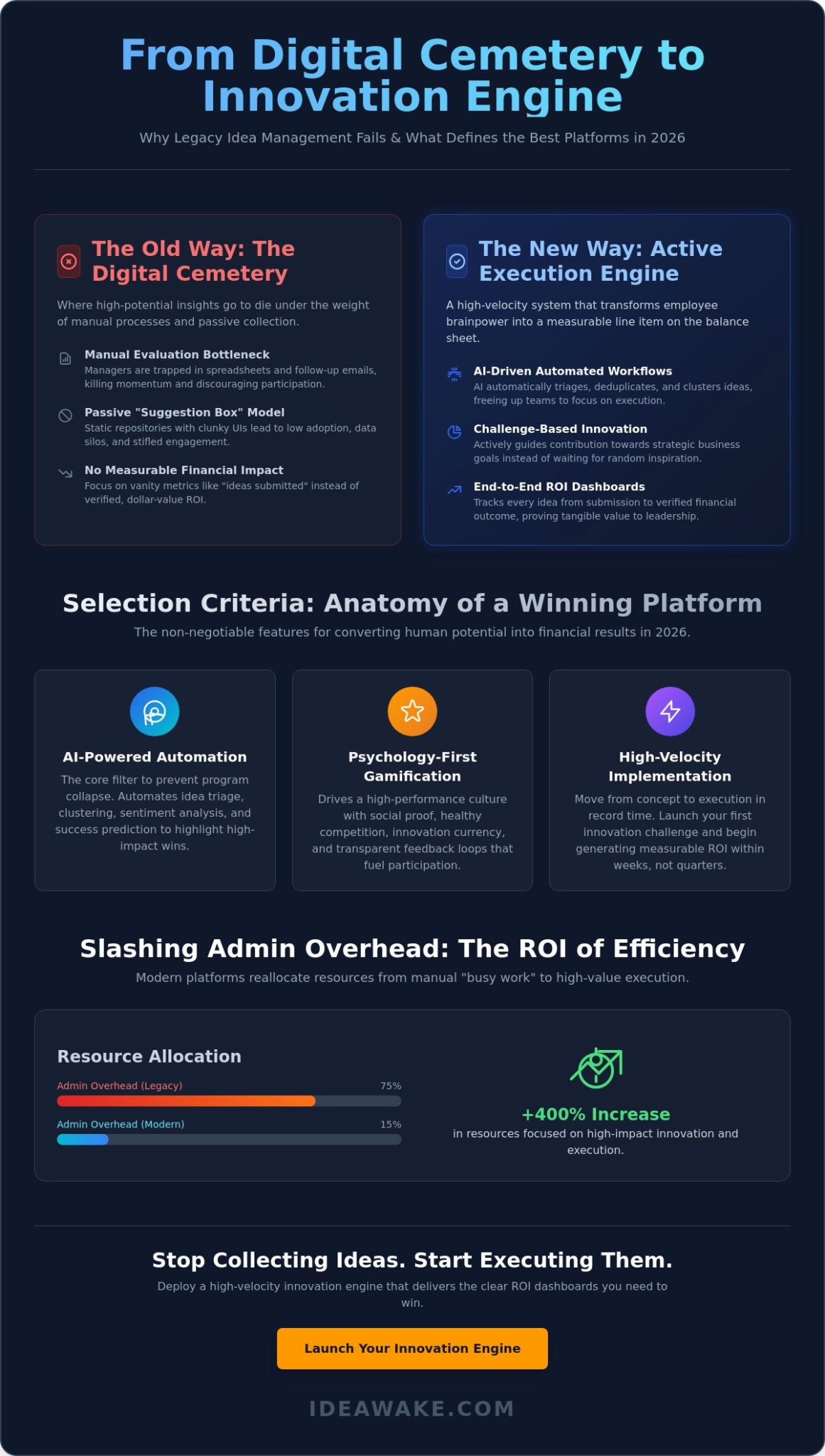
Most innovation programs are digital cemeteries where high-potential insights go to die under the weight of manual spreadsheets and “we’ll get to it” emails. You’re likely exhausted from watching legacy software stifle engagement while you struggle to prove any tangible value to leadership. Finding the best idea management software isn’t about buying a digital suggestion box. It’s about deploying a high-velocity execution engine that transforms raw employee brainpower into a measurable line item on your balance sheet.

We agree that the old way of simply “collecting” ideas is broken and a massive drain on your resources. This guide promises to cut through the enterprise fluff to identify the elite platforms that slash administrative overhead and deliver the clear ROI dashboards you need to win. We’ll preview the top-tier solutions for 2026, focusing on automated evaluation workflows, high-participation gamification, and the rapid implementation strategies that separate industry disruptors from those settling for mediocrity.

Key Takeaways

  • Stop settling for passive suggestion boxes and learn how to deploy an active, challenge-based innovation engine that prioritizes financial impact.
  • Identify the best idea management software by looking for AI-driven evaluation tools that automate the “busy work” of prioritizing hundreds of insights.
  • Boost employee engagement through psychology-first gamification features like social proof and leaderboards that turn innovation into a high-participation culture.
  • Slash administrative overhead using automated triage systems that filter out the noise and highlight only the most viable opportunities for your team.
  • Follow a high-velocity implementation strategy to launch your first innovation challenge and start generating measurable ROI within weeks.

The Death of the Digital Suggestion Box: Why Legacy Software Fails

Legacy software is a cemetery for ambition. For years, organizations have been sold the lie that a digital suggestion box is enough to foster a culture of progress. It isn’t. Traditional platforms act as static repositories, passive containers that wait for employees to stumble upon a spark of inspiration. This approach is lethal to growth. Modern innovation management has evolved into a results-driven engine that demands action over observation. The best idea management software in 2026 doesn’t just store data; it forces momentum by shifting from passive collection to active, challenge-based innovation.

The hidden costs of these legacy systems are staggering. High friction in outdated user interfaces leads to immediate drops in adoption. When employees find a system clunky or slow, they simply stop using it. This creates dangerous data silos where the most transformative insights remain locked in the minds of your frontline workers. In 2026, the market has no patience for volume-based metrics like “number of ideas submitted.” We’ve moved toward impact-based metrics that track how those ideas actually move the needle on your bottom line.

The Administrative Trap of Traditional Systems

Manual evaluation is the ultimate innovation bottleneck. When you rely on traditional systems, you’re essentially sentencing your managers to a life of unread spreadsheets and endless follow-up emails. Good ideas die in these administrative black holes because the “busy work” of sorting through noise becomes overwhelming. This kills momentum. It tells your team that their input doesn’t matter, effectively discouraging any future participation. Modern disruptors are moving toward self-governing innovation communities. These environments utilize peer-to-peer vetting and automated triage to ensure that only the most viable, high-impact concepts reach the decision-makers. You don’t need more ideas; you need a faster way to find the right ones.

Modern Architecture vs. Legacy Bloat

Cloud-native, AI-first platforms are currently crushing 10-year-old enterprise suites that were never built for the speed of modern business. Legacy bloat creates a slow, rigid experience that can’t adapt to the specific needs of a high-performance organization. Modern architecture focuses on delivering implementation-ready data rather than raw, unrefined suggestions. These platforms use AI to categorize, deduplicate, and even enhance submissions before a human ever sees them. This ensures that every minute spent in the platform is a minute spent on execution. Innovation ROI is the only metric that matters in 2026.

Selection Criteria: What Defines the ‘Best’ in 2026?

Stop looking at generic feature checklists. In 2026, the gap between mediocre tools and the best idea management software is defined by one thing: the ability to convert raw human potential into hard financial outcomes without drowning your team in paperwork. You don’t need another place to store suggestions; you need a high-velocity decision engine. The elite platforms today prioritize end-to-end lifecycle tracking, ensuring every spark of genius is followed from the initial submission to a verified dollar-value ROI dashboard. If a platform can’t show you exactly how much capital it’s saved or generated, it’s just a digital toy.

AI and Automation: The New Baseline

AI is no longer a “nice-to-have” add-on; it’s the core filter that prevents your innovation program from collapsing under its own weight. Modern systems use advanced algorithms to automatically identify duplicate ideas and cluster related concepts in real time. This doesn’t just save time. It prevents the frustration of “idea fatigue” where employees see the same problems reported repeatedly. Beyond simple organization, the top-tier platforms leverage sentiment analysis and success-prediction models to help you prioritize high-impact wins early. Automated workflows are now non-negotiable for lean innovation teams who refuse to spend their days manually triaging 500 employee submissions. If you’re serious about scaling your impact, you need an idea management platform that does the heavy lifting for you.

Engagement Science and Gamification

Sustainable participation requires more than a “like” button. To drive high-performance cultures, you must utilize psychology-first gamification that taps into social proof and healthy competition. We’re moving beyond superficial badges toward “innovation currency” and tangible rewards that reflect the value employees bring to the table. Transparent feedback loops are the fuel for this fire. When a contributor sees exactly where their idea sits in the evaluation pipeline, they stay invested. Leaderboards shouldn’t just track who posts the most; they should highlight who drives the most implementation success. This level of transparency builds trust and ensures your innovation engine never runs out of steam.

Finally, friction is the silent killer of engagement. The best platforms integrate seamlessly with the tools your team already uses, like Microsoft Teams, Slack, and Jira. By bringing the innovation process into the existing workflow, you eliminate the “one more login” hurdle that kills adoption. You want a system that meets your people where they are, allowing them to submit, vote, and track progress without ever leaving their primary communication stack. This is how you transform innovation from a periodic event into a continuous, high-output organizational habit.

Best Idea Management Software 2026: Stop Collecting Ideas and Start Driving ROI

The Top Idea Management Platforms for 2026

Selecting the best idea management software in 2026 requires a cold, hard look at your organizational goals. Do you want a complex, multi-year implementation that requires a dedicated army of consultants, or do you want a high-velocity engine that starts generating ROI in weeks? The market has split into two distinct camps: the legacy giants that offer massive feature sets for global conglomerates and the agile disruptors that prioritize speed, adoption, and automated efficiency. If you’re tired of administrative bloat, the choice becomes clear very quickly.

Platform Core Strength Implementation Speed Admin Burden
Ideawake AI-Driven ROI & Adoption High (Weeks) Low (Automated)
Traditional Enterprise Suite Enterprise Feature Depth Low (Months) High (Manual)
Large-Scale Community Platform Massive Scale Campaigns Medium High
Planview Spigit Global Resource Planning Low Very High

Ideawake: The Disruptive Leader in ROI and Adoption

Ideawake is currently crushing legacy rivals by focusing on the one thing that actually matters: getting results without the headache. By leveraging Ideawake AI, organizations are seeing an 80% reduction in administrative overhead. This isn’t just a minor improvement; it’s a total transformation of how innovation is managed. Their modern architecture allows for an implementation process that’s 3x faster than traditional enterprise suites. You don’t have time to wait six months for a rollout. Ideawake provides built-in ROI measurement tools that turn abstract employee insights into hard data, ensuring your innovation program is viewed as a profit center rather than a cost. It’s built for organizations that demand high performance and zero fluff.

Exploring Established Enterprise Platforms

There’s no denying that many established enterprise platforms have deep feature sets. Some of these providers boast impressive figures, having facilitated billions in business impact across millions of users, making them a staple for massive, multi-national conglomerates that require extreme customization. However, these “Big Box” solutions come with significant trade-offs. You’ll face longer implementation times and a level of complexity that often requires a “consultancy-heavy” model to maintain. Similarly, other large-scale community platforms can engage millions of participants, but the manual effort required to manage those extensive campaigns can be staggering. These platforms are powerful, but they often lack the “platform-led” speed and automated triage systems that modern, leaner teams need to stay competitive in a fast-moving economy. If you choose a giant, be prepared to invest the man-hours required to keep the gears turning.

Slashing Admin Overhead: The ROI of Efficiency

The #1 objection we hear from overwhelmed innovation leaders is simple: “I don’t have time to manage 500 employee ideas.” They’re right to be concerned. Without the right systems, a high volume of suggestions isn’t an asset; it’s a massive administrative liability that drains your team’s energy and kills momentum. The best idea management software solves this problem by replacing manual review cycles with high-velocity automated triage and bottom-up evaluation models. You aren’t just collecting data anymore. You’re deploying a system that filters the noise so you can focus exclusively on execution.

By shifting to a decentralized evaluation model, you let the crowd do the heavy lifting. Instead of a single manager playing gatekeeper, peer voting and social vetting identify the highest-potential insights in real time. This approach compresses what used to be weeks of grueling manual spreadsheet tracking into just a few hours of high-level oversight. You gain the clarity to make million-dollar decisions without the administrative burnout that typically plagues enterprise innovation programs.

Automating the Innovation Pipeline

Efficiency starts with trigger-based workflows that automatically move ideas through specific stages based on predefined engagement or scoring thresholds. You can configure the system to notify technical experts only when an idea reaches a certain level of peer support, ensuring their time is never wasted on low-value submissions. Role-based permissions allow you to decentralize management, giving department heads the power to own their specific innovation challenges without constant corporate hand-holding. Ideawake AI predicts idea viability and potential financial yield before a human reviewer even opens the submission. This level of automation turns a chaotic suggestion box into a streamlined factory of progress. If you’re ready to stop the manual grind, you should automate your innovation pipeline today.

From Idea to Impact: Tracking the Money

Innovation isn’t a corporate hobby; it’s a business function that must justify its existence with cold, hard cash. To win in 2026, you must integrate financial data directly into your workflow to see the real-world yield of every implemented project. Executive dashboards should speak the language of the CFO, highlighting clear ROI, cost avoidance, and resource optimization metrics. When you can show leadership a direct line from an employee insight to a specific dollar-value impact, you secure the budget and buy-in for future growth. Use your historical data to refine future innovation challenges, ensuring your team only tackles the specific problems with the highest probability of success. This is how you transform a cost center into a profit-generating engine. The best idea management software doesn’t just track thoughts; it tracks the money.

Implementation Strategy: Launching Your Innovation Engine

Implementation is where most corporate initiatives go to die in a fire of over-analysis. You don’t need a six-month roadmap or a fleet of high-priced consultants to get started. The best idea management software should be operational and generating insights in weeks, not quarters. Start by defining a high-impact Innovation Challenge that targets a specific, painful problem in your business. Whether it’s reducing supply chain waste or improving customer retention, focus on a single objective to drive clarity and urgency. When you give people a specific problem to solve, you get specific, actionable solutions.

Once your challenge is set, configure your automated evaluation criteria. Don’t overcomplicate this. A Minimum Viable Process using three to five key metrics is far more effective than a complex matrix that confuses your evaluators. Launch with a “Big Bang” approach. Use gamification, leaderboards, and immediate feedback to create a surge of buzz. Then, execute on the top-voted ideas and iterate. Use the data from your first challenge to refine the next. Finally, report your ROI. Socialize those wins across the organization to prove the platform’s value and secure an even larger budget for the next round. The best idea management software turns these steps into a frictionless, automated loop.

Setting Up for Velocity

Speed is your greatest asset. If you’re spending months planning, you’re already losing. Aim to launch your first challenge within 30 days to maintain organizational momentum. This lean approach prevents over-engineering and allows you to learn from real-world user behavior. It’s better to launch, learn, and pivot than to wait for a “perfect” system that never arrives. For a deeper dive into optimizing these workflows, see our guide on Stop Wasting Potential: Mastering Idea Management Systems. By focusing on velocity, you ensure that your innovation program stays relevant and high-impact from day one.

The Ideawake Advantage: Speed and Support

Ideawake is built for organizations that prioritize action over abstract theory. We’ve stripped away the legacy bloat to focus on the specific levers that drive employee engagement and measurable financial impact. Our platform-led model uses structured Innovation Challenges to create a repeatable, high-output success model that scales with your ambition. You don’t need more meetings or endless configuration cycles. You need a system that works as hard as you do to surface million-dollar opportunities. It’s time to stop collecting suggestions and start driving results. Crush your innovation goals with Ideawake and transform your organization into a high-velocity profit engine today.

Transform Your Organization into a High-Velocity Innovation Engine

The era of the passive suggestion box is over. To dominate in 2026, you must pivot from merely collecting ideas to executing high-impact innovation challenges that deliver documented financial gains. We’ve established that the best idea management software isn’t just a database; it’s a results-driven platform that utilizes AI to slash administrative overhead by 80% while providing end-to-end ROI tracking. You don’t have time for legacy bloat or complex, months-long rollouts that kill employee momentum before the first challenge even begins.

By prioritizing Red Dot-level UX and automated evaluation workflows, you ensure maximum adoption and a self-governing community of innovators. Ideawake is built to turn your untapped human potential into a measurable competitive advantage. It’s time to stop managing spreadsheets and start leading a movement of continuous improvement within your organization. The path to massive scale and organizational transformation starts with a single, decisive action. Stop settling for average results—book your Ideawake demo today. Your future ROI is waiting, and we’re ready to help you capture it.

Frequently Asked Questions

What is the best idea management software for large enterprises?

The best idea management software for a global enterprise depends on whether you prioritize complex customization or high-velocity results. Legacy giants like Brightidea and HYPE Innovation provide deep feature sets for massive conglomerates that require heavy consultancy support. However, modern disruptors like Ideawake are crushing these older suites by offering faster implementation and AI-driven automation that scales without the typical administrative bloat. If you want high adoption rates and measurable ROI within weeks, you need a platform built for speed and engagement.

How much does idea management software typically cost in 2026?

The market currently offers a wide spectrum of pricing models based on your organization’s scale and requirements. Entry-level tools for small teams often start with monthly subscriptions, while mid-market solutions move into the thousands per year. High-end enterprise platforms frequently use custom quotes that can reach significant annual investments depending on the number of administrators and depth of features. You should always look for a partner that ties its value to your organizational growth rather than just charging for user seats.

Can idea management software integrate with Microsoft Teams or Slack?

Yes, and this integration is non-negotiable for high-performance teams. The best idea management software in 2026 meets your employees where they already work by integrating directly with Microsoft Teams, Slack, and Jira. This eliminates the “one more login” hurdle that kills participation. By bringing the innovation process into your daily communication stack, you transform a periodic event into a continuous, high-output organizational habit that requires zero extra effort from your frontline workers.

How do you measure the ROI of an idea management platform?

You must move beyond vanity metrics like “number of ideas” and focus on hard financial yield. ROI is measured by tracking the dollar-value impact of implemented projects, including direct revenue generation, cost avoidance, and resource optimization. Leading platforms provide executive dashboards that speak the language of the CFO, showing a direct line from a single employee insight to a specific balance sheet improvement. If your software can’t quantify its own value in cash, it’s just a digital toy.

What is the difference between an innovation management platform and a suggestion box?

A suggestion box is a passive, static repository where ideas go to die in unread spreadsheets. An innovation management platform is a results-driven engine that utilizes active challenges and automated workflows to drive execution. Modern systems don’t just “collect” thoughts; they prioritize, vet, and track insights through a structured lifecycle. This shift from passive collection to active challenge-based innovation is what separates industry leaders from organizations that are merely pretending to innovate.

How does AI improve the idea evaluation process?

AI acts as a high-velocity filter that slashes administrative overhead by up to 80% in modern systems. It automatically identifies duplicate ideas, clusters related concepts, and performs sentiment analysis to predict implementation success before a human reviewer even opens the file. This allows lean innovation teams to focus on high-impact wins rather than drowning in the noise of 500 manual submissions. AI turns a chaotic suggestion list into a prioritized, implementation-ready roadmap for your leadership team.

How do you encourage employees to use an innovation platform?

Stop asking for favors and start utilizing psychology-first gamification. You drive sustainable participation by implementing leaderboards, social proof, and tangible rewards that recognize the value contributors bring to the table. Transparent feedback loops are the fuel for this fire. When employees see exactly where their idea sits in the pipeline and receive real updates on its progress, they stay invested. High engagement is a result of a culture that rewards impact and values transparent communication.

Is there free idea management software available for small teams?

Yes, several platforms offer free tiers for small teams or initial pilot programs. These entry-level versions are useful for testing the waters and proving the concept before scaling to a full enterprise engine. While these free tools lack the advanced AI automation and deep ROI tracking of premium systems, they provide a starting point for organizations that are tired of using manual spreadsheets. However, once you’re serious about driving measurable financial impact, you’ll need the robust features of a professional best idea management software suite.

Stop Wasting Potential: Mastering the Modern Idea Management System in 2026

Stop Wasting Potential: Mastering the Modern Idea Management System in 2026
Coby Skonord|
June 8, 2026

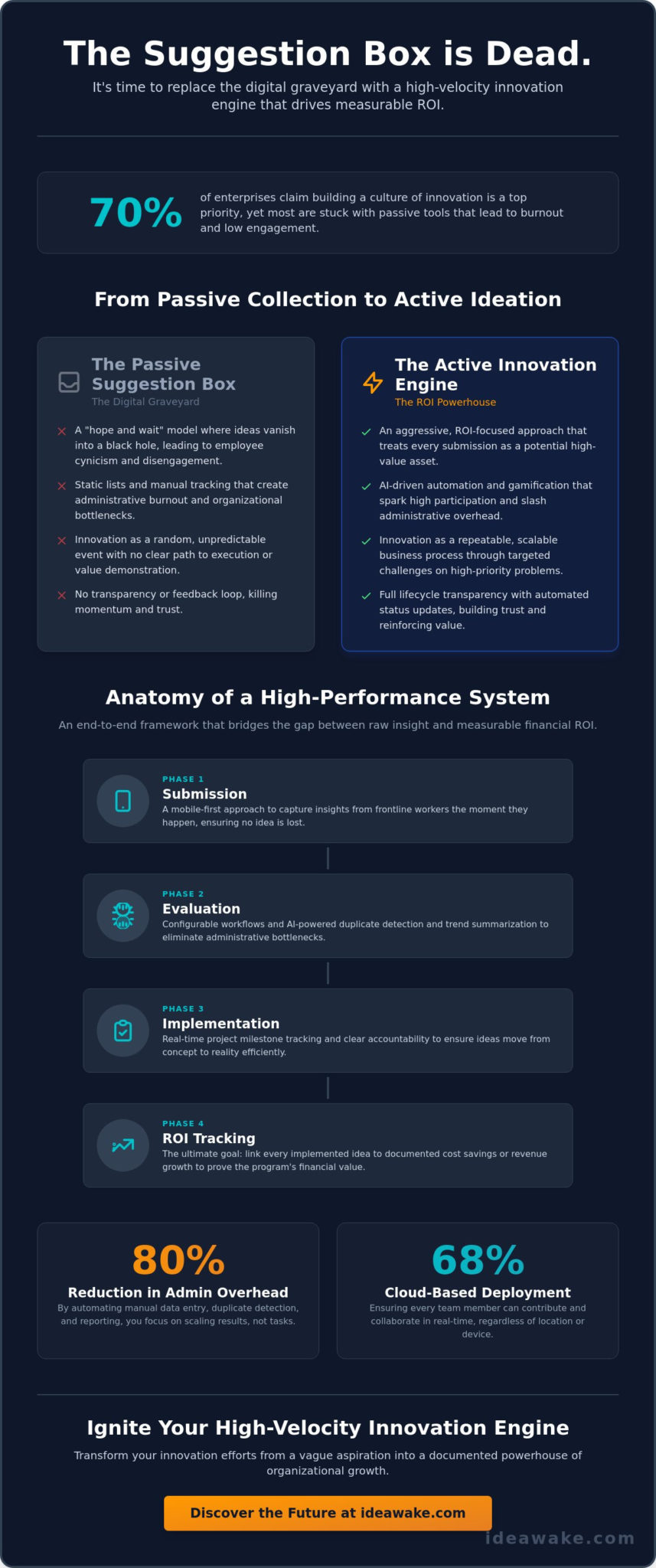
Your current suggestion box isn’t an innovation strategy; it’s a digital graveyard for your organization’s untapped potential. While 70% of enterprises now claim that building a culture of innovation is a top priority, most are still suffocating under the administrative burnout of manual tracking and embarrassing engagement levels. It’s time to stop settling for average. A modern idea management system shouldn’t just collect feedback. It must function as a high-velocity engine that automates the journey from a raw concept to a massive, measurable ROI.

You’ve probably felt the frustration of being unable to prove the financial value of your program to skeptical leadership. We understand the pressure to deliver tangible results. This article reveals how to replace stagnant processes with a streamlined, AI-driven pipeline that uses gamification to spark high participation. You’ll discover the exact data points needed to link employee creativity to your bottom line, transforming your innovation efforts from a vague aspiration into a documented powerhouse of organizational growth.

Key Takeaways

  • Learn how to replace passive suggestion boxes with an end-to-end idea management system that prioritizes high-velocity execution over simple feedback.
  • Discover the architectural shift from static lists to configurable workflows designed to accelerate evaluation and eliminate organizational bottlenecks.
  • Bridge the engagement gap by utilizing gamification strategies that transform employee participation from a chore into a high-impact contribution.
  • Implement a battle-tested 5-step framework to bridge the gap between raw insights and measurable financial ROI.
  • See how modern automation can slash your administrative overhead by 80%, allowing you to focus on scaling results rather than manual data entry.

The Suggestion Box is Dead: Defining the Modern Idea Management System

The physical suggestion box is a dusty relic of the past. Even its digital descendants often fail because they remain fundamentally passive. A true idea management system is not a simple database; it is a structured, end-to-end innovation lifecycle platform. It sits at the heart of modern Innovation management, acting as the high-velocity engine that drives organizational evolution. If your current tool just collects digital “suggestions” without a clear, automated path to execution, you aren’t innovating. You are performing innovation theatre. This performance might look good on a quarterly report, but it does nothing for your competitive advantage.

Legacy tools are built on a “hope and wait” model. That model is dead. The 2026 standard demands an aggressive, ROI-focused approach where every submission is treated as a potential asset. We are moving toward platforms that are AI-driven and deeply gamified. These systems ensure that the creative spark at the front end of innovation connects directly to a measurable impact on the back end. Anything less is a waste of your team’s time and your company’s resources. You need a system that forces action rather than one that merely invites it.

Passive vs. Active Ideation: Why the Difference Matters

Passive systems wait for lightning to strike. They act as black holes where employee ideas go to die, which quickly leads to a toxic cycle of cynicism and disengagement. When workers see their contributions vanish into an administrative void, they stop contributing. Active systems, by contrast, hunt for specific solutions. By launching targeted Innovation Challenges, leaders can focus the collective intelligence of their workforce on high-priority bottlenecks. This targeted approach shifts the culture from “we have an idea” to “we have a solved problem.” It turns innovation from a random event into a repeatable, scalable business process that delivers predictable results.

The Core Components of a 2026 System

A high-performance idea management system in 2026 must integrate four critical phases to ensure nothing slips through the cracks:

  • Submission: This must be mobile-first. Your frontline workers are often your best source of truth, and they don’t sit behind desks. They need to be able to capture insights the moment they happen.
  • Evaluation: You need configurable workflows that prevent administrative bottlenecks. AI now handles the heavy lifting of duplicate detection and trend summarization before a human ever needs to look at the data.
  • Implementation: Ideas are useless without an execution plan. The system must track accountability and project milestones in real-time to move from concept to reality.
  • ROI Tracking: This is the ultimate goal. You need clear data that connects every implemented idea to documented cost savings or revenue growth.

Automation is the critical bridge here. By using AI for administrative tasks, you can reduce the burden on managers while ensuring that no high-potential concept is ever lost in the shuffle. It’s about maximizing impact while minimizing the friction that usually kills great ideas.

The Anatomy of a High-Performance Innovation Platform

Architecture isn’t just about code; it’s about movement. A high-performance idea management system must be built for adoption, not just storage. If your platform feels like a chore to navigate, your employees will treat it like one. We are seeing a massive shift toward cloud-based solutions, which now account for 68% of total deployments as of 2026, ensuring that every team member can contribute regardless of location or device. This isn’t just about accessibility. It’s about creating a collaborative ecosystem where ideas aren’t static entries but evolving assets that teams can refine, debate, and improve in real-time. Collaborative ideation allows diverse perspectives to collide, turning a single spark into a robust, battle-tested solution.

Transparency is the non-negotiable bedrock of this architecture. When a submitter drops an idea into the system, they deserve to see its progress through every gate of the innovation lifecycle. Silence is the ultimate killer of momentum. A modern platform provides automated status updates, ensuring that every contributor knows exactly where their proposal stands. This visibility builds trust and reinforces the idea that the organization actually values the creative output of its people. It eliminates the “black hole” effect that has plagued corporate suggestion boxes for decades.

AI-Driven Insights and Admin Reduction

The administrative burden of innovation used to be the primary reason programs failed. Today, 55% of leading platforms have integrated AI to handle the grunt work that used to stall progress. AI instantly categorizes and deduplicates submissions, ensuring that your managers aren’t wasting hours sorting through repetitive noise. These tools also assist in evaluation by highlighting high-potential wins based on historical data and strategic alignment. By automating these low-value tasks, modern software can reduce innovation administrative overhead by up to 80%.

Configurable Workflows for Diverse Business Needs

Rigid, one-size-fits-all workflows are where niche innovations go to die. Your product development team requires a different set of evaluation criteria than your operations team focused on continuous improvement. A high-performance platform allows you to build complex, configurable workflows that mirror your specific business logic. This flexibility ensures that every department can innovate at its own pace without being forced into a generic mold that doesn’t fit their reality. When you leverage a flexible idea management system, you empower every corner of the organization to solve problems on their own terms. This customization is what separates a world-class innovation program from a mediocre one that only checks boxes.

“Our employees just won’t use another software tool.” This is the standard excuse for leaders who have already accepted defeat. The reality is that people don’t hate software; they hate wasting time on systems that offer zero psychological payoff. If your innovation program feels like an extra chore, you’ve already lost the battle. A modern idea management system solves this by integrating gamification as a core behavioral driver rather than a superficial add-on. If your idea management system doesn’t provide a dopamine hit within the first five minutes of use, it’s destined for the digital scrapheap. It transforms the act of sharing an idea from a lonely administrative task into a visible, high-impact contribution that earns immediate social capital.

This isn’t about playing games. It’s about leveraging the fundamental human desire for status and recognition to drive business results. While monetary rewards have their place, the 2026 standard for engagement relies on a sophisticated mix of public recognition and community validation. When an employee sees their name at the top of a leaderboard, they aren’t just looking at a ranking; they are seeing a public endorsement of their value to the company’s future. This level of transparency creates a healthy, high-performance culture where innovation is expected, not just invited. It forces a massive shift in how teams perceive their own agency within the organization.

The Power of Innovation Leaderboards

Visible rankings are the ultimate catalyst for friendly competition across departments. When you display real-time performance data, you trigger a powerful social proof effect. Laggards who were previously skeptical of the system often jump in once they see their peers gaining visibility and influence through their contributions. These leaderboards do more than just motivate; they act as a diagnostic tool for leadership. They consistently identify the “hidden” innovators in your organization. These are the frontline experts who possess deep operational knowledge but rarely speak up in traditional meetings. By giving these individuals a platform to shine, you diversify your innovation pipeline and break down the silos that usually stifle growth.

Voting, Prizes, and Real-World Incentives

Community voting features allow you to tap into the “wisdom of the crowd” to filter out the noise. When teams can vote on and refine each other’s ideas, the best concepts naturally rise to the surface before they ever reach a manager’s desk. This peer-driven validation is a critical part of the evaluation process. To keep this momentum alive, you must pair participation with real-world incentives that actually matter. Non-monetary prizes, such as a dedicated “innovation day” to work on a pet project or a featured spotlight in the company-wide newsletter, often drive more sustainable engagement than one-off cash bonuses. The most important factor is closing the feedback loop. Every participant must receive a clear, timely response. If you fail to acknowledge the contribution, no amount of gamification will save your engagement levels from a total collapse.

Stop Wasting Potential: Mastering the Modern Idea Management System in 2026

From Insight to ROI: A 5-Step Framework for Implementation

Ideas are cheap; execution is the only currency that matters. If you think a modern idea management system is just about gathering thoughts, you’ve missed the point entirely. The “Front End of Innovation” is a vanity project unless it’s backed by a ruthless, back-end execution plan. You need a disciplined Innovation Pipeline that manages risk and allocates resources to the ideas with the highest potential for impact. This is how you separate the winners from the hobbyists who are merely performing innovation theatre. Stop collecting suggestions and start building an engine that converts raw concepts into bottom-line results.

Moving from a spark of genius to a documented win requires a battle-tested structure. You can’t rely on luck or a “hope and wait” strategy. By implementing a high-velocity framework, you ensure that every submission is either validated or discarded before it drains your organization’s energy. This approach forces a massive shift in how teams perceive their own agency, turning every employee into a potential driver of organizational growth.

The 5 Steps of High-Velocity Innovation

  • 1. Targeted Challenges: Stop waiting for random sparks to fly. Launch specific prompts that force your team to solve actual, documented business bottlenecks. This hunt-first mentality ensures you’re only working on what matters.
  • 2. Collaborative Crowdsourcing: Use peer feedback to refine raw concepts. This stage isn’t just about voting; it’s about building. When teams collaborate early, they identify flaws and strengthen the value proposition before a manager ever sees it.
  • 3. Expert Evaluation: Stop guessing which ideas will work. Use data-driven scoring and configurable workflows to prioritize bets based on feasibility, cost, and potential impact.
  • 4. Prototyping & Execution: Move from digital concept to real-world trial. This is the filter that kills bad ideas early. Run small, controlled trials to validate assumptions before you commit to a full-scale rollout.
  • 5. ROI Measurement: Track the final outcome against the initial investment. If you can’t prove the financial gain or the time saved, the project wasn’t a success. This data creates the feedback loop that informs your next set of challenges.

Measuring What Matters: The ROI of Ideation

Quantifying success requires looking at both “soft” and “hard” wins. Soft wins, like a measurable shift in innovation culture or employee sentiment, are the leading indicators of long-term organizational health. Hard wins, such as documented revenue growth or operational savings, are the lagging indicators that keep your program funded and your leadership happy. You must track your participation rate, implementation rate, and net financial impact to prove your idea management system is actually working. Tracking ROI justifies the software cost in the first year. For a deeper dive into the numbers, read How to Measure ROI from Employee-Generated Ideas. If you’re tired of mediocre results and ready to scale your impact, book a demo of our platform now.

Ideawake: The Disruptive Alternative to Legacy Innovation Software

Don’t settle for enterprise software that feels like a tax on your productivity. Most legacy tools are built for compliance and storage, acting as little more than digital filing cabinets for forgotten thoughts. Ideawake is different. We have built a high-energy idea management system designed specifically for results-obsessed leaders who refuse to accept mediocrity. We don’t just provide a platform; we provide a high-velocity engine that supports your entire innovation lifecycle. From high-stakes Hackathons to year-round Continuous Improvement programs, Ideawake ensures every concept has a direct, automated path to documented ROI. By slashing administrative overhead by 80% compared to legacy competitors, we empower you to focus on scaling impact rather than managing spreadsheets.

The “ghost town” effect is the silent killer of most innovation programs. If your platform doesn’t spark immediate engagement, it’s a wasted investment. Our “built for engagement” philosophy directly addresses the psychological barriers that cause participation to crater after the first two weeks. We transform the act of innovation from a lonely administrative task into a visible, rewarding experience that employees actually want to join. It is time to stop treating innovation like a side project and start treating it like the core business driver it is.

Why Modern Architecture Wins Every Time

Clunky, bureaucratic interfaces are the graveyard of good intentions. If your employees need a manual to share a breakthrough, they simply won’t do it. Ideawake’s intuitive UI mirrors the modern applications your team already uses, which is why we successfully crush the engagement drop-off seen in standard tools. Speed is our primary competitive advantage. While legacy vendors require months of “consulting” and setup, you can get your first Innovation Challenge live on our platform in days. This cloud-based flexibility ensures that our idea management system scales seamlessly with your organization, providing a high-performance experience whether you are supporting 50 users or 50,000.

Your Partner in Transformation

We aren’t just another software vendor; we are a catalyst for cultural change. Ideawake exists because we are tired of seeing organizations settle for average results while their best ideas stay trapped in the heads of their frontline workers. We provide the structure, the automation, and the Ideawake AI tools necessary to turn your workforce into a high-output engine of growth. Stop wasting your organization’s potential on outdated methods that don’t deliver. It is time to demand more from your innovation efforts and start driving the massive shifts in performance your company deserves. Book a demo to see how Ideawake automates your innovation pipeline and finally connect your team’s creativity to your bottom line.

Ignite Your High-Velocity Innovation Engine Today

The days of passive suggestion boxes are over. You now have the blueprint to replace administrative burnout with a structured, high-velocity idea management system that prioritizes execution over noise. By moving toward a model that combines AI-driven automation with deep gamification, you eliminate the engagement crisis and finally connect employee creativity to measurable financial results. It’s time to stop performing innovation theatre and start building a repeatable pipeline that delivers a documented ROI. You have the tools to shift from a culture of “hope” to a culture of “impact.”

Don’t let your organization’s best ideas die in a digital graveyard. You can reduce your innovation administrative overhead by up to 80% while maximizing long-term participation through our proven engagement features. Our modern, AI-driven architecture is built for rapid implementation, so you can stop waiting and start winning immediately. Book your personalized demo of Ideawake and start capturing ROI today. Your team’s untapped potential is waiting for a leader bold enough to give it a platform. Let’s build something transformative together.

Frequently Asked Questions

What is an idea management system?

An idea management system is a structured platform designed to manage the entire innovation lifecycle from the initial spark of a concept to its final implementation and financial measurement. Unlike static tools, it provides a centralized hub where organizations can launch targeted challenges, crowdsource solutions from employees, and track the progress of every submission. It acts as a high-velocity engine that ensures no high-potential concept is lost in administrative silos.

How does an idea management system differ from a digital suggestion box?

Digital suggestion boxes are passive collection points where ideas often go to die without feedback or action. In contrast, a modern idea management system is a proactive execution engine that forces transparency and accountability. It utilizes automated workflows to move concepts through evaluation gates and provides real-time status updates to submitters. This shift from passive gathering to active management is what transforms a simple list into a documented driver of organizational growth.

Can idea management software really improve employee engagement?

It absolutely can if the software leverages gamification and public recognition to drive participation. When employees see their contributions validated through peer voting and visible leaderboards, they feel a sense of agency that traditional systems lack. This social proof creates a healthy, competitive culture where innovation is recognized as a core value. By closing the feedback loop and ensuring every contributor is heard, you eliminate the cynicism that usually kills engagement in legacy programs.

How do you measure the ROI of an idea management system?

ROI is measured by tracking the net financial impact of implemented ideas against the initial software and resource investment. You must analyze hard metrics like cost savings and revenue growth alongside leading indicators such as participation rates and implementation velocity. A high-performance platform provides real-time dashboards that visualize these data points, making it easy to prove the program’s value to leadership. This data-driven approach justifies the cost and ensures the program remains a strategic priority.

Is an idea management system difficult to implement in a large enterprise?

Implementation is surprisingly fast when you choose a modern, cloud-based platform designed for rapid deployment. While legacy enterprise software might take months to configure, disruptive tools allow you to launch your first targeted challenge in just a few days. These systems are built to scale seamlessly from 50 to 50,000 users, ensuring that geographic dispersion doesn’t hinder collaboration. The key is choosing a partner that prioritizes intuitive UI and administrative automation to minimize friction.

What role does AI play in modern idea management software?

AI serves as a powerful administrative filter that slashes overhead by automating low-value tasks. It instantly identifies duplicate submissions, categorizes concepts by department or theme, and summarizes complex data for faster review. Beyond simple organization, AI-assisted evaluation helps managers prioritize high-potential bets by analyzing strategic alignment and historical success patterns. This technology ensures that your innovation team spends their time on execution rather than manual data entry and sorting.

How do you encourage employees to submit high-quality ideas?

High-quality submissions are the result of targeted challenges rather than open-ended requests for suggestions. When you provide specific business problems to solve and clear evaluation criteria, you guide your workforce toward more impactful thinking. This approach eliminates the noise of irrelevant feedback and focuses your collective intelligence on high-priority bottlenecks. Pairing these challenges with non-monetary rewards and public recognition ensures that your best innovators remain motivated to contribute their top-tier insights.

What is the best way to evaluate ideas submitted through the platform?

The most effective evaluation method uses configurable workflows that mirror your organization’s specific business logic. You should implement data-driven scoring systems that assess ideas based on feasibility, cost, and potential impact. By involving subject matter experts at specific gates and using peer voting as an initial filter, you ensure that only the most robust concepts move toward prototyping. This structured approach prevents administrative bottlenecks and ensures that every decision is backed by transparent, objective data.

The Definitive Guide to Innovation Management Platforms in 2026

The Definitive Guide to Innovation Management Platforms in 2026
Coby Skonord|
June 7, 2026

Stop treating your company’s future like a digital suggestion box. Most organizations are currently buried under a mountain of uncoordinated spreadsheets and siloed projects that ultimately go nowhere. It’s a recipe for mediocrity. Modern innovation management is not about collecting ideas; it’s about eliminating the administrative friction that kills them before they can scale. You’ve likely felt the frustration of watching high-potential concepts die in a manual tracking system while employee engagement hits rock bottom. It is exhausting to manage a program that delivers zero measurable impact.

This guide provides the high-performance framework you need to deploy a world-class innovation management platform that captures, evaluates, and scales employee-led innovation to drive massive organizational ROI. You’re about to master the “Innovation OS” strategy. We will detail how to implement automated evaluation workflows that replace manual guesswork with data-driven precision. By the end of this article, you’ll have a clear roadmap to transform your innovation efforts from a chaotic cost center into a centralized, high-velocity engine with total visibility into every dollar of value created. Let’s stop settling for average and start scaling impact.

Key Takeaways

  • Replace the “dead suggestion box” with a high-velocity innovation management platform designed to capture and execute high-impact internal intelligence.
  • Implement the three critical pillars of scalable capture, transparent evaluation, and rapid scaling to eliminate the administrative friction that kills potential breakthroughs.
  • Leverage modern AI-driven architecture to slash implementation timelines from months to weeks while bypassing the adoption hurdles of legacy software.
  • Shift from tracking vanity metrics like “number of ideas” to a hard ROI framework that measures cost savings, revenue growth, and cultural impact.
  • Deploy a zero-complexity system that ensures immediate employee engagement and provides total visibility into the financial value of every new initiative.

What is an Innovation Management Platform? (Unlocking Organizational Potential)

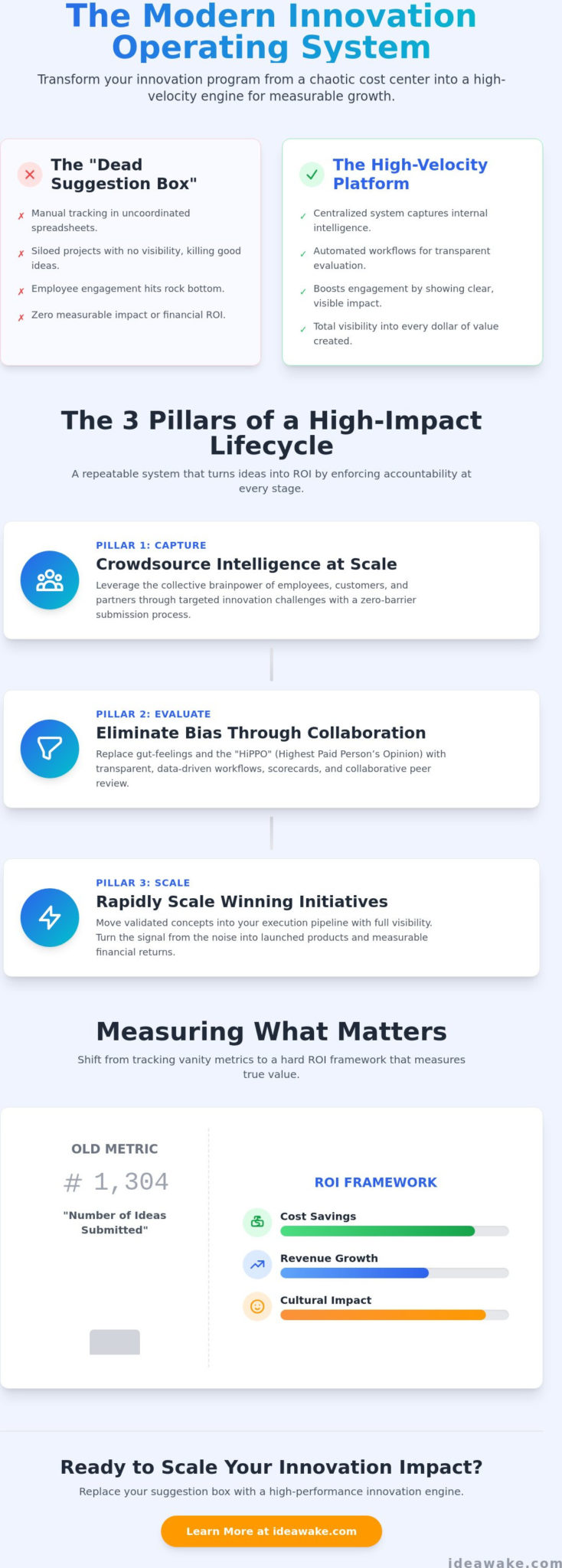
Forget the dusty box in the breakroom. An innovation management platform is a centralized, high-performance engine built to capture and execute internal intelligence at scale. It transforms raw employee insights into measurable financial growth. While the “Dead Suggestion Box” of the past acted as a graveyard for good ideas, the modern platform is a living system that forces accountability and drives action. In 2026, top-down mandates are too slow. Markets move at the speed of light; to survive, you need a bottom-up strategy that empowers those closest to the problems to solve them. This isn’t about being “nice” to employees. It’s about competitive survival in a market that rewards speed and punishes hesitation.

Effective innovation requires three distinct roles working in total sync. Leadership sets the strategic “North Star” to ensure efforts aren’t wasted on trivialities. Managers act as the critical filters, using data-driven workflows to evaluate ideas based on hard evidence rather than gut feelings. Finally, employees provide the boots-on-the-ground execution and the creative spark that keeps the organization ahead of the curve. When these three groups collaborate within a unified system, the result is a repeatable cycle of high-impact growth.

The Shift from Passive Collection to Active Management

Stop waiting for “lightning to strike.” Passive collection is a relic of the pre-digital era. Active management means creating a culture where every employee knows exactly which strategic problems the company needs to solve. When you align individual creativity with corporate objectives, you turn a chaotic brainstorm into a laser-focused strike. What is Innovation Management? It is the disciplined process of turning possibilities into profits. The innovation management platform is the nervous system of an agile organization.

Innovation Management vs. Project Management: Knowing the Difference

Don’t confuse discovery with execution. Project management tools are built to track known tasks with fixed deadlines. They’re excellent at getting things done but terrible at finding out what needs to be done. Innovation management is about discovering unknown opportunities. If you try to force the ideation phase into a rigid project management tool, you’ll suffocate the very creativity you’re trying to foster. These systems must integrate, not compete. You use the platform to find the signal in the noise, then you move the winning initiatives into your execution pipeline. Using the wrong tool at the start is a guaranteed way to ensure your best ideas never see the light of day.

The 3 Critical Pillars of a High-Impact Innovation Lifecycle

Most innovation programs fail because they lack a functional backbone. They start with a burst of creative energy and end in a bureaucratic bottleneck where ideas go to die. To drive massive organizational ROI, you must move beyond ad-hoc brainstorming and implement a repeatable, high-velocity lifecycle. A unified innovation management platform prevents high-potential initiatives from stalling in the middle of the funnel by providing a structured path from the first spark of an idea to the final product launch. Stop settling for disjointed efforts; you need a system that enforces accountability at every stage.

Pillar 1: Crowdsourcing Intelligence at Scale

Scalable idea capture is about more than just having a place to submit thoughts. It’s about leveraging the collective brainpower of your entire ecosystem, including employees, customers, and partners. Instead of waiting for random suggestions, use specialized innovation challenges to point that brainpower at specific, high-stakes business problems. A “zero-barrier” entry point is essential here. If the submission process is difficult, your best people won’t participate. You need to make it as easy as possible for front-line workers to identify inefficiencies that leadership might never see from the boardroom. Building a robust idea management system that removes these barriers is the foundation of any high-performance innovation program.

Pillar 2: Eliminating Bias Through Collaborative Evaluation

The “HiPPO” (Highest Paid Person’s Opinion) is the natural enemy of true innovation. Relying on a single leader’s gut feeling leads to expensive mistakes and missed opportunities. Modern systems use peer-voting and expert scoring to filter the signal from the noise, ensuring that “hidden gem” ideas rise to the top based on merit rather than politics. According to recent Innovation Management Market Trends, the shift toward transparent, data-driven selection is a primary driver of market growth. Automating these evaluation workflows ensures every contributor receives a timely response, which is the single most important factor in maintaining long-term engagement. You can start optimizing your evaluation process today to ensure no profitable idea is ever ignored again.

Pillar 3: From Ideation to ROI Measurement

Bridging the “Innovation Gap” requires a direct link between a good idea and a live implementation. If your ideation system doesn’t talk to your execution tools, you’re just running a high-priced hobby. You must integrate with project management software to track progress post-approval and maintain a constant feedback loop with the original innovator. This transparency keeps the momentum high and allows you to scale your innovation efforts without adding a massive administrative team. By focusing on hard ROI metrics like cost savings and revenue growth, you transform innovation from a vague cultural goal into a predictable financial engine.

The Definitive Guide to Innovation Management Platforms in 2026

Why Modern Platforms Crush Legacy Innovation Software: The AI Advantage

Legacy software is a productivity killer. It’s often disguised as “comprehensive,” but in reality, it’s a labyrinth of complex menus and administrative bloat that takes six months to deploy. By the time you’ve finished onboarding, your market has already shifted. A modern innovation management platform rejects this stagnation. Instead of months of setup, high-performance architecture allows you to go live in weeks. This speed isn’t just a convenience; it’s a competitive weapon. While your competitors are still configuring permissions, you’re already capturing high-impact insights and driving revenue.

The true differentiator in 2026 is the AI force multiplier. Managing a global innovation program used to require a small army of analysts to sift through thousands of submissions. That’s a losing game. Modern tools use machine learning to evaluate ideas 10x faster than any human team. This eliminates the “Administrative Headache” that causes most programs to collapse under their own weight. You don’t need more headcount; you need a smarter system that handles the heavy lifting of data processing while your leaders focus on strategic decision-making.

The AI Revolution in Idea Evaluation

AI has transformed the evaluation phase from a bottleneck into a high-speed pipeline. By using natural language processing, the system can automatically summarize thousands of individual submissions into actionable strategic themes. It also solves the “I’ve heard this before” fatigue through automated duplicate detection, ensuring that evaluators only spend time on truly unique concepts. By leveraging these advanced tools, an organization can reduce its innovation administrative overhead by up to 80%. This shift allows your team to focus on scaling winners rather than managing spreadsheets.

Gamification: Turning Innovation into a High-Performance Sport

Participation isn’t something you can mandate; it’s something you must inspire. Gamification is the engine that drives recurring engagement by tapping into the psychology of competition and recognition. Leaderboards, badges, and prizes aren’t just “fun” additions. They are essential components of a self-sustaining culture. When employees see their names on a leaderboard or receive public recognition for a winning idea, they move from forced participation to intrinsic motivation. This creates a high-energy environment where innovation feels like a high-performance sport rather than another corporate chore. In 2026, if your platform isn’t engaging, it’s invisible.

Measuring What Matters: A Framework for Innovation ROI and Analytics

Counting ideas is for amateurs. If you’re reporting the “number of submissions” to your CFO, you’ve already lost the room. This is the “Vanity Metric Trap.” It creates a false sense of progress while masking a total lack of financial impact. A high-performance innovation management platform must function as a financial ledger, not just a creative outlet. You need to track the hard ROI-revenue growth and cost savings-to justify your seat at the executive table. Organizations that master this framework don’t just see incremental improvements; they achieve 10x returns on their initial investment by identifying and scaling the highest-value opportunities within their workforce. Stop measuring activity. Start measuring impact.

Your innovation pipeline should be visualized as a financial asset. Every idea in the funnel has a potential valuation, and as it moves through evaluation toward implementation, that value becomes more concrete. By the time an initiative reaches the scale-up phase, you should have total visibility into its projected contribution to the bottom line. This level of transparency transforms innovation from a “nice-to-have” cultural perk into a core business driver that leadership can bank on.

Tracking the Full Lifecycle Value

True accountability requires direct attribution. You must be able to link specific revenue gains or operational savings back to the original employee-generated idea. High-impact platforms provide real-time dashboards that allow you to report to the board with absolute confidence. Beyond just the dollar amount, you must track “Time to Implementation” as a critical KPI. In a disrupted market, speed is a currency. If your system takes six months to move a cost-saving measure from approval to execution, you’re bleeding money. Efficiency in the pipeline is just as important as the ideas themselves.

Cultural Impact: The Invisible ROI

While hard numbers win budgets, the soft ROI of innovation is what builds long-term resilience. A centralized platform surfaces “Hidden Talent” across your organization, identifying high-performers who may be stuck in roles that don’t utilize their full potential. This engagement directly correlates with higher employee retention. When people feel their intelligence is valued and their ideas are implemented, they stay. You aren’t just building products; you’re building a change-ready workforce that can pivot instantly when market conditions shift. This cultural resilience is the ultimate competitive advantage. If you’re ready to stop guessing and start measuring, you can calculate your potential innovation ROI and build a bulletproof business case today.

Choosing Your Partner: Why Ideawake is the Disruptive Choice for 2026

Settling for legacy bloatware is a choice to remain stagnant. Most traditional tools are high-friction nightmares that prioritize complex consulting contracts over actual organizational results. Ideawake is the unapologetic, modern alternative. We have engineered a cloud-based innovation management platform that strips away the unnecessary complexity of enterprise software and replaces it with a high-velocity engine designed for immediate impact. If your current system takes months to configure and requires an internal specialist just to launch a simple campaign, you aren’t innovating; you’re just managing overhead. Ideawake is the partner of choice for organizations that value speed, accountability, and the relentless pursuit of measurable financial gain.

Our architecture is built on the principle of zero-complexity. We know that if a tool isn’t intuitive, your employees won’t use it. While competitors hide behind “comprehensive” features that nobody understands, we provide a streamlined, end-to-end capability that handles everything from the initial challenge to the final ROI measurement. This is a system built for the disruptors who are tired of watching high-potential ideas die in a bureaucratic bottleneck. We don’t just provide software; we provide a high-performance framework for total organizational transformation. We have eliminated the administrative friction that kills momentum, allowing you to move from ideation to implementation at a pace that legacy platforms simply cannot match.

Built for the Modern Workforce

Your employees don’t work in a vacuum, and they shouldn’t have to jump through hoops to share a breakthrough idea. Our mobile-first design and Ideawake AI ensure that participation fits seamlessly into the daily workflow. We have eliminated the data-entry burden on administrators by using advanced machine learning to handle the heavy lifting of evaluation and prioritization. This shift allows your leadership team to focus on high-level strategy while the platform identifies the highest-potential ideas with surgical precision. By automating the mundane, we empower your people to do what they do best: solve problems and drive growth. For tech professionals looking to apply this same level of AI-driven efficiency to their personal career management, you can learn more about QuickApply to see how automation is simplifying the application process.

Get Started with a High-Performance Innovation Pilot

You don’t need a year-long roadmap to start seeing results. We believe in proving value fast. With Ideawake, you can launch your first innovation challenge in less than 30 days. This rapid deployment allows you to start small, prove hard ROI with a single high-stakes problem, and then scale the framework across the entire enterprise with total confidence. It is a disciplined, low-risk path to becoming an innovation powerhouse. Don’t let another quarter slip away while your best ideas remain trapped in spreadsheets. Stop wasting potential and start driving results with Ideawake and transform your organization into a high-performance innovation engine today.

Stop Settling for Mediocrity and Start Scaling Impact

The era of the digital suggestion box is officially over. You now possess the high-performance framework required to build a repeatable, high-velocity engine that transforms raw employee intelligence into a permanent competitive advantage. By deploying a modern innovation management platform, you’re choosing to eliminate the administrative friction that has historically killed growth. You’ve seen how AI can slash your workload and how a disciplined ROI framework can turn cultural shifts into hard financial gains. It’s time to stop managing spreadsheets and start leading a revolution.

Ideawake is built for this exact moment. Our system reduces administrative overhead by 80% and provides rigorous, end-to-end ROI tracking from the first spark of an idea to its final implementation. With our AI-driven evaluation engine, you’ll never miss a high-potential opportunity again. Stop watching your competitors move faster while your best ideas remain trapped in a manual funnel. Book a Demo to See How Ideawake Drives 10x Innovation ROI and take control of your organization’s future. Your team’s untapped potential is waiting. Go unlock it.

Frequently Asked Questions

What is the primary benefit of an innovation management platform?

The primary benefit is the ability to scale high-impact internal intelligence and transform it into measurable financial growth. While ad-hoc brainstorming relies on luck, a centralized system creates a repeatable engine for identifying and executing the most profitable opportunities within your workforce. It eliminates the administrative bottlenecks that kill potential breakthroughs, ensuring that your organization remains agile and stays ahead of market disruptions.

How does innovation software differ from a simple suggestion box?

A suggestion box is a graveyard for ideas, while a modern innovation management platform is a high-velocity execution engine. Suggestion boxes lack transparency, feedback loops, and data-driven evaluation, which leads to low engagement and zero impact. In contrast, a modern platform forces accountability through automated workflows, peer-review systems, and clear implementation paths that bridge the gap between a raw concept and a live product.

Can an innovation platform integrate with my existing project management tools?

Yes, seamless integration is critical for moving from discovery to delivery. An innovation platform discovers unknown opportunities, but you need your existing project management tools to execute the known tasks required to launch them. By connecting these systems, you create a unified pipeline that tracks every initiative from the initial spark of an idea through to final implementation and ROI measurement.

How do you measure the ROI of an innovation management system?

You measure ROI by tracking hard financial metrics like cost savings, revenue growth, and operational efficiency gains directly attributed to implemented ideas. High-performance systems provide real-time dashboards that visualize the financial value of your innovation pipeline at every stage. You should also monitor soft ROI, such as employee retention and engagement levels, which contribute to long-term organizational resilience and a more change-ready workforce.

Is AI really necessary for managing employee ideas?

AI is absolutely necessary for any organization that values speed and efficiency in 2026. Manually evaluating thousands of submissions is a losing game that drains resources and causes delays. Tools like Ideawake AI act as a force multiplier, using machine learning to summarize themes, detect duplicates, and prioritize high-potential concepts 10x faster than a human team. It’s the only way to scale without adding massive administrative headcount.

How long does it take to implement a modern innovation platform?

A modern, cloud-based system can be fully operational in weeks, not the six-month timelines typical of legacy enterprise software. The key is a zero-complexity architecture that allows you to launch your first high-stakes innovation challenge in less than 30 days. Starting with a targeted pilot allows you to prove ROI quickly and then scale the framework across the entire organization with total confidence.

What features should I look for in an enterprise-grade idea platform?

Look for SOC 2 compliance, an open API for easy integrations, and robust AI-driven evaluation engines. You need a platform that supports complex workflows but remains intuitive enough for rapid user adoption. Essential features also include gamification elements like leaderboards and badges to drive recurring engagement, alongside advanced analytics that provide total visibility into your program’s financial impact and time-to-implementation.

How do we ensure high employee engagement in our innovation challenges?

High engagement is driven by transparency and the psychological power of gamification. Employees need to see that their ideas are actually evaluated and implemented, or they’ll stop contributing. Use specific innovation challenges to point their brainpower at relevant business problems, and reward participation with public recognition and leaderboards. When you move from forced participation to intrinsic motivation, your innovation culture becomes self-sustaining and high-energy. For a deeper dive into building this kind of high-participation culture, explore our complete guide to mastering the modern idea management system and learn how to link employee creativity directly to your bottom line.