
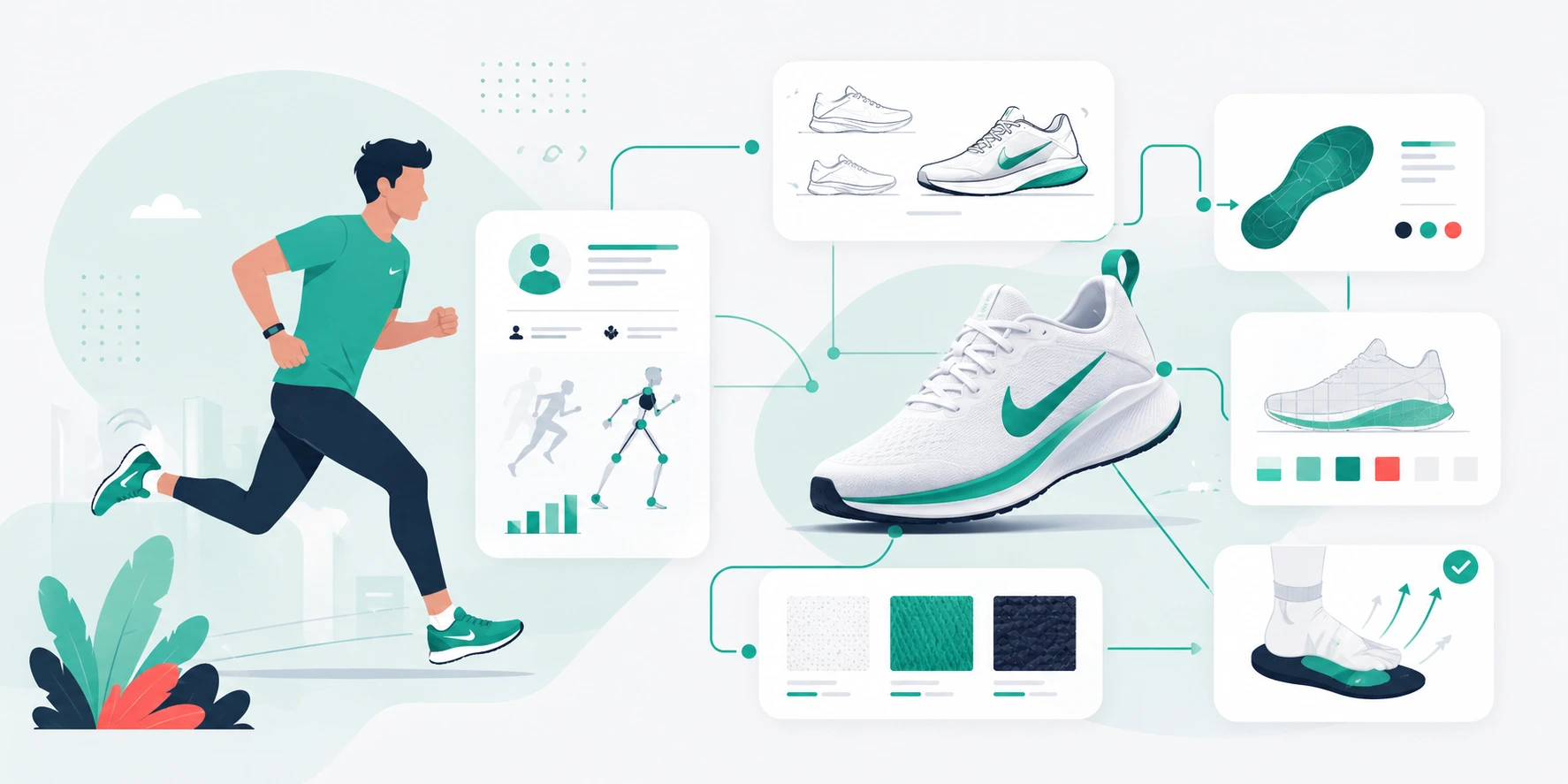
Nike is often described as an innovative brand, but that label can be a little too vague to be useful. Plenty of companies launch new products. What makes Nike worth studying is not just that it creates new things. It is that Nike has built a system for turning athlete insight into products that can survive testing, internal handoffs, manufacturing realities, and commercial pressure.
That distinction matters for innovation leaders. The hardest part of innovation is rarely the brainstorm itself. The hard part is preserving the original insight, refining the idea under real constraints, and then moving it into the business without losing momentum, context, or ownership. Nike’s process is useful because it shows what that looks like inside a large, complex company.
Nike’s public messaging now makes that system even more explicit. In October 2025, the company announced a new athlete-focused creation engine that united Innovation, Design, and Product across Nike, Jordan Brand, and Converse so teams could share insights, technology, and methods of make throughout the innovation process.
That is not just an org-chart change. It is a signal that Nike sees innovation as a connected operating model, not a standalone R&D function.
Idea Management Made Simple
Turn Your Team’s Ideas Into Measurable Impact
Capture ideas, streamline evaluation with AI, and turn promising opportunities into action. See how Ideawake can support your innovation or continuous improvement program.
Free trial includes onboarding. No credit card required.
Why Nike’s Innovation Process Is Worth Studying
Nike is a strong case study because it combines three things many companies struggle to connect. First, it starts with real user problems rather than abstract technology exploration. Second, it invests heavily in structured research and testing. Third, it pays unusual attention to what happens between idea creation and business adoption. Those middle stages are where many promising ideas die.
The company’s athlete-first language is not cosmetic. Nike’s leadership says everything begins and ends with the athlete’s voice, and its research infrastructure is designed to make that principle tangible. The Nike Sport Research Lab, housed in the LeBron James Innovation Center, includes the world’s largest motion-capture installation with 400 cameras, 97 force plates, body-mapping equipment, and environmental chambers that simulate a wide range of conditions.
How Nike’s Innovation Process Works In Simple Terms
At a high level, Nike’s process is not mysterious. The company listens closely to athlete needs, studies movement and performance in controlled and real-world settings, prototypes aggressively, and refines products until they are ready to move beyond the innovation team. What makes the system effective is how tightly those stages connect.
Insight Comes First
Nike’s research tools are built to understand athletes in a detailed, practical way. Its NSRL Baseline testing includes a 3D body scan, foot scan, barefoot pressure test, ankle range-of-motion test, and countermovement jumps. Those assessments borrow from biomechanics, physical therapy, and exercise science, which gives Nike a deeper view of how athletes move before design decisions are made.
Concepts Get Tested Under Real Constraints
Nike does not stop at idea generation. It studies movement, pressure, thermoregulation, and performance in spaces like the NSRL Fieldhouse Track and environmental chambers, then uses that data to refine products. The company’s NSRL Form tool also shows how Nike combines motion capture with a self-learning algorithm to translate movement data into practical guidance, collecting about 150 data points across the body in roughly 15 seconds.
Handoffs Matter As Much As Invention
One of the clearest lessons from Nike’s process is that innovation is not complete when a prototype works. The operational challenge is the handoff: transferring accountability, preserving the original consumer insight, and preparing downstream partners long before the formal transition happens. That is where Nike seems especially disciplined.
Lesson 1 — Start With The User, Not The Technology
Many innovation teams begin with a capability and then go looking for a problem to attach to it. Nike pushes in the opposite direction. Its official innovation messaging centers on the athlete’s goals, struggles, and performance needs.
Even the company’s newer platforms, like Aero-FIT, Nike Mind, and Project Amplify, are framed around specific problems such as cooling, sensory response, and helping everyday athletes move farther with less effort.
That is a valuable discipline for any company. User-centered innovation sounds obvious, but in practice many organizations get distracted by trends, internal politics, or the excitement of a new tool. Nike’s process is a reminder that a strong innovation system starts with a pain point sharp enough to justify the work that follows.
Companies that want to make that repeatable usually need a clearer idea management process so user insight does not get lost between capture and action.
Lesson 2 — Build A Real Research Engine Around Insight
There is a big difference between saying you listen to users and building a machine for listening well. Nike has done the second. The NSRL is not a symbolic lab. It is an operational asset that helps Nike study movement, climate, force, pressure, and fit at a level most companies cannot match. That gives product teams something far more useful than vague customer feedback. It gives them structured evidence.
The broader lesson is that innovation becomes repeatable when insight collection is institutionalized. Companies that rely on occasional workshops or one-off interviews may still produce good ideas, but they struggle to do it consistently.
Nike’s advantage comes from turning research into infrastructure instead of treating it as a side activity. The same principle applies when building a stronger idea management system that gives teams one place to capture context, compare ideas, and move promising work forward.
Lesson 3 — Unify Innovation, Design, And Product Early
Nike’s 2025 move to unite Innovation, Design, and Product across its major brands is one of the clearest signals of how the company thinks about speed and scale. The stated goal was to help teams share insights, technology, and methods of make throughout the innovation process. In other words, Nike is reducing the distance between discovery and execution.
This matters because siloed innovation is one of the most common reasons good ideas stall. A concept can look exciting in a lab or strategy deck, then lose force when design, merchandising, product, and business teams encounter it too late.
Nike’s structure suggests that alignment is not something you save for the end. It is something you design in early so the path to market is less fragile. That same logic matters in an idea management program where roles, workflows, and decision-makers need to be clear before the process gets crowded.
Lesson 4 — Prototype Aggressively, Then Let Constraints Improve The Idea
Nike’s Flyknit story is a strong example of disciplined iteration. The company says Flyknit was informed by decades of athlete insights and engineered to place support, flexibility, and breathability where athletes need them most.
It also produces about 60 percent less waste than traditional cut-and-sew methods, which shows how Nike tied performance and sustainability together instead of treating them as separate goals.
This is a useful reminder that strong innovation does not avoid constraints. It uses them. Manufacturing limits, material efficiency, fit, comfort, and sustainability pressure can force teams to sharpen an idea until it becomes more commercially viable. The point is not to protect a concept from reality. The point is to improve it through reality. That is also why stronger teams spend more time deciding which ideas deserve resources, which is where innovation portfolio management becomes more than a planning exercise.
Lesson 5 — Transfer The “Why,” Not Just The Prototype
One of the strongest insights from Nike’s handoff model is that downstream teams need more than a finished concept. They need the intent behind it. Handoffs work better when the receiving team understands the customer problem, the design logic, and the commercial rationale well enough to carry the work forward.
This is where many organizations quietly fail. A prototype gets passed over with slides, specs, and excitement, but the original insight does not survive the transition. Once that happens, the idea becomes easier to deprioritize, simplify, or misunderstand. Nike’s process suggests that preserving context is not a soft skill. It is part of execution. Teams trying to do that more consistently usually need better habits around how they implement innovative ideas after the initial excitement fades.
Lesson 6 — De-Risk With Data And Judgment, Not Data Alone
Nike clearly values data, but its process does not treat data as a substitute for design judgment. The company uses movement analysis, lab testing, and research tools to reduce uncertainty, yet its products still have to make sense as athlete experiences and as market-ready offerings. That balance matters because handoffs and decisions involve trust, timing, and human judgment, not just metrics.
Organizations often swing too far in one direction. Some rely too heavily on scoring models and kill promising ideas too early. Others rely too much on intuition and move forward without enough evidence. Nike’s process works better as a model because it combines rigorous inputs with experienced decision-making. Put simply, data can sharpen the conversation, but it rarely replaces it.
Lesson 7 — Design The Path To Scale Before The Handoff Happens
Perhaps the most transferable lesson from Nike is that scale readiness begins early. The company’s approach emphasizes building trust with downstream partners long before a formal handoff. That approach recognizes a simple truth: ideas do not succeed just because they are good. They succeed because the organization is ready to absorb them.
This may be the most relevant lesson for enterprise innovation teams. The innovation bottleneck is often not creativity. It is organizational readiness. If ownership, incentives, roadmaps, and decision rights are unclear, even strong ideas can die during transition.
Nike’s process suggests that commercialization starts earlier than many teams think. It also reinforces a simple truth echoed in what makes an idea great: quality is only half the battle if the system around the idea is weak.
Idea Management Made Simple
Turn Your Team’s Ideas Into Measurable Impact
Capture ideas, streamline evaluation with AI, and turn promising opportunities into action. See how Ideawake can support your innovation or continuous improvement program.
Free trial includes onboarding. No credit card required.
What Innovation Leaders Can Borrow From Nike
Nike’s process is obviously shaped by sport, apparel, and consumer product development, but the underlying lessons travel well. Preserve original user insight. Build stronger research inputs. Involve downstream teams earlier.
Treat handoffs as accountability transfers. And design for scale before the organization is forced to make a rushed adoption decision. Those are not sneaker lessons. They are operating-model lessons.
Innovation is rarely lost because nobody had an idea. It is lost because context disappears, ownership gets fuzzy, and the process between submission and implementation is weak.
That is why companies need systems that make ideas visible, structured, and easier to move across the business once they are worth pursuing.
Nike also shows why modern innovation work cannot stay trapped inside one team. The company’s newer innovation engine is explicitly designed to share insights, technology, and methods across functions and brands. The ideas that create impact are usually the ones that travel well across the business, not the ones that stay admired inside a single group.
Final Thoughts
Nike’s innovation process is impressive because it makes innovation feel less mystical and more operational. Athlete insight is gathered systematically. Research is institutionalized. Prototypes are refined under real constraints.
Handoffs are treated seriously. And the path to scale is considered before the work is thrown over the wall. That combination is what turns invention into impact.
That is the real lesson for innovation leaders. Great ideas do not create value on their own. Systems do. Nike’s example is useful not because every company should imitate its lab or product portfolio, but because every company can learn from the discipline it applies between user insight and market reality.