
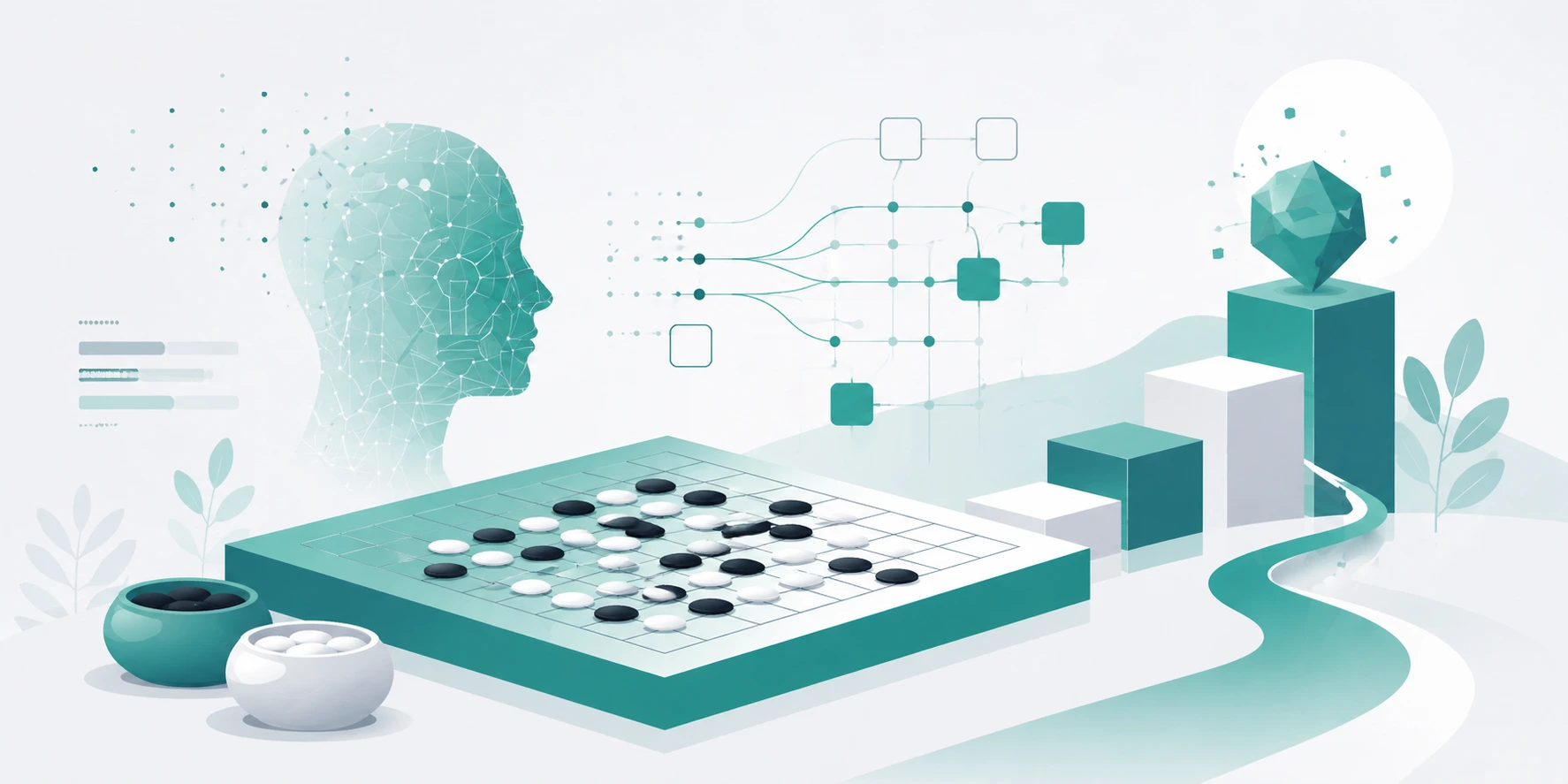
Ten years later, AlphaGo still matters for a reason that goes beyond AI history. It did not just beat Lee Sedol at Go in 2016. It showed the world that a well-designed system can search a huge possibility space, learn faster than expected, and produce a move experts did not see coming.
That is why AlphaGo remains one of the clearest modern examples of how breakthrough innovation actually happens.
Most companies already have smart people, useful ideas, and real opportunities to improve. What they often lack is a better process for capturing insight, refining it, evaluating it fairly, and moving the best ideas forward before momentum dies.
AlphaGo is a powerful reminder that innovation is rarely just about brilliance. More often, it is about building a system that can learn, test, and improve faster.
Why AlphaGo Was A Turning Point
To understand why AlphaGo changed the conversation, it helps to remember what Go represented. For decades, Go was treated as one of the hardest grand challenges in AI because of its enormous search space and the difficulty of evaluating board positions.
Then AlphaGo defeated European champion Fan Hui 5–0 in 2015, the first time an AI system beat a professional Go player on a full-sized board without handicap, and followed that by beating Lee Sedol 4–1 in Seoul in 2016.
What made the moment unforgettable was not only the win. It was Move 37 in game two against Lee Sedol. DeepMind’s 2026 retrospective describes it as a move that signaled something deeper:
AI was not only becoming strong, it was becoming capable of surprising human experts with valuable, creative-looking choices. DeepMind says that single play helped catalyze the belief that these methods could be used far beyond games.
How DeepMind Actually Built AlphaGo
The most useful part of the AlphaGo story is the process behind it. DeepMind did not arrive at a breakthrough by waiting for one genius idea to appear. It built AlphaGo in layers, each one strengthening the system’s ability to learn and make better decisions under uncertainty. That is the part innovation leaders should pay attention to.
It Started With Human Expertise
AlphaGo did not begin from zero. According to DeepMind, one part of the system was trained on expert human games so it could learn which moves strong players were likely to make in a given position. In business terms, that is an important lesson. Breakthrough innovation often starts by absorbing what top performers already know instead of pretending expertise does not matter.
Then It Learned Through Self-Play
After learning from human examples, AlphaGo improved through reinforcement learning and self-play. It repeatedly played games against versions of itself, learned from outcomes, and got stronger through those feedback loops. That is one reason the story is so relevant to innovation process design. Deep progress came from repeated testing and learning, not from a one-time ideation session.
Then It Searched Smarter, Not Harder
AlphaGo also used a policy network to suggest promising moves, a value network to estimate likely outcomes, and search methods to focus attention on better paths rather than blindly exploring everything. This matters because the system’s advantage did not come from looking at every option equally. It came from becoming much better at narrowing the field and concentrating effort where upside was highest.
The Innovation Process Behind AlphaGo
If you strip away the technical language, AlphaGo’s innovation process becomes surprisingly practical. It built on expert knowledge, created rapid learning loops, filtered noise out of a massive search space, and kept improving the process that generated decisions. That is not just an AI pattern. It is a strong general model for how modern innovation works.
Great Innovation Rarely Starts From Chaos
Companies sometimes romanticize innovation as a lightning strike. AlphaGo shows the opposite. DeepMind started with a hard problem, used known expert behavior as a foundation, then created a system that could move beyond that foundation. The lesson for leaders is simple: innovation does not become more original by ignoring existing knowledge. It becomes more powerful when you build on what is already known and then extend it systematically.
Feedback Loops Matter More Than Brainstorming Theater
AlphaGo improved because it had a tight loop between action and feedback. That is also what separates innovation programs that produce results from those that produce slide decks. If ideas are collected and then left idle, the system stalls. If ideas are refined, evaluated, tested, and fed back into the process, the quality of output improves over time. That is why an effective innovation process matters more than occasional bursts of enthusiasm.
The Best Systems Protect Non-Obvious Ideas
Move 37 became famous because it looked wrong before it looked brilliant. DeepMind’s retrospective says it had roughly a 1-in-10,000 chance by conventional expectations, which is part of why it shocked commentators and players. That is an innovation lesson in plain sight. Valuable ideas are not always the ones that look safest on first review. A strong process does not reward novelty for its own sake, but it does give unusual ideas enough space to be considered properly.
How AlphaGo Changed The World
AlphaGo’s impact reached beyond the board because it changed what researchers, business leaders, and the public believed AI could do. DeepMind now describes AlphaGo as the beginning of the modern era of AI and explicitly connects its search-and-learning techniques to later systems like AlphaFold, AlphaProof, and AlphaEvolve. Whether or not one agrees with every part of that framing, it is clear that AlphaGo shifted ambition.
It Changed How People Thought About AI
Before AlphaGo, many people still saw AI mainly as pattern recognition, classification, or rule-following at scale. AlphaGo showed a system that could operate effectively in a domain famous for intuition, strategic depth, and combinatorial complexity. That did not make it human, but it did expand the sense of what machine learning systems could plausibly contribute to discovery and decision-making.
It Changed How Go Is Studied And Played
The influence was not just symbolic. Research on human Go players after AlphaGo found measurable changes in play and training patterns once AI-based strategies entered the ecosystem. In other words, the innovation did not stop at winning. It changed how experts learned, prepared, and thought about the game itself. That is what world-changing innovation often does. It rewrites the process around the field, not just the outcome in one moment.
It Helped Open The Door To Scientific Discovery Systems
DeepMind’s own telling of the AlphaGo legacy points directly to AlphaFold. DeepMind says the methods and mindset behind AlphaGo helped pave the way for systems that now support scientific discovery. AlphaFold has since been used to predict millions of protein structures, with DeepMind saying its 2022 database expansion alone pushed predictions beyond 200 million structures. That is a remarkable leap from game-playing to real-world scientific utility.
What Companies Should Borrow From AlphaGo
Most organisations are not trying to build a Go engine or a scientific discovery system. But the AlphaGo story still offers a blueprint for how to run innovation better. The lesson is not “use AI everywhere.” The lesson is “design a system that helps good ideas become stronger, surfaces non-obvious opportunities, and shortens the time from input to action.”
Build A System, Not A One-Off Idea Campaign
AlphaGo did not emerge from a single contest or isolated experiment. It came from a sustained process with learning loops, clear objectives, and continuous improvement. Companies should think the same way. A workshop, hackathon, or suggestion box can generate energy, but without structure those ideas go nowhere. That is why companies benefit from a stronger idea management system and a repeatable idea evaluation process rather than relying on ad hoc review.
Improve Weak Ideas Before You Reject Them
One underrated lesson from AlphaGo is that strong systems do not just rank ideas. They help improve them. DeepMind used training stages, feedback, and repeated learning to strengthen the system over time. In an organisation, that translates into taking rough employee, customer, or partner ideas and helping shape them into something more decision-ready. This is where AI can be useful, not as a gimmick, but as a way to clarify, cluster, and sharpen submissions before they are judged too quickly.
Create Room For Surprising Answers
The most valuable idea in a company is not always the one that sounds most polished in the first meeting. Sometimes the high-impact idea is the one that looks slightly strange, comes from an unexpected part of the business, or cuts across established assumptions. AlphaGo’s Move 37 is a reminder that innovation systems should not only be fair and efficient. They should also be capable of noticing uncommon but promising moves.
How Ideawake Helps You Hasten The Innovation Process
This is where the AlphaGo lesson becomes practical for real organisations. Most companies are not short on ideas. They are short on a process that can capture ideas at scale, reduce duplicate noise, improve weak submissions, route ideas for fair review, and move the strongest concepts toward action before they lose relevance. That is exactly the bottleneck Ideawake is built to solve.
Ideawake helps organisations collect ideas from employees, customers, and partners in one place, evaluate them with more structure, and move them through a visible workflow instead of burying them in spreadsheets or email threads. That means less time spent manually sorting and chasing, and more time actually developing ideas that deserve attention. The result is a faster path from raw input to meaningful decision.
It also makes AI useful in the right place. Instead of treating AI as a flashy overlay, Ideawake’s positioning is closer to the AlphaGo lesson: use intelligence to improve the process itself. Use it to strengthen how AI is accelerating innovation, to support clearer evaluation, and to help teams implement innovative ideas rather than just admire them. That is how innovation starts moving faster without becoming chaos.
Final Thoughts
AlphaGo changed the world because it revealed more than a technical milestone. It showed what becomes possible when you combine expert knowledge, disciplined experimentation, rapid feedback, and a system that can find strong paths through overwhelming complexity. That is why it still matters ten years later. It was a lesson in innovation process as much as a lesson in AI.
The same principle applies inside companies now. Better innovation does not come from asking for more ideas and hoping for magic. It comes from building a process that helps people contribute, improves what they submit, evaluates it fairly, and moves the best ideas forward while they still matter. That is the bridge from AlphaGo to Ideawake, and it is a useful one because it turns a famous AI story into an operational lesson leaders can actually use