
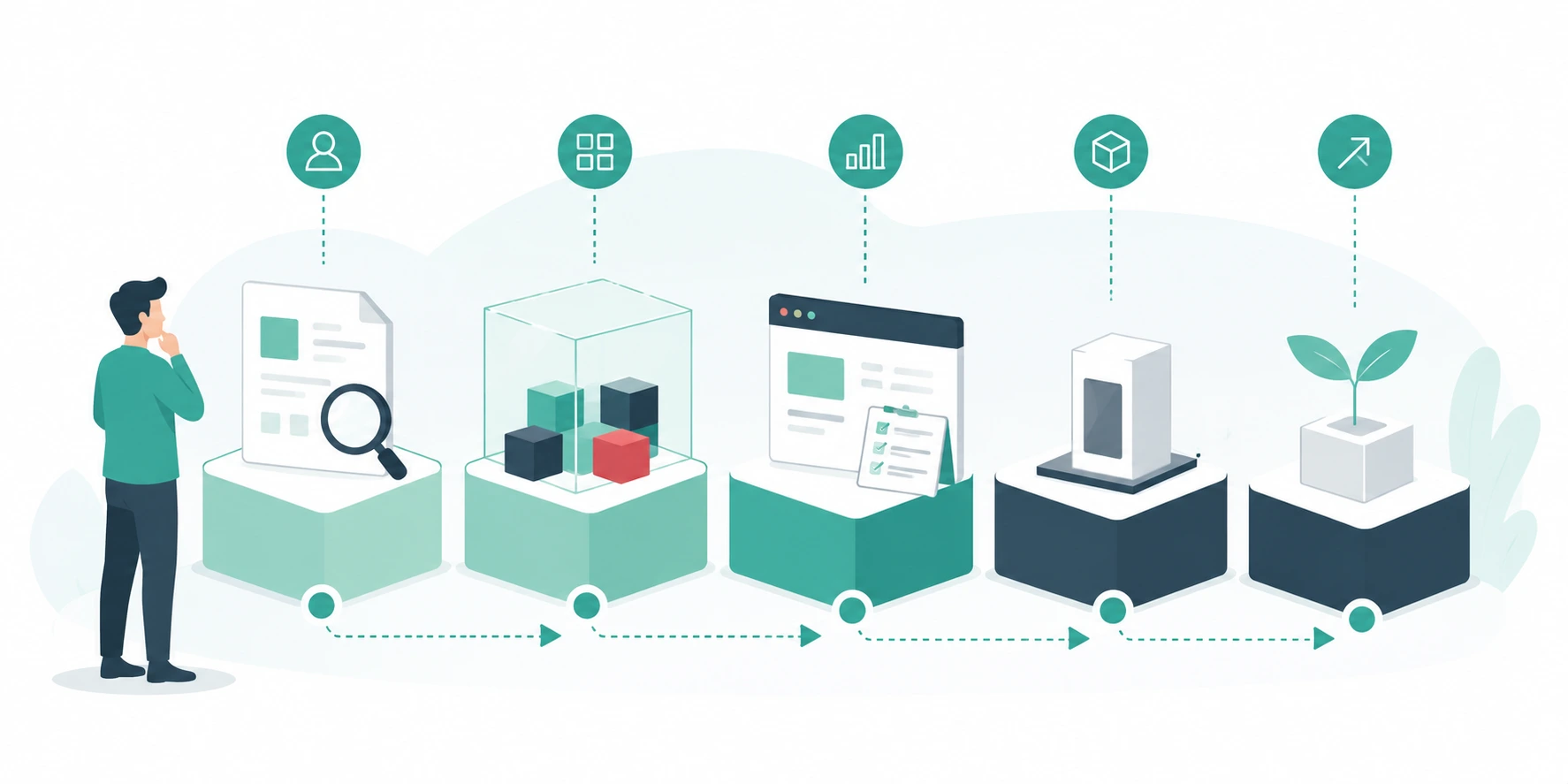
Every strong innovation starts as an unfinished thought. It may come from a customer complaint, an employee suggestion, a market shift, or a process that takes too long. Idea development is the process that turns that early thought into something clear, tested, prioritized, and ready to implement.
Without structure, ideas often stay scattered across meetings, spreadsheets, inboxes, or Slack threads. Some get ignored. Others move forward because the loudest person supports them, not because they have the strongest evidence. A clear idea development process helps organizations separate useful ideas from weak ones and move the best opportunities toward measurable impact.
What Is Idea Development?
Idea development is the structured process of improving, testing, and preparing an idea for action. It includes everything that happens after an idea first appears: evaluation, refinement, validation, prioritization, implementation, and optimization.
The goal is not to make every idea successful. The goal is to create a repeatable system for learning which ideas deserve time, funding, and ownership.
Idea Development Vs Idea Generation
Idea generation is the act of creating ideas. It can happen through brainstorming, customer feedback, employee suggestions, innovation challenges, or market research.
Idea development goes further. It asks whether the idea solves a real problem, fits the organization’s strategy, can be executed with available resources, and has enough value to justify the work. In simple terms, idea generation creates options. Idea development turns the right options into action.
Why Idea Development Matters In Business
Businesses do not fail from having too few ideas. They often fail because ideas are not evaluated or developed properly. A promising suggestion can disappear because no one owns the next step. A weak idea can consume budget because no one tested the assumptions early enough.
A strong idea development process helps teams reduce waste, make better decisions, and increase participation. Employees are more likely to contribute when they know their ideas will be reviewed fairly and moved through a visible process.
Idea Management Made Simple
Turn Your Team’s Ideas Into Measurable Impact
Capture ideas, streamline evaluation with AI, and turn promising opportunities into action. See how Ideawake can support your innovation or continuous improvement program.
Free trial includes onboarding. No credit card required.
Stage 1 — Problem Identification And Opportunity Framing
Before a team starts brainstorming, it needs to understand the problem. A clear problem statement improves idea quality because it gives people direction.
If the problem is vague, the ideas will be vague too. “Improve customer experience” can mean anything. “Reduce onboarding time for new customers from 14 days to 5 days without adding manual support work” gives the team something specific to solve.
Define The Problem Before Creating Solutions
Good ideas usually begin with strong problem discovery. Teams should look at customer pain points, employee feedback, support tickets, operational bottlenecks, sales objections, and market gaps.
The goal is to identify where value is being lost. That might mean customers are leaving during onboarding, employees are spending hours on manual reporting, or a competitor is solving a problem faster.
Set Clear Goals And Success Criteria
A useful idea development process starts with measurable outcomes. Teams should define what success looks like before solutions are proposed.
Success may mean reducing cost, increasing revenue, improving customer satisfaction, shortening cycle time, reducing risk, or improving employee engagement. These goals make it easier to evaluate ideas later.
Stage 2 — Idea Generation
Once the problem is clear, the next stage is idea generation. This is where teams create a pool of possible solutions.
The best idea generation is focused. Instead of asking for random suggestions, organizations should ask people to solve defined challenges tied to business priorities.
Common Idea Generation Techniques
Teams can use brainstorming, mind mapping, SCAMPER, customer interviews, trend analysis, employee suggestion programs, and structured innovation challenges.
SCAMPER is useful because it pushes teams to think in different directions: substitute, combine, adapt, modify, put to another use, eliminate, or rearrange. These prompts help people move beyond obvious answers.
Sources Of Strong Business Ideas
Strong ideas can come from many places. Frontline employees often see inefficiencies before leadership does. Customers reveal friction through complaints, support requests, and buying behavior. Sales teams know where prospects hesitate. Operations teams know where time and resources are wasted.
A mature idea development process does not rely on one source. It creates channels for employees, customers, partners, suppliers, and leadership to contribute useful input.
How To Avoid Low-Quality Ideation
Low-quality ideation usually comes from unclear prompts. If a company asks, “What ideas do you have?” it may receive broad, disconnected suggestions.
A better prompt is tied to a problem: “How can we reduce customer onboarding time without increasing support workload?” This helps contributors focus on ideas that are relevant, practical, and easier to evaluate.
Stage 3 — Initial Screening And Idea Evaluation
After ideas are collected, they need to be reviewed. Evaluation prevents teams from moving forward based on enthusiasm alone.
This stage does not need to be slow or complicated. Early evaluation should be lightweight enough to keep momentum but structured enough to filter weak ideas.
Evaluation Criteria For Business Ideas
Strong evaluation criteria usually include strategic fit, customer value, feasibility, business impact, cost, risk, timeline, and resource needs.
Strategic fit asks whether the idea supports current business priorities. Feasibility asks whether the organization can realistically execute it. Business impact asks whether the idea is worth the effort.
Scoring Ideas Without Killing Creativity
Scoring should help decision-making, not discourage creativity. Teams can use simple rating scales to compare ideas consistently.
For example, an idea may be scored on impact, feasibility, and urgency. This creates a shared language and reduces bias. It also helps contributors understand why one idea moves forward while another is parked or rejected.
Common Mistakes During Evaluation
A common mistake is choosing ideas based on seniority. If the most senior person’s idea always wins, employees stop participating.
Another mistake is overvaluing novelty. A new idea is not automatically a valuable idea. Some of the best innovations are practical improvements to existing products, processes, or services.
Stage 4 — Idea Refinement And Concept Development
Once an idea passes initial screening, it needs refinement. A raw idea is often incomplete. It may describe a solution but not the problem, cost, user, or risk.
Refinement turns a rough suggestion into a clear concept that can be tested.
Turn A Raw Idea Into A Clear Concept
A strong concept explains who the idea is for, what problem it solves, how the solution works, what value it creates, and what assumptions need testing.
For example, “create a customer portal” is a raw idea. A refined concept would explain which customers need it, what tasks the portal will support, how it reduces support tickets, what data it requires, and what success metrics will be tracked.
Gather Feedback From The Right Stakeholders
Refinement should include input from people who understand the customer, the technology, the cost, and the operational impact.
That may include customers, frontline employees, finance, operations, IT, compliance, product teams, and leadership. Early feedback helps uncover constraints before the organization invests too much time.
Build A Basic Concept Brief
A concept brief does not need to be long. It should include the problem, target audience, proposed solution, expected benefit, key assumptions, required resources, risks, and next test.
This brief becomes the foundation for validation and prioritization.
Stage 5 — Validation And Testing
Validation is where an idea meets evidence. This stage helps teams determine whether the idea works in the real world before full implementation.
Skipping validation is one of the fastest ways to waste resources. Teams may build something that people do not want, cannot use, or will not pay for.
Test Before Full Implementation
Testing can take many forms. Teams may use prototypes, mockups, surveys, interviews, MVPs, simulations, or small-scale pilots.
The right test depends on the idea. A process improvement might be tested with one department. A product feature might be tested with a prototype. A customer experience idea might be tested through interviews or a limited pilot.
Validate Desirability, Feasibility, And Viability
A strong idea should pass three basic tests. Desirability asks whether people want or need it. Feasibility asks whether the organization can build and operate it. Viability asks whether the business case makes sense.
An idea can fail any of these tests. Customers may like it, but the cost may be too high. The technology may work, but the operational burden may be unrealistic.
Use Feedback To Improve Or Stop The Idea
Stopping an idea is not a failure if it prevents wasted investment. Validation should help teams improve strong ideas and stop weak ones early.
The worst outcome is continuing because time has already been spent. Idea development works best when evidence, not sunk cost, guides the next decision.
Stage 6 — Idea Selection And Prioritization
After validation, teams need to decide what moves forward. Not every validated idea can be implemented at once.
Selection and prioritization help organizations match ideas with strategy, capacity, and timing.
Prioritize Ideas Based On Evidence
Ideas should be prioritized using evidence from evaluation and testing. Teams can use scoring models, impact-effort matrices, portfolio fit, strategic urgency, and resource availability.
The strongest ideas are not always the biggest ideas. Sometimes a small operational improvement can deliver faster value than a complex transformation project.
Balance Quick Wins And Strategic Bets
A healthy innovation pipeline includes both quick wins and longer-term opportunities. Quick wins build momentum and show progress. Strategic bets help the organization prepare for future growth.
The right balance depends on business goals, budget, and risk tolerance.
Decide What Moves Forward
At this stage, ideas can be approved, revised, parked, rejected, or combined with other ideas.
Clear decision categories help avoid confusion. A parked idea is not necessarily bad. It may simply be the wrong time, or it may need more evidence before moving forward.
Stage 7 — Implementation Planning
Once an idea is selected, it needs a practical execution plan. This is where many ideas lose momentum.
A good implementation plan turns the idea into defined work, with ownership, resources, milestones, and communication.
Assign Ownership And Resources
Every approved idea needs an accountable owner. Without ownership, ideas drift.
Teams should define who is responsible for execution, who supports the work, what budget is available, what tools are needed, and what timeline is realistic.
Create A Roadmap For Execution
The roadmap should include milestones, dependencies, launch requirements, risks, and review points.
For product ideas, this may include development, QA, launch, and customer communication. For process ideas, it may include workflow design, training, documentation, and adoption support.
Prepare For Change Management
Even good ideas fail when people are not prepared to use them. Implementation planning should include stakeholder communication, training, and adoption support.
If a new process saves time but employees do not understand it, the value will not be realized.
Stage 8 — Launch, Measurement, And Optimization
Implementation is not the end of idea development. Once an idea launches, teams need to measure results and improve the solution.
This stage closes the loop between idea and impact.
Track Performance Against The Original Goal
Teams should measure the idea against the success criteria defined at the beginning.
Common KPIs include adoption rate, ROI, revenue impact, cost savings, cycle time, customer satisfaction, employee engagement, support volume, or error reduction.
Improve The Idea After Launch
Most ideas need adjustment after launch. User feedback, performance data, and operational results reveal what needs to change.
Optimization may include simplifying the process, improving communication, adding features, removing friction, or scaling the solution to more teams.
Capture Learnings For Future Ideas
Post-launch reviews help improve the next idea development cycle. Teams should document what worked, what failed, what assumptions were wrong, and what should change next time.
This builds organizational learning and makes future innovation more efficient.
Idea Development Example In Business
A practical example makes the stages easier to understand. Imagine a company wants to improve customer onboarding because new customers take too long to become active.
The problem is framed clearly: onboarding takes 14 days, support teams are overloaded, and customers are losing momentum. During idea generation, employees suggest better email sequences, a self-service portal, clearer documentation, and automated progress reminders.
The team evaluates each idea based on impact, feasibility, and cost. The self-service portal scores highest but needs refinement. The concept is developed into a guided onboarding hub with task checklists, help articles, and progress tracking.
Before full implementation, the company pilots the portal with one customer segment. Feedback shows that customers like the checklist but still need live support at two points. The team improves the portal, adds support triggers, and launches it more broadly.
After launch, the company tracks onboarding time, support tickets, customer satisfaction, and activation rate. If onboarding time drops from 14 days to 6 days, the idea has created measurable value.
Idea Management Made Simple
Turn Your Team’s Ideas Into Measurable Impact
Capture ideas, streamline evaluation with AI, and turn promising opportunities into action. See how Ideawake can support your innovation or continuous improvement program.
Free trial includes onboarding. No credit card required.
How Idea Development Connects To Innovation Management
Idea development works best when it is part of a broader innovation management system. Without a system, even strong ideas can get lost.
This is where Ideawake fits naturally. Ideawake helps organizations capture ideas in one place, evaluate them with transparent criteria, collaborate across teams, and track progress from submission to implementation. Its idea management software supports structured workflows, scoring, prioritization, and reporting so teams can move from participation to measurable business outcomes. For companies trying to improve employee innovation, operational efficiency, or continuous improvement, this structure helps turn scattered suggestions into a managed innovation pipeline.
Common Idea Development Mistakes
Many idea development problems are avoidable. The first mistake is starting with solutions instead of problems. When teams jump too quickly to answers, they may solve the wrong issue.
Another mistake is asking for ideas without giving direction. Open-ended suggestion programs often create too much noise. Clear challenges tied to business goals create better input.
Skipping evaluation criteria is also risky. Without shared criteria, decisions can feel subjective or political. Moving too quickly into implementation creates another problem: teams may spend time and budget before testing whether the idea is desirable, feasible, and viable.
Finally, many teams fail to track results after launch. If outcomes are not measured, it becomes impossible to know whether the idea worked.
Conclusion
Idea development is the bridge between creativity and execution. It gives teams a clear way to move from raw concepts to tested, prioritized, and implemented outcomes.
The strongest organizations do not rely on random inspiration. They build a repeatable process for finding problems, generating ideas, evaluating options, testing assumptions, and measuring results. When idea development is structured, innovation becomes easier to manage, easier to scale, and easier to connect to real business impact.
FAQs About Idea Development
What Are The Core Stages Of Idea Development?
The core stages are problem identification, idea generation, initial evaluation, refinement, validation, prioritization, implementation planning, launch, measurement, and optimization.
What Is The Difference Between Idea Generation And Idea Development?
Idea generation is the process of creating ideas. Idea development is the broader process of improving, testing, prioritizing, and implementing those ideas.
What Are Examples Of Idea Development In Business?
Examples include improving customer onboarding, developing a new product feature, reducing manual reporting, launching an employee engagement program, or redesigning a service process.
How Do You Evaluate A New Idea?
A new idea can be evaluated using criteria such as strategic fit, customer value, feasibility, business impact, cost, risk, timeline, and required resources.
What Tools Help With Idea Development?
Common tools include idea management software, scoring models, innovation dashboards, collaboration platforms, surveys, prototypes, and pilot programs.
Why Do Ideas Fail During Development?
Ideas often fail because the problem is unclear, validation is weak, ownership is missing, resources are limited, stakeholders are not aligned, or success criteria are never defined.