
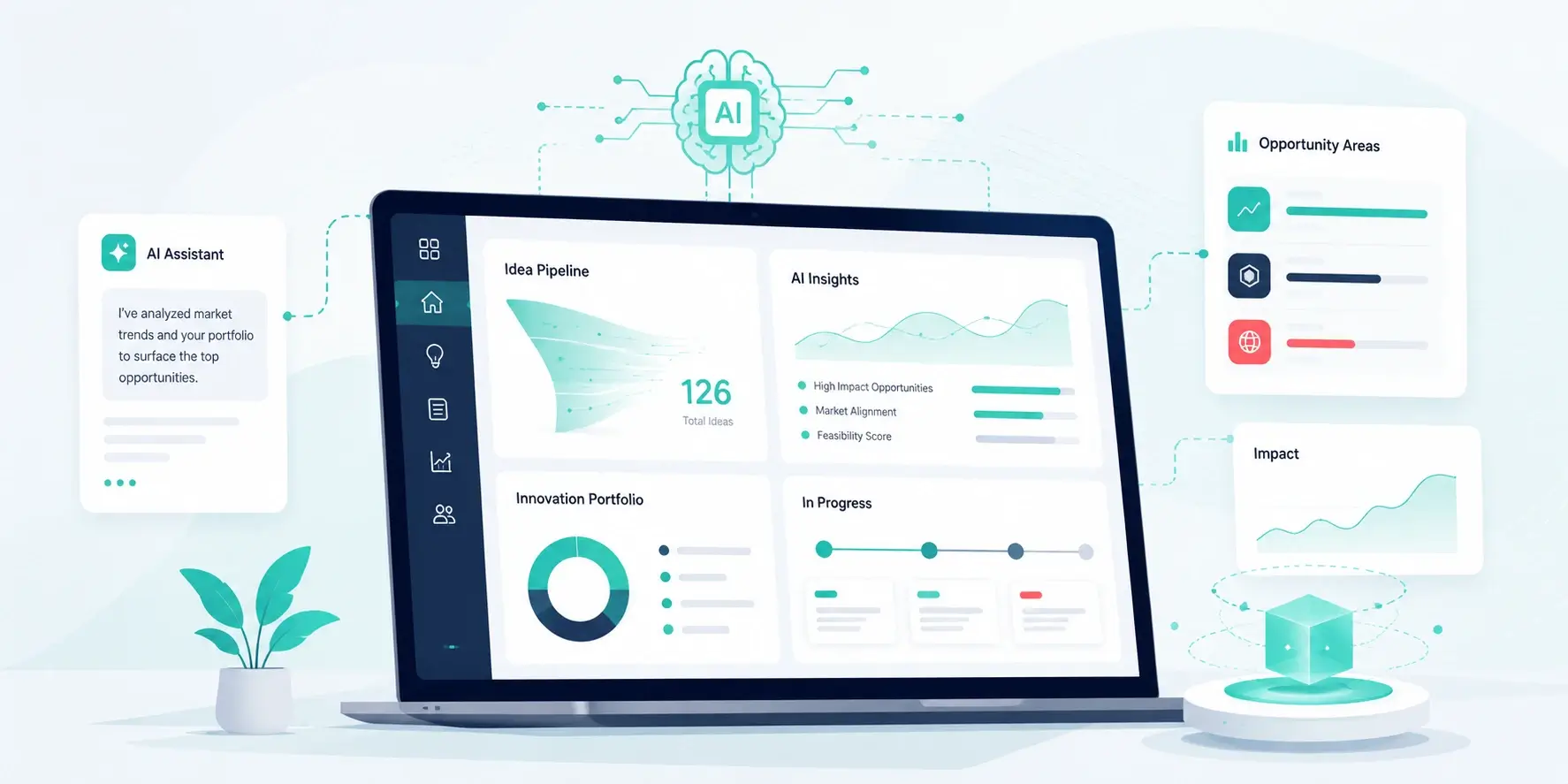
An AI-powered innovation management platform helps organizations collect, evaluate, prioritize, and implement ideas with less manual work. It brings idea management, workflow automation, evaluation, portfolio tracking, and reporting into one system, then uses artificial intelligence to improve speed and decision quality.
The goal is not to replace innovation teams. The goal is to help them manage more ideas, reduce duplicated effort, find stronger opportunities, and move selected projects toward measurable business outcomes.
What Is An AI-Powered Innovation Management Platform?
An AI-powered innovation management platform is software that supports the full innovation lifecycle. It helps teams capture ideas from employees, customers, partners, or external programs, then organize those ideas through review, prioritization, validation, and execution.
AI adds a smarter layer to this process. It can summarize submissions, suggest missing details, detect similar ideas, recommend tags, cluster related opportunities, and help reviewers evaluate ideas against business criteria.
How It Differs From Traditional Innovation Management Software
Traditional innovation management software gives teams a structured place to collect ideas, run campaigns, manage workflows, and track progress. That already improves on spreadsheets, email threads, and scattered documents.
AI-powered platforms go further. They help innovation managers reduce review time, improve idea quality, identify patterns across large numbers of submissions, and surface opportunities that may be missed in a manual review process.
Why General AI Tools Are Not Enough
General AI tools can help with brainstorming, summarizing notes, writing challenge descriptions, or drafting business cases. They are useful, but they do not automatically manage an innovation pipeline.
A real innovation management platform understands workflow stages, reviewer roles, permissions, past submissions, evaluation criteria, strategic themes, and portfolio status. That context is what makes AI useful for execution, not just idea generation, and it is a key part of a stronger idea management process.
Why Companies Are Moving To AI-Powered Innovation Platforms
Many organizations do not suffer from a lack of ideas. They suffer from weak intake, slow evaluation, unclear ownership, duplicated submissions, and poor follow-through.
AI-powered innovation platforms address those problems by making the process more structured and less dependent on manual administration. That matters most when innovation programs involve multiple departments, locations, business units, or stakeholder groups.
Too Many Ideas, Not Enough Evaluation Capacity
Employee idea programs, innovation challenges, and continuous improvement campaigns can generate hundreds or thousands of submissions. Reviewing each one manually takes time, especially when ideas are incomplete, duplicated, or difficult to compare.
AI helps by grouping similar ideas, summarizing long submissions, flagging related concepts, and helping reviewers focus on the most relevant information. This improves review speed without lowering decision quality.
Innovation Work Gets Stuck In Manual Admin
Innovation managers often spend too much time cleaning data, chasing reviewers, preparing reports, checking for duplicates, and updating leadership. These tasks matter, but they should not consume the entire innovation function.
AI and workflow automation reduce repetitive work. Notifications, routing, reviewer assignments, progress updates, and dashboards help teams keep ideas moving without relying on one person to manually manage every step.
Leaders Need Better Pipeline Visibility
Executives need to know what is in the innovation pipeline, which ideas are moving, which projects are stalled, and where business value is expected. Without visibility, innovation becomes hard to defend.
A strong platform gives leaders a view of idea volume, evaluation status, implementation progress, estimated ROI, cost savings, revenue potential, and participation across the organization.
Core Features Of An AI-Powered Innovation Management Platform
The best AI innovation platforms are not just idea boxes with a chatbot attached. They use AI across intake, evaluation, collaboration, prioritization, and reporting.
The most useful features are the ones that reduce friction while keeping humans in control of strategic decisions.
AI-Assisted Idea Capture
Good ideas often fail because they are poorly explained. AI-assisted idea capture helps contributors structure their submissions with clearer titles, problem statements, expected benefits, affected teams, and possible implementation steps.
This helps employees submit stronger ideas without needing to understand formal innovation language. It also helps reviewers compare ideas more fairly because each submission contains the right information.
Duplicate Detection And Similarity Search
Duplicate ideas are common in large organizations. Different teams may describe the same issue in different words, or several employees may submit variations of the same concept.
AI-powered duplicate detection identifies similar and related ideas across campaigns, departments, and historical submissions. This prevents repeated review work and helps teams combine related suggestions into stronger proposals.
AI Idea Evaluation And Scoring
AI can support idea evaluation by checking submissions against defined criteria such as strategic fit, expected impact, feasibility, cost, implementation complexity, customer value, and ROI potential.
Human review still matters. AI should support decision-making, not make final calls without context. The best use of AI is to give reviewers a clearer starting point and reduce inconsistency in early screening.
Automated Summaries And Reviewer Support
Reviewers do not always have time to read every submission in full. Automated summaries help them understand the core idea, problem, expected value, and possible risks more quickly.
AI can also generate short executive briefs, evaluation notes, and comparison summaries. This is especially useful when innovation managers prepare stage-gate meetings or leadership reviews.
Trend And Technology Scouting
Some AI-powered innovation platforms also support trend scouting and technology scouting. These tools scan external signals such as market news, patents, research publications, startup activity, and competitor movement.
This is useful for R&D, strategy, and foresight teams that need to identify emerging opportunities before they become obvious. It helps connect external market intelligence with internal innovation priorities.
Innovation Portfolio Management
Idea management is only one part of innovation. Teams also need to track pilots, experiments, projects, budgets, owners, risks, timelines, and business impact.
AI can help detect stalled initiatives, identify bottlenecks, compare portfolio balance, and surface projects that may need leadership attention. This gives innovation managers a clearer view of what is actually moving toward implementation.
Where AI Helps Across The Innovation Lifecycle
AI can support every stage of innovation, but its value changes depending on where the idea sits in the pipeline.
Early in the process, AI improves participation and idea quality. Later in the process, it helps with evaluation, portfolio tracking, and value measurement.
Foresight And Opportunity Discovery
AI can scan market signals and help teams identify emerging customer needs, industry shifts, new technologies, regulatory changes, and competitive threats.
This gives innovation teams better inputs before they launch a challenge or create a new initiative. Instead of asking for random ideas, they can focus people around validated opportunity areas.
Ideation And Employee Participation
AI can make ideation easier for employees who have useful insights but do not know how to present them. A platform can prompt users to explain the problem, who is affected, why it matters, and what outcome they expect.
This increases submission quality and reduces the burden on innovation managers who would otherwise need to rewrite or clarify vague ideas.
Evaluation And Prioritization
AI helps reviewers compare ideas against consistent criteria. It can summarize feedback, group similar submissions, recommend categories, and highlight ideas with strong strategic alignment.
This makes evaluation faster and more transparent. It also helps reduce bias because every idea can be reviewed through the same basic structure.
Experimentation And Validation
Once ideas move forward, AI can help teams draft pilot plans, identify assumptions, suggest validation questions, and summarize experiment results.
This keeps the focus on learning before scaling. Instead of approving large projects too early, teams can test whether the idea solves a real problem and has a credible path to value.
Execution And Portfolio Tracking
AI can help monitor progress after ideas are approved. It can flag overdue tasks, summarize project status, identify stalled work, and support leadership reporting.
This matters because innovation does not end when an idea is selected. The real business value comes from execution, adoption, and measurable outcomes, which is why teams need a better way to implement innovative ideas after evaluation.
Where Ideawake Fits In AI-Powered Innovation Management
Ideawake helps organizations turn employee ideas into measurable business impact through idea management software built for participation, evaluation, and implementation. The platform is designed for teams running employee ideation, innovation challenges, continuous improvement programs, and internal innovation pipelines.
Ideawake’s Aurora AI supports practical innovation work by helping detect duplicate ideas, link related ideas, and autocomplete certain custom fields. This reduces administrative work for innovation managers and helps reviewers spend more time on decision-making instead of manual sorting.
The platform is also built around ease of adoption. Employees need a simple way to submit ideas, while innovation teams need a configurable idea management system with ROI dashboards, reporting, and integrations with tools such as Teams, Slack, JIRA, and Asana.
How To Choose The Right AI Innovation Management Platform
Choosing the right platform depends on the type of innovation program you are running. A company focused on employee ideas needs different functionality from a company focused on startup scouting or advanced technology foresight.
The best platform should match your workflow, not force your team into a rigid process that does not fit your organization.
Match The Platform To Your Innovation Model
Start by identifying your main use case. Are you collecting employee ideas? Running open innovation challenges? Managing R&D opportunities? Tracking continuous improvement projects? Building a portfolio of experiments?
Once that is clear, compare platforms based on the workflows they support. A strong employee idea management platform should make participation easy, evaluation consistent, and implementation measurable.
Check Whether AI Is Built Into The Workflow
Some platforms mention AI but only use it for basic content generation. That may help with writing, but it does not improve the full innovation process.
Look for AI inside idea intake, duplicate detection, summarization, evaluation, routing, reporting, and portfolio management. AI is most useful when it is connected to the actual workflow.
Prioritize Ease Of Adoption
Innovation platforms fail when employees do not use them. A simple submission experience, clear communication, mobile-friendly access, integrations, and transparent feedback loops all affect participation.
Ease of adoption matters just as much as advanced features. If the system feels complicated, employees will return to email, spreadsheets, or informal conversations.
Review Governance, Security, And Permissions
Enterprise innovation work requires control. Look for role-based permissions, audit trails, secure data handling, SSO, admin controls, and configurable review stages.
Governance is especially important when ideas involve customer data, intellectual property, operational risk, or sensitive business strategy.
Ask How ROI Is Tracked
Innovation teams need to prove value. The platform should help track implementation rate, cost savings, revenue impact, cycle-time reduction, participation, and time saved during evaluation.
ROI tracking should not be limited to financial outcomes. Some innovation programs also measure risk reduction, employee engagement, customer experience, and process improvement.
Free Vs Paid AI-Powered Innovation Management Tools
Searchers often look for a free AI-powered innovation management platform, and free tools can be useful for early brainstorming.
However, free tools usually break down when the organization needs workflow, accountability, and reporting.
What Free Tools Can Do
Free or general AI tools can help teams brainstorm ideas, summarize meeting notes, draft challenge prompts, or create early business case language.
They are helpful for small teams that are still experimenting with their innovation process and do not need formal governance.
Where Free Tools Break Down
Free tools usually do not provide structured idea intake, duplicate detection across a full idea database, reviewer assignments, stage-gate workflows, portfolio dashboards, permissions, integrations, or ROI reporting.
That is where a paid innovation management platform becomes necessary. Once multiple teams and decision-makers are involved, the process needs structure.
Common Mistakes When Using AI For Innovation Management
AI can make innovation programs faster, but it can also create noise if teams use it without clear strategy and governance.
The platform should support better decisions. It should not become another system that produces more ideas than the organization can act on.
Treating AI As A Replacement For Strategy
AI can suggest ideas and summarize data, but it cannot decide what the business should prioritize. Leadership still needs to define strategic themes, investment priorities, and risk appetite.
Without strategy, AI may only create more activity. Activity is not the same as innovation progress.
Measuring Idea Volume Instead Of Business Impact
A high number of submissions can look positive, but volume alone does not prove success. The better question is how many ideas were reviewed, tested, implemented, and measured.
Innovation teams should track movement through the pipeline, not just the size of the intake pool.
Letting AI Score Ideas Without Human Review
AI can assist evaluation, but human judgment is still needed for feasibility, ethics, customer value, technical risk, and organizational fit.
The best approach is human-led and AI-supported. Reviewers should use AI to reduce manual effort, not outsource accountability.
FAQs About AI-Powered Innovation Management Platforms
What Is An AI-Powered Innovation Management Platform?
It is software that uses AI to help organizations collect, organize, evaluate, prioritize, and implement ideas. It supports the innovation lifecycle from idea capture to portfolio tracking and business impact measurement.
How Does AI Improve Idea Management Software?
AI improves idea management by summarizing submissions, detecting duplicates, recommending tags, clustering related ideas, supporting evaluation, and reducing manual review work.
Can ChatGPT Replace Innovation Management Software?
ChatGPT can help with brainstorming, writing, and summarizing, but it does not manage workflows, permissions, review stages, dashboards, duplicate detection across a full idea database, or portfolio tracking on its own.
What Features Should An AI Innovation Platform Include?
A strong platform should include AI-assisted idea capture, duplicate detection, automated summaries, strategic scoring, workflow automation, reviewer support, portfolio dashboards, integrations, and ROI tracking.
What Is The Difference Between Idea Management Software And Innovation Management Software?
Idea management software focuses on collecting and evaluating ideas. Innovation management software covers a broader process, including strategy, campaigns, workflows, experimentation, portfolio tracking, implementation, and outcomes.
Are There Free AI-Powered Innovation Management Platforms?
Some tools offer free trials or free AI idea generators. Full innovation management usually requires a paid platform because teams need workflow governance, permissions, integrations, dashboards, and reporting.
Conclusion
An AI-powered innovation management platform helps organizations move from scattered ideas to structured execution. It improves the quality of submissions, reduces duplicate work, speeds up evaluation, and gives leaders better visibility into the innovation pipeline.
The best platforms do more than generate ideas. They help teams connect ideas to business goals, prioritize what matters, support implementation, and measure outcomes. For organizations that want employee ideas to become real business results, AI-powered innovation management is becoming a practical operating system, not just another software category.