
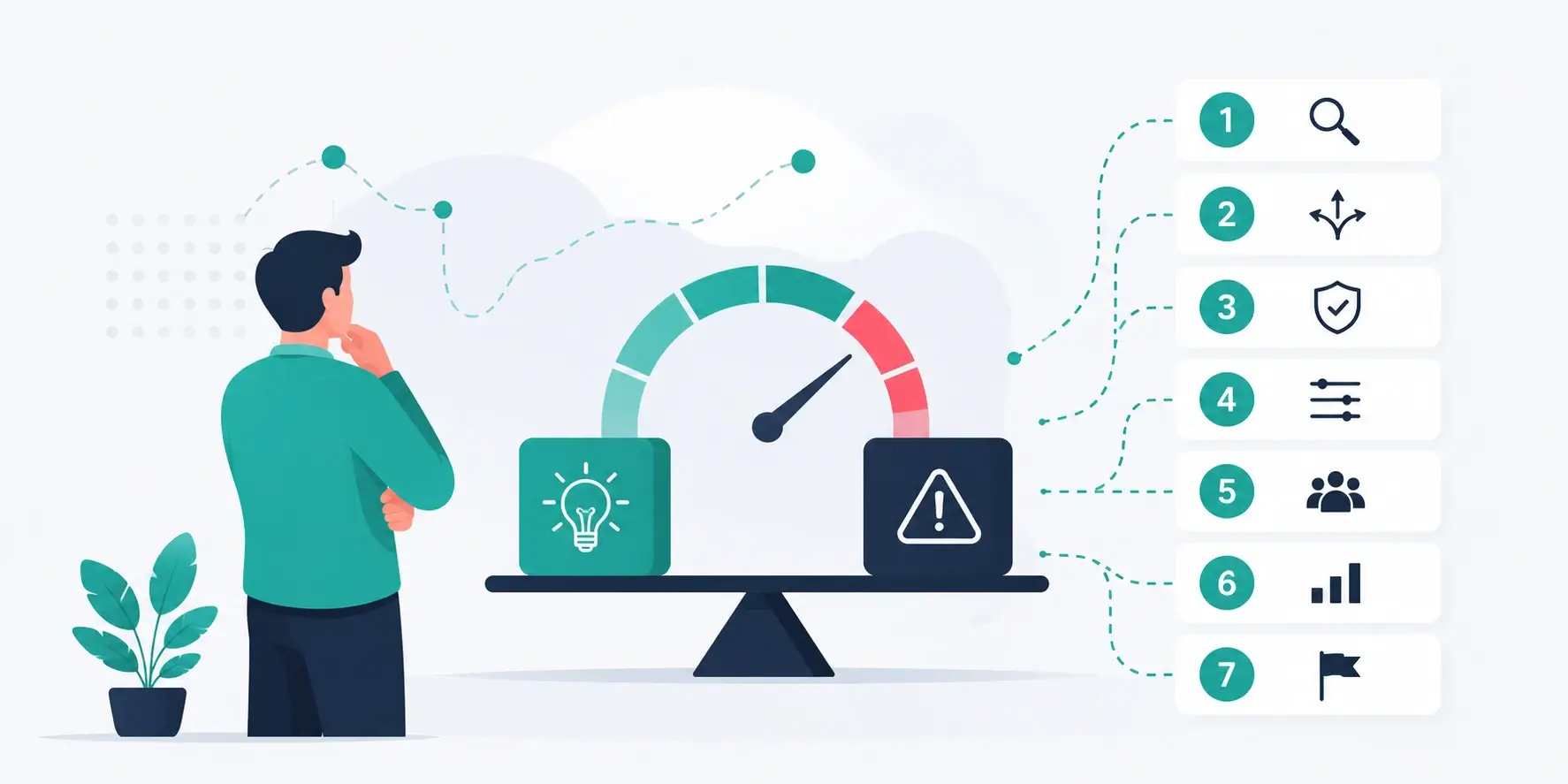
Innovation always carries risk. A new idea may miss customer needs, cost more than expected, fail during implementation, or create adoption problems after launch. That does not mean companies should avoid innovation. It means they need a clear system for testing ideas before major resources are committed.
The goal of innovation risk management is not to remove uncertainty. That would remove innovation itself. The goal is to identify the biggest assumptions, test them early, fund ideas in stages, and scale only when there is enough evidence to move forward.
What Are Innovation Risks?
Innovation risks are the uncertainties that can affect the success of a new product, service, process, technology, or business model. These risks can appear during idea generation, validation, development, launch, or adoption.
Some risks are easy to see, such as a high development cost or a technical limitation. Others are harder to detect, such as weak user demand, internal resistance, unclear ownership, or regulatory exposure.
Common innovation risks include:
- Market risk: Customers may not want or pay for the solution.
- Technical risk: The company may not be able to build it reliably.
- Operational risk: Teams may struggle to deliver or support it.
- Financial risk: Costs may outweigh the expected return.
- Regulatory risk: Legal, data, safety, or compliance issues may block progress.
- Adoption risk: Employees or customers may not use the solution.
- Reputational risk: A failed launch may damage trust.
These risks are not reasons to stop innovating. They are signals that the company needs better validation, governance, and decision-making.
Idea Management Made Simple
Turn Your Team’s Ideas Into Measurable Impact
Capture ideas, streamline evaluation with AI, and turn promising opportunities into action. See how Ideawake can support your innovation or continuous improvement program.
Free trial includes onboarding. No credit card required.
Why Innovation Risk Management Matters
Many organizations do not suffer from a lack of ideas. They suffer from poor follow-through. Ideas get submitted, discussed, delayed, and eventually forgotten because no one owns the next step.
Good innovation risk management creates structure without killing momentum. It helps teams move from idea to evidence, from evidence to decision, and from decision to implementation.
When risk is not managed well, companies waste budget on weak ideas, ignore strong ideas, duplicate work, and lose employee confidence. When risk is managed well, leaders can make faster decisions because they have better information. That is why companies reduce innovation risk more effectively when they support ideas through a structured idea management program rather than relying on ad hoc reviews and disconnected tools.
Strategy 1: Identify Desirability, Feasibility, And Viability Early
The first step is to test whether an idea is desirable, feasible, and viable. These three lenses help teams avoid investing too much in ideas that sound exciting but have weak business foundations.
Desirability asks whether customers, employees, or users actually need the solution. A strong idea should solve a real pain point, not just introduce a new feature or process because it seems interesting.
Feasibility asks whether the organization can build, integrate, and maintain the solution. This includes technology, data, talent, operations, infrastructure, and security.
Viability asks whether the idea makes business sense. It should align with strategy, support measurable outcomes, and have a realistic path to value.
How To Apply This Framework
Before funding a full project, teams should answer three questions: who needs this, can we build it, and can it create value? If any answer is weak, the next step should be validation, not execution.
This approach keeps teams from writing full business cases too early. It also helps leaders separate ideas that need more evidence from ideas that are ready for deeper investment.
Strategy 2: Use Stage-Gate Governance Without Creating Bureaucracy
Stage-gate governance breaks the innovation process into phases. Each phase ends with a decision point where leaders review evidence and decide whether to continue, pivot, pause, or stop.
This structure reduces risk because funding is released in stages. Teams do not receive a full project budget based on assumptions. They earn more investment by proving the idea has merit.
A simple stage-gate process may include discovery, scoping, validation, pilot, launch, and scale. Each stage should have clear criteria, decision owners, and required evidence. In practice, this works best when it is part of a broader idea management process instead of a series of isolated approvals.
Keep The Process Lightweight
Stage-gates fail when they become paperwork exercises. Early-stage ideas should not need the same approval process as a major product launch.
The risk level should determine the level of governance. A small internal process improvement may need a quick review, while a new customer-facing platform may require legal, technical, financial, and operational review.
Good governance should speed up decisions, not slow them down. If teams know what evidence is required, they can move faster and avoid repeated debates.
Strategy 3: De-Risk Core Assumptions With MVPs And Prototypes
Many innovation projects fail because teams build too much before testing the core assumption. A prototype or minimum viable product helps teams test the most important question with less cost and less risk.
An MVP is not a low-quality version of the final product. It is the smallest useful test of the value proposition. It should help the team learn whether the idea solves the right problem for the right audience.
For example, before building a full software workflow, a team might test a manual version with a small group of users. Before launching a new service, the company might run a controlled pilot with one department or one customer segment.
Test The Riskiest Assumption First
Teams should identify the assumption most likely to kill the idea. That may be customer demand, technical performance, data access, compliance approval, cost structure, or user adoption.
Testing the riskiest assumption first prevents wasted work. If the idea fails, it fails early and cheaply. If it succeeds, the team has stronger evidence for the next funding decision.
Fast feedback loops also matter. Customer interviews, usage analytics, pilot results, prototype testing, and support feedback all help teams adjust before the project becomes expensive. Validation matters because the goal is not just to test ideas in theory, but to implement innovative ideas with stronger evidence, clearer ownership, and less wasted investment.
Strategy 4: Diversify The Innovation Portfolio
A company should not place all innovation resources behind one large bet. Even promising ideas can fail because markets shift, technology changes, or adoption takes longer than expected.
A balanced innovation portfolio spreads risk across different time horizons and opportunity types. Some initiatives should improve existing products or processes. Others should expand into adjacent markets. A smaller share can focus on transformational bets.
A practical portfolio may include:
- Incremental innovation: Lower-risk improvements to current products, services, or operations.
- Adjacent innovation: Medium-risk opportunities using existing capabilities in new ways.
- Transformational innovation: Higher-risk ideas that may create new markets or business models.
This mix gives companies near-term wins while still investing in future growth.
Review Portfolio Health Regularly
Portfolio balance should not be set once and forgotten. Leaders need regular reviews to see where resources are going and whether the risk mix still matches strategy.
A healthy review looks at stage progress, funding, risk level, expected value, dependencies, and ownership. It also checks whether too many ideas are stuck in validation or too few ideas are reaching implementation.
Strategy 5: Separate Innovation KPIs From Operational Metrics
Traditional business metrics are useful, but they can damage early-stage innovation when used too soon. A new idea may not have reliable ROI, revenue, or margin data during discovery.
If leaders demand full financial certainty too early, teams may reject bold ideas before they have been properly tested. Innovation needs stage-specific metrics.
Early-stage metrics should focus on learning. Later-stage metrics should focus on performance, adoption, and value created.
Use The Right Metrics At The Right Stage
During discovery, useful metrics include assumptions tested, customer interviews completed, evidence quality, and validation speed. During pilot, teams should track adoption, usage, cost, technical performance, and user feedback.
After launch, metrics can include revenue impact, cost savings, productivity gains, customer retention, process cycle time, and ROI.
The point is simple: measure the question that matters at that stage. Early on, the question is “Should we keep learning?” Later, it becomes “Should we scale?”
Strategy 6: Use Open Innovation And Strategic Partnerships
Companies do not need to carry every innovation risk alone. Strategic partnerships can reduce technical, financial, and operational exposure.
Open innovation allows organizations to work with startups, universities, suppliers, customers, consultants, and technology partners. This can provide faster access to expertise, research, tools, and market feedback.
Partnerships are especially useful when the company lacks internal capability or needs to move faster than internal development allows. A partner may already have the technology, data, process knowledge, or distribution channel needed to test an idea.
Manage Partnership Risk Carefully
Partnerships reduce some risks but introduce others. Companies still need clear agreements around intellectual property, data access, security, compliance, ownership, timelines, and success criteria.
A strong partnership should define who owns what, who pays for what, who approves changes, and what happens if the pilot fails. Clear terms keep collaboration productive.
Strategy 7: Build A Predict-And-Prevent Innovation Culture
Innovation risk is easier to manage when teams are encouraged to raise concerns early. If employees fear blame, they hide problems until they become expensive.
A predict-and-prevent culture treats risks as useful information. Teams are expected to identify weak assumptions, challenge plans, and share failed experiments without fear of punishment.
One practical method is a pre-mortem. Before a project moves forward, the team asks: if this failed six months from now, what likely caused it? This question surfaces risks that normal planning often misses.
Make Failed Experiments Useful
Not every failed experiment is a failure. If it produces clear evidence and prevents wasted investment, it creates value.
Leaders should reward useful learning, not just successful launches. That does not mean accepting careless work. It means expecting teams to test assumptions, document findings, and make better decisions based on evidence.
How Ideawake Helps Teams Manage Innovation Risk
Ideawake helps organizations manage innovation risk by giving teams a structured way to capture, evaluate, prioritize, and track ideas from submission to implementation. Instead of managing ideas through scattered spreadsheets, emails, and meetings, teams can use an idea management system to centralize submissions, apply scoring criteria, run configurable workflows, and monitor portfolio progress. Aurora AI can also support teams by detecting duplicate ideas, linking related submissions, and helping evaluators work through large idea volumes more efficiently.
This kind of system reduces risk because decision-makers can see what is in the pipeline, who owns each idea, what stage it is in, and what evidence supports the next decision. It also improves transparency for employees, which keeps participation higher and prevents strong ideas from disappearing without feedback.
Idea Management Made Simple
Turn Your Team’s Ideas Into Measurable Impact
Capture ideas, streamline evaluation with AI, and turn promising opportunities into action. See how Ideawake can support your innovation or continuous improvement program.
Free trial includes onboarding. No credit card required.
Common Innovation Risk Management Mistakes
One common mistake is treating every idea like a full business case. Early ideas need testing before detailed financial projections. A business case built on untested assumptions can create false confidence.
Another mistake is adding too many approval layers. Risk controls should match the size and risk of the idea. If every small improvement needs executive approval, teams will stop participating.
Companies also overvalue activity metrics. Idea counts, workshops, and submissions matter, but they do not prove impact. Better measures include validation quality, decisions made, pilots launched, adoption, and value created.
A final mistake is poor communication. When employees submit ideas and never hear back, trust drops. Feedback loops are part of risk management because they keep the system active and credible.
Final Thoughts
Innovation risk cannot be removed, and it should not be feared. The companies that innovate well are not reckless. They use structured systems to test ideas, manage uncertainty, and decide where to invest.
By combining desirability, feasibility, viability, stage-gates, MVPs, portfolio balance, better KPIs, partnerships, and psychological safety, organizations can reduce wasted effort without slowing progress.
The strongest innovation programs do not depend on luck. They depend on clear governance, practical validation, transparent decisions, and a repeatable process for turning ideas into measurable results.
FAQs About Innovation Risks
What Are Innovation Risks?
Innovation risks are uncertainties that can affect whether a new idea, product, service, process, or business model succeeds. These risks can involve the market, technology, operations, finance, regulation, adoption, or reputation.
What Are The Main Types Of Innovation Risk?
The main types include market risk, technical risk, operational risk, financial risk, regulatory risk, reputational risk, and adoption risk. Most innovation projects include more than one type.
How Can Innovation Risk Be Managed Effectively?
Innovation risk can be managed through early assumption testing, stage-gate governance, MVP validation, portfolio diversification, tailored KPIs, strategic partnerships, and transparent risk reporting.
What Are The 7 Steps Of Innovation?
A practical 7-step innovation process includes discovery, idea capture, evaluation, validation, pilot testing, implementation, and performance measurement.
What Are The 7 Types Of Risk Management?
Common risk management approaches include avoidance, reduction, transfer, sharing, acceptance, escalation, and contingency planning. In innovation, staged investment and risk reduction are often the most useful.
How Does Innovation Management Software Reduce Risk?
Innovation management software reduces risk by centralizing ideas, standardizing evaluation, tracking ownership, managing workflows, identifying duplicate ideas, and giving leaders visibility into the full innovation portfolio.