
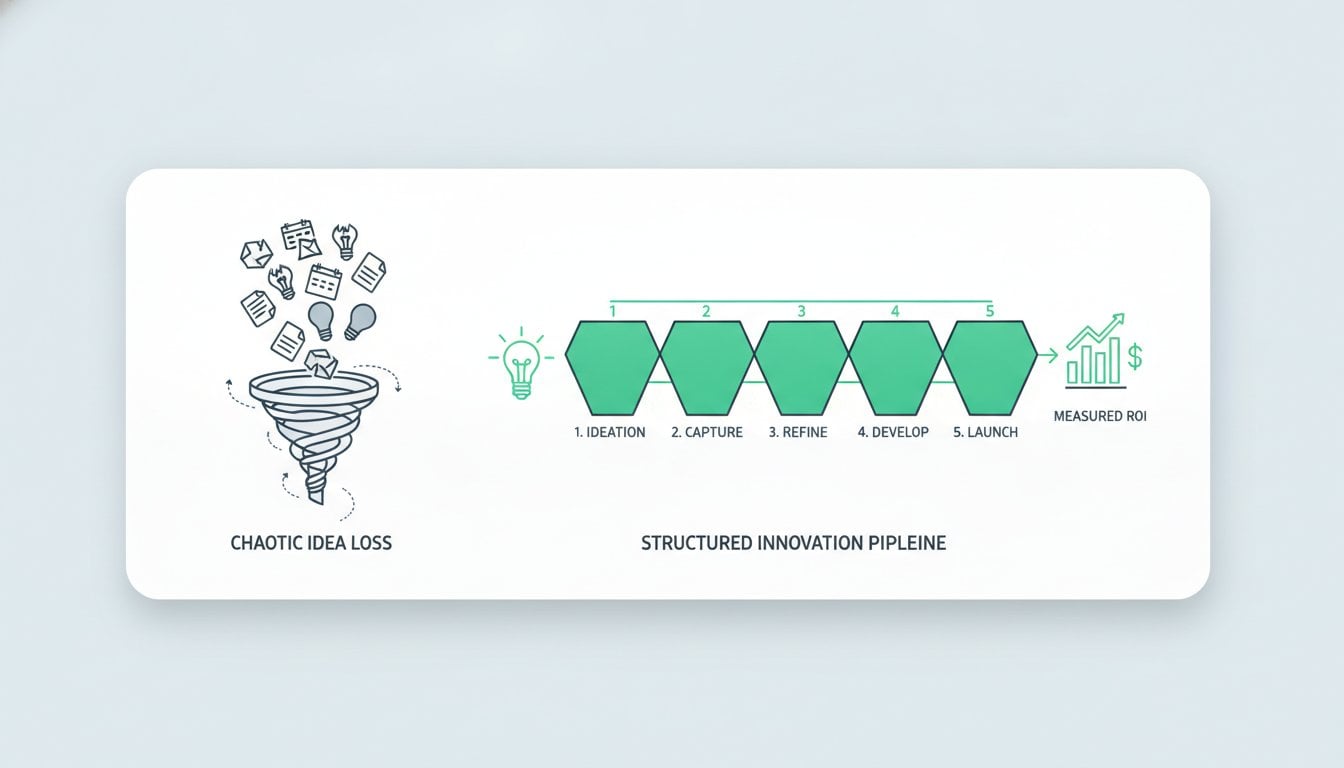
Your organization is bleeding capital every time a brilliant insight is shared in a hallway and never documented. This isn’t just a missed opportunity; it’s a systemic failure that directly fuels financial waste and talent turnover. Disengaged employees worldwide account for an estimated $8.8 trillion in lost productivity, according to research from October 2025. To remain competitive, you must stop losing employee ideas to the black hole of manual spreadsheets and outdated suggestion boxes that offer no feedback or visibility.
You already know that your team’s best insights are often lost in the noise of daily operations, leading to an administrative nightmare that kills morale. This guide will show you how to stop the drain of valuable employee insights and transform them into measurable ROI through structured innovation management. We’ll explore how to replace manual tracking with a high-performance framework that captures intellectual capital at scale. By the end of this article, you’ll have a clear roadmap to turn raw suggestions into a high-impact engine for organizational growth and documented performance shifts.
Key Takeaways
- Quantify the hidden financial and cultural costs of “idea leakage” and how it serves as a leading indicator for employee disengagement.
- Identify the specific administrative friction points in manual tracking that cause high-value insights to disappear into organizational “black holes.”
- Implement a strategic 5-step framework to stop losing employee ideas by centralizing intake and establishing transparent, stage-gate evaluation workflows.
- Compare the scalability limits of spreadsheets against purpose-built innovation management platforms to determine the right fit for your organization.
- Leverage AI and automation to close the feedback loop, ensuring every contributor receives timely updates without increasing management’s manual workload.
The High Cost of Lost Intellectual Capital
Organizations often suffer from “idea leakage,” a silent drain where frontline insights vanish before they reach decision-makers. This isn’t just a missed suggestion; it’s a failure to document and act on the very intelligence that drives competitive advantage. When you fail to stop losing employee ideas, you aren’t just missing a single spark of creativity. You’re signaling to your workforce that their expertise is optional. This creates a culture of silence that is a leading indicator of systemic disengagement.
The data confirms the financial stakes are high. Research from 2025 by Wellable shows that companies with highly engaged workforces are 23% more profitable. This profitability isn’t a byproduct of luck. It’s the direct result of a workforce that feels empowered to solve problems and optimize processes. Every lost idea is a missed opportunity for operational excellence and a tangible hit to your bottom line.
How Unheard Ideas Drive Talent Turnover
There’s a deep psychological link between having a “voice” and organizational commitment. When employees feel their contributions are ignored, they stop caring. We’ve moved far beyond the antiquated history of suggestion systems where a physical box collected dust in a breakroom. Modern talent expects transparency and a visible feedback loop. Your high-performers are the most likely to leave when their insights are sidelined. They don’t just want a paycheck; they want to see their professional expertise shape the company’s future. If they can’t innovate at your organization, they’ll find a competitor that listens.
The Financial Impact of Innovation Leaks
The cost of lost ideas often shows up as invisible waste in manual processes. Your frontline staff sees the “hidden factory” every day. They know where the redundant checks live and where the bottlenecks stall production. When these insights aren’t captured, you’re effectively subsidizing inefficiency. These leaks often fall into the 8 forms of lean waste, specifically the waste of non-utilized talent. It’s a massive oversight. Structured innovation management changes the math. Instead of viewing employee feedback as a burden, high-performance organizations treat it as a high-yield asset. By creating a system to stop losing employee ideas, you transform raw suggestions into a measurable engine for growth and cost reduction.
Why Organizations Struggle to Capture Employee Innovation
Capturing innovation isn’t a matter of intent; it’s a matter of architecture. Most organizations lose high-value insights because they lack a dedicated infrastructure for intellectual capital. When you rely on fragmented tools, you create an administrative nightmare that eventually kills the desire to contribute. To stop losing employee ideas, you must first identify the technical and psychological barriers that turn brilliant suggestions into forgotten artifacts.
The “Black Hole” effect is the primary reason innovation programs fail. This occurs when an idea is submitted but the contributor receives no status update. Without a visible feedback loop, the psychological contract between the employee and the organization breaks. They assume their input doesn’t matter. Administrative friction compounds this issue. Manual evaluation processes are slow, inconsistent, and prone to human error. If your system requires a manager to manually copy data from an email into a spreadsheet, you’ve already lost.
Informal capture methods like Post-it notes or whiteboard sessions are excellent for brainstorming but fail at scale. They lack the metadata required for strategic decision-making. Without a centralized database, your organization’s intellectual property remains trapped in silos. This fragmentation prevents you from identifying trends, avoiding duplicate efforts, and calculating the true ROI of your innovation efforts. If your current process feels like a manual struggle, you can see how automation streamlines capture.
The Failure of the Digital Suggestion Box
Email aliases and dedicated Slack channels are where great ideas go to die. They lack the transparency required for a high-performance culture. Top-down feedback loops are inherently opaque, leaving employees to wonder if their ideas were even read. Many innovation failures originate here. It’s not that the ideas were bad; it’s that the capture method was too chaotic to allow for proper execution. These digital boxes offer no way to track progress, leading to a complete breakdown in trust.
The Manager Bottleneck
Managers are often the unintended gatekeepers of innovation. Under the weight of initiative fatigue, many see new ideas as additional tasks rather than solutions. If every suggestion requires a manager’s immediate attention, the system will eventually clog. As noted in Inc. Magazine, effective suggestion systems must distribute the evaluation load to remain sustainable. Transitioning to a model that includes peer-to-peer evaluation can bypass this bottleneck entirely, allowing the best ideas to rise to the top without draining management resources.
Comparing Solutions: Manual Tracking vs. Idea Management Software
Many leaders attempt to hack together a solution using Excel or shared documents. It works for five ideas. It fails at fifty. To stop losing employee ideas, you need a system that scales without adding administrative headcount. Spreadsheets are static repositories, not active drivers of innovation. They lack the automation required to move a concept from a raw suggestion to a finished project, often resulting in a graveyard of unimplemented potential.
The choice between building a custom tool and purchasing a dedicated idea management platform is a pivot point for your strategy. Custom software often leads to bloated development timelines and maintenance nightmares that distract your IT team. Specialized platforms offer immediate implementation and a significantly lower Total Cost of Ownership (TCO). These tools are built specifically for the innovation lifecycle, providing mobile accessibility that ensures frontline workers can submit insights the moment they occur, rather than waiting until they reach a desktop.
The Hidden Costs of Ideawake vs. Spreadsheets
Excel is only free if you value your time at zero. Manual data entry and fragmented reporting turn innovation managers into data clerks. Our Ideawake vs. Spreadsheets comparison highlights how manual systems fail to provide real-time ROI tracking. You can’t prove the value of your program to stakeholders if your data is trapped in disconnected tabs. High-performance organizations use automation to eliminate this friction, allowing managers to focus on execution rather than administrative upkeep.
Key Features of a Modern Idea Management Platform
Software doesn’t just store data; it drives behavior. Gamification elements like voting and leaderboards turn participation into a high-energy cultural shift. This social proof is vital for sustained engagement. Crucially, modern tools utilize structured idea evaluation criteria to ensure every submission is judged objectively. This protects institutional knowledge. When a key manager leaves, their evaluation history and the ideas they championed stay in your centralized database. Your intellectual capital remains secure, searchable, and ready for implementation regardless of staff turnover.
A 5-Step Framework to Stop Losing Employee Ideas
Turning intent into action requires a repeatable architecture. To stop losing employee ideas, you must shift from a passive collection mindset to an active management strategy. This framework provides the tactical steps necessary to capture, evaluate, and implement insights while maintaining high levels of engagement across your workforce. It works because it replaces individual effort with systemic reliability.
- Step 1: Centralize Intake. Eliminate fragmented feedback by creating a single, authoritative source for all submissions. This removes the chaos of disconnected emails and verbal suggestions.
- Step 2: Implement Stage-Gate Evaluation. Use transparent workflows where ideas move through predefined phases. This ensures consistency and prevents the manager bottleneck from stalling progress.
- Step 3: Incentivize Participation. Use gamification and public recognition to drive contribution volume. High-performance cultures reward the behavior they want to see repeated.
- Step 4: Automate Feedback Loops. Ensure every contributor receives a status update regardless of the outcome. Automation is the only way to scale this without increasing administrative overhead.
- Step 5: Measure and Communicate ROI. Track the financial impact of every implemented idea. Sharing these wins validates the program and secures long-term executive support.
Standardizing the Idea Submission Process
A well-designed submission form is the foundation of quality data. Instead of asking for generic suggestions, design forms that require employees to articulate the specific problem and the potential impact of their solution. This “why-centric” approach filters out noise and highlights high-value opportunities. Leveraging idea crowdsourcing allows you to gather diverse perspectives on these submissions, refining raw concepts into actionable projects. You can also focus creativity by launching specific innovation challenges that target your organization’s most pressing strategic goals.
Building a Culture of Continuous Improvement
Innovation shouldn’t be an annual event. Transitioning to a formal continuous improvement process embeds problem-solving into the daily workflow. Executive sponsorship is the catalyst for this shift. When leaders publicly validate and reward contributions, they signal that innovation is a core competency, not a side project. This validation is critical for retention. High-performers stay when they see their work making a documented difference. If you’re ready to build this framework in your organization, you can book a free demo today to see these steps in action.
Ideawake: Closing the Loop with AI and Automation
Ideawake serves as the modern architecture for enterprise innovation, providing the necessary structure to stop losing employee ideas at every level of the organization. While previous sections detailed the cultural and procedural shifts required, this platform provides the technical backbone to sustain those changes. It integrates directly with existing enterprise workflows, such as Microsoft Teams and Slack, to meet employees where they already work. This removes the friction that often kills participation before it begins.
The platform’s capability to track an idea from the initial submission through to the final ROI ensures that no insight is ever lost in an organizational “black hole.” This visibility is what builds long-term trust and high-performance cultures. By centralizing intellectual capital, leaders can finally move away from the administrative nightmare of manual tracking and focus on high-impact execution.
Leveraging AI for Idea Evaluation
Executing with Confidence
Capture is only half the battle. Execution is where the financial value is realized. A structured implementation process is essential for turning raw concepts into operational reality. Ideawake provides the project management framework to move ideas through the stage-gate evaluation discussed earlier, ensuring accountability at every step. To validate the success of these initiatives, managers can use the ROI calculator to quantify the exact impact on the bottom line. This data-driven approach turns innovation from a subjective exercise into a core business driver. It’s time to replace fragmented tools with a high-performance system designed for scale. You can sign up for a demo today to stop losing employee ideas and start building a measurable engine for growth.
Transforming Intellectual Capital into Measurable Growth
The decision to stop losing employee ideas is a fundamental commitment to organizational high performance. We’ve established that relying on manual spreadsheets creates an administrative burden that kills innovation before it can scale. By implementing a centralized framework, you replace the “black hole” of unheard suggestions with a transparent, automated engine for continuous improvement. This shift doesn’t just protect your institutional knowledge; it turns every frontline insight into a potential driver of operational excellence.
Ideawake provides the modern architecture needed to capture this untapped potential. Trusted by global enterprise leaders, our platform utilizes AI-driven evaluation to reduce administrative time by 80%, allowing your managers to focus on high-impact execution. With end-to-end ROI tracking for every implemented idea, you can finally quantify the financial value of your team’s creativity with absolute certainty.
Don’t let your organization’s next breakthrough vanish into a hallway conversation. Stop losing ideas and start driving ROI with Ideawake—Book your demo today. Your team is ready to contribute. It’s time to give them the platform they deserve.
Frequently Asked Questions
What is the most effective way to capture employee ideas?
Centralized digital platforms are the gold standard for modern organizations. They replace fragmented emails and hallway chats with a structured intake form that captures the specific problem and its potential impact. This architecture allows for real-time tracking and ensures every submission is documented in a searchable database rather than lost in a manager’s inbox.
Why do most employee suggestion programs fail?
Programs fail primarily due to the “black hole” effect, where contributors receive no feedback or status updates. When employees feel their input is ignored, they stop participating entirely. Additionally, manual evaluation processes often create a manager bottleneck that stalls progress and kills the momentum necessary for a high-performance culture.
How do you incentivize employees to share their ideas?
Use a combination of gamification and public recognition to drive engagement. High-performance organizations implement leaderboards, voting systems, and tangible rewards to validate contributions. Demonstrating that an idea was actually implemented and had a measurable impact is often the most powerful incentive for long-term participation.
How much time does it take to manage an idea management platform?
Modern platforms utilize AI to reduce administrative overhead by up to 80%. Automated duplicate detection and trend analysis allow innovation managers to focus on high-level strategy rather than manual data entry. Total management time typically scales down as the system automates feedback loops and evaluation workflows.
Can idea management software integrate with Slack or Microsoft Teams?
Yes, top-tier platforms integrate directly with these enterprise collaboration tools to meet employees where they already work. This integration allows users to submit and vote on ideas without leaving their daily communication channels. It significantly lowers the barrier to entry for frontline workers who don’t spend their day at a desk.
How do you measure the ROI of an employee idea?
ROI is measured by tracking specific outcomes such as cost savings, hours recovered, or new revenue generated from implemented concepts. Using a dedicated ROI calculator allows you to quantify these performance shifts and present clear financial data to stakeholders. This proves the program’s bottom-line impact with absolute certainty.
What is the difference between creativity and innovation in the workplace?
Creativity is the generation of novel concepts, while innovation is the successful implementation of those concepts to create tangible value. You must stop losing employee ideas by moving beyond simple brainstorming and establishing a structured execution pipeline. This transforms creative sparks into documented organizational results and measurable growth.
How do I handle unfeasible employee ideas without discouraging them?
Provide transparent, objective feedback that explains the specific criteria used for the decision. Instead of a flat rejection, frame the response around current strategic goals or resource constraints. This maintains the psychological contract and encourages the contributor to refine their next submission based on the organization’s practical needs.