
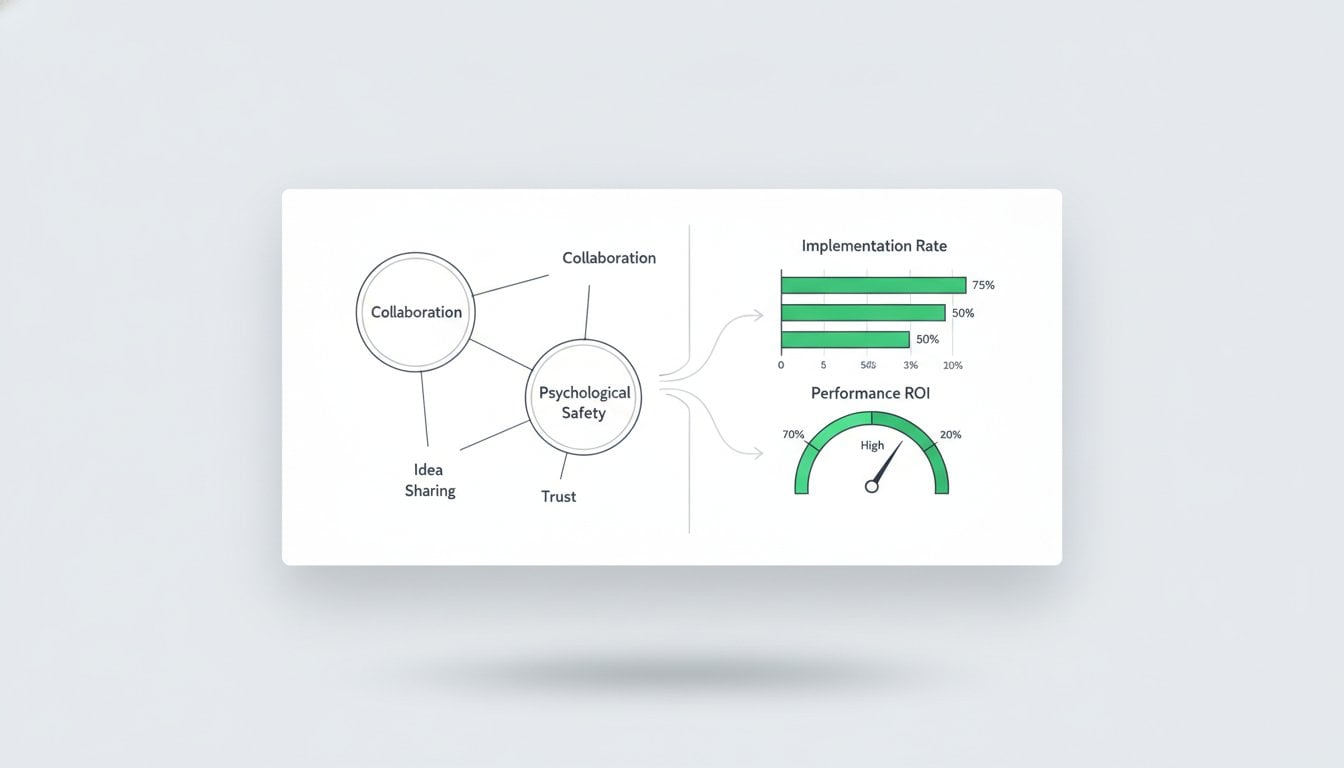
Innovation culture is not a “feeling” your HR team surveys once a year; it is the measurable efficiency with which your organization converts raw human potential into implemented ROI. Most enterprise leaders understand that a stagnant culture kills growth, yet they struggle to prove it to a skeptical board when the only data available comes from low-participation suggestion boxes. It’s difficult to justify cultural initiatives when you can’t connect them to the bottom line. This guide provides the exact framework you need to learn how to measure innovation culture using hard data that turns subjective sentiment into a concrete driver of performance. A 2026 global survey revealed that 21 new entrants joined the list of the Top 100 global innovators, proving that the competitive landscape is shifting rapidly for those who can’t quantify their creative output. You’ll gain a repeatable audit process and the specific KPIs required to prove that cultural shifts lead directly to higher implementation rates. We’re moving beyond “vibes” to establish an evidence-driven system that secures your competitive advantage.
Key Takeaways
- Move beyond subjective “vibes” by defining innovation culture as a set of observable behaviors that directly accelerate your idea-to-value lifecycle.
- Learn how to measure innovation culture by distinguishing between leading indicators like psychological safety and lagging indicators like financial ROI.
- Execute a repeatable five-step audit process to map your organization’s idea journey and identify the specific friction points that stall progress.
- Discover why shifting from spreadsheets to a dedicated innovation management platform is a critical step in scaling a high-performance culture.
- Use AI-powered tools to eliminate the “culture tax” of manual administration and provide the real-time visibility required for executive buy-in.
Defining Innovation Culture: Why “Vibes” Aren’t Enough in 2026
Innovation culture is often mistakenly reduced to employee perks or creative office layouts. In reality, it’s the specific set of organizational behaviors that either accelerate or obstruct the journey from a raw concept to realized market value. As we move through 2026, the era of “theatrical innovation,” characterized by aesthetic brainstorming sessions and sticky notes, has ended. Enterprise standards now demand structural innovation. This requires moving toward data-backed systems that treat culture as a measurable asset rather than an abstract feeling. Understanding how to measure innovation culture involves adopting “Innovation Accounting,” a framework that bridges the gap between cultural health and financial performance. By grounding these efforts in the principles of innovation management, leaders can stop relying on intuition and start calculating impact.
The Financial Risk of an Unmeasured Culture
When culture remains unmeasured, organizations suffer from “innovation leaks.” These are the critical points where high-value ideas perish due to middle management bottlenecks or a lack of clear feedback loops. This isn’t just a morale issue; it’s a significant financial drain on the organization. Research into the benefits of employee ideation programs shows that structured engagement reduces turnover and optimizes operational efficiency. Without measurement, you also risk funding “zombie projects.” These are initiatives that persist purely because the culture lacks the psychological safety to admit failure and cut losses. A measured culture provides the data necessary to kill these drains on resources before they impact the bottom line.
Innovation as an Outcome of Internal Systems
Think of your culture as the “operating system” and your digital tools as the hardware. High-performance hardware is useless if the underlying OS is riddled with bugs. To fix this, leaders must distinguish between creativity vs. innovation. Creativity is the act of generating ideas. Innovation is the successful implementation of those ideas to create tangible value. Truly knowing how to measure innovation culture involves auditing the systems that support this transition. This requires a structured idea submission process that tracks every concept from inception to impact. When the process is visible and structured, culture becomes a predictable engine for growth rather than a series of happy accidents.
The 3 Core Pillars of a Measurable Innovation Culture
Culture is not a monolith. It is a high-performance engine built on three quantifiable pillars that dictate your organization’s ability to evolve. When enterprise leaders ask how to measure innovation culture, they must look beyond employee satisfaction scores. You need to analyze the specific behaviors that drive the High-Performance Innovation Loop: the continuous cycle of ideation, validation, and implementation. Without these pillars, your innovation strategy is just a collection of expensive slides. By measuring psychological safety, resource accessibility, and leadership responsiveness, you transform culture into a predictable driver of ROI.
Measuring Psychological Safety and Risk Tolerance
Psychological safety is the bedrock of any creative organization. It is not about being “nice”; it is about the freedom to fail without career-ending repercussions. We track this through the “Failure Rate” as a positive cultural metric. In a healthy ecosystem, innovation failures are not sunk costs; they are high-value learning data points that prevent future mistakes. Psychological safety is the primary predictor of success for both incremental vs. radical innovation. If your team only submits “safe” ideas, your culture is effectively stalled. You must measure the frequency of “risky” or “radical” ideas submitted to gauge the true level of trust within your workforce.
Resource Accessibility and the “20% Time” Myth
Intent is nothing without access. Many firms claim to support new ideas but provide zero budget or time for employees to explore them. Google’s 20% time program serves as a legendary benchmark for resource allocation, yet many enterprises fail to implement the underlying mechanics. To truly understand how to measure innovation culture, you must track “Time-to-Resource” as a critical KPI. This measures how quickly a validated idea receives the necessary funding or headcount. This prevents the stagnation found in the 8 forms of lean waste, specifically the waste of underutilized human talent. If your team cannot access resources without a 12-month committee review, you don’t have an innovation culture; you have a bureaucracy.
Leadership responsiveness completes the loop. Transparency in decision-making builds the trust required for high-volume participation. If feedback takes six months, the momentum dies. Measuring the velocity of the “Yes/No” decision is critical for cultural health. If you want to see how these metrics look in a real-world environment, schedule a platform walkthrough to explore our data-driven dashboards.
Quantitative vs. Qualitative: Choosing Your Innovation Metrics
Distinguishing between what we can count and what we can feel is the most significant challenge when determining how to measure innovation culture. Leading indicators act as early warning systems, predicting future success based on current engagement levels. These include the volume of active contributors and the frequency of structured sessions like reverse brainstorming. Conversely, lagging indicators such as implementation rates and time-to-market reflect the historical performance of your systems. A 2026 European benchmark study of over 100 innovation teams is currently formalizing these KPIs to help organizations move from activity-based reporting to impact-based results. A holistic “Culture Scorecard” weights these metrics to ensure that high activity actually translates into commercial value.
Hard Metrics: Participation Rates and Pipeline Velocity
Soft Metrics: Sentiment Analysis and Collaborative Diversity
A 5-Step Process to Audit Your Organization’s Innovation Health
Enterprise leaders often get lost in the theoretical “how” of cultural transformation. To master how to measure innovation culture, you need a repeatable audit process that exposes the hidden friction in your operations. This audit isn’t a one-time event; it is a systematic review of how ideas flow or stall within your existing hierarchy. By following a structured five-step approach, you can identify precisely where your organization is leaking value. It’s about moving from anecdotal evidence to a rigorous, data-driven assessment of your innovation health.
- Step 1: Establish a Baseline. Run a blinded cultural assessment to identify perceived bottlenecks.
- Step 2: Map the Idea Journey. Track a single concept from the initial employee suggestion through to implementation.
- Step 3: Analyze Collaborative Reach. Measure the depth of cross-departmental involvement in a single project.
- Step 4: Audit Feedback Loops. Calculate the Mean Time to Feedback (MTTF) provided by management.
- Step 5: Review Implementation Success. Compare the rate of implemented ideas against baseline cultural sentiment scores.
Establishing a Baseline with Employee Surveys
The first step requires radical honesty. You must ask questions that target “permission to fail” and “clarity of strategy.” For example, ask employees if they feel safe proposing an idea that contradicts current business units or if they understand the specific criteria for a “winning” project. It’s also vital to assess innovation skills alongside attitude. A willing team without the right skills will still fail to execute. This baseline measurement provides the starting point for the phases of continuous improvement, ensuring you aren’t building on a fractured foundation.
Analyzing the Idea Pipeline for Cultural Friction
Once you have a baseline, you must look at the pipeline itself. Ideas frequently stall during the idea evaluation process because of opaque decision-making or excessive bureaucracy. This is where the “Innovation Friction Coefficient” comes into play. The Innovation Friction Coefficient is the ratio of submitted ideas to those that receive a formal evaluation. High friction indicates a culture that discourages participation through silence. Utilizing a centralized idea management database makes this audit possible by providing a single source of truth for every interaction. It allows you to see where momentum dies and which managers are acting as catalysts rather than gatekeepers.
Auditing these five steps reveals the true state of your organization’s creative health. If your MTTF is over 30 days, your culture will inevitably stagnate regardless of your vision. If you’re ready to stop guessing and start measuring these metrics in real-time, schedule a platform demo to see our automated audit dashboards in action.
Scaling Culture with Modern Innovation Management Platforms
Scaling a high-performance culture across a global enterprise is impossible when using manual, disconnected tools. The decision between Ideawake vs. Spreadsheets is more than a technical preference; it’s a critical cultural choice. Spreadsheets are static and siloed, often acting as the place where engagement and visibility go to die. In contrast, a modern platform provides the transparency required to understand how to measure innovation culture at every level of the hierarchy. By automating the administrative burden, AI tools for innovation managers eliminate the “culture tax” that often prevents middle management from buying into new initiatives. To ensure long-term adoption, deep integrations with existing communication stacks keep innovation within the daily workflow, making participation as natural as sending a message.
Leveraging AI for Real-Time Cultural Mapping
The real power of a digital-first approach lies in predictive analysis. Using Ideawake AI, leaders can identify emerging cultural trends and potential bottlenecks before they manifest as significant performance drops. For organizations looking to unify heart-centered cultures and organizational data into predictive analytics, heartsy™ provides the necessary infrastructure. This technology monitors the sentiment of cross-departmental collaboration, providing a real-time heat map of organizational health. Gamification elements, such as peer voting and reward systems, maintain long-term engagement by recognizing contributions publicly and fairly. Additionally, structured idea evaluation tools help remove human bias from the selection process. This ensures that ideas are judged on their objective merit rather than the departmental rank of the submitter, fostering a truly meritocratic environment.
Implementation: Moving from Data to Action
Transitioning to a data-driven system requires a clear implementation roadmap. It begins with setting specific baseline KPIs and then rolling out the platform to pilot groups to gather initial sentiment data. The ultimate goal is to foster the kind of environment that produced the 10 innovative product examples that have defined market leadership in recent years. Culture is a powerful competitive edge, but it requires a modern platform to sustain and scale. If you’re ready to stop managing innovation through guesswork and start seeing the hard data behind your creative output, sign up for a demonstration to see your cultural metrics in action.
Transforming Cultural Insight into Measurable Performance
The era of treating organizational culture as a nebulous “vibe” has been replaced by a demand for rigorous, evidence-based management. You now have the framework to move beyond subjective surveys and implement a system where psychological safety and resource accessibility are tracked with the same precision as financial OpEx. By mastering how to measure innovation culture, you empower your organization to identify “innovation leaks” and bridge the gap between raw creativity and realized market value. Success in the competitive environment of 2026 requires more than just good intentions. It demands an infrastructure that makes the intangible tangible. Ideawake is trusted by enterprise leaders to manage the full innovation lifecycle by providing built-in AI sentiment analysis for cultural health tracking. With proven ROI measurement tools for C-suite reporting, you can finally demonstrate the direct link between cultural health and the bottom line. It’s time to stop guessing and start leading with data.
Ready to see your innovation metrics in real-time? Book a demo of Ideawake today.
Your organization’s untapped potential is waiting for a system that can finally prove its value. By taking these steps, you aren’t just measuring a culture; you’re building a resilient engine for future growth.
Frequently Asked Questions
Is innovation culture really measurable or is it just a buzzword?
Innovation culture is a measurable asset defined by observable behaviors rather than a vague corporate buzzword. You can quantify it by tracking specific interactions within your idea pipeline, such as the frequency of cross-departmental contributions and the speed of resource allocation. When you treat culture as a data set, you move from subjective sentiment to objective performance tracking that identifies exactly where your organization is leaking potential.
What are the most important KPIs for measuring innovation culture?
The most effective KPIs for determining how to measure innovation culture include leading indicators like the percentage of active contributors and the volume of radical versus incremental ideas. You should also track lagging indicators such as your idea conversion rate and the total ROI per implemented project. These metrics provide a holistic view of your innovation health by connecting employee engagement directly to financial outcomes.
How often should an organization audit its innovation culture?
Organizations should perform deep-dive audits annually while maintaining real-time pulse checks through their innovation management platform. Continuous data collection allows you to spot cultural friction as it happens rather than waiting for a yearly report to reveal a drop in engagement. This proactive approach ensures your innovation engine remains optimized and your teams stay aligned with strategic business objectives throughout the fiscal year.
Can software like Ideawake actually improve our company culture?
Software provides the necessary infrastructure to scale the behaviors you want to see in your organization. Ideawake improves culture by providing a transparent, meritocratic environment where every employee sees their ideas evaluated through a structured, bias-free process. This visibility builds the trust required for high-volume participation and eliminates the administrative bottlenecks that typically discourage employees from sharing their best concepts.
What is the difference between an engagement survey and an innovation culture audit?
Engagement surveys measure general employee satisfaction and morale, whereas an innovation culture audit measures the efficiency of your idea-to-value lifecycle. While an employee might be happy at work, they may still feel the organization is too risk-averse to support new initiatives. An audit specifically targets the systems, feedback loops, and resource access points that dictate your company’s actual capacity for change and growth.
How do we measure psychological safety in a corporate environment?
You can measure psychological safety by analyzing the ratio of “risky” or radical ideas submitted compared to safe, incremental suggestions. Another critical metric is the participation rate following a failed project; if engagement drops after a failure, it indicates a lack of safety. High-performance cultures show steady participation levels because employees know that well-managed risk is a valued part of the learning process.
Should we reward employees for ideas that fail?
You should reward the rigor of the process and the data gathered rather than the failure itself. Celebrating the “smart failure” of a well-tested hypothesis encourages risk-taking and helps kill zombie projects before they drain excessive resources. This cultural shift ensures that employees focus on high-impact experimentation without fear of career repercussions, which is a core component of how to measure innovation culture effectively.
How do we connect cultural metrics to financial ROI?
Connecting culture to ROI requires tracking how improvements in engagement and feedback velocity lead to higher implementation rates. By reducing your “Innovation Friction Coefficient,” you increase the volume of ideas that reach the market, which directly impacts your bottom line. Use an ROI calculator to assign dollar values to the time saved through automated triage and the revenue generated from employee-led continuous improvement initiatives.