
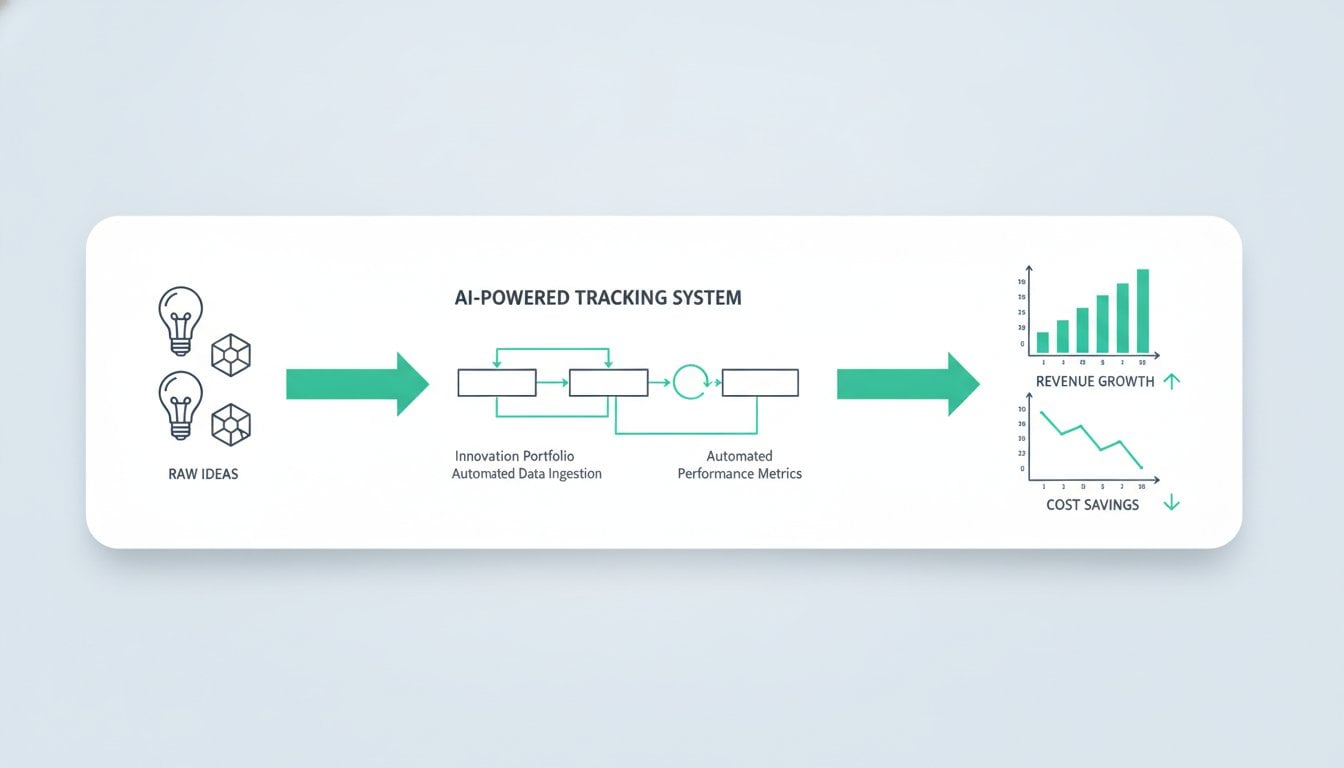
Why do 56% of CEOs report zero revenue growth or cost savings from their massive AI investments despite global spending projected to hit $2.5 trillion in 2026? This staggering accountability gap, highlighted in a January 2026 PwC survey, proves that throwing capital at “innovation” without a rigorous system for innovation program ROI tracking is a recipe for executive skepticism. You likely agree that relying on vanity metrics like idea volume is no longer enough to justify your budget. It’s frustrating to manage spreadsheet chaos while leadership demands to see exactly how employee suggestions impact the bottom line.
We promise to help you bridge this gap by mastering the tiered data architectures and automated workflows required to transform raw concepts into measurable strategic growth. This reference guide provides a standardized framework for reporting financial returns that aligns with the new ISO 56001:2024 standards. You’ll learn how to replace manual evaluation overhead with high-performance tracking that secures increased investment and turns your innovation hub into a verified profit center. It’s time to stop guessing and start proving your program’s worth with hard data.
Key Takeaways
- Transition from tracking vanity metrics to a tiered architecture that prioritizes cost savings and revenue growth as the ultimate measures of success.
- Implement a centralized data infrastructure for innovation program ROI tracking to accurately capture baselines and the financial impact of implemented ideas.
- Utilize metered funding and portfolio management strategies to balance risk, ensuring that 100% success rates don’t mask a lack of ambitious, high-return initiatives.
- Automate the innovation lifecycle with AI to reduce administrative evaluation overhead by up to 80%, allowing teams to focus on execution rather than data entry.
Defining Innovation Program ROI Tracking: From Vanity to Value
Innovation program ROI tracking isn’t a simple calculation of dollars in versus dollars out. It’s a comprehensive measurement of the financial, strategic, and cultural returns generated relative to every resource invested in your innovation ecosystem. In 2026, the definition has shifted from vague “creativity” to rigorous accountability. You can’t just claim your program is successful; you have to prove it with hard data that satisfies the scrutiny of a CFO.
Many leaders fall into the “Vanity Metric Trap.” They celebrate 500 ideas submitted or 80% employee participation. These are activity metrics, not impact metrics. While engagement matters, counting ideas without tracking their implementation is a recipe for budget cuts. To combat this, elite organizations use Innovation Accounting to measure progress during the early stages when traditional financial ROI hasn’t materialized yet. This approach bridges the gap between lead indicators, like pipeline health, and lag indicators, such as direct cost savings or top-line revenue growth.
Establishing a clear innovation lifecycle management process is the only way to create a traceable path from a raw concept to a measurable financial outcome. Without this infrastructure, ideas die in the “valley of death” between ideation and implementation. You need a system that captures data at every stage to ensure that innovation program ROI tracking remains accurate and transparent.
The ROI Maturity Model
Your tracking capabilities usually evolve through three distinct stages. Level 1 is activity-based, focusing on participation rates and raw idea counts. Level 2 moves to efficiency, measuring time-to-implementation and the cost-per-validated-idea. The gold standard is Level 3: Impact-based tracking. This level focuses on validated financial returns and direct alignment with corporate strategic goals. Reaching Level 3 requires moving beyond manual data entry and embracing automated tracking workflows.
Why 61% of Organizations Fail to Track ROI
The Three Pillars of Innovation ROI: Financial, Strategic, and Cultural
Constructing a comprehensive innovation program ROI tracking report requires a holistic view that satisfies three distinct internal stakeholders: the CFO, the Chief Strategy Officer, and the Head of HR. If you only present financial gains, you ignore the long-term value of a resilient culture. If you only present engagement scores, you risk losing your budget. You must balance hard financial data with strategic alignment and cultural health to secure lasting executive buy-in.
Hard ROI: Cost Savings and Revenue Generation
Hard ROI represents the tangible, audited financial impact of implemented ideas. To track cost savings effectively, many enterprises utilize the 8 forms of lean waste framework. This allows teams to categorize ideas by their ability to reduce overproduction, waiting times, or defects, translating operational improvements directly into OpEx reductions. For revenue generation, distinguish between incremental improvements to existing service lines and entirely new product revenue. Because innovation projects often span years, calculating the Net Present Value (NPV) is critical for comparing the future value of these initiatives against today’s investment costs. Following a five-step process for measuring innovation ensures that these financial calculations remain consistent and auditable across the entire portfolio.
Strategic and Cultural ROI
Measuring “Strategic Fit” allows you to quantify how effectively your innovation pipeline supports your organization’s annual goals. This is measured by tracking the percentage of implemented ideas that directly contribute to specific corporate objectives. Cultural ROI is the long-term increase in organizational agility and problem-solving capacity. While it feels abstract, it has significant financial implications. High participation in an employee suggestion program correlates strongly with increased empowerment scores and decreased turnover. The benefits of employee ideation programs extend far beyond the ideas themselves; they foster a sense of ownership that improves retention. Reducing turnover by even a few percentage points can save an enterprise millions in recruitment costs annually. To see how these pillars come together in a unified dashboard, you can book a demo with our team to explore automated innovation program ROI tracking workflows.
Building the ROI Tracking Infrastructure: Data, Baselines, and AI
Infrastructure is the silent killer or catalyst of enterprise innovation success. To move beyond the vanity metrics discussed in previous sections, you need a centralized data vault that tracks every idea from the moment of submission through to implementation and final financial audit. This digital paper trail is essential for innovation program ROI tracking because it eliminates the “black hole” where high-potential ideas often disappear. Without a dedicated infrastructure, you’re left guessing which initiatives actually contributed to the bottom line.
The most significant shift in 2026 is the integration of AI driven innovation software as the primary engine for automated reporting. While global AI spending is projected to reach $2.59 trillion this year, many organizations still struggle with an accountability gap. Modern platforms solve this by using machine learning to predict financial impact based on historical performance and real-time market data. This automation reduces the administrative burden of evaluation by up to 80%, allowing your team to focus on execution rather than manual data entry.
Relying on manual tools often leads to “spreadsheet chaos.” When comparing ideawake vs spreadsheets, the primary risk of manual tracking is data fragmentation. Spreadsheets are static and prone to version control errors, making it nearly impossible to maintain a “source of truth” across departments. A dedicated platform provides a dynamic environment where data flows seamlessly from HR and Finance systems to validate every claim of success.
Establishing Reliable Baselines
Accurate measurement is impossible without a clear starting point. Baselining involves capturing current state data before an innovation is implemented to measure the delta in performance. You must collaborate with Finance and HR to access verified “Source of Truth” data, such as current OpEx for a specific process or existing employee retention rates. For process innovations, setting up control groups is a highly effective way to isolate the impact of your initiative. If historical records are missing, use industry benchmarks or a “burn-in” period of data collection to establish a credible foundation.
The Build vs. Buy Dilemma for ROI Tracking
Many enterprises consider developing a custom internal tool to track their innovation pipeline. However, the hidden costs of maintenance, security updates, and integration often outweigh the initial perceived savings. Our build vs buy idea management software guide highlights that modern platforms offer a significantly lower Total Cost of Ownership (TCO). These solutions provide out-of-the-box integrations with your existing tech stack, ensuring that your innovation program ROI tracking is both scalable and secure from day one.
Managing the Innovation Portfolio: Balancing Risk and Return
A 100% success rate is a red flag. If every project in your pipeline hits its target, your program is failing to take the risks necessary for breakthrough growth. High-performance innovation program ROI tracking requires you to view your pipeline as a portfolio, not a list of guaranteed wins. You must balance the “Exploit” side, which involves optimizing your core business, with the “Explore” side, where disruptive, high-potential ideas live. Settling for safe, incremental gains alone ensures long-term stagnation while your competitors chase transformative shifts.
To manage this balance, you need enterprise innovation tools that provide a visual map of your risk distribution. This visibility allows you to stop guessing about pipeline health and start making data-driven decisions that align with your risk appetite. Moving beyond a “suggestion box” mentality requires a rigorous approach to how capital is deployed and reclaimed based on performance.
Metered Funding and Evidence-Based Decisions
Traditional annual budgeting is the enemy of agility. Instead of releasing a full budget upfront, elite organizations use metered funding to maintain accountability. Metered funding is an incremental investment strategy that reduces financial risk by requiring evidence of value at each stage. This approach allows you to set “Kill Gates,” which are predefined milestones where a project must prove its viability or face termination. By failing fast, you significantly reduce “Innovation Waste” and can reallocate those resources to projects showing real traction. This ensures that your innovation program ROI tracking reflects actual progress rather than just sunk costs.
Incremental vs. Radical Innovation ROI
Not all returns follow the same timeline. Incremental vs radical innovation requires different measurement horizons and expectations. Incremental improvements offer faster, more predictable ROI, often focusing on immediate cost savings or service line enhancements. These are your program’s “bread and butter.” Conversely, “Moonshot” projects may have a 5-10 year horizon. These radical initiatives require a balanced scorecard that weights potential market dominance against current implementation costs. While 83% of companies rank innovation as a top priority, only 3% feel prepared to execute. Closing this gap requires a reporting framework that respects these different lifecycles without sacrificing financial rigor.
Ready to transform your portfolio’s financial reporting from a guessing game into a verified profit center? Book a free demo to see how we automate risk and return tracking for global enterprises.
Automating the ROI Lifecycle with Modern Innovation Platforms
Manual evaluation is the bottleneck of enterprise growth. When teams rely on human review for every submission, administrative overhead balloons, leading to the “innovation fatigue” that kills programs before they scale. Implementing a dedicated innovation management platform changes this dynamic by reducing administrative evaluation tasks by up to 80%. This shift allows innovation managers to move from data entry to strategic execution. Automated innovation program ROI tracking ensures that every implemented idea is automatically logged, valued, and reported without manual intervention.
Real-time visibility is no longer a luxury; it’s a requirement for executive buy-in. Automated dashboards provide leadership with an instant view of the pipeline’s health, from the cost of participation to the validated net present value of implemented projects. This level of transparency transforms the innovation department from a mysterious cost center into a verified engine of financial performance. It’s the difference between asking for a budget and proving why you deserve a larger one.
AI-Driven ROI Insights
Closing the Loop: From Implementation to Reporting
True accountability requires connecting your innovation pipeline to your financial “Source of Truth.” This means utilizing integrations with your ERP and CRM systems to pull actual financial performance data post-implementation. When an idea is implemented, the system tracks the delta in cost savings or revenue growth directly from your business records. This closes the “ROI Loop.” Sharing these verified success stories across the organization does more than just satisfy the board; it drives a higher quality of future submissions by showing employees exactly how their contributions impact the company’s bottom line.
Comprehensive innovation program ROI tracking is the lifeblood of a sustainable, scalable innovation culture. It’s time to stop treating innovation as an intangible asset and start measuring it with the same rigor as any other business unit. To see the potential impact on your organization, Access the Ideawake ROI Calculator to start your journey toward data-driven innovation leadership.
Securing the Future of Your Innovation Strategy
Transitioning from vanity metrics to a rigorous data architecture is the only way to ensure your program survives the accountability demands of 2026. By integrating financial, strategic, and cultural pillars, you transform a simple suggestion box into a verified engine for organizational growth. We’ve seen how establishing reliable baselines and utilizing metered funding allows you to manage risk while pursuing radical breakthroughs. Modernizing your innovation program ROI tracking isn’t just about reporting; it’s about building a culture where every employee’s contribution has a traceable path to the bottom line.
Ideawake is trusted by global organizations to manage thousands of ideas through end-to-end lifecycle tracking from raw concept to financial validation. Our AI-driven insights reduce administrative overhead by up to 80%, giving you the freedom to focus on implementation rather than spreadsheet management. It’s time to stop guessing and start proving your impact with financial validation. Access the Idea Management ROI Calculator today to visualize your potential returns and secure the executive buy-in your initiatives deserve. Your path to measurable strategic impact starts now.
Frequently Asked Questions
What is the most important metric for innovation program ROI tracking?
The most important metric is validated financial impact, specifically Net Present Value (NPV), which accounts for the time value of money in multi-year projects. While engagement metrics provide lead indicators, executive leadership prioritizes hard ROI such as direct cost savings and top-line revenue growth. Aligning these figures with the 8 Forms of Lean Waste ensures that every dollar claimed is auditable and grounded in operational reality.
How long does it typically take to see a positive ROI from an innovation program?
Enterprises typically see a positive return within 6 to 18 months when focusing on incremental improvements and process optimizations. Radical or moonshot innovations often require a three to five year horizon before achieving significant financial validation. By utilizing metered funding and failing fast on low-potential projects, organizations can accelerate the timeline to profitability and reduce the overall cost of the innovation pipeline.
Can you track ROI for “Soft” innovations like cultural changes?
You can track cultural ROI by measuring proxy metrics such as employee retention rates, empowerment scores, and participation levels in continuous improvement initiatives. Cultural shifts lead to tangible financial gains through reduced turnover costs and increased organizational agility. In 2026, leading firms correlate high participation in an employee suggestion program with lower recruitment expenses, proving that a healthy innovation culture directly contributes to the bottom line.
What is the difference between ROI and ROE (Return on Expectation) in innovation?
ROI focuses strictly on financial gains relative to investment, while ROE measures how well a program meets predefined strategic or qualitative goals. If a project is designed to improve brand perception or test a new market, ROE tracks success against those specific objectives even if immediate revenue is low. A balanced innovation program ROI tracking strategy uses both to provide a complete picture of value to diverse stakeholders.
How much should an enterprise invest in innovation tracking software?
Investment should be based on the Total Cost of Ownership (TCO) relative to the administrative hours saved and the value of the ideas captured. The software should ideally pay for itself by reducing evaluation overhead by up to 80% through automation and AI-driven scoring. Organizations should avoid the build trap; custom internal tools often carry hidden maintenance costs that far exceed the annual subscription fees of professional platforms.
Is it possible to track ROI for ideas that were never implemented?
It is possible to track the value of non-implemented ideas by measuring “Innovation Waste” reduction and the cost of avoided failures. Identifying a flawed concept early through a Kill Gate saves the organization from future sunk costs, which represents a form of defensive ROI. Additionally, these ideas contribute to an organization’s Option Value, providing a library of insights that may become viable as market conditions or technologies evolve.
How do you handle “Double Counting” when multiple departments claim the same ROI?
Resolve double counting by establishing strict attribution rules and using a centralized data vault that acts as the single source of truth. If multiple departments contribute to an idea’s success, the ROI should be split based on predefined percentages of resource contribution or impact. This level of transparency prevents inflated reporting and maintains the credibility of your innovation program ROI tracking efforts with the finance department.
What role does the CFO play in innovation program ROI tracking?
The CFO acts as the ultimate auditor and strategic partner, ensuring that all reported financial gains meet corporate accounting standards. They provide the Source of Truth data required for baselining and help define the criteria for what constitutes a hard return. Engaging the CFO early in the process transforms them from a potential skeptic into a champion who can help secure increased budgets for future initiatives.