
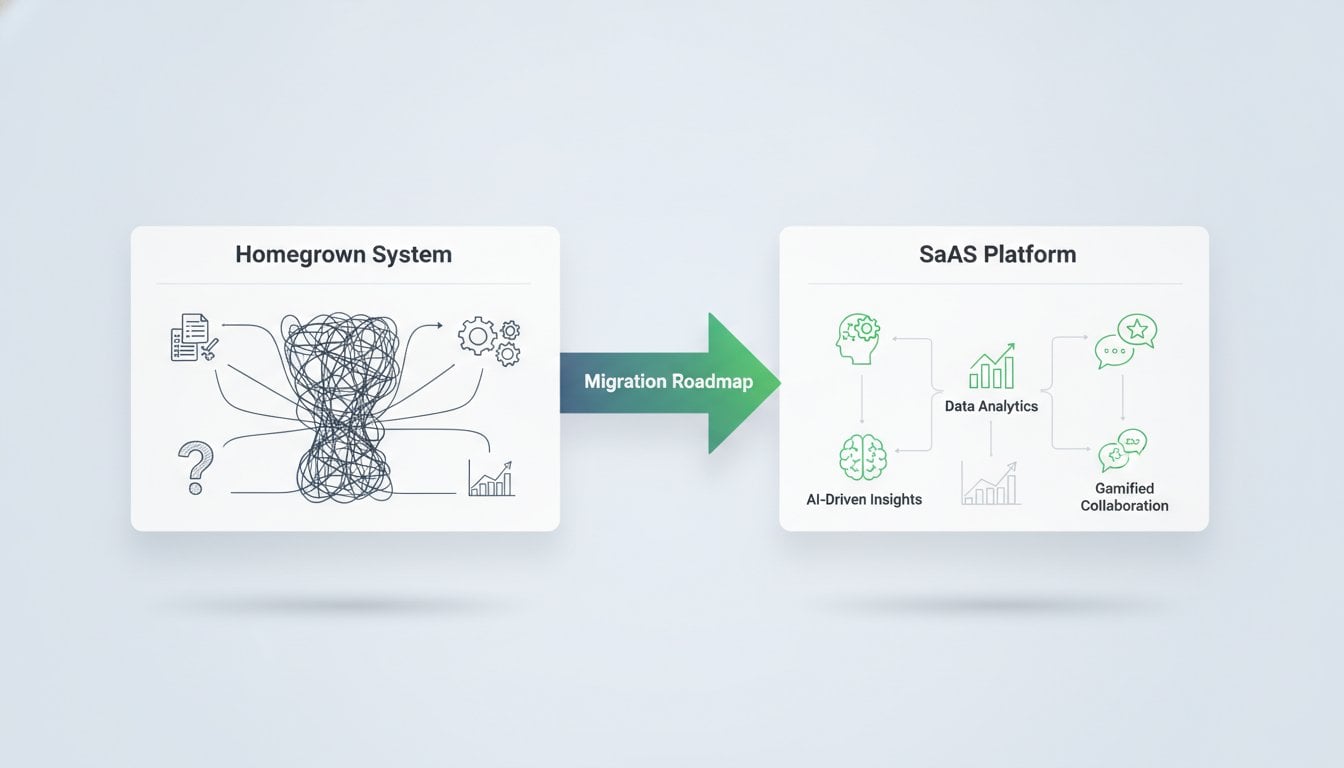
With the global innovation management market projected to reach as high as $20.48 billion by 2026, the gap between companies using manual tools and those leveraging professional platforms has never been wider according to Insight Partners. You likely built your internal tool to save costs and maintain control, but now you’re facing the reality of stagnant employee engagement and an administrative nightmare of manual idea tracking. It’s frustrating to see great ideas stall simply because your current system can’t prove their financial impact to leadership. Moving from a homegrown idea tool to a SaaS platform isn’t just a software upgrade; it’s a strategic shift that automates your innovation pipeline and turns raw creativity into measurable ROI.
In this 2026 strategic guide, you’ll discover how to transition to a scalable system using gamification and AI-driven insights to maximize your organization’s untapped potential. We’ll outline the exact steps to eliminate manual bottlenecks and implement clear reporting that finally links every employee suggestion to the bottom line. It’s time to stop managing spreadsheets and start driving high-impact results through a modern, automated workflow.
Key Takeaways
- Identify the critical signs that your internal portal has become a bottleneck, specifically how maintenance debt drains IT resources and stalls execution.
- Learn why moving from a homegrown idea tool to a SaaS platform reduces total cost of ownership by eliminating hidden expenses related to hosting, security, and manual updates.
- Discover how to leverage built-in gamification and AI-driven evaluation to drive sustained employee engagement and move beyond simple idea submission.
- Follow a structured roadmap to audit your existing innovation data and select a partner that aligns with your organization’s specific maturity level.
- Transition from a basic suggestion box to a full-lifecycle innovation ecosystem that supports specialized initiatives like hackathons and continuous improvement.
The Homegrown Ceiling: Identifying When Your Custom Tool Is Holding Back Innovation
Most organizations start their innovation journey with a simple internal portal or a shared spreadsheet. It feels like a strategic move at the time. You maintain full control, avoid recurring subscription fees, and build a tool tailored to your specific internal language. However, as your program matures, that custom-built solution often becomes a bottleneck rather than a catalyst. The shift toward professional innovation management requires more than just a place to park suggestions; it requires a system built for scale and execution.
The “Submission Trap” is the first sign of trouble. Internal portals are excellent at collecting ideas. They are essentially digital suggestion boxes. But they fail at the execution phase because they lack the automated workflows required to move an idea through a rigorous vetting process. When employees see their contributions disappear into a digital “black hole,” participation plummets. Moving from a homegrown idea tool to a SaaS platform solves this by providing transparency and structured feedback loops that keep the momentum alive.
Submission vs. Implementation: The Critical Gap
Generic tools rarely include the complex logic needed for multi-stage evaluation. Without automated notifications and stage-gate tracking, the administrative burden falls entirely on your innovation team. This manual overhead leads to burnout and slow response times. If you are comparing innovation resources: ideawake vs spreadsheets, the difference is clear. Professional platforms automate the “nudge” while homegrown tools require constant manual intervention to keep ideas moving toward implementation.
The Hidden Cost of Internal Maintenance
The tipping point arrives when the cost of missed opportunities exceeds the cost of a subscription. If your current tool can’t handle gamification, automated scoring, or AI-driven duplicate detection, you aren’t just losing time. You’re losing the high-impact ideas that could define your company’s future. Moving from a homegrown idea tool to a SaaS platform is the only way to ensure your innovation ecosystem remains future-proof and results-driven.
Strategic Advantages of Migrating to an Innovation Management SaaS Platform
Transitioning from a custom build to a dedicated platform provides a level of sophistication that few internal IT departments can replicate. This move enables organizations to leverage an academic guide to systems development logic, where the “buy” decision often yields superior long-term results through specialized functionality. Moving from a homegrown idea tool to a SaaS platform allows your team to shift focus from troubleshooting code to executing strategy. It provides immediate access to pre-built, best-in-class workflows that have been refined across thousands of innovation cycles.
AI-Powered Insights and Lifecycle Automation
One of the most significant leaps in performance comes from the integration of advanced automation. Ideawake AI specifically addresses the administrative bottlenecks that plague internal tools by automating the grouping and deduplication of ideas. This capability can reduce administrative overhead by 50% or more, allowing managers to bypass the manual labor of sorting through repetitive submissions. By using data-driven scoring models, the platform identifies high-potential “winners” faster than any manual review process could achieve. This ensures that resources are allocated to the ideas with the highest projected ROI before momentum fades.
Boosting Engagement Through Gamification
Homegrown tools often struggle with the “one and done” submission problem. Employees log in, submit an idea, and never return. A professional SaaS platform transforms this experience by utilizing the psychology of leaderboards, voting, and prizes. This gamified approach turns a static suggestion box into a dynamic, collaborative community. Participation rates typically see a significant lift when users can track their impact and compete for recognition. It fosters a culture where innovation is a continuous conversation rather than a sporadic task.
Scalability is the final pillar of this transition. A SaaS solution supports global teams across different time zones without requiring additional infrastructure investment or local server maintenance. It integrates seamlessly with your existing enterprise stack, including Microsoft Teams, Slack, and your CRM, ensuring that innovation happens where your employees already work. This level of connectivity is difficult to maintain in a custom tool without constant developer intervention. If you’re ready to see how these features can transform your current process, you might consider how to optimize your innovation pipeline with a dedicated solution.
The Build vs. Buy Debate: Why SaaS Delivers Higher Innovation ROI
Deciding whether to construct an internal portal or purchase a specialized solution is a pivotal strategic choice for any innovation leader. While the internal route feels like a cost-saving measure at first glance, the reality of moving from a homegrown idea tool to a SaaS platform often reveals a much higher return on investment. The primary differentiator is the “Time-to-Value” advantage. A professional platform can launch in weeks. In contrast, internal builds frequently stall in development for months or even years, delaying the capture of high-value employee insights. Moving from a homegrown idea tool to a SaaS platform allows you to stop acting as a software developer and start acting as an innovation strategist. You can find a deeper dive into these trade-offs in our guide on build vs buy idea management software.
Calculating Your Innovation TCO
Total Cost of Ownership (TCO) extends far beyond the initial development phase. It includes ongoing server hosting, constant security patches to meet modern compliance standards, and the inevitable stream of feature requests from users. Maintaining robust client-side protection against script attacks and fraud, which services like cside provide automatically for many platforms, is another hidden layer of management that homegrown tools often fail to address. These hidden costs create a “Maintenance Drain” that distracts your most expensive talent. A simple formula to visualize this is: (Annual Developer Salary / 2,000) x (Hours spent on tool maintenance + Hours spent on feature updates). When you add the opportunity cost of these developers not working on customer-facing products, the price of a homegrown tool increases significantly. A SaaS subscription offers a predictable, all-inclusive alternative that eliminates these surprises.
Quantifying ROI Beyond Cost Savings
Measuring the financial impact of your innovation program shouldn’t be a guessing game. Professional platforms provide built-in analytics that track an idea from the moment of submission through to its final financial realization. This level of transparency is essential for securing long-term executive buy-in. To get a precise estimate for your organization, use our idea management ROI calculator. By 2026 enterprise standards, Innovation ROI is defined as the ratio of net financial gain, encompassing both cost savings and new revenue streams, relative to the total program investment, including software, administration, and implementation costs. This comprehensive view ensures you’re measuring the actual value delivered, not just activity levels.
A Step-by-Step Roadmap for Moving from Homegrown Tools to SaaS
Success in moving from a homegrown idea tool to a SaaS platform isn’t guaranteed by the software alone; it’s determined by the rigor of your migration strategy. Transitioning from a custom environment requires a surgical audit of your existing innovation pipeline to separate high-value insights from historical noise. You must categorize every record in your current system as something to keep, archive, or purge before the first byte is transferred. This disciplined start ensures your new environment remains a high-performance engine rather than a cluttered repository of abandoned suggestions.
The Data Migration Framework
Legacy systems are often filled with “zombie ideas” that have stalled due to lack of oversight. Prioritize active ideas and high-value historical data that can inform future trends while purging redundant or low-quality entries. Use robust integrations to bridge the gap between your old databases and the new platform, ensuring a seamless flow of information without manual entry errors. Cleaning your data is non-negotiable. If you migrate duplicate entries or incomplete profiles, you’re simply moving your “garbage in, garbage out” problem to a more expensive piece of software. Focus on high-fidelity records that provide clear context for evaluation and implementation.
Change Management and User Adoption
The technical shift is only half the battle. To ensure high user adoption on day one, you must communicate the “Why” behind the change. Employees need to know that moving from a homegrown idea tool to a SaaS platform means faster recognition for their contributions and a more transparent path to implementation. Training your stakeholders using implementation best practices will reduce friction and prevent the “new tool fatigue” that often kills innovation programs. Identify and leverage “Innovation Champions” within different departments to drive early activity. These power users act as internal advocates, demonstrating the platform’s value through active participation and collaborative problem-solving.
Future-Proofing Your Innovation Ecosystem with Ideawake
The final phase of moving from a homegrown idea tool to a SaaS platform is about shifting your perspective from “what we can build” to “what we can achieve.” A custom portal is often a static destination, but a modern architecture is a living ecosystem designed to evolve alongside advancements in AI and shifting enterprise needs. Ideawake provides a full-lifecycle environment that manages everything from initial crowdsourcing to final financial realization. This inherent flexibility allows your organization to launch specialized initiatives like high-energy hackathons or long-term continuous improvement programs without requiring a single hour of internal development time.
Scaling Innovation Across the Enterprise
Ideawake is engineered for the complexities of global team collaboration. It effectively bridges the gap between disparate departments and time zones, ensuring that a great idea in one region can be refined and supported by experts in another. This level of connectivity is one of the primary benefits of employee ideation programs, as it breaks down organizational silos and fosters a unified culture of proactive problem-solving. When you utilize a professional innovation management platform, you’re investing in a system that scales with your growth rather than one that requires constant technical patches to stay functional.
Measuring Success: The ROI of Implementation
- Engagement Rate: Track participation levels across all target departments to ensure the change management strategy is working.
- Velocity: Measure the average time it takes for an idea to move from submission to evaluation.
- Pipeline Value: Calculate the projected financial impact of the top 10% of your submissions.
- Efficiency Gain: Document the reduction in administrative hours previously spent on manual tracking and reporting.
Moving from a homegrown idea tool to a SaaS platform provides the structural integrity needed to turn innovation from an abstract goal into a repeatable business process. It replaces the inherent uncertainty of custom code with the reliability of an enterprise-grade engine. If you’re ready to see how a modern platform can transform your organization’s output and drive measurable results, it’s time to take the next step. Book a demo to see these capabilities in action and start your journey toward a more impactful innovation ecosystem.
Unlocking Enterprise Value Through Modern Innovation Management
The transition from an internal suggestion box to a professional ecosystem is no longer optional for organizations seeking measurable growth. We’ve explored how manual tracking creates a ceiling for your potential, whereas a dedicated platform provides the automation and AI-driven evaluation needed to reduce administrative time by 50%. Moving from a homegrown idea tool to a SaaS platform allows you to stop managing spreadsheets and start realizing the financial impact of every employee insight.
Global enterprises already use these modern architectures to manage thousands of ideas with precision. By focusing on a scalable, 2026-ready system, you ensure your innovation strategy remains resilient against shifting market demands. It’s time to replace maintenance debt with a results-driven engine that empowers your workforce. A modern, scalable architecture built for 2026 and beyond doesn’t just store ideas; it executes them. This shift ensures that every hackathon and continuous improvement initiative delivers tangible value to your bottom line.
Your team’s creativity is your most valuable asset. Give them a platform that matches their potential.
Frequently Asked Questions
What are the primary risks of staying with a homegrown idea management tool?
The biggest risks include technical obsolescence and the inability to integrate with modern communication stacks like Slack or Teams. Homegrown tools often lack mobile accessibility, which prevents frontline workers from participating in real time. This isolation leads to a fragmented innovation culture where valuable insights from the field never reach decision makers, eventually turning your portal into an expensive, unused asset.
How long does it typically take to move from an internal portal to a SaaS platform like Ideawake?
Moving from a homegrown idea tool to a SaaS platform typically takes between four and eight weeks. This period includes data migration, security reviews, and stakeholder training. While custom builds can take months to update with new features, a professional platform is ready for launch almost immediately after the initial configuration and user mapping are complete.
Will we lose our historical idea data during the migration process?
You won’t lose your historical data if you follow a structured migration framework. Most professional platforms allow you to import historical records via CSV or API integrations. This ensures that the context and institutional memory of previous innovation cycles are preserved. You can keep your valuable insights searchable and actionable within your new, more powerful environment without starting from zero.
Is a SaaS innovation platform more secure than our internal company servers?
Yes, professional SaaS platforms generally offer enhanced security by maintaining strict adherence to international standards. For organizations that need to validate their enterprise-wide compliance with regulations like ISO 27001, DORA, or NIS2, you can check out CWORT for comprehensive validation services.
How does gamification actually increase employee participation in innovation programs?
Gamification increases participation by introducing social proof and intrinsic rewards into the innovation workflow. Features like leaderboards, digital badges, and voting systems transform a lonely submission process into a collaborative community. When employees see their colleagues getting recognized for their contributions, it creates a positive feedback loop that drives sustained engagement and higher submission quality over the long term.
What is the typical ROI timeframe when switching to a professional innovation management platform?
Organizations generally see a measurable return on investment within six to twelve months of switching. This timeframe allows enough time for the first wave of high-potential ideas to move through the evaluation and implementation phases. By using professional analytics, you can track the realized value of these ideas as they begin to impact your company’s bottom line through cost savings or new revenue.
Do we need significant IT involvement to implement a SaaS innovation tool?
IT involvement is remarkably low compared to the resources required to maintain a custom tool. Your technical team will primarily be involved in the initial setup of Single Sign-On (SSO) and a standard security review. Once the platform is live, your innovation team can manage workflows and challenges independently without needing to submit tickets for every minor feature request.
How does AI improve the idea evaluation process compared to manual methods?
AI improves the process by instantly identifying duplicate submissions and grouping related concepts together for faster review. Moving from a homegrown idea tool to a SaaS platform gives you access to sentiment analysis and automated scoring models. This allows managers to focus their energy on the top 10% of high-impact ideas rather than manually sorting through hundreds of low-value entries.