
While 78% of organizations have integrated AI into their business functions, a staggering 61% still cannot attribute a single dollar of EBIT impact to these investments. For most innovation leaders, the process remains a black hole where capital enters and vague cultural shifts come out. You’ve likely spent hours wrestling with manual spreadsheets or trying to explain to a skeptical CFO why a failed pilot was actually a success. It’s frustrating to watch high-potential ideas wither because you lack the data to defend their budget. Using AI to measure innovation ROI changes this dynamic by replacing guesswork with real-time, predictive analytics.
This guide provides a definitive framework to transform your innovation department into a high-performance engine of measurable growth. You’ll learn how to automate reporting that satisfies strict financial requirements and gain the confidence to allocate capital where it generates the highest impact. We’ll also cover how to stay compliant with the 2026 regulatory landscape, including the EU AI Act and other emerging data transparency regulations. It’s time to stop treating innovation as a luxury and start managing it as a predictable driver of your bottom line.
Key Takeaways
- Replace manual tracking with automated systems to prevent the 30% data decay rate common in traditional innovation spreadsheets.
- Discover how using AI to measure innovation ROI allows you to quantify “soft” benefits like employee engagement through automated sentiment analysis.
- Transition from historical reporting to predictive value forecasting by utilizing Monte Carlo simulations to assess project success probabilities.
- Implement a five-step framework to centralize your innovation data and establish a single source of truth for all financial reporting.
- Utilize real-time dashboards to translate raw ideas into boardroom-ready impact reports that align with strict 2026 regulatory standards.
The Challenge of Quantifying Innovation in the Modern Enterprise
Innovation departments often operate as financial black holes. Management sees the creative spark but rarely sees the resulting cash flow. This disconnect creates the “innovation gap,” where brilliant ideas fail to receive funding because their value isn’t proven. Most leaders still rely on manual spreadsheets to bridge this gap. However, industry benchmarks suggest that legacy tracking methods lead to a 30% data decay rate as information gets lost across departments. Manual entry is slow; it’s prone to human error; it’s fundamentally unscalable. Using AI to measure innovation ROI solves this by aggregating fragmented data from every business unit into a single, actionable stream.
The corporate world is moving away from “soft” metrics like participation rates. In 2026, the only metric that matters is EBITDA impact. Using AI to measure innovation ROI allows you to track this impact from the moment an idea is submitted to its final implementation. By centralizing your data, you eliminate the silos that prevent a holistic view of your innovation portfolio’s health.
The Limitations of Historical ROI Reporting
Looking backward is a strategic death sentence. Traditional Return on Investment (ROI) reporting usually occurs months after a project concludes. By then, the opportunity for agile resource reallocation has passed. Market volatility in 2026 demands faster, more aggressive reporting cycles. If you rely on vanity metrics or historical post-mortems, you’ll likely continue funding “zombie projects” that drain capital without delivering value. Real-time visibility is the only way to remain competitive in a landscape where 42% of companies abandoned their AI initiatives in 2025 due to poor tracking.
Bridging the Gap Between Creativity and the Balance Sheet
Financial validation requires a clear understanding of the difference between creativity vs. innovation. While creativity generates the raw material, innovation is the process of turning that material into profit. Effective data capture must span the four main types of business collaboration to ensure no value is missed. This complexity is why the role of the Chief Innovation Officer has become essential for standardizing measurement. They serve as the critical link between creative output and the balance sheet, ensuring every project is held accountable to the bottom line through standardized, AI-driven reporting.
How AI Automates the Innovation ROI Lifecycle
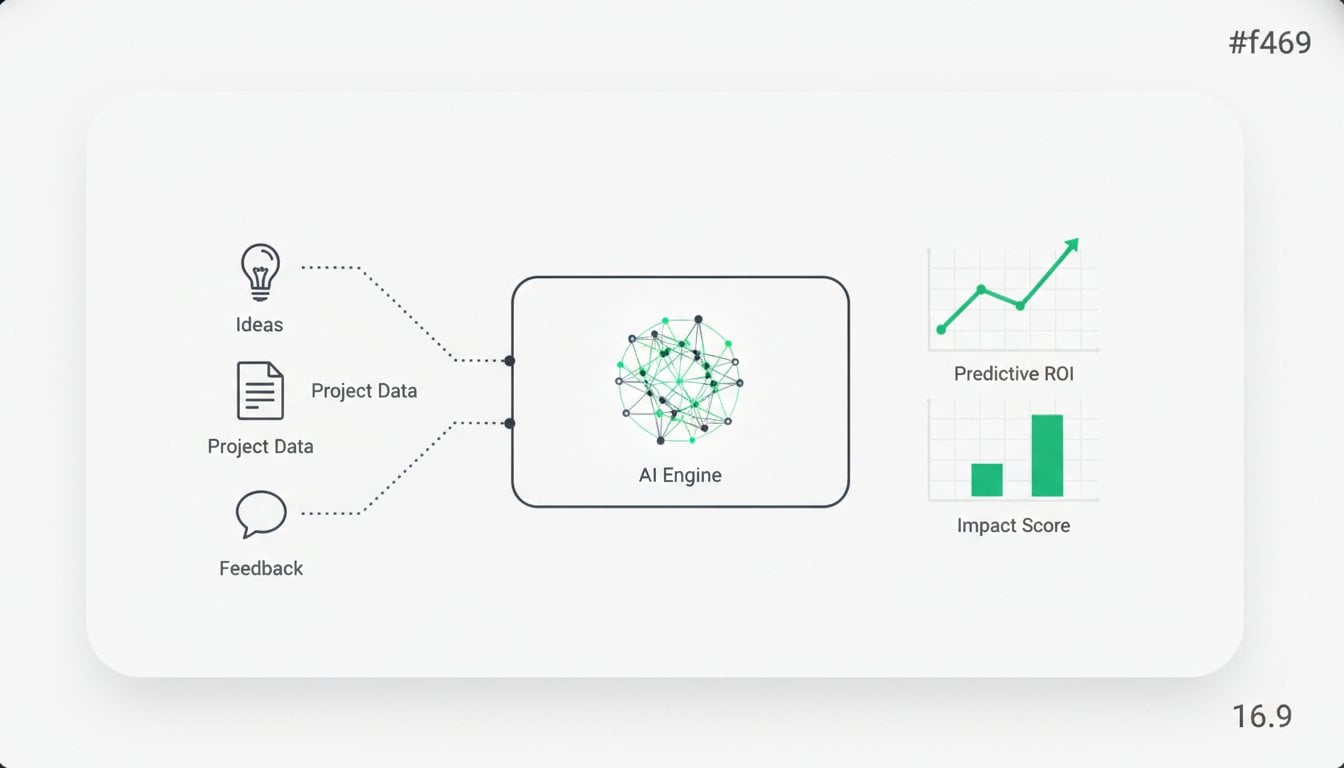
The technical mechanism behind this involves continuous data synchronization. Instead of waiting for quarterly reviews, machine learning models analyze thousands of historical data points to identify patterns in successful projects. They recognize team compositions or initial budget allocations that typically lead to high returns. This predictive capability ensures that resources are directed toward projects with the highest statistical probability of delivering a return, effectively using AI to measure innovation ROI before a project even leaves the ideation phase.
Automated Data Capture for Idea Management
Manual data entry is the primary cause of the data decay that plagues legacy systems. Modern AI tools for innovation managers bypass this by pulling data directly from the source. Through seamless integrations with ERP and CRM systems, these platforms track implementation costs against projected savings in real time. This creates a closed-loop system where financial data flows automatically, ensuring that the Chief Innovation Officer always has a live view of the portfolio’s performance. It’s a significant shift from the static reports that once gathered dust in management folders.
Standardizing the Idea Evaluation Process
Subjectivity often kills great ideas because human evaluators are prone to internal politics or risk aversion. Algorithmic weighting helps reduce the cognitive bias that typically plagues manual reviews. By applying a standardized idea evaluation and scoring model, AI identifies “hidden gems” that might be overlooked by human evaluators focused solely on short-term gains. This objective approach is a key component of a broader 5-Step Framework for Measuring Innovation, which emphasizes the need for consistent, data-backed metrics across the entire organization. If you’re still relying on manual scoring, you’re likely missing out on significant value. You can schedule a personalized platform walkthrough to see how automated scoring can refine your pipeline.
Predictive Analytics: Moving from Post-Mortems to Value Forecasting
Historical reporting is an autopsy. It tells you why a project died but does nothing to save the patient. Predictive analytics shifts the focus from what happened to what is likely to occur. By using AI to measure innovation ROI, organizations move beyond static spreadsheets into dynamic forecasting. One powerful method involves Monte Carlo simulations, which run thousands of “what-if” scenarios to predict the probability of a project’s success based on variables like market saturation and resource availability. This approach provides a robust framework for measuring AI ROI by identifying potential financial outcomes before significant capital is committed.
This shift helps eliminate “Technical Debt.” When you can see a project’s declining probability of success in real time, you can kill low-value initiatives before they drain your budget. Modern AI driven innovation software acts as a filter, highlighting market winners while flagging projects that no longer align with strategic goals. It’s a proactive way to manage your portfolio that ensures every dollar spent is backed by data-driven confidence.
Forecasting Financial Impact Before Implementation
Predictive modeling requires different benchmarks for incremental vs. radical innovation. Incremental projects often have higher success probabilities but lower returns, while radical shifts carry more risk. AI models account for these differences by simulating various budget allocation scenarios. This real-time forecasting builds stakeholder confidence because it replaces gut feelings with statistical evidence. When you can show a CFO a 75% probability of a specific return based on live data, securing additional funding becomes a conversation about math rather than faith. To better understand the investment required for these specialized systems, you can explore AI Transformation Consulting and Custom Solution Development Fees to see how AITHENTIC supports enterprise-wide implementation.
Identifying and Mitigating Innovation Failures
Failure is an expensive teacher. However, by analyzing past innovation failures, AI models learn the early warning signs of a project in distress. These systems act as a tripwire for projects that exceed their ROI payback period or fail to hit key milestones. Using AI to measure innovation ROI creates an early warning system that protects your capital. Predictive ROI is a risk-mitigation tool that protects your capital by providing objective data to pivot or stop projects that are statistically unlikely to succeed. It ensures that your innovation portfolio isn’t just a list of ideas, but a curated set of high-probability financial assets.
A 5-Step Framework for Implementing AI-Driven ROI Tracking
Accountability in innovation isn’t accidental. It requires a rigorous, five-phase approach to ensure every idea is tracked from its inception to its final impact on the balance sheet. Phase 1 starts with centralizing your innovation database to create a “Single Source of Truth.” This eliminates the data silos that typically obscure the true cost of development. Phase 2 involves defining your Hard and Soft ROI KPIs within your AI model, ensuring you capture both direct financial gains and indirect cultural benefits. Using AI to measure innovation ROI effectively requires this level of foundational clarity before any analysis begins.
Phase 3 integrates these measurement parameters into the idea submission process, allowing the system to perform automated value tagging from the start. Phase 4 establishes a feedback loop where implementation data is fed back into the AI engine to refine future predictions. Finally, Phase 5 involves scaling this framework across the entire enterprise to ensure every business unit speaks the same financial language. This systematic approach ensures that your innovation portfolio remains lean, focused, and consistently profitable.
Laying the Data Foundation
The choice between ideawake vs. spreadsheets is a choice between growth and stagnation. Spreadsheets lack the version control and real-time synchronization required for modern enterprise reporting. By mapping diverse data sources, from frontline employee suggestions to operational savings, you create a robust environment for AI to operate. Security is paramount here; you must ensure your system maintains strict data privacy standards while aggregating these high-value insights.
Defining High-Impact ROI Metrics
Precision is everything. You must move beyond surface-level participation rates and focus on calculating labor cost reductions through automation while measuring the benefits of employee ideation programs on employee retention. These metrics provide a holistic view of value that satisfies both the CFO and HR. Using AI to measure innovation ROI allows you to plug these variables into an ROI calculator for automated, real-time tracking that proves the worth of your innovation pipeline.
Ideawake: The Modern Engine for Real-Time Innovation ROI
Ideawake is engineered to eliminate the administrative complexity that traditionally suffocates innovation departments. Its modern architecture provides a unified environment where high-velocity measurement isn’t just possible; it’s the standard. By using AI to measure innovation ROI, the platform transforms thousands of raw submissions into a prioritized list of financial assets. Real-time dashboards provide an immediate translation of employee activity into hard financial impact reports, giving leadership the visibility they’ve lacked for decades. This level of transparency ensures that innovation is managed with the same financial rigor as any other core business function.
Administrative overhead is one of the biggest silent killers of innovation ROI. Ideawake addresses this by offering automated workflows that reduce manual tasks by 40%. This efficiency allows innovation managers to focus on high-value strategy rather than chasing data in spreadsheets. Using AI to measure innovation ROI allows you to maintain a lean operation while scaling your output. These data-backed implementation strategies ensure that once an idea is validated, the path to market is clear and statistically optimized for success.
Beyond the Suggestion Box: A Strategic Partner
Take Control of Your Innovation Pipeline
Success in 2026 requires more than just a collection of good thoughts. It demands a structured implementation process that tracks every dollar from submission to savings. Ideawake provides the tools to move beyond the experimentation phase and into a state of predictable growth. You can start with a data-driven trial to see how these predictive tools can refine your specific pipeline and reduce your risk profile. Don’t let your best ideas get lost in the noise of manual reporting.
Standardizing Financial Accountability in Innovation
The transition from manual, error-prone spreadsheets to automated data capture is no longer optional. Organizations that fail to adapt are essentially operating in the dark, losing critical insights to data decay and administrative friction. By using AI to measure innovation ROI, you transform your pipeline from a series of high-stakes guesses into a predictable financial engine. Predictive analytics allow you to identify and kill low-value projects early, preserving capital for high-impact initiatives that drive genuine EBITDA growth.
To further verify the logic and reasoning behind these institutional capital decisions, you can visit askOdin to explore their AI-driven judgment infrastructure.
Ideawake provides the end-to-end visibility required to satisfy strict 2026 financial requirements. It’s a platform built to track millions in OpEx savings while ensuring every employee suggestion is evaluated with objective, algorithmic precision. You don’t have to settle for “soft” metrics when hard financial data is within reach. It’s time to leverage the tools that turn raw creativity into a measurable balance sheet asset.
Take control of your innovation destiny and stop treating organizational growth as a happy accident. With the right data-driven framework, your next breakthrough is a matter of math, not luck.
Frequently Asked Questions
How does AI actually calculate the ROI of an idea before it is implemented?
AI calculates pre-implementation ROI by correlating current idea attributes with historical success data. It uses machine learning to identify patterns in team composition, project scope, and initial budget that previously led to profitable outcomes. By running Monte Carlo simulations, the system assigns a probability score to the projected financial impact. This allows leaders to prioritize initiatives based on statistical likelihood rather than subjective intuition.
What is the difference between “Hard ROI” and “Soft ROI” in innovation management?
Hard ROI refers to tangible financial gains such as EBITDA growth, OpEx savings, or direct revenue from new products. Soft ROI encompasses intangible benefits like improved employee engagement, cultural shifts toward experimentation, and talent retention. While traditional methods struggle to quantify the latter, modern platforms use sentiment analysis and engagement metrics to assign a data-backed value to these cultural improvements, ensuring they aren’t ignored during budget reviews.
Can AI accurately measure ROI for incremental innovations like process improvements?
AI is exceptionally effective at measuring ROI for incremental innovations because these projects often have clear, existing benchmarks. By analyzing process data before and after an improvement, the system calculates precise labor cost reductions or waste elimination. Using AI to measure innovation ROI in these process improvements provides a closed-loop reporting system that tracks minor efficiency gains that usually go unnoticed in manual spreadsheets.
Do I need a large data set to start using AI for innovation measurement?
You don’t need decades of data to begin. Most platforms use pre-trained models and industry benchmarks to provide initial insights while your specific organizational data matures. As you feed more implementation results back into the system, the predictive accuracy increases through a continuous feedback loop. Starting early allows the engine to begin identifying patterns in your specific business environment, eventually creating a highly customized ROI forecasting model.
How does AI-driven ROI tracking help with innovation budget approval?
Using AI to measure innovation ROI replaces speculative pitches with data-backed financial forecasts that satisfy strict CFO requirements. It provides real-time visibility into the innovation funnel, showing exactly how much value is being generated at each stage. When you can present a report showing a high probability of a specific return based on historical performance, budget approval transitions from a negotiation into a logical capital allocation decision.
Is AI measurement more accurate than traditional financial reporting for innovation?
AI measurement is significantly more accurate because it eliminates the data decay rate associated with manual entry and human error. Traditional financial reporting is often a retrospective analysis that looks backward. In contrast, AI provides real-time, objective analysis that reduces cognitive bias in project scoring. It creates a single source of truth that captures every dollar of impact, ensuring that no value is lost across departmental silos.
What are the most important KPIs to track using AI in an innovation program?
The most critical KPIs include total pipeline value, implementation velocity, and projected vs. actual OpEx savings. AI also allows you to track project success probability and “Time to Value,” which measures how quickly an idea moves from submission to financial impact. By monitoring these metrics through an automated dashboard, leadership can maintain an agile portfolio that reallocates resources away from underperforming projects toward those with the highest verified potential.