

A strategy that never reaches the front line is just paperwork. An operational excellence management system connects organizational goals to everyday work, giving leaders and employees a shared way to improve processes, quality, safety, and customer experience. It brings responsibilities, performance measures, and regular reviews into one system, making improvement part of how work gets done.
That takes more than choosing a method or setting a target. The system must align daily management with broader priorities, make performance visible, and give employees a practical way to raise and address problems. This guide explains how it works, what it is designed to achieve, and how Lean, Six Sigma, and Kaizen can support improvement. You’ll also learn how daily management connects plans to consistent action.
Key Takeaways
- Connect strategic priorities to daily work with clear ownership, performance measures, and regular review.
- Use recognized standards, such as ISO 9001, as reference points when shaping a system around your organization’s needs.
- Choose improvement methods based on the problem: Lean targets waste, Six Sigma focuses on variation and defects, and Kaizen supports ongoing incremental change.
- Use a Plan-Do-Check-Act cycle to set actions, carry them out, review results, and refine procedures.
- Align daily management across teams so employees can surface problems, follow standards, and contribute improvement ideas.
What Is an Operational Excellence Management System (OEMS)?
An operational excellence management system connects strategic priorities with the routines, standards, and decisions that shape daily work. It gives leaders and employees a shared structure for improving quality, productivity, and customer experience.
Leadership and Improvement Culture
Leadership and improvement culture shape how continuous improvement becomes part of everyday work. Leaders’ choices signal whether employees are encouraged to raise problems, test better approaches, and learn from results.
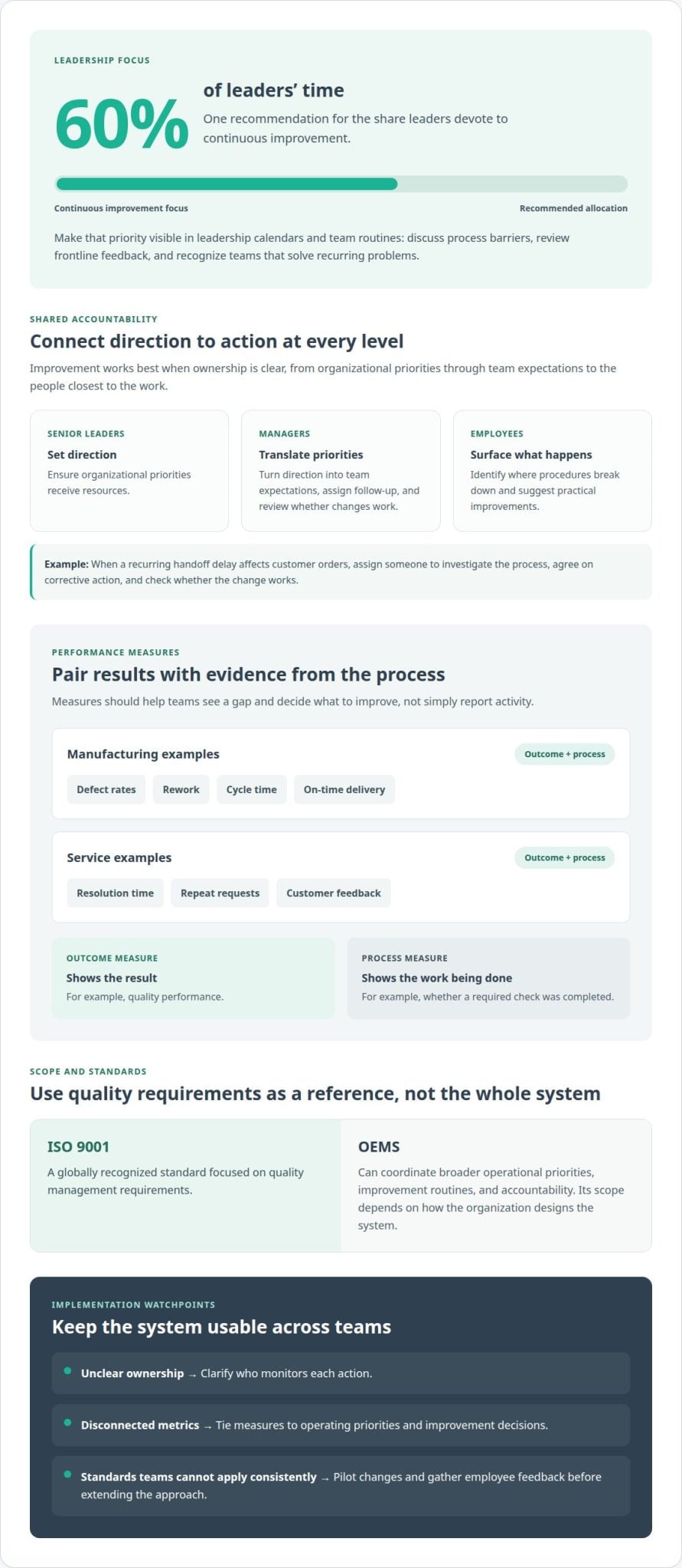
A useful starting point is to make improvement visible in leadership calendars and team routines. One recommendation is for leaders to spend 60% of their time on continuous improvement. Leaders can reinforce that priority by discussing process barriers, reviewing frontline feedback, and recognizing teams that solve recurring problems. The continuous improvement approach works best when those actions connect to clear operating priorities, rather than becoming a separate initiative.
Accountability for Operational Excellence
Accountability means assigning ownership for performance standards, improvement actions, and follow-up decisions. Without an owner, an issue can persist across shifts, teams, or locations.
Senior leaders set direction and ensure priorities receive resources; managers translate those priorities into team expectations. Employees closest to the work can spot where procedures break down and suggest practical changes. For example, if a recurring handoff delay affects customer orders, a manager can assign someone to investigate the process, agree on corrective action, and review whether the change works. This creates shared responsibility without making improvement solely a leadership task.
Metrics and Performance Indicators
Metrics and key performance indicators show whether operational priorities are producing stronger results. They are most useful when they help teams identify a gap and decide what to improve, rather than simply report activity.
Useful measures depend on the operation and its goals. A manufacturing team might monitor defect rates, rework, cycle time, and on-time delivery; a service team might track resolution time, repeat requests, and customer feedback. Pair outcome measures, such as quality, with process measures, such as whether a required check was completed. Leaders can then see what changed and which part of the work needs attention.
ISO 9001 is an example of a globally recognized standard relevant to an operational excellence management system, according to the International Organization for Standardization. ISO 9001 focuses on quality management requirements, while an operational excellence management system can coordinate broader operational priorities, improvement routines, and accountability. Business management systems may cover additional organizational functions, so the scope depends on how the organization designs its system.
Common implementation risks include unclear ownership, disconnected metrics, and standards that teams cannot apply consistently. Leaders can reduce these risks by piloting changes, gathering employee feedback, and clarifying who monitors each action before extending the approach across the organization.
What Is an Operational Excellence Management System (OEMS)?
An operational excellence management system connects strategic priorities with the routines, standards, and decisions that shape daily work. It gives leaders and employees a shared structure for improving quality, productivity, and customer experience. In practice, it clarifies how teams identify process problems, assign actions, and assess whether changes support organizational goals.
Leadership and Improvement Culture
Leadership and improvement culture shape how continuous improvement becomes part of everyday work. Leaders’ choices signal whether employees are encouraged to raise problems, test better approaches, and learn from results. A written standard alone cannot show teams how to respond when actual work differs from the documented process.
A useful starting point is to make improvement visible in leadership calendars and team routines. One recommendation is for leaders to spend 60% of their time on continuous improvement. Leaders can reinforce that priority by discussing process barriers, reviewing frontline feedback, and recognizing teams that solve recurring problems. The continuous improvement approach works best when those actions connect to clear operating priorities. For example, a manager can make an unresolved process barrier a standing agenda item and assign follow-up to the relevant team.
Accountability for Operational Excellence
Accountability means assigning ownership for performance standards, improvement actions, and follow-up decisions. Without an owner, an issue can persist across shifts, teams, or locations.
Senior leaders set direction and ensure priorities receive resources; managers translate those priorities into team expectations. Employees closest to the work can spot where procedures break down and suggest practical changes. For example, if a recurring handoff delay affects customer orders, a manager can assign someone to investigate the process, agree on corrective action, and review whether the change works. This creates shared responsibility without making improvement solely a leadership task.
Metrics and Performance Indicators
Metrics and key performance indicators show whether operational priorities are producing stronger results. They are most useful when they help teams identify a gap and decide what to improve, rather than simply report activity.
Useful measures depend on the operation and its goals. A manufacturing team might monitor defect rates, rework, cycle time, and on-time delivery; a service team might track resolution time, repeat requests, and customer feedback. Pair outcome measures, such as quality, with process measures, such as whether a required check was completed. Leaders can then see what changed and which part of the work needs attention.
ISO 9001 is an example of a globally recognized standard relevant to an OEMS, according to the International Organization for Standardization. ISO 9001 focuses on quality management requirements, while an OEMS can coordinate broader priorities, improvement routines, and accountability. Business management systems may cover additional organizational functions, so their scope depends on how an organization designs and connects its processes.
Common implementation risks include unclear ownership, disconnected metrics, and standards that teams cannot apply consistently. Leaders can reduce these risks by piloting changes, gathering employee feedback, and clarifying who monitors each action before extending the approach across the organization. This makes gaps visible while there is still time to adjust processes and responsibilities.
Lean, Six Sigma, Kaizen, and related tools
Lean, Six Sigma, and Kaizen help teams translate strategic priorities into practical improvement actions. An operational excellence system can combine them, matching each method to the problem instead of treating one tool as a universal fix.
Match the Method to the Problem
Six Sigma provides a structured way to investigate variation and defects. General Electric implemented Six Sigma to enhance process quality and reduce defects across its manufacturing units. A team could define a defect precisely, examine where it occurs, and use process data to identify contributing factors before testing a countermeasure. This approach is useful when inconsistent results persist despite clear work instructions.
Kaizen emphasizes ongoing, incremental improvement involving the people who do the work. A team might use a shift handoff to surface a recurring equipment setup problem, test a small adjustment, and record its effect. The value lies in learning through manageable changes, not launching a major redesign for every issue.
Use Root-Cause Tools Before Choosing Actions
The 5 Whys and fishbone diagrams help teams investigate underlying causes instead of treating visible symptoms. If a shipment leaves late, a fishbone diagram can organize possible causes across staffing, materials, equipment, and procedures. The 5 Whys then helps trace a specific delay to a process cause, such as an unclear release step. Teams can select actions that address the cause and monitor whether the problem recurs.
The Shingo Model adds principles that connect methods to organizational behavior: quality at the source, customer value, a zero-inventory supply chain, and understanding the workplace at all levels. These principles help leaders assess whether a proposed improvement supports the broader system. Dr. Shigeo Shingo published 18 books on his business philosophy, reflecting a body of work focused on improvement and operational practice.
There is no need to force every tool into every initiative. A team confronting excess process steps may start with Lean; a team investigating recurring defects may use Six Sigma; employees identifying small daily frustrations may apply Kaizen. For sustainability, 3M’s Pollution Prevention Pays program has prevented more than 2.66 million tons of pollutants, while its long-running process improvement and sustainability work has saved nearly $2.3 billion USD. These examples show how improvement methods can address both operational and environmental priorities.
Let the strategic objective guide method selection: define the issue, choose a suitable tool, test targeted actions, and review the result. This keeps improvement practical and focused on outcomes that matter to the operation.
Management system cycle
A management system needs a repeatable cycle for turning priorities into action and learning from results. Plan-Do-Check-Act (PDCA) provides a practical structure for setting goals, carrying out measures, auditing work, and reviewing procedures.
Implementation follows a clear sequence: define the operating priority, pilot a response, review the evidence, then refine and expand the practice.
- Plan: Define the performance issue and the outcome the team needs. For example, a distribution center might address recurring order-picking errors. Set an action plan, identify who owns each action, and choose a measure that shows whether errors are changing. Record the current procedure and conditions that could affect the result, such as staffing patterns or material availability.
- Do: Carry out the planned measures in a pilot area before launching them across the organization. A warehouse team could test a revised picking sequence in one workflow, brief affected employees, and record where the new practice differs from the plan. A pilot makes operational friction visible while the scope remains manageable. It also gives employees a specific opportunity to report unintended effects.
- Check: Compare the observed result with the objective, and audit whether the agreed procedure is being followed. If errors continue, examine whether the cause lies in the sequence, training, materials, or another process condition. An audit should identify gaps and evidence, not simply confirm that a form was completed. The review should distinguish between a weak countermeasure and inconsistent execution.
- Act: Use the review to adjust the procedure, clarify responsibilities, or select another countermeasure. If the pilot shows the revised sequence is practical and supports the objective, leaders can standardize it and plan how to extend it. If it fails to address the issue, return to planning with what the test revealed. Documenting the decision helps other teams understand what changed and why.
The cycle also needs a defined review rhythm. Leaders should review the system and its achievements annually, then assess whether objectives, measures, and procedures still fit operational priorities. A review can examine unresolved actions, audit findings, recurring problems, and lessons from pilots. It should identify practices that need clearer ownership or follow-up, keeping the system useful instead of letting it become static documentation.
Feedback matters during both the pilot and wider rollout. Employees can explain where a proposed change creates delays, conflicts with another procedure, or complicates a handoff. Gathering their input before organization-wide implementation gives leaders time to refine actions and establish workable standards. Without this feedback loop, a change may be formally launched but fail to become consistent practice across teams.
PDCA supports efficiency by making review part of execution, not a separate cleanup exercise. Success depends on clear objectives, assigned action owners, evidence from the work, and decisions that change practice when results call for it. This discipline makes each cycle a useful test of how well the operation performs and adapts.
Daily management systems and organizational alignment
Daily management connects organizational priorities with the decisions employees make in routine work. It works best when strategic objectives, team measures, and frontline actions are clearly linked.
Consider a manufacturer focused on improving delivery reliability. Executives set the priority, site leaders translate it into operating goals, and production teams track issues affecting completed orders. A daily review connects missed targets to specific causes, such as a delayed material handoff or an unclear work instruction. Each level can act within its authority while keeping the shared objective in view.
Alignment takes more than cascading targets. Teams should understand how their measures affect other groups’ work. If production increases output while inspection capacity stays fixed, completed units may wait for review. A shared view of production flow, inspection queues, and delivery status helps leaders see the trade-off and coordinate a response across departments.
Daily huddles and visual management make this coordination practical. A team might review its current performance measure, flag a deviation, assign an owner, and record the next action. A meeting is useful when it resolves a work issue or escalates a barrier, not when it repeats status reports without decisions. Consistent routines engage employees by giving them a clear way to raise obstacles and follow up.
Layered process audits help verify that agreed standards are followed and issues are corrected before they recur. For example, supervisors can check whether teams follow a critical equipment procedure, record a gap, and track its correction. Audit findings can also show where a standard is impractical, prompting leaders to revise the process instead of blaming employees for workarounds.
To implement the system across a large organization, define the alignment chain in plain terms: enterprise objective, site or function contribution, team measure, and frontline action. Then decide who reviews each measure, how teams escalate blocked work, and where decisions are recorded. This structure helps prevent local improvements from undermining broader priorities.
Software can support the system by bringing measures, action owners, audit findings, and employee input into a shared view. It should make work easier to understand, not add another reporting burden. For example, when a team identifies a recurring handoff problem, a common record can capture the issue, assigned action, and outcome for other teams facing the same challenge. The key is to align the measures, routines, and escalation paths people use to deliver results.
Ideawake: Innovation Management Platform
Ideawake’s Innovation Management Platform helps organizations capture, evaluate, and implement ideas from employees, customers, and partners. It fits when improvement depends on engaging people across teams and giving promising suggestions a path from submission to action. Voting, leaderboards, prizes, and AI features support participation and idea review, while a shared process helps teams manage ideas through the innovation lifecycle.
For an operational excellence program, this can help collect frontline proposals, organize evaluation, and track which ideas move toward implementation. It complements daily management by creating a structured channel for suggestions that might otherwise remain within one team or location. Contact Ideawake to discuss how its platform could support your organization’s improvement goals.
Turn Improvement Into a Shared Practice
The next step is to make improvement accessible beyond the teams already involved. An operational excellence management system can provide direction, but employees also need a clear way to contribute ideas, identify opportunities, and help move promising changes forward.
Ideawake offers an Innovation Management Platform, an Idea Management Platform, and Continuous Improvement tools. These offerings help organizations create a more structured path for employee input, evaluation, and implementation. The right starting point depends on where your improvement process needs stronger participation or follow-through.
Consider which gap matters most now: collecting ideas across teams, evaluating them consistently, or connecting selected ideas to action. A focused conversation can help clarify how an idea management approach fits alongside your existing improvement practices.
Your next operational improvement can start with a clearer path for people to contribute. Build that path with purpose and keep progress moving.
Frequently Asked Questions
What is an operational excellence management system?
An operational excellence management system is the coordinated structure an organization uses to manage performance and improve how work is done. It links priorities, responsibilities, processes, and review practices. For example, a company with recurring order errors can use the system to find where they occur, assign an investigation, and decide how to assess a proposed change. The system supports consistent management rather than relying on isolated improvement projects.
What are the core elements of an operational excellence management system?
Core elements include clear governance, defined processes, performance measures, assigned responsibilities, and mechanisms for reviewing risks and improvement actions. Organizations also need document control, so employees can identify the current procedure and understand how updates are approved. For example, a site may keep an approved maintenance procedure, record revisions, and assign a role to review audit findings. These elements help connect local decisions with organization-wide expectations.
What operational excellence frameworks are commonly used, such as Lean, Six Sigma, and Shingo?
Lean, Six Sigma, and the Shingo Model are commonly used frameworks, each offering a different perspective on improvement. Lean examines process flow and waste, Six Sigma focuses on defects and variation, and the Shingo Model connects operational principles with organizational behavior. A team might use Lean to locate a bottleneck, Six Sigma to investigate inconsistent outcomes, and Shingo principles to assess whether a proposed change reinforces customer value.
What software supports operational excellence management, and what does it cost?
Software can support operational excellence by organizing performance information, documenting improvement work, assigning action owners, and making progress visible across teams. Costs depend on the software’s scope, user access, workflows, integrations, and support requirements. For an enterprise, the deciding factor is whether the system fits existing processes and governance needs, not simply how many features it includes. Compare the work it enables with the effort required to administer it.
How can organizations build a culture of continuous improvement and employee engagement?
Organizations build a continuous improvement culture by making it safe and worthwhile for employees to raise problems, then responding visibly to their input. For example, after a frontline employee flags a confusing approval step, a manager can explain whether the process will change, who owns the review, and what happens next. Closing the feedback loop shows that participation leads to decisions, even when an idea is not adopted.
What U.S. regulations or industry standards affect operational excellence management systems?
ISO 9001 is a globally recognized standard relevant to an OEMS, and IATF 16949 is an example of a third-party certification audit standard. The material does not identify specific U.S. regulations.