
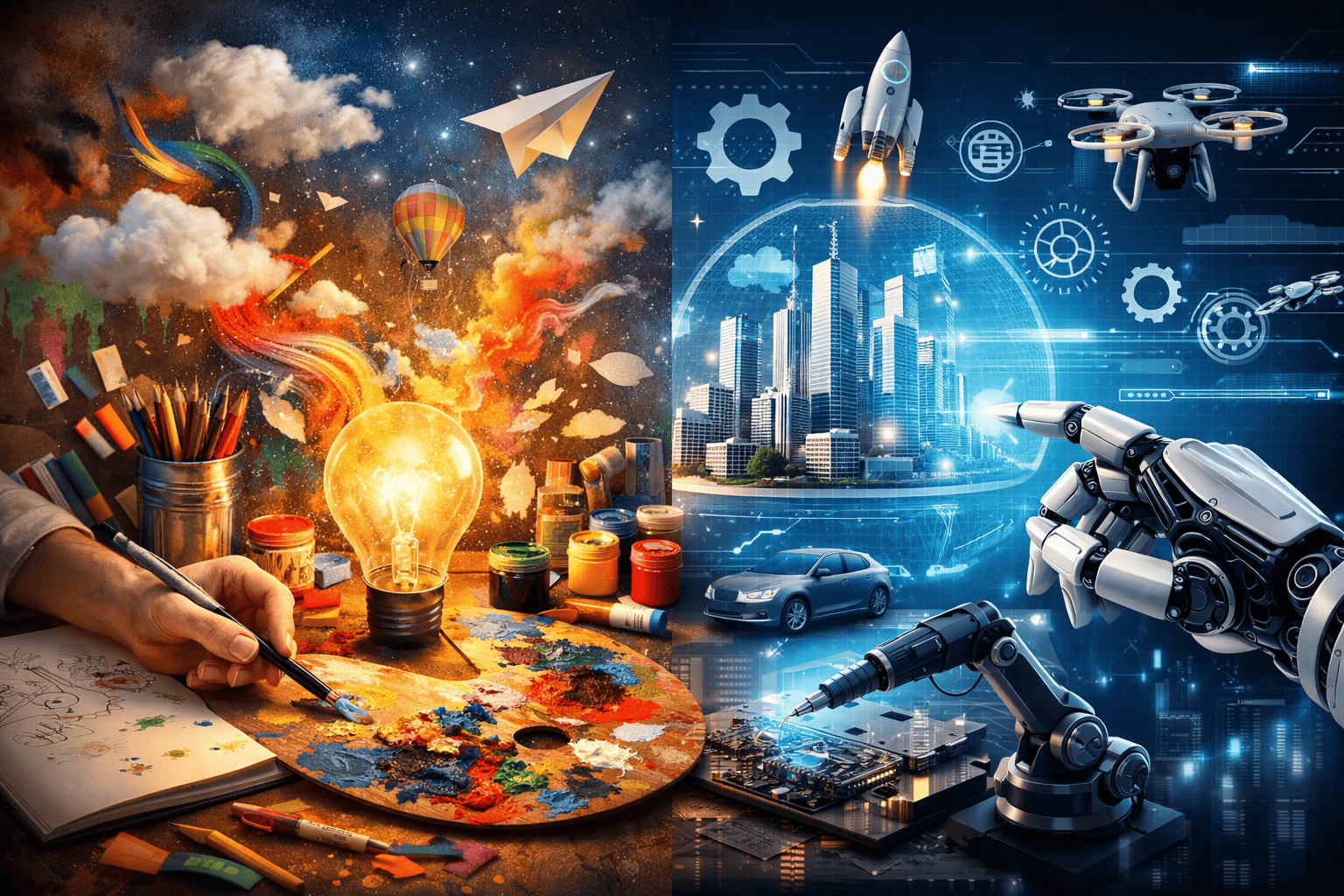
People often use “creativity” and “innovation” as if they mean the same thing. They don’t. When teams confuse them, they get predictable problems: lots of brainstorming, very little shipping, or constant execution with no fresh thinking. If we want consistent results, we need a clear definition of both, plus a practical bridge that turns creative ideas into real outcomes.
Creativity is the ability to generate original ideas and possibilities. It’s the “what if” thinking that produces concepts, fresh angles, and unexpected connections. Innovation is the disciplined work of implementing those ideas into solutions that create value in the real world.
Innovation becomes visible when something is adopted: a product ships, a process changes, customers choose it, costs drop, quality improves, or time-to-market accelerates.
This article breaks down the difference between creativity and innovation with examples, shows how invention fits in, and lays out a simple process we can use to move from ideas to implementation.
Quick definition
Creativity is about generating new ideas and possibilities. Innovation is about implementing those ideas in a way that creates measurable value.
Creativity can exist on its own. We can be creative and produce a hundred interesting concepts without changing anything.
Innovation can’t exist without some creative input, because innovation needs a new approach, whether it’s a new product feature, a better workflow, or a smarter business model.
Creativity: what it produces

Creativity produces options. The output is usually intangible at first: a concept, a sketch, a new way of describing the problem, a different customer journey, a hypothesis about what customers want, a reframed constraint that opens up new solutions.
Creativity shows up in brainstorming, ideation workshops, early-stage product discovery, design sprints, and problem-solving sessions. It’s often divergent: we expand the space of possibilities before we decide what to pursue.
Innovation: what it produces

Innovation produces outcomes that are implemented and used. The output is tangible: a product, service, process, system, or business model that works in practice. It survives real constraints: budget, time, compliance, engineering limits, customer acceptance, and operational reliability.
Innovation is collaborative by nature. It usually needs cross-functional coordination—product, engineering, operations, finance, legal, marketing, customer support—because implementation rarely belongs to one person or one team.
The difference between creativity and innovation in business
The simplest way to understand the difference between creativity and innovation is to separate idea generation from execution and adoption. Creativity produces potential. Innovation produces realised value.
Idea generation vs execution and adoption
Creativity creates a list of possible solutions. Innovation selects the best candidate, proves it works, and gets it into the hands of users.
This distinction matters because the skills and incentives are different. Creativity benefits from psychological safety, time to explore, and openness to “bad” ideas that can lead to good ones. Innovation benefits from clarity, prioritisation, decision-making, and accountability. If we ask a team to do both at the same time, we often get weak ideation and weak execution.
Novelty vs value creation
Creativity is not required to be useful. A creative idea can be original and interesting without solving a problem. Innovation must create value. Value can be external (customers adopt it, revenue increases, retention improves) or internal (cycle time drops, errors decrease, compliance becomes easier, costs reduce, service levels improve).
A clever concept that no one uses is creativity. A solution that gets adopted and changes outcomes is innovation.
Individual spark vs cross-functional delivery
Creativity can happen alone. Innovation rarely can. Even if the original idea comes from a single person, implementation requires coordination across roles. That’s why organisations can have highly creative employees and still fail at innovation: the system doesn’t convert ideas into action.
A simple comparison that makes the difference obvious
Creativity and innovation differ across several dimensions:
Creativity focuses on generating ideas, exploring possibilities, and reframing problems. Innovation focuses on implementing, validating, and scaling solutions. Creativity is measured by originality and range of options. Innovation is measured by adoption and impact. Creativity can be fast and lightweight. Innovation requires resources and trade-offs. Creativity can be individual. Innovation is usually cross-functional.
We can be creative without innovating. We can’t innovate well without creative input, because execution without fresh thinking becomes incremental and repetitive.
Creativity and innovation examples
Examples make the difference between creativity and innovation easier to see. A good way to structure examples is: creative insight → what changed → innovation outcome.
Example 1: Product and customer experience
Creative insight: Customers abandon onboarding because the process feels confusing and slow.
What changed: We redesign the onboarding flow with fewer steps, clearer instructions, and better in-app guidance.
Innovation outcome: Completion rates increase, support tickets drop, and time-to-value improves.
The creative part is identifying and reframing the problem. The innovation part is building the improved flow, validating it, rolling it out, and measuring the impact.
Example 2: Process innovation inside a company
Creative insight: Approvals are slow because requests bounce between teams with missing information.
What changed: We create a standard intake form with required fields, clear ownership, and automated routing.
Innovation outcome: Cycle time reduces, fewer rework loops occur, and teams spend less time chasing details.
Again, the creativity is spotting the root cause and proposing a new approach. The innovation is implementing it in the real workflow, training users, and confirming results.
Example 3: Business model innovation
Creative insight: Customers want predictable costs and faster purchasing decisions.
What changed: We redesign pricing and packaging into tiered plans with clearer outcomes and fewer custom quotes.
Innovation outcome: Sales cycles shorten, conversion improves, and forecasting becomes more reliable.
Creativity helps us imagine a different model. Innovation makes it real with operational changes, systems updates, and sales enablement.
Creativity vs innovation vs invention
Another common confusion is mixing innovation with invention. They overlap, but they aren’t the same.
Creativity is the generation of ideas. Invention is the creation of a new thing that works for the first time—often a prototype, method, or technical breakthrough. Innovation is the implementation and adoption of something new that creates value at scale.
A working prototype that stays in a lab is invention. When it becomes a reliable product, is manufactured, sold, adopted, and maintained, it becomes innovation. Many inventions never become innovations because scaling is hard. That scaling work—supply chains, reliability, support, compliance, distribution, pricing, training—is the core of innovation.
A fast way to remember the difference is:
Creativity = ideas.
Invention = first workable solution.
Innovation = implemented solution that gets used and delivers value.
Creativity and innovation in entrepreneurship
In entrepreneurship, the difference between creativity and innovation becomes a survival issue. Startups often have no shortage of creative ideas. The constraint is execution, validation, and distribution.
Creativity generates possibilities, but businesses also need a reliable way to evaluate and implement those ideas. An idea management platform helps teams collect suggestions, collaborate on solutions, and identify opportunities worth pursuing. This approach can support more effective employee innovation programs across the organization.
Why entrepreneurs need both
Creativity helps entrepreneurs spot opportunities, see unmet needs, and differentiate. It supports positioning, storytelling, and product design. Innovation is what turns that advantage into a business: building something people pay for, delivering it reliably, improving it, and scaling operations.
Entrepreneurs who are only creative tend to stay in concept mode. Entrepreneurs who only execute often build the wrong thing quickly. Strong startups combine creativity with innovation discipline: learn fast, decide fast, ship what works, and stop what doesn’t.
Where startups fail
Two failure modes show up repeatedly.
First, strong ideas without validation. Teams fall in love with a concept, build for months, and then discover customers don’t care or won’t pay.
Second, shipping without a clear problem. Teams build features because they can, not because they solve a real pain point. That produces activity, not progress.
Innovation reduces both risks by forcing evidence-based decisions.
Turning creativity into innovation: the missing middle
Most organisations don’t fail because they lack creativity. They fail because they lack a bridge from ideas to outcomes. A structured idea management platform can provide that bridge by helping teams capture ideas, improve them through collaboration, evaluate the strongest opportunities, assign ownership, and move selected ideas toward implementation.
A practical process from ideas to implemented results
We can structure the creativity-to-innovation path into seven steps:
- Capture real problems, not just ideas.
High-value innovation starts with pain points: customer complaints, churn drivers, sales objections, support volume, quality issues, compliance burdens, or long cycle times. When we start with problems, ideas become easier to evaluate. - Improve ideas through collaboration.
Raw ideas are often incomplete. We refine them by adding context: who it helps, why it matters, what constraints exist, and what success would look like. This is where creativity still matters, because refinement often requires new angles. - Evaluate with clear criteria.
We use simple criteria to reduce debate: strategic fit, expected impact, feasibility, risk, dependencies, and time-to-learn. The goal is to sort quickly and fairly, not to predict the future with false precision.
As idea volume grows, consistent evaluation can become difficult to manage manually. AI for innovation management can support this stage by helping teams identify duplicate submissions, categorize ideas, assist with structured evaluation, and surface promising opportunities for further review. - Prioritise what to test first.
Even good ideas compete for resources. Prioritisation decides what moves forward now versus later. This step prevents the common trap of trying to do everything and finishing nothing. - Validate assumptions with small experiments.
Validation is where innovation becomes real. We test the most uncertain assumptions with low-cost methods: customer interviews, prototypes, landing-page demand tests, pilots in one team, A/B tests, or process simulations. We set a timebox and success criteria so the experiment ends with a decision. - Develop and launch.
Once validated, we build for reliability, not just novelty. This includes documentation, training, change management, and operational readiness—because adoption is the real finish line. - Measure impact and iterate.
Innovation isn’t finished at launch. We track adoption and outcomes, then adjust. If adoption is low, we fix friction. If impact is smaller than expected, we find why. This is how innovation stays tied to value.
What validation looks like in practice
Validation does not have to be complex. The key is to test the riskiest assumption first.
If we’re unsure customers want the solution, we test demand with interviews, prototypes, or sign-up intent. If we’re unsure it’s feasible, we build a technical spike. If we’re unsure it will improve outcomes, we pilot it in a controlled environment and measure the change.
Validation is the difference between ideas that feel exciting and solutions that deserve investment.
Common blockers that stop creativity becoming innovation
Most blockers are predictable.
One is ownership. If no one owns implementation, ideas stay ideas. Another is capacity. Teams want to innovate, but they have no time or budget for experiments. Another is unclear decisions. If leaders don’t define criteria and decision rights, work stalls in endless discussion. Another is focusing on idea volume instead of throughput. A long list of ideas can look productive while nothing gets implemented.
A clear process fixes these blockers by making decisions faster and responsibilities explicit.
Workplace implications: how leaders should use both
Creativity and innovation are complementary, but they aren’t interchangeable. Leaders get better results when they know which mode they’re in.
When to optimise for creativity
We optimise for creativity when the problem is unclear, the market is changing, or we need new approaches. Creativity is useful in early discovery, when we’re trying to understand customer needs, identify root causes, or explore new business models.
When to optimise for innovation
We optimise for innovation when we already have a promising direction and need execution. Innovation is useful when we’re validating, building, launching, and scaling. At this stage, consistency, prioritisation, and delivery discipline matter more than generating more options.
What to measure
We should measure creativity and innovation differently.
Creativity signals include participation in ideation, diversity of submissions, and clarity of problem statements. Innovation signals include cycle time from idea to test, validation rate, adoption, and measurable outcomes like revenue lift, cost reduction, or quality improvements.
If we measure creativity by ROI too early, we discourage exploration. If we measure innovation only by participation, we reward activity instead of results.
Where Creativity Becomes Innovation: How Ideawake Helps
Creativity is where ideas are born; innovation is where those ideas get evaluated, funded, implemented, and measured. Ideawake helps teams close that gap by giving you one system to capture raw input, turn it into decision-ready initiatives, and keep execution tied to outcomes so you’re not relying on scattered spreadsheets and one-off decks. If your challenge is choosing the right initiatives and sequencing them across departments, our Portfolio Management Software workflow helps you prioritise by impact, effort, and strategic fit. If your goal is steady, measurable gains in operations, quality, or customer experience, our Continuous Improvement use case shows how teams run repeatable cycles that actually stick. For a quick baseline on what “innovation” really means (and how to define it in a way leaders can align around), this related read is a strong companion: Idea Management Process: 6 Steps to Turn Ideas Into ROI.
Ready to Turn Ideas Into Measurable Results?
Discover how Ideawake helps your organization capture, evaluate, and implement ideas with one powerful innovation management platform.
Schedule Your 30-Minute Demo →Conclusion
Creativity and innovation work together, but they solve different problems. Creativity produces possibilities. Innovation turns selected possibilities into implemented solutions that get adopted and deliver value. When we treat them as the same, we either brainstorm without shipping or ship without thinking.
The bridge is process: clear themes, consistent evaluation, fast validation, and disciplined implementation. With that system in place, creativity becomes useful input, and innovation becomes a repeatable capability. For teams that want to make that transition faster, Ideawake provides the structure to capture ideas, prioritise the right bets, and track them through validation and rollout—so the organisation doesn’t just generate ideas, it delivers results.
FAQs
What is the difference between creativity and innovation?
Creativity is generating original ideas and possibilities. Innovation is implementing those ideas into solutions that create value and get adopted.
Can you have innovation without creativity?
Innovation needs some creative input, even if it’s small. Without new thinking, execution becomes incremental improvement. Creativity can exist without innovation, because ideas can remain unimplemented.
What are examples of creativity and innovation at work?
A creative idea might be a new onboarding concept. Innovation is shipping that onboarding change, rolling it out, and proving it improved completion rates and reduced support tickets.
What’s the difference between creativity, innovation, and invention?
Creativity generates ideas. Invention creates a workable new solution for the first time. Innovation implements and scales a solution so it’s adopted and produces value.
Why are creativity and innovation important in entrepreneurship?
Creativity helps entrepreneurs spot opportunities and differentiate. Innovation is what turns a concept into a business through validation, delivery, and scaling.
How do companies turn creative ideas into innovation?
They use a process: capture real problems, refine ideas, evaluate with criteria, prioritise, validate assumptions with experiments, implement, then measure adoption and outcomes.
How do you measure innovation vs creativity?
Creativity is measured by the quality and breadth of ideas and problem framing. Innovation is measured by throughput, adoption, and outcomes such as revenue, cost reduction, speed, or quality improvements.