
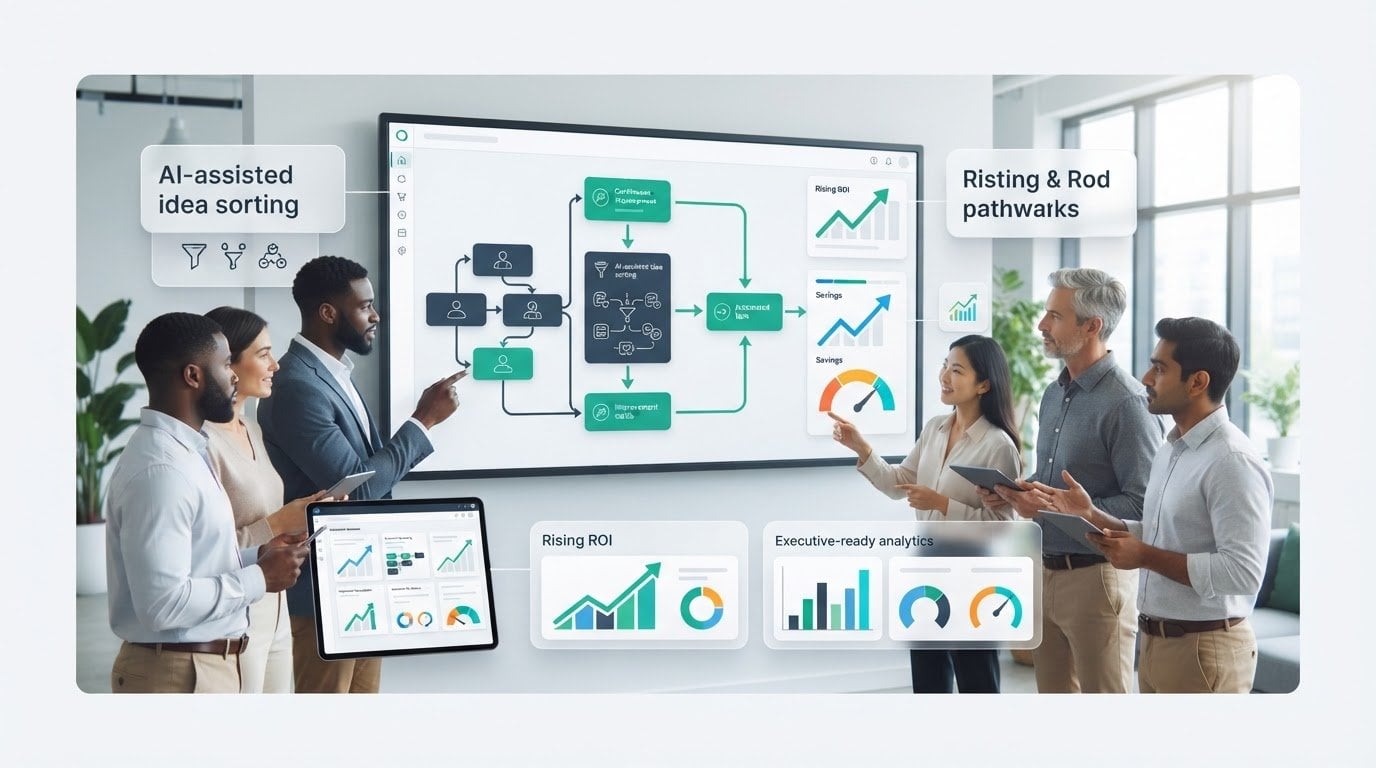
Only 7% of organizations have successfully scaled operational excellence mechanisms enterprise-wide, according to research from McKinsey. Most leaders realize that relying on manual spreadsheets and fragmented email chains to manage growth is a losing strategy. You’re likely tired of seeing high-potential ideas die in administrative bottlenecks or struggling to quantify the financial impact of frontline suggestions. It’s time to demand more from your enterprise continuous improvement tools than just a digital suggestion box.
You’ll discover how to transition from broken feedback loops to a high-impact, AI-driven system that delivers measurable enterprise growth. We’ll examine the shift toward centralized “systems of intelligence” that align with the new ISO 9001:2026 standards, providing a clear roadmap for automated workflows and executive-ready ROI dashboards. This guide breaks down how to use modern idea management software and task-specific AI agents to eliminate administrative overhead, ensuring every improvement contributes directly to your bottom line.
Key Takeaways
- Learn why legacy methods like spreadsheets create a “Chaos Gap” and how to bridge it with a centralized digital system of record.
- Discover how AI-driven evaluation and automated deduplication slash administrative burden by prioritizing the highest-impact improvements.
- Evaluate the total cost of ownership between custom builds and modern enterprise continuous improvement tools to ensure long-term scalability and compliance.
- Follow a proven 5-step implementation roadmap that uses targeted Innovation Challenges to solve specific business problems with frontline insights.
- Master the transition from tracking vanity metrics to hard financial outcomes by using ROI calculators to quantify cost savings for executive buy-in.
The Evolution of Enterprise Continuous Improvement: Why Legacy Methods Fail
The transition from physical suggestion boxes to digital innovation hubs isn’t just a tech upgrade; it’s a survival requirement. For decades, organizations relied on manual continual improvement processes that lived on plant floor whiteboards or in locked wooden boxes. These methods are fundamentally unscalable for the modern enterprise. Today, the “Chaos Gap” occurs when leadership attempts to manage complex operational excellence through spreadsheets and fragmented email threads. These manual systems lack auditability and real-time visibility, causing high-impact ideas to vanish into departmental silos before they ever reach a decision-maker.
Research from McKinsey indicates that roughly 70% of digital transformations fail, often due to poor employee engagement and a lack of structured support. Without dedicated enterprise continuous improvement tools, the momentum of any initiative quickly stalls. This is why forward-thinking organizations are increasingly appointing a Chief Innovation Officer to centralize the CI toolset and ensure that feedback loops remain closed and productive. A centralized platform transforms innovation from a vague cultural goal into a repeatable, data-driven business process.
The Hidden Costs of Fragmented CI Systems
Relying on legacy tools creates a significant administrative burden. Innovation managers often spend up to 40% of their week manually updating status reports or chasing stakeholders for feedback. This overhead isn’t just a waste of talent; it creates a “feedback black hole” where employees stop submitting ideas because they never hear back. When frontline insights are trapped in silos, the organization loses the ability to replicate small wins across different business units, directly impacting the bottom line. This fragmentation prevents the collection of clean data, making it nearly impossible to defend the program’s ROI during budget reviews.
Modern CI in a Hybrid World
The rise of distributed workforces means that innovation management for remote teams must be centralized and accessible from any device. Passive suggestion programs are being replaced by active “Innovation Challenges” that target specific operational bottlenecks. By establishing a single source of truth, enterprise continuous improvement tools allow teams to collaborate on solutions in real-time. This shift ensures that every employee, whether in a corporate office or on a manufacturing floor, has the power to contribute to the organization’s growth. Moving away from passive collection to active problem-solving is what separates high-performing enterprises from those stuck in perpetual pilot mode.
Essential Features of Modern Continuous Improvement Software
Modern software replaces passive suggestion boxes with structured, digital intake systems. These enterprise continuous improvement tools utilize standardized forms to ensure every idea arrives with the necessary context for evaluation. This structure aligns with the continuous improvement model promoted by the American Society for Quality, which focuses on reducing process variation through disciplined data collection. By centralizing this intake, organizations eliminate the “Chaos Gap” where valuable insights are lost to informal conversations or unmonitored email threads.
Leveraging AI for Idea Evaluation
Gartner predicts that 40% of enterprise applications will feature embedded, task-specific AI agents by the end of 2026. Within Ideawake AI, this technology moves beyond simple storage. The platform automatically identifies duplicate submissions and clusters related trends, preventing innovation managers from being buried under repetitive data. By applying automated scoring based on strategic feasibility, the system filters high-impact opportunities to the top. This significantly reduces “review fatigue,” allowing leadership to focus their energy on implementation rather than administrative sorting. It’s a shift from being a data clerk to becoming a strategic architect of change.
Gamification and Engagement Dynamics
Sustaining engagement is often the most difficult hurdle in any CI initiative. Data from McKinsey shows that transformations are 1.4 times more likely to succeed when frontline employees generate the improvement ideas. Modern enterprise continuous improvement tools leverage gamification elements like leaderboards and peer voting to drive this participation. Voting acts as social proof, helping the best ideas gain momentum naturally while providing leadership with immediate feedback on what the frontline values most. Transparency is equally vital. When workers see their ideas moving through a visible pipeline, it builds a culture of “Frontline Power” and eliminates the morale-killing “feedback black hole.”
Implementation shouldn’t be a manual hand-off. Automated workflow management ensures that once an idea is approved, it moves through pre-defined stages without getting stuck in an inbox. Organizations adopting integrated process intelligence report an average 30% boost in operational efficiency according to Forrester Research. This end-to-end visibility is essential for scaling operational excellence across global business units. If you’re ready to see how these features function in a live environment, you can schedule a platform walkthrough to explore the interface.
The Build vs. Buy Dilemma: Choosing Your CI Infrastructure
Deciding whether to build an internal tool or purchase a specialized platform is a critical turning point for your operational excellence strategy. In 2026, developing a custom continuous improvement system carries an initial cost between $100,000 and $750,000 in development alone. Beyond the initial build, enterprises must account for annual maintenance and integration overhead, which typically requires an additional 15% to 25% of the original cost every year. These figures lead many organizations to realize that buying a scalable SaaS solution offers a much faster speed-to-value. By selecting specialized enterprise continuous improvement tools, leaders can focus on building a continuous improvement culture rather than managing software bugs and technical debt.
Why Custom-Built Tools Often Stagnate
Internal development projects frequently suffer from feature lag. Maintaining modern innovation software for enterprise requires constant updates to keep pace with AI advancements and security protocols. Most internal IT teams lack the bandwidth to build advanced idea evaluation and scoring tools that provide the necessary granularity for global operations. Diverting internal resources away from core products to maintain a CI system creates a significant opportunity cost. This often outweighs any perceived savings from owning the code, as the tool fails to evolve with the organization’s needs.
Evaluating Vendor Flexibility and Scalability
A robust vendor provides more than just software; they offer comprehensive implementation support to ensure the tool is adopted across the organization. Modern platforms integrate seamlessly with existing ERP and CRM systems, creating a unified data ecosystem for your business. When comparing Ideawake vs. spreadsheets, the scalability advantage is undeniable. Spreadsheets break down when moving from a single department to a global enterprise. Cloud-based enterprise continuous improvement tools ensure that performance remains stable while meeting rigorous enterprise-grade security and compliance requirements. This infrastructure allows you to scale your initiatives without the technical burden of a legacy custom build.
Implementing CI Tools at Scale: A 5-Step Roadmap
Deploying enterprise continuous improvement tools effectively requires a shift from passive observation to active orchestration. While traditional methodologies like PDCA provide a foundational mindset, they often lack the digital framework needed to manage thousands of inputs across global units. A successful rollout isn’t just about the technology; it’s about the governance that ensures every submitted idea has a clear path to implementation. Organizations that follow a structured roadmap avoid the “Chaos Gap” and move directly into measurable value creation.
Defining Your Strategic Objectives
Step 1 begins with defining specific business problems through targeted “Innovation Challenges.” Instead of asking for generic suggestions, you should focus your workforce on high-priority bottlenecks, such as reducing cycle time in a specific production line. This aligns CI initiatives with high-level Operational Excellence goals. You must select KPIs that go beyond vanity metrics. While participation rates are leading indicators of culture, implementation rates and validated ROI are the lagging indicators that prove the program’s worth. A compelling “Why” serves as the catalyst for employee buy-in, making it clear how their contributions impact the company’s future.
The Pilot Phase: Building Internal Momentum
Establishing clear phases of continuous improvement represents the second critical milestone. Without defined ownership for each stage, ideas stall in the approval process. Step 3 involves launching a high-visibility pilot in a department known for its agility. This “high-win” environment allows you to document the benefits of employee ideation programs quickly, creating internal case studies that convince skeptical stakeholders. Iterating on the submission process during this phase ensures the system is friction-free before a global rollout.
In Step 4, leverage AI to analyze the pilot’s initial results. This technology helps refine evaluation criteria by identifying which types of ideas yielded the highest ROI. Finally, Step 5 involves scaling the program by integrating CI participation into standard performance reviews. When continuous improvement is tied to professional growth, it ceases to be an “extra” task and becomes a core responsibility. This structured approach ensures that your enterprise continuous improvement tools deliver a sustained competitive advantage.
Measuring Success: Turning Continuous Improvement Into ROI
Scaling operational excellence requires more than just a high volume of suggestions; it demands a rigorous focus on financial outcomes. Many leaders make the mistake of tracking vanity metrics, such as the total number of ideas submitted, without correlating them to the bottom line. Modern enterprise continuous improvement tools solve this by providing a direct link between frontline feedback and measurable growth. It’s about the bottom line. By moving beyond participation rates, you can transform your CI program from a cost center into a primary driver of organizational value.
Hard ROI vs. Soft ROI in Continuous Improvement
To secure long-term executive support, you must quantify both the hard and soft returns of your initiatives. Hard ROI focuses on tangible gains like labor-hour reductions and waste elimination. According to Forrester Research, organizations adopting integrated workflow automation see an average 25% reduction in process waste. Utilizing a dedicated ROI calculator allows your team to present these findings with financial precision. Simultaneously, you shouldn’t overlook “Soft ROI,” which includes improvements in employee retention and cultural engagement. Automated dashboards consolidate these data points into real-time reports, ensuring leadership always has a single source of truth for the program’s impact.
The Future of CI: Predictive Analytics
The next evolution of continuous improvement lies in predictive capabilities. Rather than just reacting to past performance, Ideawake AI helps predict the potential impact of an idea before you commit resources to implementation. By analyzing historical data from previous Innovation Challenges, the system can forecast which improvements are most likely to succeed in your specific operational context. This data-driven approach also identifies “Innovation Champions,” the individuals who consistently contribute high-impact solutions, allowing you to foster a core group of internal experts. This shift from historical reporting to predictive intelligence ensures your enterprise continuous improvement tools remain a high-impact asset as you scale.
Book a demo to see how Ideawake tracks ROI in real-time.
Securing a Scalable Future for Enterprise Innovation
The shift from legacy spreadsheets to modern enterprise continuous improvement tools isn’t optional for organizations targeting sustainable growth. By centralizing frontline insights, you’ll eliminate the “Chaos Gap” and ensure every high-potential idea is captured. An AI-powered evaluation engine significantly reduces administrative complexity, allowing your managers to focus on strategic execution rather than manual data entry.
Implementing a structured roadmap ensures your program scales without performance degradation. With end-to-end ROI tracking, you’ll finally provide the financial transparency that executives demand. Transitioning to a specialized platform offers a clear speed-to-value advantage, positioning your organization as a leader in operational efficiency while avoiding the high maintenance costs of custom builds.
Success belongs to those who treat innovation as a data-driven business process. You’ve got the roadmap; now it’s time to execute and unlock your organization’s full potential.
Frequently Asked Questions
What are the best enterprise continuous improvement tools for 2026?
The top tools for 2026 are those that move beyond simple intake to become centralized “systems of intelligence.” Ideawake’s Innovation Management Platform is a primary choice because its modern architecture reduces administrative complexity while supporting the full innovation lifecycle. You should prioritize platforms that offer AI-driven insights and comply with the latest ISO 9001:2026 standards. These tools must provide end-to-end ROI tracking to justify the investment to your organization’s stakeholders.
How does AI improve the continuous improvement process in large organizations?
AI streamlines the evaluation phase by automatically identifying duplicate ideas and clustering related trends. This significantly reduces “review fatigue” for innovation managers. Task-specific AI agents can also predict the potential impact of an improvement before you commit resources to implementation. By automating high-volume administrative tasks, AI allows leadership to focus on strategic execution. Gartner predicts that 40% of enterprise applications will feature embedded AI agents by the end of 2026.
Is it better to build an internal idea management tool or buy a SaaS platform?
Buying a specialized SaaS platform is typically superior due to the immediate speed-to-value advantage. Building an internal tool often costs between $100,000 and $750,000 initially, with annual maintenance requiring up to 25% of the original build cost. SaaS platforms like Ideawake eliminate this technical debt while providing specialized features like gamification and advanced ROI dashboards. Buying ensures you stay updated with the latest AI protocols without diverting internal IT resources.
How do you measure the ROI of a continuous improvement program?
Measuring ROI requires tracking both hard savings and soft organizational benefits. Hard ROI includes labor-hour reductions, waste elimination, and direct cost savings. Soft ROI focuses on employee retention and cultural engagement. Use an ROI calculator to quantify these impacts for executive reporting. Modern enterprise continuous improvement tools provide automated dashboards that correlate implemented ideas with measurable financial uplift, ensuring the program’s value is always visible to your board of directors.
What features should I look for in continuous improvement software?
Prioritize features that drive engagement and slash administrative overhead. Essential capabilities include:
- AI-driven idea evaluation and automated deduplication.
- Gamification elements like leaderboards and peer voting.
- Mobile-first access for deskless frontline workers.
- Structured submission forms to ensure high-quality data.
- Automated stage-gate workflows for seamless implementation.
These features ensure the system scales across global business units without becoming a manual burden for your managers.
How can we encourage employees to participate in CI initiatives?
Encouragement stems from transparency and meaningful recognition. Use gamification features like prizes and leaderboards to make participation rewarding. It’s vital to show employees the progress of their ideas to avoid the “feedback black hole” that kills morale. Launching targeted Innovation Challenges that focus on specific operational bottlenecks also makes the process feel relevant. When workers see their contributions leading to actual changes, their engagement levels naturally increase across the organization.
Can continuous improvement tools integrate with existing software like Teams or Slack?
Idea management is the structured process of capturing and evaluating suggestions from various stakeholders. Continuous improvement is the ongoing effort to enhance products, services, or processes by implementing those ideas. While idea management provides the “what,” continuous improvement focuses on the “how” and the long-term results. A modern platform like Ideawake supports both functions by managing the full lifecycle from the first submission through to the final ROI measurement.