

The strongest hackathon ideas tackle a specific problem and demonstrate a practical solution. Keep the scope small enough for your team to build and explain clearly. A working prototype gives judges something concrete to assess.
It’s tempting to chase the flashiest technology, but a compelling project also needs a clear user, a practical use case, and a straightforward way to show whether it works. For enterprise teams, that means connecting creativity to real operational needs without letting the scope overwhelm the build.
This article will help you choose an idea that suits your team, align it with judging criteria, and shape a clear demo. Explore concepts across AI, hardware, and the Internet of Things, plus practical ways to assess feasibility and refine a promising concept before you start building.
Key Takeaways
- Choose a focused problem and a single end-to-end feature your team can demonstrate, rather than trying to build a complete product.
- Match the project to the judging rubric by making its user, practical value, and evidence of success easy to understand.
- Explore AI concepts at different levels of complexity, using a small, relevant dataset to keep evaluation manageable.
- Turn brainstorming into a decision process: capture assumptions and unknowns, then narrow ideas by feasibility and impact.
- For hardware and IoT concepts, account for setup and device failure risks while keeping the core demonstration useful even if a component fails.
1. AI hackathon project concepts organized by difficulty
Choose an AI project that fits your team’s skills and build time. A focused project with one working feature is easier to demonstrate than a broad concept with unfinished parts. For a short event, consider a meeting action-item extractor or a support-ticket assistant. Both have a clear input, output, and way to evaluate results.
For an entry-level build, create a text classifier that sorts employee suggestions into themes. Sample comments can provide test material, while a simple interface displays categories and examples. An intermediate project could analyze product feedback and group recurring themes. A more advanced team might build a vision tool to identify defects in labeled images. Keep the model’s task narrow, then show one correct result and one error case.
Social-good and sustainability concepts include a tool that matches offers of reusable materials with local organizations, or an assistant that explains recycling instructions. A strong concept identifies one community need, a usable data source, and a practical outcome, such as making sorting instructions easier to understand.
For healthcare, education, and accessibility, consider a plain-language explainer for health information, a study coach that organizes lecture notes, or an image-description prototype for people with low vision. Use synthetic or public sample data, and make the demo’s limits clear. A study coach, for example, can organize selected lecture notes into topics and practice prompts.
Common building blocks include a language-model API, a vision API, a public dataset, and a lightweight interface. Teams can connect them through a notebook or basic web application. Choose tools your team already understands, and test a complete input-to-output path before adding features.
Teams without coding experience can still develop useful concepts: map an employee suggestion journey, storyboard a recycling assistant, or create a clickable screen mockup. Assign roles for user research, process design, and presentation. Newcomers can shape a credible workflow even if they aren’t writing code.
For a themed event, turn the theme into a specific user problem before choosing technology. Validate the concept early by sketching the user journey, reviewing sample data, and defining a practical test. Make the prototype easy to demonstrate, then connect its evidence to the judging criteria. In the pitch, explain the problem, solution, and evaluation, then rehearse your delivery.
Make participation welcoming by sharing the challenge, approved data, and tool access before teams begin. Offer roles for builders and non-coders, and keep the first task small enough to complete together. Strong concepts need a path beyond the demo: implementing innovative ideas requires clear ownership and a next step.
2. Choosing an idea to match the judging rubric
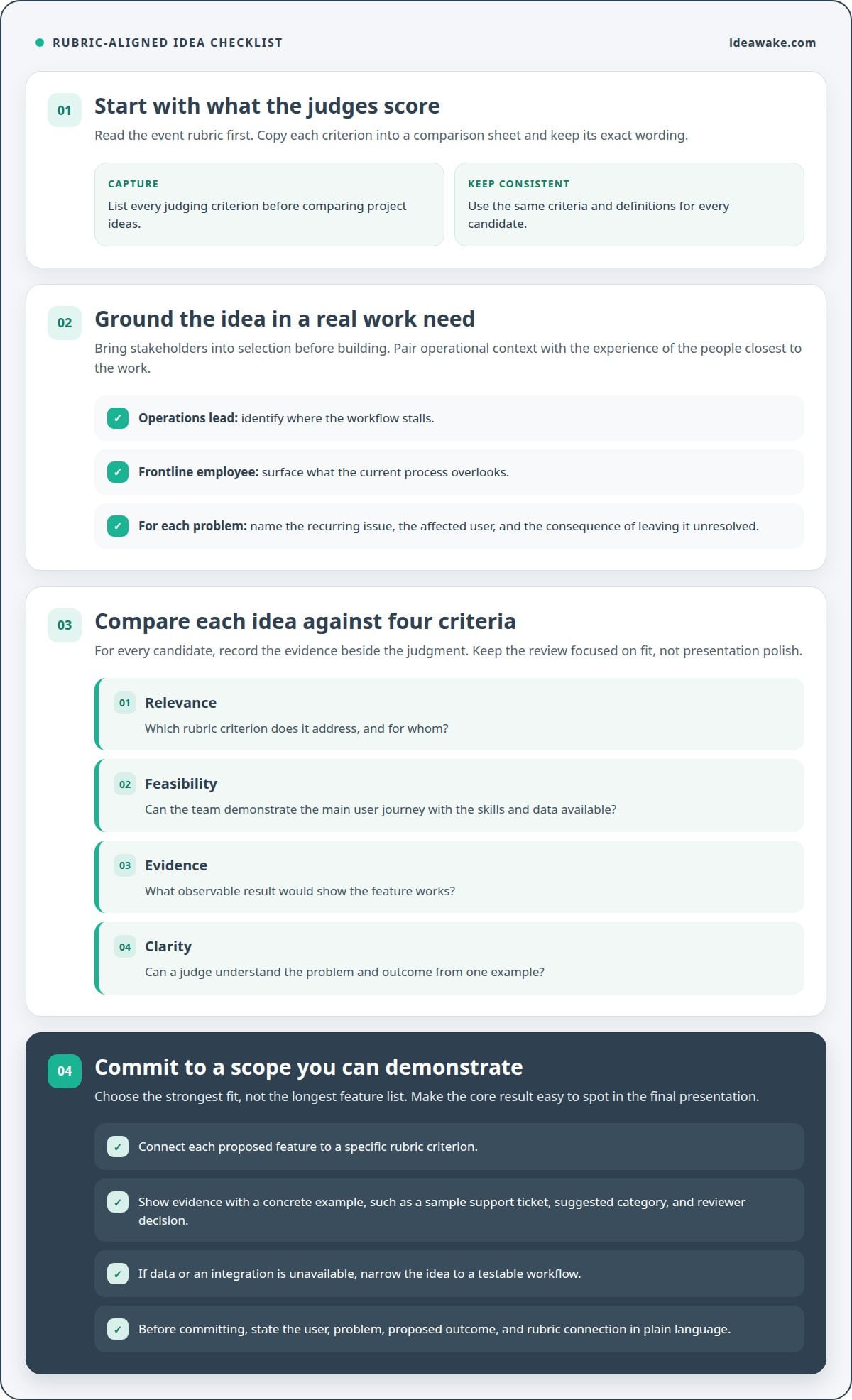
A promising concept can miss the mark if it solves a problem judges aren’t scoring. Start by reading the event rubric, then copy each criterion into a comparison sheet. Common examples include user impact, feasibility, originality, and demonstration quality. Use the rubric’s exact wording, because each event defines success differently.
Next, connect every proposed feature to a criterion. For example, a support-ticket assistant might demonstrate operational value with a sample ticket, a suggested category, and a reviewer’s decision. If the rubric emphasizes accessibility, show how a user with a specific need completes the same task. One clear example gives judges evidence, not just a claim.
Bring stakeholders into idea selection before the event begins. An operations lead can explain where a workflow stalls, while a frontline employee can point out what current processes overlook. Ask each person to name a recurring problem, the user affected, and the consequence of leaving it unresolved. Those details help teams distinguish an urgent need from an interesting technology looking for a use.
Compare candidate projects against a shared set of questions:
- Relevance: Which rubric criterion does the project address, and for whom?
- Feasibility: Can the team demonstrate the main user journey with available skills and data?
- Evidence: What observable result would show the feature works?
- Clarity: Can a judge understand the problem and outcome from one example?
Keep the evaluation consistent across submissions. Use the same criteria and definitions for every team, and ask reviewers to record evidence beside each judgment. A shared process reduces the influence of presentation polish alone. A simple idea evaluation process can also help organizers separate potential impact from build readiness.
Choose the idea with the strongest fit, not the longest feature list. If a concept depends on unavailable data or an unfamiliar integration, narrow it to a testable workflow. For example, demonstrate how a reviewer routes a sample suggestion before building a complete enterprise system. Make the core result easy to spot in the final presentation.
Before teams commit, have them state the user, problem, proposed outcome, and rubric connection in plain language. Organizers can use that short pitch to spot mismatches early and redirect scope. For enterprise events, a structured hackathon planning discussion can help align challenges, stakeholders, and judging criteria before teams start building.
3. AI-focused hackathon challenges
A strong AI challenge starts with a work problem, not a tool demonstration. Ask teams to explore how secure, useful AI could support employees’ daily work. This framing gives participants a practical goal while leaving room to examine different workflows. For example, teams might help staff find internal guidance or summarize recurring operational questions.
Define the challenge with four parts: a specific user, a recurring task, an approved information source, and an observable outcome. “Improve onboarding” is too broad. “Help new hires find the correct internal procedure, then show the source passage” gives teams a user and a testable result. The source matters: an answer that can’t be traced to reliable material may create more work than it saves.
Set expectations before teams begin. State which data they may use, which AI tools are approved, and what information must stay out of prompts. Use sample or synthetic records when sensitive employee, customer, or operational information isn’t necessary. Clear boundaries let teams focus on solving the challenge instead of guessing what they can access.
Make the evaluation criteria visible in advance. A practical checklist can include:
- Task completion: Does the prototype complete the stated workflow?
- Source quality: Can a user inspect the material behind an answer?
- Failure handling: Does it explain when information is missing or unclear?
- Human review: Can a person correct or reject an output?
- Adoption path: Does the team explain where the tool fits into existing work?
For a policy assistant, test it with representative questions based on approved sample documents. Record whether each response answers the question, points to relevant source material, or correctly acknowledges a gap. This focused evaluation won’t prove broad performance, but it gives judges concrete behavior to inspect. Ask teams to explain what the results do and don’t show.
Challenge themes can also focus on employee support, knowledge access, or process improvement. For example, an AI assistant could turn a long procedure into a step-by-step checklist while preserving links to the original sections. Another team might identify repeated themes in anonymized feedback and present examples for a human reviewer. In both cases, the expected value is clearer when teams name the user and the decision their prototype supports.
End with a demonstration that follows one realistic task from input to output. Have teams show the source, explain one limitation, and describe a next test after the event. That discipline keeps an AI challenge grounded in responsible use and practical value, rather than impressive-sounding features alone.
4. Hackathon brainstorming
Brainstorming works best when teams turn a broad theme into a specific user problem. Start with the event prompt, then note who is affected, the obstacle, and when it occurs. For a sustainability theme, “reduce waste” is too broad. “Help a facilities team spot reusable materials before disposal” gives participants a clear situation to investigate.
Capture promising concepts in a shared document before choosing one. For each, record the solution, key assumptions, and critical unknowns. A materials-reuse tool might assume staff can identify items accurately, while an unknown is whether nearby organizations can accept them. Naming that uncertainty helps the team decide what its prototype needs to test.
Use prompts that explore different angles on the same challenge. Ask who encounters the problem, what information they lack, and what action could change the outcome. For a campus sustainability event, one group might explore reuse matching; another might focus on detecting contamination in recycling. Keep both concepts visible while comparing their users, data needs, and demonstration paths.
Examples make brainstorming more productive when teams examine the mechanism, not just the technology. A blockchain concept could use Soulbound NFTs to verify educational certificates, following EIP-4671. A job-matching concept could compare skill tags across 30 fictional profiles. Each example suggests a different test: certificate authenticity for one, or whether profile attributes support a useful match for the other.
Move from idea generation to selection with a short review. Ask each team member to explain the user, problem, and proposed change. Then identify the assumption most likely to undermine the concept. If a reuse-matching idea depends on reliable item descriptions, focus the next discussion on how users will provide them.
Time-box validation around evidence, not debate. One proposed hackathon theme is testing a new market idea within two weeks; another is testing each product idea in a week. Teams can use these prompts to design a small experiment, such as presenting a concept to potential users and recording their reactions. The goal is to uncover an important unknown, not claim full market proof.
Before teams commit, compare concepts with the event’s purpose and available capabilities. A detection prototype may need images, while a certificate-verification concept may need sample records. Review the strongest assumptions, name the data each test requires, and document why the selected idea merits a build. A structured idea crowdsourcing approach can help organizers gather and sort concepts from participants before the event.
5. Hardware and Internet of Things
Hardware can make a hackathon solution tangible: a sensor detects a condition, software interprets it, and an interface shows what happens next. Consider an energy-monitoring concept that displays equipment use, or a leak detector that sends a visible alert. Each example connects a physical signal to a user need, giving the demo a clear purpose.
Keep the prototype focused on one complete path. Describe what the device senses, how the signal reaches the application, and what action the user sees. For an indoor air-quality concept, the demo might show a sensor reading, a threshold comparison, and an on-screen alert. That end-to-end sequence communicates more than a collection of disconnected components.
Hardware failure is a real project risk. A loose connection, depleted battery, or unavailable device can interrupt a live demo. Reduce the risk by testing each component independently, then testing the full flow. Prepare a recorded or simulated sensor input as a fallback, so the team can still explain the software behavior if the physical device stops responding.
Before selecting a build, map the practical requirements:
- Input: Identify the sensor or device and the signal it provides.
- Connection: Describe how data reaches the prototype, such as a local connection or network message.
- Response: Specify what the application displays or triggers after receiving data.
- Fallback: Prepare a sample reading that demonstrates the same workflow.
For a sustainability challenge, teams could prototype a room-occupancy display to help staff identify unused spaces. The demo should show how an occupancy signal changes the display, not claim energy savings without measuring them. This keeps the pitch credible: present the observed behavior, then explain what a later field test would need to assess.
Choose components that suit the team’s existing skills and the event’s environment. A team familiar with simple microcontrollers may prefer one sensor and a basic dashboard. A team without hardware experience can model incoming readings and build the interface first. Either approach can produce a useful proof of concept when the user, signal, and response are clear.
Judge the project by its usefulness, reliability, and clarity, not by the number of devices. One working sensor can support a stronger story than several untested components. For broader planning considerations, the enterprise hackathon guide connects prototype decisions to event design and follow-through.
Ideawake: Idea Management Platform
Ideawake’s Idea Management Platform helps organizations capture, evaluate, and implement employee, customer, and partner ideas. It’s a natural next step when a hackathon produces promising concepts that need clear evaluation and a path to implementation.
Ideawake’s Hackathons offering connects event participation with broader innovation work. Ideas can move beyond a final presentation into a process for assessing their potential and deciding what to advance. For organizations seeking ongoing participation, the platform also supports continuous improvement and innovation management.
Contact Ideawake to discuss how its Idea Management Platform can support your organization’s hackathon and idea-to-implementation process.
Turn the Next Experiment Into Ongoing Progress
The most valuable next step is deciding how promising work will continue after the event. Give each selected concept an owner, a decision path, and a clear learning goal. This creates a bridge from a short-term experiment to the organization’s broader priorities, without treating every prototype as a finished solution.
Ideawake’s Innovation Management Platform and Continuous Improvement tools help organizations connect new opportunities with ongoing innovation work. For teams ready to bring promising hackathon ideas into a more structured process, Ideawake can help make participation and follow-through part of a wider innovation effort.
Build on your teams’ momentum and shape the next step together.
Your next useful experiment can start with one focused challenge and a clear path forward.
Frequently Asked Questions
What makes a strong hackathon project in 2026?
Strong hackathon ideas address a specific user problem and give the team a clear way to demonstrate progress. A project should connect its solution to a real workflow, rather than adding AI or connected devices without a reason. For example, a prototype that helps staff find the right internal form makes the task, user, and result clear. Make the idea memorable through useful execution, not technological novelty alone.
What are the best hackathon project ideas for beginners?
Beginner-friendly projects use familiar workflows and simple inputs. A room-equipment checkout tracker could let staff record borrowed items and see what remains available. Another option is a supply-request dashboard that groups sample requests by department. Teams can map the process, sketch screens, and test whether a colleague understands the next step. These projects let non-coders contribute through research, workflow design, copy, and presentation while technical teammates build a small demo.
What are unique hackathon ideas for 2026?
Look for overlooked friction between teams, not just headline-grabbing technology. A handoff tracker could make unclear ownership visible when work moves between departments. A repair-or-replace guide could help facilities staff compare options using their chosen criteria. For a distinctive result, show how a real user makes one decision with the prototype. A fresh angle comes from the problem, audience, and experience, not from adding features without a clear purpose.
What are good AI hackathon project ideas?
Useful AI projects can help staff compare policy revisions, check whether a procurement request includes required information, or find definitions in an internal glossary. Each concept should use approved sample material and make its output easy to review. For a policy comparison demo, show the original and revised passages beside a short summary. This lets judges assess whether the AI highlights meaningful changes and whether a person can inspect the underlying text.
How do you choose a project that can be built in 24 to 48 hours?
For a 48-hour build, choose a single user journey with accessible data and a visible result. First, define the user and their task. Then list the minimum inputs, output, and tools required. Remove features that don’t support the main demonstration. Before building, sketch the flow and test whether the team can explain it clearly. If a key dependency is unavailable, replace it with sample data or narrow the prototype.
What makes a hackathon project stand out to judges?
A project stands out when judges can quickly see who benefits and what changes for them. Show one realistic task from beginning to end, then identify what the demo proves and what still needs testing. For example, a maintenance-request prototype might show how a technician receives a clearer description of a reported issue. A concise presentation, a working core interaction, and candid limits make the pitch easier to assess.
What are common hackathon rules and judging criteria?
Rules vary by event, so organizers should clearly state eligibility, team formation, submission deadlines, permitted tools, and data restrictions. Judging criteria often assess usefulness, feasibility, originality, execution, and presentation, but the rubric should define each term. Teams should also know what to submit, such as a demo or project description. For AI projects, organizers can specify approved tools and data, then apply the same criteria consistently.