
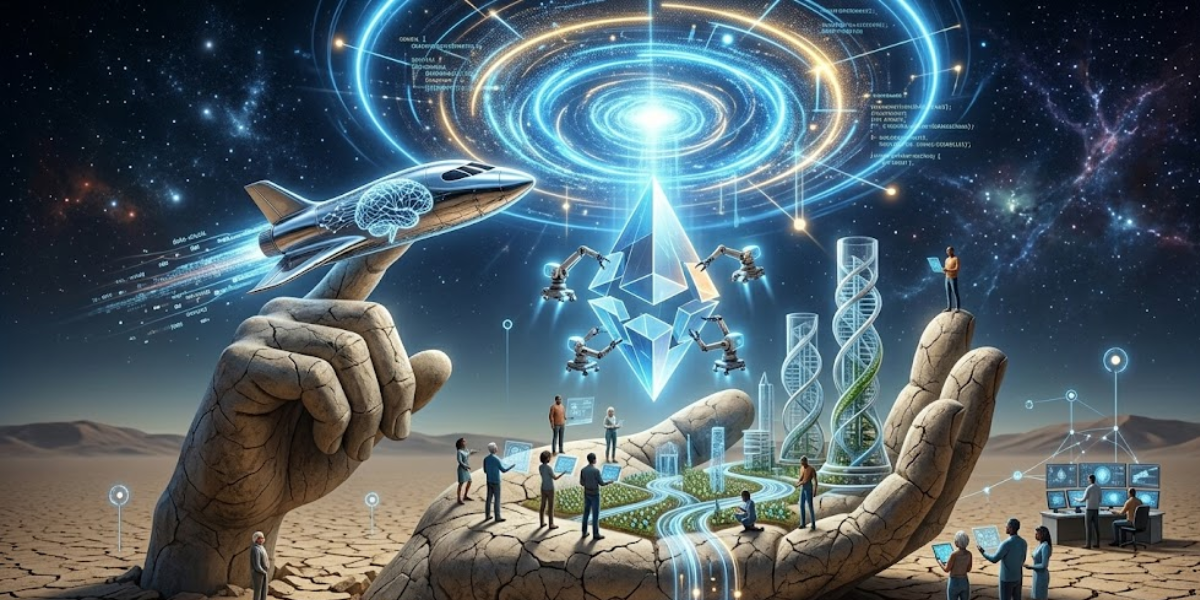
Innovation has always been the driving force behind business growth, but the pace at which it happens is changing dramatically. What once took years of research, testing, and iteration can now be achieved in a fraction of the time.
Artificial intelligence is at the center of this shift. It is not just improving efficiency, it is redefining how innovation happens across industries, teams, and entire ecosystems.
The Rise Of AI As A General-Purpose Innovation Engine
AI is not a single-purpose tool. It is a foundational technology that impacts multiple industries at once, making it one of the most powerful drivers of modern innovation.
Why AI Is Different From Previous Technologies
Unlike traditional tools, AI has the ability to learn, adapt, and improve over time. This makes it more than just a support system. It becomes an active participant in the innovation process.
AI can process vast amounts of information, generate insights, and even suggest new ideas. This creates a system where innovation is no longer limited by human capacity alone.
The Concept Of Compressed Innovation Cycles
One of the most important shifts AI introduces is the compression of time. Innovation cycles that previously took decades are now happening within years or even months.
This acceleration is driven by faster experimentation, rapid iteration, and the ability to test ideas at scale. Businesses that adapt to this pace gain a significant competitive advantage.
Core Mechanisms Through Which AI Accelerates Innovation
AI does not accelerate innovation through a single function. It transforms multiple stages of the innovation process simultaneously.
Cognitive Amplification And Idea Generation
AI expands the boundaries of human creativity. It can generate thousands of ideas, variations, and solutions within minutes.
This allows teams to explore possibilities they may never have considered. Instead of starting from scratch, innovation begins with a wide range of options ready to be refined and executed.
Virtual Prototyping And Simulation
Traditional product development often relies on physical prototypes, which are expensive and time-consuming. AI changes this by enabling virtual testing and simulation.
Companies can now test products, designs, and strategies in digital environments before committing resources. This reduces risk and speeds up decision-making.
Pattern Recognition In Big Data
One of AI’s strongest capabilities is identifying patterns in large datasets. It can uncover trends, connections, and opportunities that are not immediately visible to humans.
This helps businesses identify new markets, improve products, and anticipate customer needs with greater accuracy.
Automating Repetitive Work
A significant portion of innovation work involves repetitive tasks such as data entry, documentation, and analysis. AI automates these processes, freeing up time for more strategic thinking.
As a result, teams can focus on creativity, problem-solving, and execution rather than routine tasks.
How AI Is Transforming The Innovation Lifecycle
AI is not just improving individual tasks. It is reshaping the entire innovation lifecycle from idea generation to market launch.
Ideation Stage
In the early stages of innovation, AI helps generate and validate ideas quickly. It analyzes trends, customer behavior, and market gaps to suggest high-potential concepts.
This reduces guesswork and ensures that ideas are aligned with real-world demand.
Research And Development
AI accelerates research by processing large volumes of data in seconds. It identifies relevant insights, summarizes information, and highlights key findings.
This allows teams to move from research to execution much faster than before.
Product Development
During development, AI assists with design, engineering, and optimization. It can suggest improvements, predict performance, and identify potential issues early.
This leads to better products and shorter development cycles.
Testing And Optimization
AI-powered simulations allow businesses to test multiple scenarios without physical limitations. Products can be refined and optimized before they reach the market.
This reduces failure rates and increases overall success.
Go-To-Market Strategy
AI also plays a role in marketing and distribution. It analyzes customer data to create targeted strategies and predict market responses.
This ensures that products reach the right audience at the right time.
Industry-Specific Examples Of AI-Driven Innovation
AI is not limited to one sector. Its impact can be seen across a wide range of industries, each benefiting in unique ways.
Healthcare
In healthcare, AI is accelerating drug discovery and improving diagnostics. Complex processes that once took years can now be completed much faster.
This leads to quicker treatments and better patient outcomes.
Manufacturing
Manufacturing is becoming more efficient through AI-driven design and automation. Companies can create optimized products while reducing waste and costs.
This improves both productivity and sustainability.
Software Development
In software, AI-assisted tools help developers write, test, and optimize code faster. This reduces development time and improves overall quality.
It also allows teams to focus on building innovative features rather than handling repetitive coding tasks.
Materials Science
AI is helping scientists discover new materials by analyzing chemical structures and predicting properties. This speeds up experimentation and opens new possibilities.
The result is faster breakthroughs in industries like energy, construction, and technology.
AI And The Shift From Linear To Exponential Innovation
Innovation is no longer a slow, step-by-step process. AI is transforming it into a faster and more dynamic system.
Traditional Innovation Models
Traditional models follow a linear approach. Ideas move through stages one at a time, with each step requiring significant time and resources.
This limits the number of ideas that can be explored and slows overall progress.
AI-Driven Innovation Models
AI enables parallel experimentation. Multiple ideas can be tested and refined simultaneously.
This creates a system of continuous improvement, where innovation happens faster and at a larger scale.
The Business Impact Of AI On Innovation Success
The adoption of AI is not just a technological upgrade. It has a direct impact on business performance and competitiveness.
Faster Time-To-Market
AI reduces the time required to develop and launch products. Businesses can respond to market demands more quickly.
This speed is often the difference between leading the market and falling behind.
Reduced Costs
By automating tasks and reducing the need for physical testing, AI lowers operational costs. Companies can allocate resources more efficiently.
This makes innovation more accessible and sustainable.
Improved Decision-Making
AI provides data-driven insights that support better decision-making. Leaders can make informed choices based on real-time information.
This reduces uncertainty and increases the likelihood of success.
Increased Competitive Advantage
Companies that adopt AI gain a significant edge. They innovate faster, operate more efficiently, and adapt more easily to change.
This positions them as leaders in their respective industries.
Challenges Of Using AI In Innovation
Despite its benefits, AI adoption comes with challenges that organizations must address.
Data Readiness Issues
AI systems rely on high-quality data. Without proper data infrastructure, their effectiveness is limited.
Organizations need to invest in data management and organization to fully leverage AI.
Skill Gaps And Talent Shortage
Implementing AI requires specialized skills. Many businesses struggle to find or develop the talent needed to manage these systems.
This can slow down adoption and limit potential benefits.
Ethical And Governance Concerns
AI raises questions about privacy, bias, and accountability. Organizations must ensure that their use of AI aligns with ethical standards.
This requires clear policies and responsible practices.
Over-Reliance On Automation
While automation is beneficial, over-reliance on AI can reduce human oversight. Innovation still requires human judgment and creativity.
Balancing automation with human input is essential.
How To Successfully Implement AI For Innovation
To fully benefit from AI, organizations need a clear and strategic approach.
Build AI-Human Collaboration Models
AI should be seen as a partner, not a replacement. It handles data and computation, while humans provide context and judgment.
This collaboration leads to better outcomes.
Align AI With Business Strategy
AI initiatives should support overall business goals. Without alignment, efforts can become fragmented and ineffective.
Clear objectives ensure that AI delivers real value.
Invest In Data Infrastructure
Strong data systems are essential for AI success. Organizations need to collect, organize, and maintain data effectively.
This creates a foundation for accurate insights and better decisions.
Start With Small Experiments
Instead of large-scale implementation, businesses should begin with small projects. This allows them to test, learn, and refine their approach.
Successful experiments can then be scaled.
Scale What Works
Once effective strategies are identified, they should be expanded across the organization. This ensures consistent and sustainable innovation.
The Future Of AI-Driven Innovation
AI is still evolving, and its impact on innovation will continue to grow.
Self-Improving AI Systems
Future AI systems will become more autonomous, improving their own performance over time. This will further accelerate innovation.
Organizations will need to adapt to this rapidly changing environment.
Cross-Industry Breakthroughs
AI enables breakthroughs in one field to influence others. This interconnected innovation leads to faster and more impactful progress.
Industries will become more collaborative and integrated.
Continuous Innovation Ecosystems
Innovation will become an ongoing process rather than a series of isolated projects. AI will support continuous improvement and adaptation.
This creates a dynamic and resilient business environment.
How Our Approach Helps Businesses Innovate Faster With AI
Innovation is no longer about adopting every new technology. It is about using the right tools in the right way.
Our approach focuses on integrating AI into existing workflows to enhance efficiency and accelerate results. We help businesses identify opportunities, implement solutions, and scale innovation effectively.
By combining strategy, automation, and execution, we enable organizations to move faster without losing control or clarity.
Final Thoughts On AI And Innovation Acceleration
AI is changing the rules of innovation. It is making processes faster, smarter, and more efficient.
Businesses that embrace this shift will be able to innovate at a pace that was previously impossible. Those that resist it risk falling behind in an increasingly competitive landscape.
The future of innovation is not just about new ideas. It is about how quickly and effectively those ideas can be turned into reality.
FAQs
How Does AI Accelerate Innovation?
AI speeds up innovation by automating tasks, generating ideas, analyzing data, and enabling faster testing and decision-making.
What Industries Benefit Most From AI Innovation?
Industries like healthcare, manufacturing, software, and materials science benefit significantly due to their reliance on data and experimentation.
Can Small Businesses Use AI For Innovation?
Yes, AI tools are becoming more accessible, allowing small businesses to improve efficiency and compete with larger organizations.
What Are The Risks Of AI In Innovation?
Risks include data quality issues, ethical concerns, and over-reliance on automation without proper human oversight.
Is AI Replacing Human Innovation?
No, AI enhances human creativity and decision-making. It works best when combined with human expertise and judgment.