
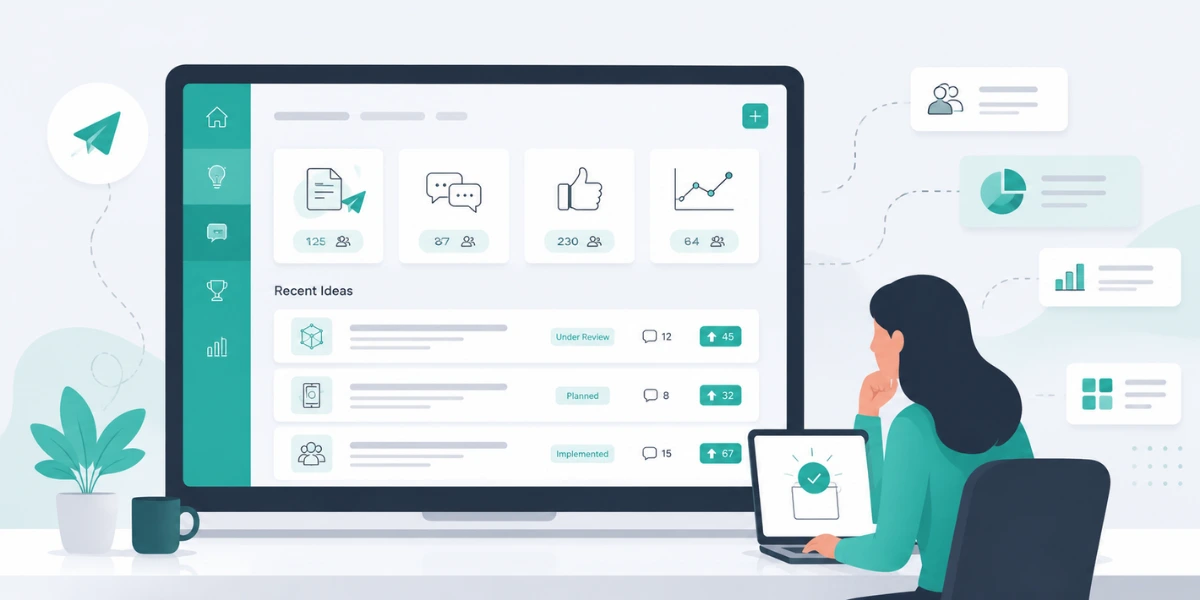
Most organizations do not struggle to get ideas because people have nothing to say. They struggle because ideas are scattered across inboxes, chat threads, forms, surveys, meeting notes, and support tickets, which makes it hard to see patterns or act with confidence.
That is where idea portal software becomes valuable. It gives teams a central place to collect, organize, discuss, and review ideas from employees, customers, partners, or broader communities without relying on disconnected tools that bury useful input.
At its best, an idea portal is not just a digital suggestion box. It becomes the front door to a better innovation process, one where participation is easier, good ideas are easier to spot, and the path from submission to decision is much clearer.
What Is Idea Portal Software?
Idea portal software is a platform that allows organizations to gather ideas in one structured, visible place. Instead of relying on email chains or spreadsheets, it gives contributors a clear way to submit ideas and gives reviewers a better way to manage what comes in.
Some portals are designed mainly for customer feature requests and product feedback. Others are broader and support employee ideation, innovation challenges, process improvement, partner input, and more complex programs that need a stronger workflow after the idea is submitted.
More Than A Submission Form
A true idea portal does more than collect text in a box. It usually includes voting, commenting, tagging, routing, status updates, and visibility controls so teams can move from idea intake toward actual prioritization and action.
That difference matters because collecting ideas is the easy part. The harder part is helping people understand what happens next, who reviews submissions, and how promising ideas move through the system without disappearing into a backlog.
Who Uses Idea Portal Software?
The category is often associated with SaaS product teams, but the real use cases are much broader. Any organization that wants better input, stronger participation, and more structured decision-making can benefit from an idea portal.
Product Teams Collecting Customer Feedback
Product teams use idea portals to gather feature requests, identify recurring problems, and understand which improvements matter most to users. A well-run portal helps them move beyond scattered feedback and gives customers a visible way to contribute to the roadmap conversation.
Internal Teams Running Employee Ideation
Many companies also use portals internally to capture employee suggestions around cost savings, process improvement, safety, service quality, and innovation. In these environments, the portal becomes a channel for surfacing ideas that would otherwise stay trapped in individual teams or frontline routines.
Innovation Leaders Running Campaigns
Innovation leaders often use idea portals to support challenges, hackathons, and themed campaigns. In those cases, the portal helps create focus, gather ideas at scale, and keep participation visible across departments, locations, or business units.
Companies Collecting Partner Or Community Input
Some organizations need structured input from suppliers, partners, distributors, or broader communities. A portal makes that possible without forcing every submission through manual review or one-off communication channels that are impossible to track well over time.
How Idea Portal Software Works
The best idea portals feel simple on the surface, but they support a clear process underneath. That balance is what makes them useful both for contributors and for the teams responsible for reviewing submissions.
Idea Submission Through A Central Portal
The process usually starts with a branded portal where people can submit ideas, feedback, or improvement suggestions. Depending on the use case, the portal may be public, private, or submit-only, and the submission form may include custom fields to capture the right level of detail.
A good submission experience matters more than many teams realize. If it feels confusing, too long, or disconnected from the contributor’s context, participation drops and the portal becomes another underused system.
Discussion, Voting, And Clarification
Once ideas are submitted, other users can often vote, comment, or add context. This helps surface interest, identify duplicates, and build stronger submissions through discussion rather than forcing contributors to get everything perfect the first time.
Voting can be useful, but it works best as one signal rather than the only decision-making method. Popularity matters, but popularity alone is not the same thing as strategic fit, feasibility, or business value.
Triage, Routing, And Ownership
After submission, the real operational work begins. Ideas need to be routed to the right reviewers, grouped into the right categories, and assigned some level of ownership so they do not sit untouched while more submissions continue to pile up.
This is one of the most important differences between a lightweight portal and a stronger platform. If triage is manual and unclear, even a well-designed portal can quickly become another backlog generator instead of a system for better decisions.
Evaluation And Follow-Through
The best portals support evaluation with more structure than simple upvotes. Teams may review ideas against criteria such as customer value, strategic alignment, cost, effort, risk, and implementation readiness before deciding what moves forward.
That is also the point where organizations start to see whether the portal is helping the business or just creating more administrative work. A portal is only valuable if it improves clarity, speed, and confidence in the decision-making process.
Core Features To Look For In Idea Portal Software
A lot of tools promise idea collection, but fewer tools handle what happens after collection. Buyers should look beyond the front-end experience and pay close attention to how the platform supports visibility, governance, and action.
Flexible Portals And Submission Controls
A useful portal should let organizations control branding, permissions, form fields, and visibility based on the audience. A customer-facing portal has different needs than an internal employee portal, and a strong platform should handle both without creating unnecessary complexity.
Collaboration And Status Visibility
Commenting, voting, tagging, and status updates are important because they create transparency around what is happening. Contributors are much more likely to trust the system when they can see that ideas are being reviewed, discussed, and moved through a visible process.
Duplicate Management And Smart Categorization
As idea volume grows, duplicate submissions become a real problem. The more successful your portal is at driving participation, the more valuable it becomes to detect similar ideas, group themes, and reduce repetitive review work.
Integrations And Reporting
No portal should exist in isolation. The strongest tools connect to project tools, communication tools, or systems of record so ideas can move into execution more smoothly, while reporting helps leaders see trends, engagement, review bottlenecks, and outcomes over time.
The Benefits Of Idea Portal Software
When implemented well, idea portal software does more than centralize feedback. It changes how organizations listen, how they prioritize, and how they turn participation into useful momentum.
Centralized Input Instead Of Scattered Feedback
The first benefit is obvious but powerful. Instead of hunting through surveys, chat messages, support conversations, and spreadsheets, teams get a single source of truth for ideas and feedback that is easier to search, review, and compare.
Better Visibility Into What People Want
Portals help reveal recurring patterns that would otherwise be easy to miss. Whether the audience is employees or customers, it becomes much easier to see where pain points are concentrated, which themes keep resurfacing, and which requests deserve closer attention.
Easier Prioritization At Scale
When idea volume increases, unstructured review becomes unsustainable. A portal helps teams create a repeatable process for triage and prioritization so decisions become more consistent and less dependent on whoever happens to be paying attention at the time.
Stronger Participation And Transparency
People contribute more when the process feels visible and fair. An idea portal gives them a clear place to engage, while status updates and discussion features help reduce the feeling that ideas go into a black hole and never come back out.
Idea Portal Software Vs Idea Management Software
This is where many buyers get confused. Idea portal software is often the front door, while idea management software supports the fuller process that begins after the idea comes in.
A portal may be enough if your main goal is gathering suggestions and creating a visible intake layer. But if you need structured review, ownership, prioritization, implementation, and reporting, the conversation starts moving toward a broader idea management process rather than a simple collection tool.
That is why many organizations eventually look beyond intake alone. They realize that a portal without workflow can improve participation while still leaving the hardest part unresolved, which is how to evaluate and move the best ideas into action consistently.
Common Use Cases For Idea Portal Software
The category covers more ground than many software pages admit. The same underlying system can support very different business needs depending on how the portal is configured and how mature the review process is behind it.
Customer Feature Request Portals
This is the most familiar use case. Companies create a visible place for customers to submit ideas, vote on requests, and follow updates, which helps product teams collect demand signals without relying only on support tickets or sales anecdotes.
Employee Suggestion And Improvement Portals
Internal portals are especially useful for organizations trying to improve participation in continuous improvement or operational innovation. A strong portal gives employees a simple way to contribute, while managers get a better structure for evaluation than an overflowing inbox or spreadsheet.
Innovation Challenges And Campaigns
Some organizations use portals to support time-bound campaigns with a specific theme or business objective. In that context, the portal creates focus, encourages participation, and gives reviewers a better way to compare ideas within the same challenge framework.
Community And Partner Feedback Portals
External portals can also support partners, distributors, franchisees, or community stakeholders who have valuable insight but need a clean channel to contribute it. This becomes especially useful when organizations want input beyond their own internal teams.
Where Basic Idea Portals Fall Short
A basic portal can be a major improvement over scattered feedback, but it still has limits. In many cases, the portal solves intake while leaving governance, evaluation, and implementation largely manual.
Collection Without Management
Some tools are very good at helping people submit ideas but much weaker at helping reviewers manage the workflow after submission. That creates a dangerous illusion of progress because the organization looks engaged while the review process remains slow and inconsistent.
Voting Without Real Evaluation
Upvotes and comments can help highlight momentum, but they are not a substitute for structured judgment. Good decisions usually require more than popularity, especially when ideas need to be measured against strategic priorities, effort, ownership, and expected impact.
Backlogs, Noise, And Duplicate Ideas
As participation rises, portals can become noisy unless duplicates are managed well and review workflows are clear. Without those controls, successful idea collection creates more friction for evaluators instead of making their work easier.
Weak Connection To Implementation
This is often the biggest problem. If the portal does not connect well to follow-through, teams end up collecting ideas they cannot track, prioritize, or implement with confidence, which eventually damages trust in the entire process.
How AI Is Changing Idea Portal Software
AI is starting to improve some of the most frustrating parts of idea portal management, especially for teams dealing with larger volumes of submissions. The most useful applications are practical, not flashy.
AI-powered idea and Innovation Management can help detect duplicate ideas, connect related suggestions, summarize themes, and reduce the manual work involved in triage. That matters because portal success often creates an admin burden, and AI can help teams keep participation high without drowning reviewers in repetitive cleanup.
It can also help organizations spot clusters of demand or recurring improvement opportunities more quickly. When used well, AI does not replace human judgment. It improves the signal-to-noise ratio so reviewers can spend more time making decisions and less time sorting through clutter.
How Ideawake Goes Beyond A Basic Idea Portal
For organizations that need more than a submission layer, Ideawake is built to support the full journey from idea capture to measurable progress. It gives teams a structured way to gather ideas from employees, customers, and partners while making evaluation, follow-through, and visibility much easier to manage.
If your goal is not only to collect ideas but to create a stronger, scalable workflow, Ideawake’s idea management software platform is a natural next step. It is designed for real-world use cases like innovation challenges, continuous improvement, and broader idea crowdsourcing, while helping teams build a more effective idea management system that does not stop at intake.
That matters because idea portals only create value when good ideas go somewhere meaningful. A stronger platform helps teams review faster, reduce noise, create ownership, and ultimately implement innovative ideas with more confidence and less manual effort.
How To Choose The Right Idea Portal Software
The right platform depends on what problem you are really trying to solve. If you only need a place to collect suggestions, a simpler portal may be enough, but if you need visibility, governance, and better decision-making, you should choose accordingly.
Start by defining your use case clearly. A customer feedback portal, an employee suggestion portal, and an enterprise innovation portal may look similar on the surface, but they require very different levels of workflow, visibility, permissions, and reporting.
Then think beyond the portal itself. The strongest choice is usually the one that fits how your organization will evaluate, prioritize, and act on ideas over time, not just how clean the submission form looks on day one.
It is also smart to compare the category against broader platforms if your needs are growing. Many teams begin by searching for a portal, then realize they are really comparing their options in the broader best idea management software landscape once scale and follow-through become more important.
Final Thoughts
Idea portal software plays an important role in modern feedback and innovation workflows. It gives organizations a better way to collect ideas, make participation easier, and create more visibility than disconnected systems ever could.
But the best portal is not just the one that makes submission easy. It is the one that helps your organization make better decisions after the ideas arrive, reduce friction for reviewers, and turn participation into progress that people can actually see.
FAQs
What Is Idea Portal Software?
Idea portal software is a platform that helps organizations collect, organize, and review ideas from employees, customers, partners, or communities in one central place.
How Does Idea Portal Software Work?
It typically provides a portal where users submit ideas, while reviewers use features like voting, commenting, categorization, routing, and status tracking to manage what happens next.
What Features Should Idea Portal Software Have?
The strongest platforms usually include customizable portals, flexible submission forms, collaboration tools, status updates, duplicate management, integrations, and reporting.
Is Idea Portal Software Only For Product Teams?
No. Product teams use it often, but it is also valuable for employee innovation, continuous improvement, partner input, and cross-functional idea programs.
What Is The Difference Between Idea Portal Software And Idea Management Software?
Idea portal software usually focuses on idea collection and front-end participation, while idea management software supports a broader workflow that includes evaluation, prioritization, implementation, and measurement.
Can Idea Portal Software Be Used For Employee Innovation?
Yes. Many organizations use idea portals internally to collect suggestions around cost savings, process improvement, service quality, safety, and broader innovation initiatives.
What Does AI Do In Idea Portal Software?
AI can help detect duplicate ideas, identify themes, connect related submissions, and reduce manual triage work so reviewers can focus more on decision-making.
Are Free Idea Portal Software Options Worth Using?
They can be useful for smaller teams or simple use cases, but organizations with higher idea volume or more complex workflows usually need stronger governance, reporting, and follow-through capabilities.