
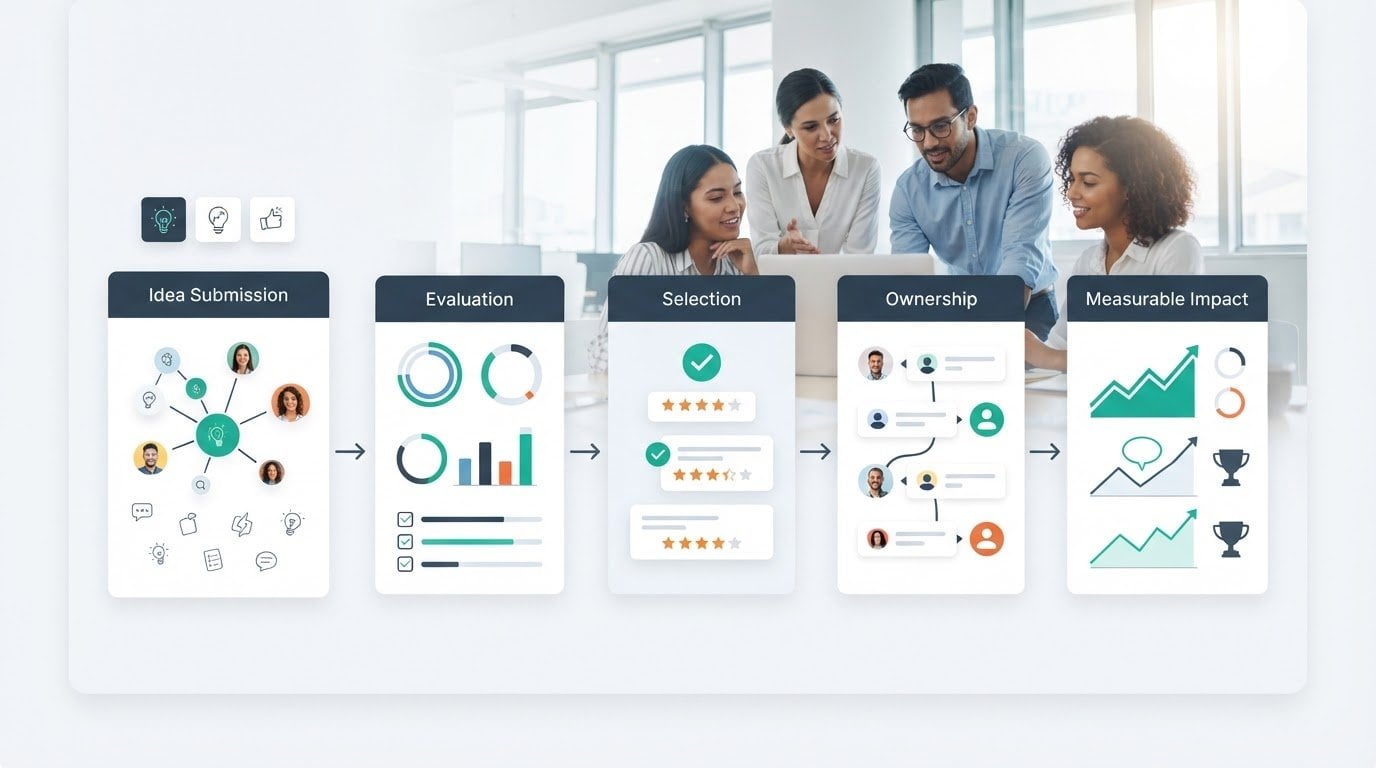
What good is a challenge full of ideas if no one can tell which ones deserve attention or what happens next? Innovation challenge software should do more than collect submissions. It should give participants a clear way to contribute and help teams move promising ideas through review, decisions, and follow-through.
If submissions are scattered across forms, spreadsheets, and chat threads, it’s harder to keep people engaged, compare ideas consistently, and make ownership visible. A campaign can attract plenty of activity yet still fall short if submissions aren’t focused or selected ideas stall after evaluation. The platform matters, but so does the process behind it.
This guide explains how innovation challenge software fits into an innovation program and what to assess, from submission forms and participant engagement to review workflows and outcome tracking. You’ll learn how to set a useful challenge brief, compare platforms against your process, and connect participation with measurable results. The goal is a challenge that doesn’t end when submissions close, but creates a clear path from contribution to action.
Key Takeaways
- Distinguish a time-bound innovation challenge from ongoing idea collection so the process matches the goal.
- Use innovation challenge software to make review stages, decision ownership, and next steps easier to follow.
- Compare platforms by program fit, participant experience, evaluation, reporting, and integrations, not by feature count alone.
- Set the challenge problem, evaluation criteria, and success measures before launch to focus participation and assess results.
- Connect engagement tools and analytics with workflows and ROI tracking to understand what happens after ideas are submitted.
What innovation challenge software does, and where it fits
Innovation challenge software is a digital system for collecting ideas in response to a defined need and managing the challenge from launch through review. It gives organizers a structured way to explain the problem, invite relevant participants, gather submissions, and coordinate what happens next.
A challenge is one format within the broader practice of innovation management. It turns a specific question into a focused program rather than treating every contribution as an isolated suggestion. The software can organize participation and make the process visible, but the organization still sets priorities, weighs trade-offs, and decides which ideas to pursue.
What makes an innovation challenge different from an idea box?
An idea box invites suggestions, often on any topic and at any time. A challenge is more focused: organizers define a question, identify who should contribute, and explain what the program is trying to learn or address. A clear brief gives participants useful boundaries without prescribing the answer. For example, it might describe a process problem and ask employees for practical ways to improve it. This structure also supports organized employee ideation programs.
Challenges are often time-bound, with a launch, submission period, and review phase. That creates a shared moment for participation and gives reviewers a defined set of ideas to consider. Ongoing idea collection, by contrast, keeps a channel open for contributions across different topics. An unstructured brainstorm may generate discussion, but without a specific prompt or process, ideas can be difficult to compare or carry forward.
Who uses innovation challenge software?
Innovation teams use challenge tools to coordinate contributions from employees, customers, or partners, depending on the question and intended audience. A team might invite employees to suggest ways to simplify an internal process, ask customers to identify unmet needs, or gather partner perspectives on a shared business challenge. Choose participants for their relevant experience or insight, not simply to maximize the size of the group.
The software helps organizers present the brief, collect responses in one place, and manage participation and review. It supports a program; it doesn’t choose the strategic problem or decide which proposal deserves investment. Those responsibilities remain with the organization’s leaders and reviewers.
That distinction matters. A well-framed challenge connects a real organizational need with people who can offer useful perspectives. The platform provides structure for gathering and assessing those perspectives, while clear goals and human judgment guide decisions. Without that combination, a challenge can become just another submission form. With it, focused participation has a defined purpose.
How challenge software moves ideas from submission to evaluation
A challenge needs a clear operating path, not just a place to submit ideas. Innovation challenge software can organize that path so participants know what to provide and reviewers can see what has been considered, what needs a decision, and who owns the next step. A practical sequence is:
- Define the challenge. Set the problem, intended audience, submission window, and review approach.
- Collect ideas. Use a structured form to gather submissions in a consistent format.
- Review submissions. Screen for relevance, clarify details, and organize similar proposals.
- Select candidates. Compare eligible ideas against agreed criteria and record decisions.
- Track next steps. Assign owners and move selected ideas into further assessment or action.
Set evaluation criteria before reviewing submissions so every idea is assessed against the same expectations. Criteria might cover alignment with the challenge, potential benefit, feasibility, or evidence needed for further review. Without a shared basis, reviewers may rely on different assumptions, making comparisons less consistent and decisions harder to explain.
From challenge brief to structured submissions
A useful brief states the problem, who the challenge is for, relevant context, and what participants should submit. Forms can then prompt for information that helps reviewers understand each proposal, such as the need addressed, the suggested change, and any assumptions or resources involved. Keep prompts relevant: unnecessary questions add effort without improving the review. Optional anonymous posting can be useful when organizers want contributions assessed without displaying the submitter’s identity, but it need not be enabled for every challenge.
Similar submissions also need a sensible handling process. Semantic duplicate detection can flag ideas with related meaning even when participants use different wording. Depending on the review rules, similar ideas can be grouped for evaluation or merged, while preserving useful distinctions. Reviewers should still check whether proposals that sound alike contain different details or approaches.
From evaluation to accountable next steps
Scorecards help reviewers apply shared criteria, while configurable workflows and approval stages show where an idea sits and who is responsible for moving it forward. Assigned owners can record a decision, request clarification, or coordinate the next review. This makes progression visible instead of leaving submissions in an inbox with no clear status. A structured idea evaluation process and criteria can help teams make review more consistent and transparent.
Comments and collaboration let participants or reviewers add context, and voting can help surface ideas for consideration. These inputs can inform deliberation, but they shouldn’t replace evaluation against the challenge’s criteria. Once a decision is made, record the rationale and next action, whether an idea advances, needs more information, or isn’t selected. That feedback closes the loop for participants and gives the team a usable record of the challenge. If you’re assessing how a platform could support this flow, you can explore a challenge workflow in a demo.
How to assess innovation challenge software beyond its feature list
A long feature list doesn’t tell you whether a platform fits your challenge. Start with the program you need to run, then assess whether the software helps participants contribute, administrators manage the process, reviewers make informed decisions, and responsible teams take selected ideas forward. Requirements vary with the audience and workflow, so compare platforms against your own needs rather than looking for a universal best.
Use a comparison framework that connects each capability to a practical need:
| Area | What to assess |
|---|---|
| Program fit | Can you set up the challenge around its purpose, audience, and submission needs? |
| Participant experience | Can participants access the challenge, understand expectations, and receive updates? |
| Evaluation | Can reviewers use shared criteria and record decisions? |
| Workflow | Can administrators see submission status, ownership, approvals, and next steps? |
| Reporting | Can teams track relevant KPIs and understand what happens to selected ideas? |
| Integrations | Can the platform fit alongside the tools teams already use? |
Match platform capabilities to your challenge goals
For targeted feedback, focus on challenge setup, participant access, and submission forms that gather relevant details. A cross-functional program may need collaboration, routing, and configurable review stages so different teams can contribute without losing sight of ownership. If outcome tracking is central, assess whether administrators can create KPIs, view dashboards, and use financial ROI charts to monitor progress. An innovation software selection framework can help organize broader platform requirements around these goals.
Separate essentials from enhancements. A challenge with a narrow audience may prioritize clear forms and simple review, while a program involving several teams may depend on configurable workflows and collaboration. Notifications, gamification, and analytics can support engagement and visibility, but they’re valuable only when they serve the challenge’s purpose. Assess each capability in context: does it solve a real problem in the work your team needs to do?
Check adoption, security, and system fit
Evaluate the experience from both sides. Participants need a straightforward way to access the challenge on desktop or mobile, see announcements, receive notifications, and understand what happens after they submit. Administrators need to track submissions, communicate updates, and hand selected ideas to the teams responsible for assessment or implementation. Consider how participant feedback will be collected and used, too.
Security and integration choices also matter. Ideawake describes its security approach as zero data retention, and states that customer data is not used to train external models. Its integrations include Microsoft Teams, Jira, Asana, and Slack. An integration can connect systems, but that doesn’t mean every workflow or handoff happens automatically. Identify the information each connection needs to support and how it fits the team’s process. For a practical look at challenge workflows, you can explore Ideawake in a demo.
How to plan a challenge that earns participation and useful ideas
Strong participation starts before launch. Give people a clear reason to contribute, make the task easy to understand, and decide in advance how you’ll judge whether the challenge was useful. A practical sequence keeps planning focused:
- Define the problem. Frame a specific need that participants can meaningfully address.
- Choose the audience. Invite people with relevant experience, knowledge, or perspective.
- Set evaluation criteria. Agree on what reviewers will consider and who will make decisions.
- Launch and support participation. Share the brief, explain how to submit, and send useful reminders.
- Review and communicate. Update participants on progress, decisions, and next steps.
Before launch, select success measures that fit the challenge. These might include the relevance of submissions, participation across the intended audience, completion of review stages, or progress of selected ideas into further assessment. Set a baseline or define how each measure will be recorded, so the team can learn from the campaign without assuming a particular participation or ROI result. A platform can help organize idea crowdsourcing, but a clear purpose and timely communication give people a reason to take part.
Set the challenge up for focused participation
Use a concise problem statement, then explain why it matters and what participants are being asked to contribute. Choose an audience suited to the question, and describe submission expectations in plain language. People should understand what information to provide, how their input will be reviewed, and when they can expect updates. Points, leaderboards, or prizes may suit some programs, but treat them as optional engagement approaches, not guaranteed drivers of useful ideas or results.
Keep the brief focused enough to guide contributions without dictating a solution. For example, if the goal is to identify friction in an internal process, invite participants who encounter or support that process and ask them to describe the issue and a possible improvement. Make the invitation accessible through the channels the audience uses, and use announcements or notifications to clarify deadlines and answer common questions.
Close the feedback loop after submissions arrive
Tell participants what happens after submission and provide progress updates at meaningful points, such as when review begins or decisions are communicated. Challenge owners should share outcomes clearly, including when an idea needs more work or isn’t selected. For ideas that advance, assign an owner and connect the next steps to a workflow or project tracking process. That handoff gives promising contributions a route toward action; a defined approach to implementing innovative ideas can help teams carry the work forward.
Use the close of the challenge to capture lessons as well. Compare results with the measures set before launch, note where participants needed more guidance, and identify review bottlenecks. Those observations can sharpen the next brief and improve the participant experience. The goal isn’t simply to collect submissions. It’s to run a process people can understand, learn from, and trust.
How Ideawake supports innovation challenges from ideas to impact
Ideawake is an enterprise-grade idea and innovation management platform that supports challenges beyond the submission stage. It connects idea collection with evaluation, configurable workflows, participant engagement, and ROI tracking. For teams that need to keep submissions organized and make follow-through visible, the value is in linking these steps in one managed program rather than treating each idea as a separate record.
Ideawake reports average participation rates of 50 % - 80 % versus typical 5 % - 15 % with other tools. These are company-reported averages, not a promise of results for any individual challenge. Ideawake also reports an average six-month financial impact of $1,000,000. Outcomes depend on the program and how ideas are evaluated and acted on, so use measures that fit your own challenge when assessing performance.
Bring challenge participation into a managed workflow
Challenge submissions can move through evaluation stages, assigned ownership, and progress tracking in configurable workflows. That structure helps organizers see what is awaiting review, what decision has been made, and where selected ideas go next. Duplicate detection can help teams identify similar submissions, while notifications and collaboration tools support communication among participants and reviewers.
Engagement options include points, leaderboards, and prizes, which organizers can use to support participation. Analytics and reporting extend visibility beyond activity: Ideawake includes customizable dashboards, KPI creation, and financial ROI charts. Together, these capabilities help teams monitor defined measures and connect challenge activity with the progress and value they track, without assuming that submissions automatically become business results.
Explore whether Ideawake fits your challenge program
Ideawake also offers configurable AI agents for evaluation, tagging, short-listing, and market research. These capabilities support specific parts of the challenge process; they don’t remove the need for human review and decisions. AI-generated ideas and insights are listed as Coming Soon, so they aren’t currently available capabilities.
Assess the platform against your challenge requirements: the participant experience, review approach, workflow ownership, and measures you need to follow. Ideawake’s reported averages can provide context, but your success criteria should reflect your program’s purpose and baseline. A walkthrough can show how the platform’s challenge capabilities relate to your process.
Turn your next challenge into a clear next step
Choose one business question worth exploring and decide how you’ll recognize useful progress. Set a clear starting measure, identify who will review submissions, and name the team responsible for moving selected ideas forward. That preparation gives your innovation challenge software a purpose beyond collecting responses: it helps your organization learn what participants can contribute and what the program should improve next.
Ideawake reports average participation rates of 50 % - 80 % versus typical 5 % - 15 % with other tools, and an average six-month financial impact of $1,000,000. These are company-reported averages, not a guarantee of results. Use them as context, then define measures that reflect your own challenge goals and follow-through.
A well-run challenge can create a practical starting point for better questions, stronger collaboration, and ideas with a clear path forward. Book a free Ideawake demo to see how the platform can support your next challenge.
Frequently Asked Questions
What is innovation challenge software?
Innovation challenge software is a digital workspace for coordinating a focused contribution campaign. Its practical value becomes clear when people outside one team need to take part: organizers can provide a consistent experience and keep program records together. Before choosing a system, identify what participants need to know and what administrators must record. That scoping helps distinguish a dedicated challenge environment from a basic form or shared inbox.
How does innovation challenge software work?
Organizers use the platform to configure the participant experience and manage the campaign’s administrative details. For example, they can prepare challenge materials, make announcements, and use notifications to keep contributors informed. Reviewers and administrators then use the system’s records to coordinate their work. Before rollout, decide who will administer the challenge, who can review entries, and who should receive updates so access and communication fit the team’s responsibilities.
What features should innovation challenge software include?
Choose capabilities based on the work your team needs to do, not a generic feature checklist. If administrators will maintain records outside the platform, for example, exporting may matter. If different people manage separate initiatives, consider whether the system can support distinct views or lists. Ideawake includes exporting, custom lists, and saved views. Prioritize functions that remove a real friction point for your organizers or participants.
Can innovation challenge software support anonymous submissions?
Yes. Ideawake supports optional anonymous posting. Before enabling it, establish a clear policy for participants: explain whether identifying details should be omitted from the submission itself and how organizers will handle follow-up questions. A consistent explanation helps set expectations and reduces the chance that participants misunderstand what anonymous posting means in that challenge. The choice should reflect the program’s purpose and the information reviewers need to assess contributions.
How do you measure the success of an innovation challenge?
Separate observed results from projections. If a selected idea is expected to improve a process, record the expected change, the evidence used to assess it, and whether the result has been verified. This makes later reporting more useful than treating an estimate as an achieved outcome. It also gives program leaders a clearer basis for deciding which assumptions to revisit and what evidence to gather in future challenges.
Can innovation challenge software integrate with tools like Microsoft Teams or Jira?
Yes. Ideawake integrates with Microsoft Teams and Jira, among other tools. To make an integration useful, define what information should be available to each team, such as a reference to a selected idea or its current status. Also agree on where the authoritative decision record lives. That preparation can help teams coordinate without creating competing records or assuming every handoff is automatic.
How is innovation challenge software different from idea management software?
The labels can overlap, so assess the platform by the work it needs to support. If your organization runs both focused campaigns and ongoing programs, consider whether administrators can keep their audiences, records, and reporting distinct while using one system. This practical fit matters more than terminology: the right setup should let teams run a particular challenge without making the broader idea program harder to manage.