
Did you know that 55% of innovation management platforms have already integrated AI to automate idea evaluation, yet many organizations still struggle to generate a tangible return on their investments? According to Business Research Insights, while 70% of enterprises prioritize an innovation culture, the gap between ideation and implementation remains a significant hurdle. You’ve likely felt the frustration of information silos and the heavy administrative burden of manually vetting thousands of submissions. Without a structured innovation pipeline management strategy, these ideas often become a source of friction rather than a driver of growth.
It’s difficult to justify budgets when you can’t point to a direct financial impact. This guide will show you how to replace chaotic suggestion boxes with a high-performance engine for measurable ROI. You’ll learn how to build a repeatable process for vetting ideas and capture the clear data required to prove your program’s value to stakeholders. We’ll explore how modern architecture and AI insights can eliminate evaluation bottlenecks, drive higher employee participation, and finally deliver the results your organization demands in 2026.
Key Takeaways
- Learn how to transition from a passive suggestion box to a structured innovation pipeline management system that treats ideas as measurable financial assets.
- Discover the five essential stages of the innovation lifecycle, from aligning idea generation with specific business challenges to leveraging internal crowdsourcing for faster refinement.
- Identify the administrative bottlenecks inherent in legacy spreadsheets and learn how modern, cloud-based architectures reduce overhead through automated workflows.
- Master data-driven metrics like Pipeline Velocity and Yield Ratio to provide clear evidence of your innovation program’s performance and justify future budgets.
- Explore how AI-driven tools can automate the scoring and duplicate detection process, allowing your team to focus on high-impact implementation rather than manual evaluation.
The Architecture of a High-Impact Innovation Pipeline
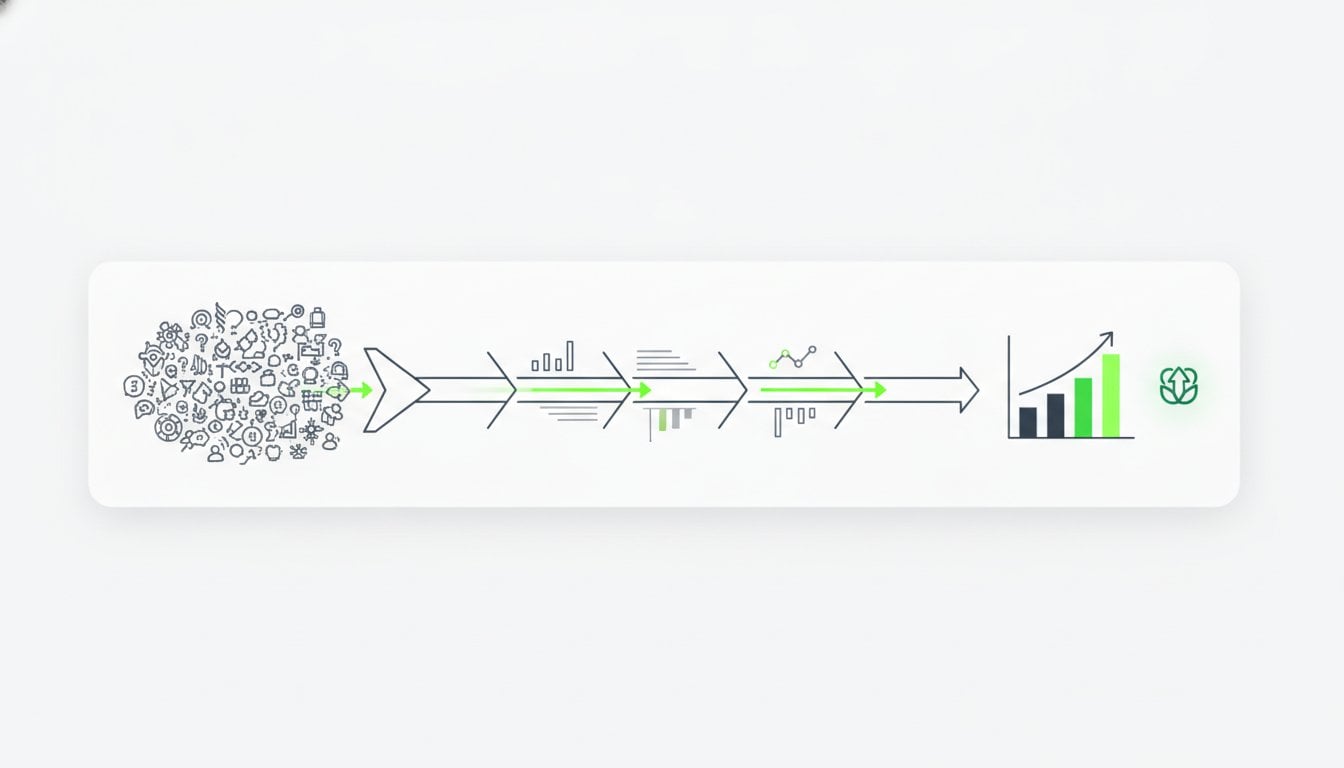
Innovation pipeline management is the systematic process of converting raw concepts into implemented solutions that deliver measurable ROI. It’s the engine room of modern innovation management. In 2026, market leaders have largely abandoned the traditional “suggestion box” model. While a suggestion box is a passive repository that often leads to employee disengagement, a managed pipeline is an active, data-driven workflow. Research indicates that approximately 55% of platforms now use AI to improve evaluation, reflecting a shift toward objective decision making. Modern architecture is no longer optional. It’s essential for reducing the administrative friction that typically kills great ideas before they ever reach the prototype stage. Large enterprises, which hold nearly 78% of the market share, utilize these systems to ensure their innovation budgets are backed by hard data rather than optimistic speculation.
Why Pipeline Management is the Backbone of Corporate Growth
The Consequences of a Clogged or Leaky Pipeline
Pipelines fail when they become either “clogged” or “leaky.” A clog occurs when a small team of evaluators is overwhelmed by thousands of unranked ideas, leading to burnout and stagnation. This administrative burden stalls progress and discourages future participation. Conversely, a leaky pipeline loses high-potential projects due to poor evaluation criteria or a lack of stakeholder buy-in. Most innovation failures don’t happen because the ideas were bad. They happen because the pipeline couldn’t support the weight of the evaluation process or failed to provide transparency to the contributors. By 2026, effective innovation pipeline management relies on automated scoring and AI-driven insights to patch these leaks. This ensures that the most viable, data-backed concepts move toward implementation while administrative overhead remains manageable.
The 5 Essential Stages of Innovation Pipeline Management
To achieve a measurable financial impact, your innovation pipeline management strategy must follow a disciplined, five-stage lifecycle. This journey begins with Strategic Alignment and ends with operational Implementation, ensuring every dollar spent is tied to a verified business outcome. By treating the pipeline as a series of rigorous filters, you can move away from the chaos of unvetted ideas and toward a predictable engine of growth.
Stage 1 & 2: Moving from Capture to Collaboration
The final stage, Implementation and ROI Measurement, is where the transition to operational reality occurs. Success here requires end-to-end lifecycle tracking to prove that the initial investment yielded the promised results. If you want to see how these stages can be automated for your team, you can book a free demo to explore modern pipeline workflows and start maximizing your innovation returns.
Legacy Systems vs. Modern Platforms: Identifying Your Bottlenecks
Many organizations attempt to manage their innovation efforts using general-purpose tools like Excel or SharePoint. While these might work for small teams, they fail to scale in a complex enterprise environment. Manual innovation pipeline management often leads to a massive administrative burden, consuming hundreds of hours that should be spent on execution. When you contrast the manual approach with automated platforms, the difference in efficiency is staggering. Legacy systems lack the real-time data flow needed to keep pace with market changes. This creates bottlenecks that stall high-potential projects and waste precious resources.
The Hidden Costs of Manual Pipeline Management
The true cost of using outdated tools isn’t just the software license fee. It’s the idea decay that occurs when slow response times kill momentum. According to the Ideawake vs Spreadsheets analysis, organizations using manual methods lose significant time on data entry and status tracking. This lack of speed results in lost ROI as competitors beat you to market. Beyond the financial impact, manual systems damage employee morale. When contributors don’t see progress or receive feedback, they stop participating. Transparency is the antidote to disengagement, and legacy tools simply cannot provide the visibility required to keep a workforce inspired.
Modern Features That Drive Pipeline Velocity
Switching to a specialized platform changes the equation by automating the most tedious parts of the lifecycle. For example, AI tools for innovation managers can instantly categorize submissions and identify duplicates, which significantly reduces the workload for review committees. A centralized idea board serves as a single source of truth, ensuring that every stakeholder has access to the same data. This visibility is enhanced by mobile-first submission features, allowing frontline workers to contribute insights the moment they occur. When these platforms include integrations with MS Teams or Slack, innovation becomes part of the daily workflow rather than an occasional extracurricular activity.
Data-Driven Metrics: How to Measure Pipeline Velocity and ROI
Effective innovation pipeline management requires more than just counting the number of ideas collected. You must treat your pipeline as a financial instrument where every stage has a measurable cost and a projected return. One of the most critical metrics to track is Pipeline Velocity. This is the average time an idea takes to move from the initial submission to a fully realized implementation. Organizations that fail to monitor velocity often see their most promising concepts die in committee. A slow pipeline is a leaky pipeline, as market conditions shift faster than your internal processes can react.
Another vital indicator is the Yield Ratio. This calculation compares the number of successful implementations against the total number of submissions. A low yield ratio might suggest that your strategic alignment is off or that your evaluation criteria are too broad. To balance your portfolio, you should also adopt “Innovation Accounting.” This framework is designed for high-uncertainty projects where traditional financial metrics don’t apply early on. It allows you to track progress through learning milestones and pivot points before you commit significant capital. Balancing these with non-financial metrics like employee engagement ensures the long-term health of your innovation ecosystem.
The ROI of Employee Ideation Programs
The benefits of employee ideation programs extend far beyond cultural improvements. They provide a direct path to operational savings and new revenue streams. However, many leaders ignore the “cost of inaction.” When a valid, cost-saving idea is ignored for six months, the organization effectively pays a penalty in lost efficiency. To get a precise understanding of the potential impact on your bottom line, you should use an idea management ROI calculator. This tool helps you quantify the specific financial gains your organization can expect by professionalizing its innovation workflows.
KPIs for Every Stage of the Funnel
To identify bottlenecks, you must track performance across the entire funnel. Each stage requires specific KPIs to ensure the engine is running smoothly:
- Submission Metrics: Monitor the participation rate and idea diversity across different departments to ensure you aren’t stuck in an information silo.
- Evaluation Metrics: Track the time-to-decision and evaluator throughput to prevent administrative clogs that stall momentum.
- Outcome Metrics: Measure the final implementation rate and the realized net savings or revenue generated by each project.
Ideawake: Streamlining Your Innovation Lifecycle from Submission to ROI
Ideawake is specifically engineered to eliminate the administrative complexity that often paralyzes corporate growth. In a landscape where 55% of platforms now leverage AI, Ideawake leads by integrating advanced features that automate the most tedious parts of the lifecycle. By using Ideawake AI, your team can instantly handle duplicate detection and initial scoring, ensuring that reviewers only spend time on high-potential concepts. This transition from manual filtering to automated intelligence is the cornerstone of effective innovation pipeline management. Whether your organization is running high-impact hackathons or steady continuous improvement programs, the platform provides a unified environment to track every idea from the initial spark to the final financial outcome.
The implementation process is designed for speed, significantly reducing the time-to-value for large enterprises. Many legacy tools require months of configuration, but Ideawake’s modern architecture allows for a rapid rollout that starts delivering insights within weeks. This efficiency is critical for maintaining the momentum of your innovation culture and ensuring that employee engagement doesn’t wither during a long setup phase.
Why Modern Architecture Matters for Scalability
Scaling an innovation program across thousands of employees shouldn’t increase the burden on your innovation leads. Ideawake is built on a cloud-first architecture that supports massive user bases while maintaining enterprise-grade security. This makes it a premier choice for innovation management software. Managers can launch targeted Innovation Challenges to solve urgent problems, using structured workflows to ensure quality as participation grows.
Getting Started: From Chaos to Clarity
The journey from a chaotic suggestion box to a structured engine of growth is straightforward. The process is clear: Capture, Evaluate, Implement, and Measure. Each step is supported by real-time data and automated tracking to ensure no ROI is left on the table. If you’re ready to see this architecture in action, you can sign-up for a personalized demo. Don’t settle for manual tracking. Compare Ideawake to legacy tools to see the difference in ROI.
Building the High-Performance Innovation Engine of 2026
Effective innovation pipeline management is the bridge between a creative workforce and a growing bottom line. By moving away from legacy tools and embracing a structured, AI-driven approach, you eliminate the administrative friction that stalls organizational progress. You’ve seen how modern architecture reduces manual evaluation time by over 50%, enabling your team to focus on high-impact implementation rather than data entry. Trusted by global enterprises to drive ROI, this data-backed strategy provides the transparency needed to keep employees engaged and stakeholders informed.
The end-to-end lifecycle tracking offered by modern platforms ensures that no viable idea is lost to information silos or slow response times. Stop settling for average results. It’s time to build a high-performance innovation engine that delivers year-over-year value. Execution is everything. Your organization’s future depends on its ability to execute with precision.
The path from a chaotic suggestion box to a streamlined growth engine is shorter than you think. Start maximizing your organization’s untapped potential today.
Frequently Asked Questions
What is innovation pipeline management?
Innovation pipeline management is the systematic process of moving ideas from raw concepts to measurable ROI. It involves capturing, evaluating, and implementing ideas through a structured workflow. Unlike a passive suggestion box, it actively manages the lifecycle of an idea to ensure it delivers value. This process is essential for organizations that want to turn employee creativity into tangible financial gains without getting bogged down by administrative complexity.
How is an innovation pipeline different from a traditional project management funnel?
While project management focuses on executing defined tasks, an innovation pipeline manages uncertainty and high-potential concepts before they become projects. It starts with a broader intake of raw ideas and uses specific evaluation criteria to filter for feasibility and strategic alignment. A traditional funnel often lacks the front-end ideation and crowdsourcing elements that define effective innovation pipeline management. It’s about vetting the “what” before the project manager handles the “how.”
What are the most common bottlenecks in an innovation pipeline?
What are the most common bottlenecks in an innovation pipeline?
AI automates the heavy lifting of categorization, duplicate detection, and initial scoring. According to research from Business Research Insights, approximately 55% of platforms have integrated AI as of 2026 to improve evaluation. Tools like Ideawake AI use sentiment analysis and machine learning to surface high-potential concepts based on peer feedback. This ensures that human evaluators focus on the most viable ideas, significantly increasing the capacity of the review team.
How do you measure the ROI of an innovation pipeline?
You measure ROI by tracking realized net savings or revenue generated from implemented ideas against the total cost of the program. Organizations should also monitor “Pipeline Velocity,” which is the time an idea takes to move from submission to execution. Key KPIs include:
- Participation rate across departments
- Realized net savings or revenue
Tracking these metrics provides the hard data needed to justify innovation budgets.
Is innovation pipeline software better than using spreadsheets?
Specialized software is significantly more efficient than spreadsheets for large-scale enterprise innovation. Spreadsheets are static, prone to error, and lack the automated workflows required to manage thousands of submissions. They create significant time loss in data entry and status tracking. Modern platforms like Ideawake provide a centralized “single source of truth,” offering real-time transparency and automated reporting that manual tools simply cannot replicate. This shift allows teams to focus on implementation rather than spreadsheet maintenance.
How long does it take to implement an innovation management platform?
Implementation times vary based on organizational size, but modern cloud-based platforms are designed for rapid rollout. Because they use a modern architecture, these systems reduce the technical barriers that once made enterprise software deployments take months. Most organizations can launch their first innovation challenge within a few weeks. This fast time-to-value is critical for maintaining momentum and proving the program’s worth to stakeholders early in the process.
Can frontline employees participate in innovation pipeline management?
Frontline employees are often the most valuable contributors because they are closest to operational inefficiencies. Modern platforms utilize mobile-first submission and gamification features like leaderboards to encourage participation from all levels of the organization. By lowering the barrier to entry, companies can tap into the collective intelligence of their entire workforce. This inclusive approach to innovation pipeline management drives higher engagement and surfaces practical solutions that leadership might otherwise overlook.