
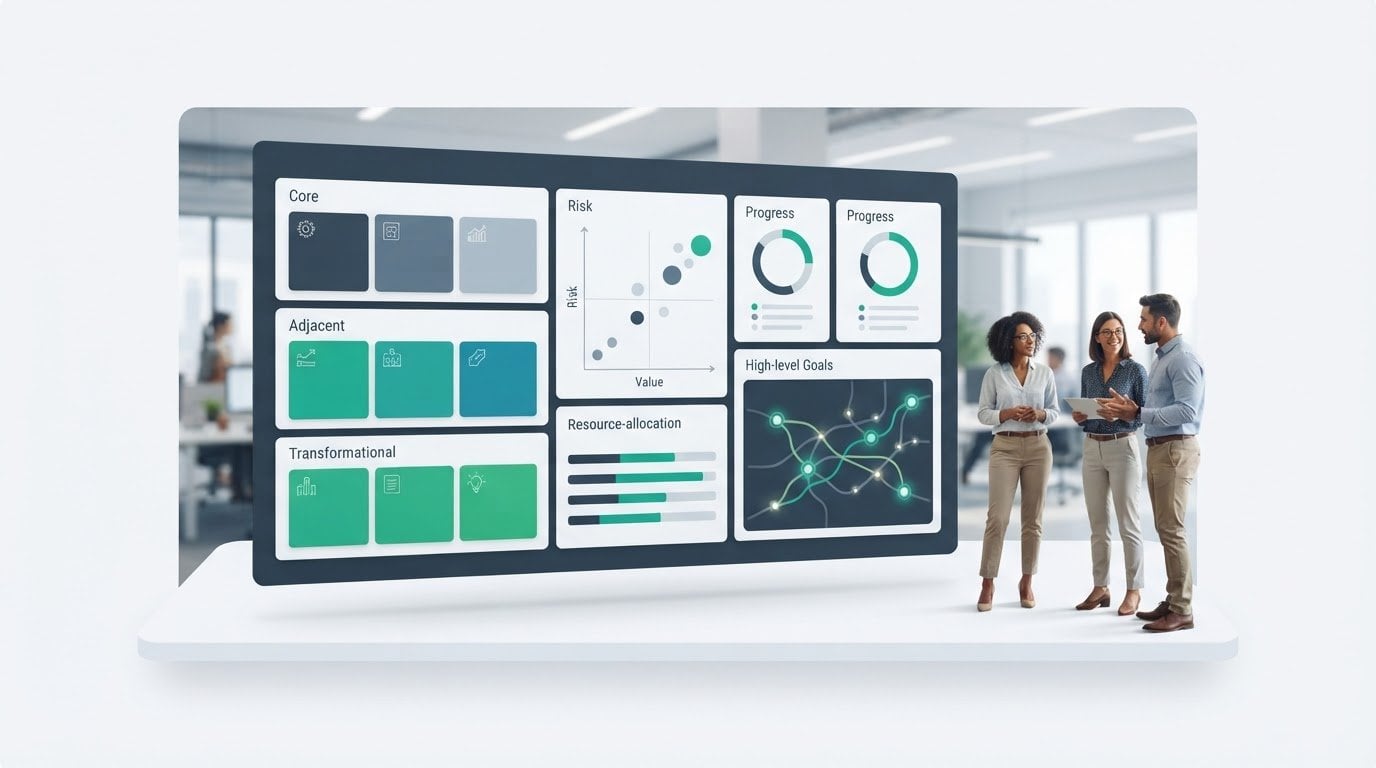
A stack of promising projects isn’t a strategy. Innovation portfolio management assesses, prioritizes, and monitors initiatives as a connected whole, helping leaders see how each supports enterprise goals. The right innovation portfolio management software centralizes initiatives and makes them easier to compare against consistent criteria, rather than treating every idea as an isolated bet.
Organizations want to protect promising ideas while focusing resources on work that can deliver value. The challenge is balancing near-term improvements with longer-term opportunities and making risk, progress, and strategic fit visible enough to guide investment decisions.
This article explains how portfolio management works and what to look for in supporting software. You’ll learn how analytics, AI, and collaboration tools can inform decisions about resources, risk, timing, and expected returns, as well as how to evaluate initiatives and adjust the portfolio when priorities change.
Key Takeaways
- Connect collaboration tools to make initiative updates, ownership, and decisions easier to follow across teams.
- Assess innovation initiatives as a portfolio, linking investment choices to enterprise strategy rather than reviewing each idea in isolation.
- Balance core, adjacent, and transformational work, then redirect resources as evidence and priorities change.
- Use analytics and AI to surface portfolio patterns, monitor progress, and support better-informed decisions.
- Evaluate software by how well it centralizes initiatives, standardizes assessment, and gives leaders visibility into progress.
Integration with enterprise collaboration tools
Collaboration tools connect portfolio decisions with the conversations where work happens. For example, a team discussing a customer problem in Microsoft Teams can record the resulting initiative in a shared portfolio workflow. Preserve the context: the original need, its owner, strategic purpose, and next decision. Without those details, discussion can generate activity without giving the enterprise useful insight.
Start by mapping your innovation process and identifying where teams lose information. A product team might capture an employee suggestion, ask finance to assess resource needs, and invite operations to review implementation risks. A connected workflow makes ownership and decision history easier to follow, giving leaders a clearer basis for comparing proposals across business units.
A small business may need only a shared workspace with simple submission, discussion, and review steps. Large enterprises generally need portfolio-wide visibility, consistent evaluation, and coordination across teams, business areas, and external partners. In either case, choose tools based on the number of participants, decision complexity, and reporting needs, not company size alone.
Integration also supports long-term competitiveness by bringing outside knowledge into planning. Disruption expected to remain 5-10 years away can itself create risk, so organizations need ways to notice changing customer needs and emerging technologies. A partner ecosystem can contribute specialized expertise or access to pilot users. For example, a manufacturer could invite a supplier to review a materials pilot before expanding it.
Set clear collaboration rules before inviting partners into a pilot. Define who can submit ideas, who evaluates them, and how teams share progress. Keep sensitive details within appropriate groups and record decisions in each initiative’s history. Regular updates help surface blockers early, while a named owner ensures feedback leads to a next step rather than another meeting.
- Use one decision record: Capture the proposal, evidence, owner, and review outcome in a shared location.
- Make reviews structured: Ask participants to assess strategic fit, customer value, feasibility, and risk.
- Close the feedback loop: Tell contributors whether an idea advances, changes direction, or stops, and explain why.
Employees may resist adoption if portfolio reviews feel like extra administration. Explain the purpose, connect initiatives to business strategy, train employees on the workflow, and recognize meaningful contributions. These steps make collaboration part of decision-making rather than a separate task. When teams and partners can see how their input informs decisions, the organization builds a stronger foundation for learning and future investment.
What Is Innovation Portfolio Management?
Strategic Portfolio Alignment
A strategic portfolio translates business priorities into choices about which initiatives to advance, reshape, or pause. Leaders can map proposals against growth goals, customer needs, and available capabilities, then identify gaps or excessive concentration. The Three Horizons model distinguishes core business development, emerging growth businesses, and future options, as described by McKinsey’s Three Horizons of Growth. That view helps teams test whether today’s portfolio supports current priorities and longer-term competitiveness.
Risk tolerance matters because strategic alignment isn’t the same as choosing only familiar projects. The Innovation Ambition Matrix helps frame initiatives by risk and ambition. Bansi Nagji and Geoff Tuff describe the framework in their Harvard Business Review article. A company focused on improving an existing service might pair that work with a more exploratory initiative. The useful test is whether each investment has a clear strategic purpose and an appropriate level of uncertainty.
Investment Decisions and ROI
Investment decisions weigh expected value against required resources, execution risks, and evidence of progress. Common measures include expected revenue growth, cost savings, time-to-market, strategic alignment, and risk exposure. A scoring model makes these criteria visible, while stage-gate reviews give leaders defined points to reassess assumptions. Choose measures that fit each initiative instead of forcing every development project into the same ROI formula.
ROI informs portfolio choices, but it shouldn’t be the only consideration. Early initiatives may build capabilities or test customer demand before financial returns become clear. Record assumptions, milestones, and evidence, then revisit funding as results emerge. This makes it easier to redirect resources from underperforming work to initiatives with stronger strategic value, rather than relying indefinitely on an initial business case.
For 2026, the best platform fit is one that supports portfolio visibility, consistent evaluation, and decisions aligned with your organization’s strategy. Compare how each option handles risk, maturity, business area, progress tracking, and the metrics leaders use to review investment choices.
Implement the system by defining strategic goals and evaluation criteria, organizing existing initiatives, assigning owners, and setting review points. Onboard teams, assess progress against agreed measures, and adjust the portfolio as evidence or priorities change.
Portfolio strategy should reflect the organization’s actual investment choices, not a fashionable template. Frameworks such as the Three Horizons model and Innovation Ambition Matrix can guide discussion, while teams tailor dimensions to their strategy. For practical selection criteria, explore this guide to choosing innovation management software.
Balancing resources, time, risk, options, and profitability
A balanced portfolio matches resources and timing to each initiative’s risk and expected return. Comparing core, adjacent, and transformational work helps an organization avoid relying on just one type of outcome.
Feasibility Assessment
Assess feasibility by examining the capabilities, technology, dependencies, and people each initiative requires. A service redesign, for example, may use existing systems, while a new digital offer could require technical development and customer testing. Record assumptions, identify resource gaps, and use stage-gate reviews to determine whether the evidence supports continued investment. This separates an attractive concept from work the organization can realistically deliver.
Resource Allocation and Waste Reduction
Resource allocation assigns people, budget, and leadership attention according to strategic value and delivery needs. During a portfolio review, compare active work with available capacity, then pause duplicated efforts or initiatives whose supporting evidence has weakened. Redirecting those resources toward stronger opportunities can reduce wasted development effort. Clear owners and decision dates help teams act on changes instead of letting low-value work continue by default.
Time is a portfolio constraint, not just a project schedule. A near-term process improvement may produce learning quickly, while a transformational technology initiative may require longer development and staged investment. Compare milestones and dependencies across initiatives before committing scarce specialists. If several projects need the same engineering skills, sequence the work or narrow its scope to protect progress without overloading the team.
Risk should be considered across the portfolio. Core initiatives often improve existing products or operations; adjacent initiatives extend current capabilities into a new market or offer; transformational initiatives pursue less familiar opportunities. A portfolio weighted heavily toward core work may limit future options, while too many uncertain bets can strain resources. Leaders can set a deliberate mix, then adjust it as customer evidence and strategic priorities change.
Profitability decisions should consider expected revenue growth, cost savings, time-to-market, and risk exposure. These measures help compare initiatives, but they need context: a pilot may be valuable for learning before its direct returns are clear. Review the assumptions behind each forecast and use scoring models or stage-gate discussions to determine what would justify further investment. The aim is informed decision-making, not false precision.
Innovators also need practical support to turn allocated resources into results. Give each initiative an accountable sponsor, access to relevant subject-matter expertise, and a clear way to resolve cross-team dependencies. A circular-economy project, for example, may need input from operations, procurement, and product development. Environmental, social, and governance measures, such as energy efficiency or emissions considerations, can connect transformation goals with resilience and profitability.
Data analytics, AI, and predictive modeling
Analytics connect initiative data to portfolio decisions, helping leaders assess value, progress, and emerging trends. Predictive models and dashboards make patterns easier to identify and act on.
Portfolio Analytics and Value Measurement
Start by centralizing initiative data, then compare projects against agreed measures. Common measures include expected revenue growth, cost savings, time-to-market, strategic alignment, and risk exposure. A dashboard, for example, can show that one business area has several delayed launches while another has available capacity. Leaders can investigate the cause and adjust priorities using consistent evidence.
Trend analysis adds context to these measures. An organization could group initiatives by customer segment, technology, maturity, or business area, then track changes in progress and expected value. Sentiment analysis can help identify themes in employee or customer comments, such as repeated requests for simpler onboarding. Teams should review the original feedback before treating a theme as a signal to invest.
AI-Assisted Analysis and Prioritization
Machine learning can identify patterns across initiative descriptions, evaluation scores, and historical outcomes. AI-assisted analysis, for example, could flag proposals with similar goals, highlight missing evidence, or group ideas addressing the same customer problem. Use these findings to inform prioritization, not replace accountable review. Leaders still need to weigh strategic fit, feasibility, risk, and available capabilities.
Set a clear workflow for AI-supported evaluation. First, define the criteria people use to assess initiatives. Next, check whether portfolio data is complete and consistently categorized. Then compare AI-generated themes with human assessments and record why a proposal advances or pauses. This keeps recommendations explainable and helps teams catch errors, such as treating duplicate concepts as separate opportunities.
Real-Time Analytics
Real-time dashboards give teams a current view of submissions, reviews, owners, and initiative progress. A portfolio manager can spot a stalled evaluation, identify the decision owner, and resolve a bottleneck before it affects downstream work. The value depends on timely updates and shared definitions. If one team marks a project “active” while another uses that status differently, portfolio comparisons lose meaning.
Make analytics useful by connecting each metric to a decision. Rising customer interest could trigger further discovery, while a missed milestone could prompt a resource review. Keep dashboards focused on signals leaders can act on and set a regular review cadence. Predictive analytics can support performance monitoring by highlighting patterns worth investigating, rather than presenting forecasts as fixed outcomes.
Innovation management software features
Innovation portfolio management software centralizes initiatives, supports consistent evaluation, and shows progress across a portfolio. Compare platforms by configurability, analytics, workflow fit, and ease of use, rather than relying on feature counts alone.
Feature Comparisons
Core capabilities include initiative tracking, configurable evaluation, portfolio views, and progress reporting. Useful systems let teams categorize work by risk, maturity, business area, technology, or function. Compare how each platform moves an opportunity from submission through assessment and review, and whether its workflows reflect your organization’s decision process.
Configurability matters because portfolio strategies differ. A team prioritizing emerging technologies may need maturity and risk views, while a continuous improvement program may focus on operational impact. Assess flexibility and analytics separately: flexibility shows whether workflows can adapt, while analytics show whether leaders can interpret portfolio activity.
Look for evidence behind feature claims. Ask how each capability works in a realistic workflow and test it with an initiative your team understands. Follow a proposal from submission through evaluation, then check whether reviewers can see its status, rationale, and next step. This reveals gaps that feature descriptions alone can obscure.
- Portfolio structure: Can users group and filter initiatives using the dimensions leaders need?
- Evaluation: Can reviewers apply shared criteria and record decision rationale?
- Reporting: Can leaders see progress, ownership, and portfolio patterns together?
- Adaptability: Can workflows change as priorities and processes evolve?
Usability Considerations
Usability determines whether employees and decision-makers can complete tasks without unnecessary friction. Test common actions, such as submitting an opportunity, completing an evaluation, and finding its latest status. Clear labels, focused forms, and role-appropriate views help users understand what to do next. Excessive fields or confusing navigation can slow adoption.
Test a scenario with people in different roles. Ask an employee to submit an idea, a reviewer to assess it, and a portfolio leader to compare initiatives. Note where users need guidance, repeat information, or lose sight of the next step. This shows whether the platform supports real workflows, not just an administrator’s ideal process.
Finally, distinguish usability from simplicity alone. Enterprise teams may need configurable workflows and detailed portfolio reporting, while smaller teams may prefer a lighter setup. Choose a platform that handles the required complexity without adding avoidable steps. A focused demonstration using your own evaluation criteria helps stakeholders compare the experience directly.
Ideawake: Innovation Management Platform
Ideawake’s Innovation Management Platform helps organizations capture, evaluate, and implement ideas from employees, customers, and partners. Turn portfolio priorities into a repeatable process: gather opportunities, assess them against your criteria, and track ideas toward implementation. Ideawake AI and gamification features, including voting and leaderboards, support participation and help teams surface promising contributions.
Consider Ideawake when ideas are scattered across disconnected channels or teams need a clearer path from submission to action. The platform supports the innovation lifecycle while reducing administrative complexity, helping decision-makers connect participation with evaluation and follow-through. Explore Ideawake to see how it could support your organization’s approach.
Contact Ideawake to discuss your innovation management needs.
Make your next investment decision actionable
Use an upcoming portfolio review to strengthen how your organization evaluates new opportunities. Define the decision you need to make, the evidence leaders will use, and how teams will record the outcome. Then assess whether innovation portfolio management software can support the process without adding unnecessary steps. Starting with a focused use case can turn a broad ambition into a practical operating rhythm.
Ideawake offers an Innovation Management Platform, an Idea Management Platform, and Continuous Improvement tools to help organizations develop and manage ideas. These offerings can bring employee contributions into a clearer process, from gathering suggestions to evaluating them and supporting follow-through. Start a conversation about your current priorities and how your teams make investment decisions.
Build a portfolio process that helps your people make informed choices and move promising work forward.
Frequently Asked Questions
What is innovation portfolio management?
Innovation portfolio management is the practice of deciding which innovation initiatives to fund, continue or stop so the overall mix supports company strategy. It treats ideas and projects as a portfolio of bets with different levels of risk, cost and expected return. The goal is to put limited money and people behind the initiatives most likely to create value.
How do you balance risk and impact in an innovation portfolio?
Spread investment across time horizons and risk levels, then review the mix on a fixed schedule. A common starting point is to put most resources into core improvements, a smaller share into adjacent opportunities and a small share into transformational bets, often described as a 70/20/10 split. Set clear evidence thresholds for each stage so higher-risk ideas earn more funding only as their assumptions are proven.
How do enterprises track innovation initiatives from idea to execution?
They use one system of record that follows each initiative from submission through evaluation, approval, implementation and measured results. Each stage has an owner, criteria and a due date, and status is visible to leaders and submitters. Ideawake tracks every idea through configurable stages and integrates with Jira and Asana so approved work can move into project tracking.
How should an innovation portfolio review make kill-or-continue decisions?
Decide in advance what evidence each initiative must show by the next review, then hold to it. Score every initiative on the same criteria, such as strategic fit, validated demand, cost to the next milestone and risk, and compare them side by side. Stopping weak initiatives quickly frees people and budget for stronger ones, so a healthy portfolio should kill some projects every quarter.
What features should innovation portfolio management software have?
Look for custom scorecards, multi-stage workflows, automated routing to reviewers, portfolio dashboards and ROI tracking that compares projected and actual value. Integrations with project tools and an API matter so approved work does not have to be re-entered. Our idea management software feature guide has a full checklist.
How is innovation portfolio management different from project portfolio management?
Project portfolio management governs approved projects that are already being delivered. Innovation portfolio management sits earlier: it decides which ideas become projects at all and keeps reassessing them while uncertainty is high. The two connect at the handoff, when an approved initiative moves into delivery with its business case and assumptions intact.
How much does innovation portfolio management software cost?
Cost depends on the number of users and administrators, workflow complexity, integrations and support. For Ideawake, most mid-size programs land in the middle of the Business plan range, around $1,000 to $1,500 per month, and enterprise portfolios with unlimited users are quoted. See the Ideawake pricing page and our innovation management software pricing guide.
Which innovation tools integrate with project management and collaboration systems?
Ideawake integrates with Microsoft Teams, Slack, Office 365, Jira and Asana, and offers an API and SCIM provisioning for custom connections. That lets ideas be submitted where people work and lets approved initiatives flow into project tracking without duplicate records. For financial systems, map which fields need to move and who owns them before choosing an integration approach.