
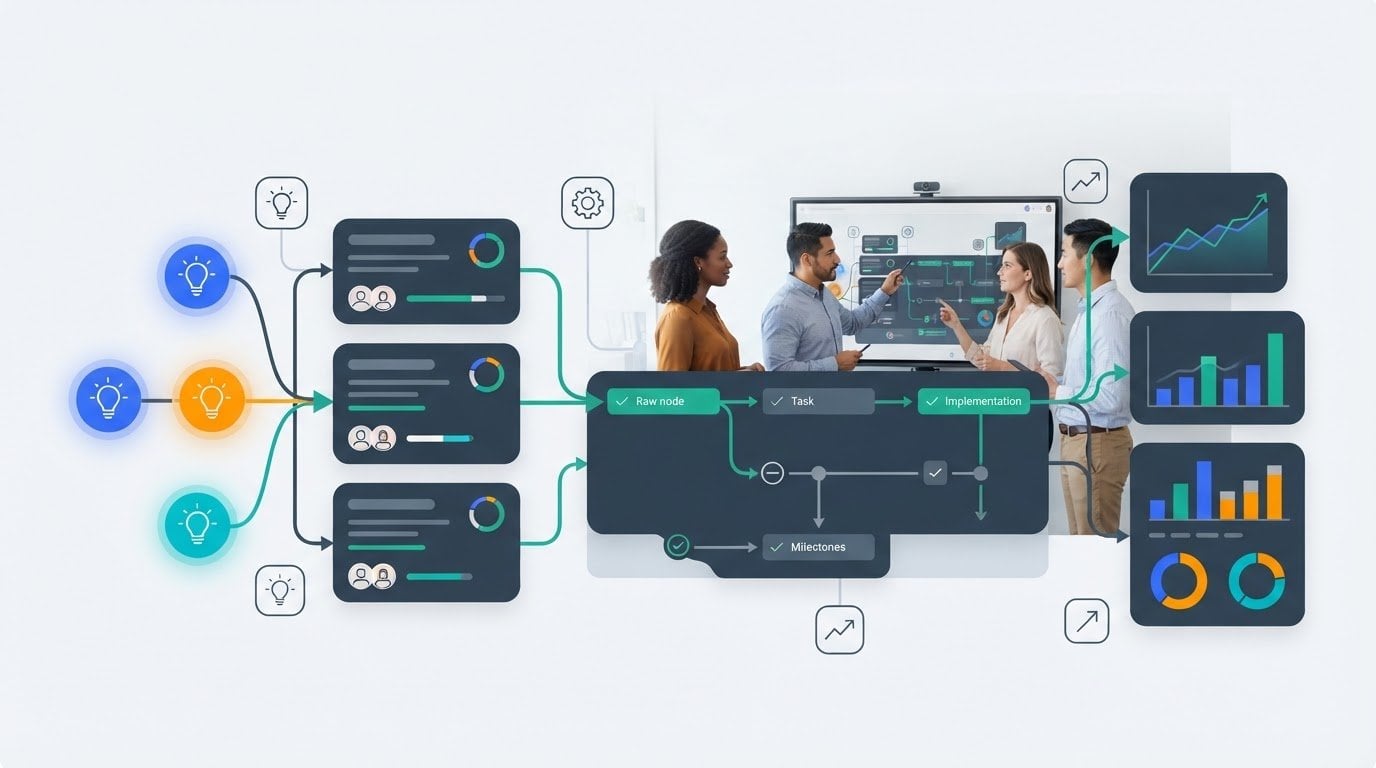
A bigger idea inbox won’t scale innovation. It will scale the backlog. A scalable innovation platform connects ideas to decisions, implementation, and measurable outcomes, so promising initiatives don’t get lost across teams and tools.
As innovation programs expand, coordination gets harder. Participation can dip beyond early adopters, ownership can become unclear, and leaders may struggle to see which ideas are progressing or delivering value. Adding campaigns or software alone won’t solve these problems. Scale depends on connected workflows, clear governance, and a process people can use consistently.
This article explains what makes an innovation platform scalable across an organization and how to build a repeatable approach from idea intake through evaluation and implementation. You’ll learn how to clarify ownership, sustain participation across teams, and track progress against meaningful business outcomes. The goal isn’t simply to collect more ideas. It’s to create an operating system that helps good ideas move forward and makes their impact visible.
Key Takeaways
- A scalable innovation platform manages more than idea submissions. It connects participants, initiatives, workflows, governance, and measurement.
- Map the path from idea capture to implementation and impact, with clear evaluation criteria and ownership at each stage.
- Compare platforms by lifecycle coverage, flexibility, participation, governance, reporting, and usability. Look for ways to reduce disconnected work.
- Start with a focused initiative, learn from how it works in practice, then refine the process before expanding to more teams.
- AI-driven insights and gamification can support evaluation and participation, while clear governance keeps decisions and outcomes accountable.
What Makes a Scalable Innovation Platform Different From an Idea Repository?
A scalable innovation platform is a system for moving ideas from submission through evaluation, ownership, implementation, and impact measurement. A digital suggestion box collects input. A platform helps an organization decide what to do with it and track what happens next.
That distinction matters as an innovation program grows. Scale isn’t simply a larger number of users. It means teams can repeat a clear process across different initiatives and stakeholder groups, with governance and measurement that make decisions understandable. Employees, customers, or partners may contribute ideas, while teams run distinct initiatives, from continuous improvement to innovation challenges. The process should support that variety without leaving every group to invent its own rules.
What does scalable mean in an innovation program?
Organizational scalability is the ability to apply a repeatable approach across teams, initiative types, and participants. It’s different from technical capacity, which concerns whether a system can handle more activity. A program can accommodate more users and still fail to scale if review criteria, decision rights, and follow-through vary from one team to another.
Consider an employee suggestion to reduce a recurring step in a work process. A consistent workflow routes it to the right reviewer, assesses it against shared criteria, and assigns an owner if it’s selected. That owner coordinates implementation, and the team records whether the change produced the intended result. Each stage has a next step and someone responsible. That’s a repeatable process, not just a submission stored for later.
Innovation management connects the work of developing ideas with putting them into practice. A useful platform gives that discipline an operational structure, helping an initiative move beyond collecting suggestions. Organizations exploring different innovation approaches can also compare incremental and radical innovation as they define which kinds of ideas their processes should support.
How is a platform different from an idea repository?
A repository answers, “What ideas were submitted?” A platform should also help answer, “Who reviews them? What decision was made? Who owns the next step? What result followed?” These questions become harder to resolve when ideas sit in separate forms, spreadsheets, and team tools. Information gets duplicated, status updates become manual, and responsibility can blur between review and implementation.
Clear status visibility and accountable ownership make progress easier to follow across teams. Reviewers can see where decisions are needed, contributors can understand what’s happening to their ideas, and leaders can connect activity with outcomes instead of relying on submission counts alone. For a broader overview of the discipline, Innovation management provides useful context. The practical test is simple: does the system only preserve ideas, or does it help the organization act on them and learn from the results?
How a Scalable Innovation Platform Connects Ideas to Outcomes
A connected lifecycle gives every idea a clear route: capture, clarify, evaluate, prioritize, assign, implement, and measure. Each transition should preserve context and decision history. Teams can then see what was proposed, why it advanced, who is responsible, and what resulted.
From idea submission to evaluation and prioritization
Start with a guided submission that asks for information reviewers can use, such as the problem, who it affects, and the proposed improvement. Keep prompts focused. Overly complex forms can make participation harder, while sparse submissions leave reviewers guessing. Next, apply consistent criteria tied to the initiative’s goals. Teams might assess strategic fit, feasibility, and potential benefit, then record why an idea was advanced, deferred, or declined.
Voting and gamification can draw attention to ideas and encourage participation, but popularity isn’t the same as business value. Use engagement signals as one input, not a substitute for evaluation. AI-driven insights can help organize submissions or surface patterns for review, but people still need to interpret the findings, apply program criteria, and make accountable decisions. Explore how AI tools for innovation managers can support this analysis without replacing governance.
From implementation tracking to ROI measurement
Once an idea is selected, assign an owner and define the next steps, milestones, and status updates. For example, a customer suggestion to simplify an onboarding step might move from review to a team-owned test, then into implementation if the results support the change. A visible record helps contributors and decision-makers follow progress instead of relying on scattered updates.
Measurement should distinguish activity from outcomes. Submission totals, votes, and review completion show participation and process movement. They don’t establish whether an implemented idea created value. Define a relevant outcome measure before work begins, such as time saved, fewer process errors, or another operational improvement aligned with the initiative. A scalable innovation platform makes lifecycle data useful by connecting decisions, ownership, implementation, and results in one traceable view.
That connection turns reporting into organizational learning: teams can see where ideas stall and which approaches deliver. Bain & Company’s discussion of the best practices of great scalers also emphasizes embedding repeatable practices as organizations grow. To see how connected workflows can support idea evaluation and follow-through, explore an innovation platform walkthrough.
How to Evaluate Scalable Innovation Platforms Without Adding Complexity
A platform should make innovation work easier to coordinate, not add another layer of administration. Evaluate it against your program goals, participants, decision rights, and existing processes. The right fit supports a consistent approach to managing ideas while allowing teams to adapt workflows when initiatives genuinely differ.
Which platform capabilities matter as programs grow?
Use the criteria below to compare how a platform supports work across an initiative’s lifecycle. Look beyond feature lists. Ask how each capability would help your teams make decisions, keep work visible, and learn from results.
| Evaluation area | What to assess |
|---|---|
| Lifecycle coverage | Can teams carry ideas from submission through evaluation, implementation, and outcome measurement? |
| Workflow flexibility | Can distinct challenges use relevant steps and criteria without forcing every initiative into one template? |
| Participation | Can the process support employees, customers, or partners where their input is relevant? |
| Governance | Are decision rights, review criteria, and ownership clear at each stage? |
| Reporting | Can teams follow status and connect program activity to outcomes? |
| Usability | Are submission and review journeys straightforward for participants and administrators? |
These criteria work together. A customer-focused challenge may need different prompts from an employee process-improvement initiative, while both can use clear ownership and progress reporting. A scalable innovation platform should make that variation manageable without fragmenting data or obscuring decisions.
How can teams avoid complexity and low adoption?
Start with the user journey. Participants should understand what information to provide and what happens after submission. Reviewers should be able to apply the program’s criteria without unnecessary steps. Governance needs enough consistency to make decisions explainable, but not so much rigidity that every initiative follows an ill-fitting process.
Then compare the platform’s administrative steps with the work it is meant to improve. Does it reduce duplicate entry, scattered status updates, and manual follow-up, or simply relocate them? If teams must maintain parallel spreadsheets to understand ownership or progress, the workflow may not be connected enough. Simplicity doesn’t mean removing every control. It means having the right controls in the right places.
For organizations modernizing older processes, this guide to innovation software alternatives can help frame the transition. Compare platforms using a real initiative and the people who would run it. That practical test reveals whether the system can support meaningful flexibility while keeping work clear, traceable, and manageable.
How to Scale an Innovation Program in Practical Stages
Expanding an innovation program works best as a sequence of deliberate steps, not a company-wide launch that assumes every team is ready at once. Begin with a meaningful, bounded use case. Clarify accountability, configure the workflow, launch with a defined group, learn from actual participation, and expand what proves useful. This gives teams room to improve the process before more initiatives depend on it.
Start with a focused use case and clear ownership
Choose a business challenge specific enough to guide action, such as reducing friction in a process or improving a customer experience. Identify who can contribute, who makes decisions, and what outcome would indicate progress. Assign responsibility for screening submissions, evaluating ideas, implementing selected proposals, and communicating decisions. Without those owners, ideas can stall between approval and action.
Configure only the workflow needed for that initiative. Set clear submission prompts, review criteria, and decision points, then select measures that reflect activity and outcomes. Participation and review completion help show whether the program is functioning; an outcome measure should reflect the challenge itself. An idea management ROI calculator can help teams think through how to connect implemented ideas with value.
Expand through feedback, learning, and repeatable workflows
After launch, review where participants drop off, which steps create avoidable friction, and whether decisions are communicated clearly. Ask contributors and reviewers what was confusing, then refine prompts, criteria, and updates before adding another initiative. Share decisions, including why ideas move forward or don’t, so participation feels connected to real action.
As the program grows, standardize the elements that support consistency, such as decision roles and status definitions, while allowing workflows to reflect different initiative goals. A scalable innovation platform can help keep those processes connected, but the operating practice matters just as much: clear communication, useful feedback, and visible follow-through. Expand when the initial workflow is understood and owners can carry it into the next context without rebuilding the process from scratch.
Scale is not a single launch milestone. It’s the ability to repeat what works, adapt what doesn’t, and keep responsibility clear as more teams take part.
How Ideawake Supports a Scalable Innovation Platform Strategy
A platform’s value depends on how well its capabilities fit the work an organization needs to coordinate. Ideawake supports a scalable innovation platform strategy with a cloud-based innovation management platform that connects idea capture, evaluation, implementation, and ROI measurement. This lifecycle coverage helps teams follow ideas beyond submission and examine progress through to outcomes.
The platform supports ideas from employees, customers, and partners, along with initiatives such as innovation challenges and hackathons. These sources and formats can serve different program goals. Consider who will participate, who will evaluate submissions, and how selected ideas will move into action. The aim is a connected process, not a one-size-fits-all initiative.
Where Ideawake fits in the innovation lifecycle
Ideawake supports the path from an initial idea to evaluation, implementation, and ROI measurement. AI-driven insights can assist with analyzing ideas, while gamification can support participation. Neither removes the need for clear criteria, accountable decision-makers, or thoughtful follow-through. Those practices help teams use platform capabilities in line with their program’s purpose.
For example, an organization could use a challenge to gather ideas from a defined participant group, evaluate submissions against its objectives, and track selected ideas through implementation. The workflow and outcome measures should reflect the initiative rather than assume results in advance.
What to explore in a platform demonstration
Bring a real use case to a demonstration and trace it through the lifecycle. Consider how participants submit ideas, how reviewers assess them, who owns implementation, and how the organization records outcomes. This makes it easier to judge whether the workflow supports your governance needs and addresses friction in the current process.
Also identify where administrative work can be simplified and where flexibility is needed for different initiatives. A demonstration should connect platform capabilities to the way your teams operate, so you can assess fit based on the work rather than a feature list.
Turn a repeatable innovation process into lasting impact. Innovation scales when ideas move through connected workflows, with clear ownership, consistent evaluation, and outcomes leaders can track. A scalable innovation platform is more than a place to collect submissions. It helps teams build a repeatable path from idea to implementation while adapting the process to different initiatives.
Start with a focused use case, make decisions visible, and learn from participant feedback before expanding. Ideawake’s cloud-based innovation management platform supports the lifecycle from idea submission through ROI measurement, including ideas from employees, customers, and partners. AI-driven insights and gamification can support analysis and participation, while clear governance keeps accountability with the people making and carrying out decisions.
See how those workflows could apply to your organization’s innovation goals.
Frequently Asked Questions
What is a scalable innovation platform?
A scalable innovation platform is software that manages ideas beyond collection by connecting submission, evaluation, ownership, implementation, and measurement. Unlike a digital suggestion box, it gives teams repeatable workflows and visibility across initiatives and participant groups. Organizational scalability means teams can apply consistent criteria and governance while adapting steps to a use case. The goal is to turn submitted ideas into decisions and trackable outcomes.
How does an innovation platform help companies scale innovation?
An innovation platform helps companies scale innovation by creating a shared process for capturing ideas, routing them to reviewers, assigning implementation owners, and tracking results. Teams can run different initiatives without losing visibility into decisions or progress. For example, employee improvement ideas and customer suggestions may need distinct prompts, yet both can use clear ownership and outcome tracking. That makes coordination more repeatable as participation expands across groups.
What features should a scalable innovation platform have?
A scalable innovation platform should support the idea lifecycle from submission through implementation and outcome measurement. Look for workflows that can adapt to different initiatives, clear roles for evaluation and follow-through, accessible participation for relevant stakeholder groups, and reporting that shows status and results. Usability matters too: participants need a straightforward way to contribute, while administrators need processes that reduce duplicate tracking rather than add another layer of work.
How can an organization scale innovation without creating more bureaucracy?
Keep the process focused on the decisions and actions the initiative actually requires. Define who reviews ideas, who approves next steps, and who communicates outcomes, then avoid collecting information that won’t inform those decisions. Use common governance principles across programs, but allow relevant differences in prompts or evaluation criteria. Review administrative steps against the work they’re meant to improve. If teams must maintain duplicate records to understand progress, simplify the workflow.
How do you measure the ROI of an innovation platform?
Measure ROI by connecting implemented ideas to outcomes relevant to their original goals. Set a baseline and define what value means for the initiative, such as reduced process time, fewer errors, cost savings, or new revenue. Track submissions and implementation progress as activity measures, but don’t treat them as proof of impact. Record realized outcomes and the costs associated with delivering them, then review results consistently to understand which ideas created value.
Can AI help scale innovation management?
AI can support innovation management by helping teams analyze ideas and surface insights as submissions grow. These insights can assist reviewers, but they shouldn’t replace human judgment, agreed evaluation criteria, or accountable governance. Teams still need to assess strategic fit, decide which ideas to advance, and assign implementation owners. Used thoughtfully, AI can support analysis within a clear process; it isn’t a substitute for one.
How should a company start scaling its innovation program?
Start with one meaningful, bounded business challenge rather than launching an organization-wide program at once. Identify the participants, decision-makers, expected outcomes, and owners for reviewing and implementing ideas. Configure a simple workflow, launch it with the intended group, then review participation, decision visibility, and process friction. Use feedback to refine the approach before extending it to other teams or initiative types. Expand what works, and adapt what doesn’t.