

Most organizations don’t have an idea problem.
They have a process problem.
Great ideas show up in hallway conversations, in Teams chats, during customer calls, on the shop floor, and in the “we should really fix this someday” pile.
And then they disappear—because there’s no simple, repeatable system to capture them, improve them, evaluate them fairly, and turn them into measurable impact.
That’s what an innovation process is supposed to do.
Not inspire. Not brainstorm. Not create a “suggestion box” that fills up and turns into noise. A real innovation process turns ideas into action, and action into results you can point to in a meeting without sweating.
This post breaks down the innovation process the way it should actually work in the real world: simple enough to run weekly, structured enough to be fair, and measurable enough to prove ROI.
What an innovation process really is (and why it breaks)
An innovation process is a repeatable way to move from:
Problem → Ideas → Prioritization → Implementation → Measured impact
Sounds obvious. Yet most programs break for predictable reasons:
1) The “suggestion box” trap
When you ask for “any ideas,” you get a lot of… anything. Some are gold. Most are vague. Many are duplicates. And evaluators drown.
A working innovation program doesn’t collect random ideas. It collects ideas around clear goals.
2) No clear ownership
If an idea isn’t assigned to a real owner, it doesn’t move. It sits. Then people stop submitting because they learn the truth: “nothing happens.”
3) Evaluation is inconsistent or political
If your process doesn’t make decisions transparent—using criteria that everyone understands—you don’t get the best ideas. You get the safest ideas, or the loudest ideas.
4) No measurement loop
When leadership can’t see pipeline health or impact, innovation becomes a “nice-to-have.” Then budgets shrink. Then the program dies.
A strong innovation process solves all of this by being intentionally boring in the best way: consistent, structured, and measurable.
Process innovation vs. product innovation (quick clarity)
Innovation doesn’t always mean launching a new product.
In many organizations, the highest-value wins come from process innovation—improving how work gets done so you reduce cost, increase speed, improve quality, or eliminate waste. It’s often “invisible” to customers, but it’s very visible in your margins, delivery times, error rates, and employee sanity.
Product innovation is what you sell. Process innovation is how you build, deliver, support, and operate.
And here’s the important part: process innovation is easier to crowdsource because the people closest to the work usually know exactly where the friction lives.
If you want ROI from ideas, you want a process that makes it easy for those people to contribute, and easy for leaders to act.
That’s where Ideawake shines.
The Ideawake Innovation Process: simple, repeatable, measurable
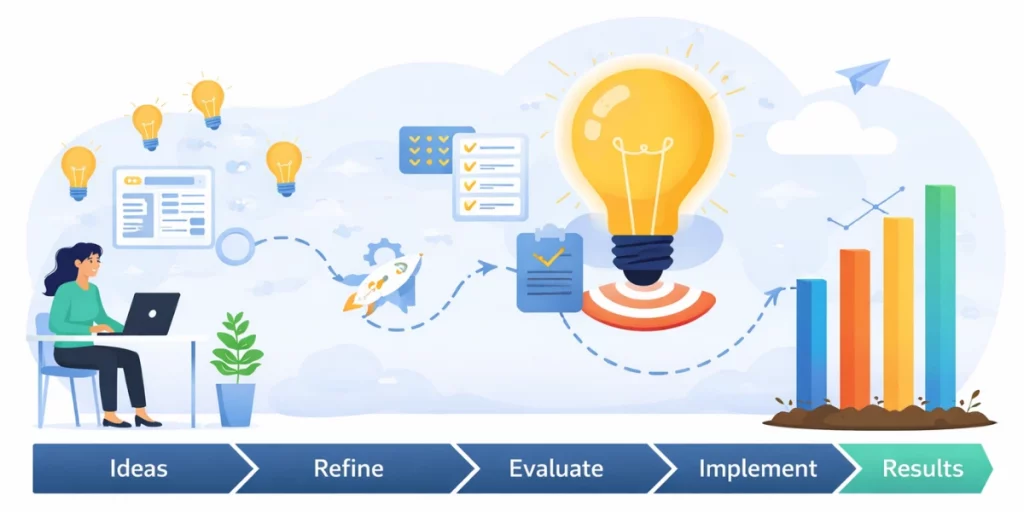
A great innovation process doesn’t try to be complicated. It tries to be effective.
Here’s the process we see work across organizations of all sizes when they use Ideawake to run employee, customer, or partner ideation.
1) Define the challenge (so ideas are usable)
If you want great inputs, you have to give a great prompt.
Innovation programs collapse when they ask for “ideas to improve the company.” That’s not a challenge. That’s a vague request for free consulting.
Instead, define targeted challenges tied to business goals, like:
- Reduce cycle time by 10%
- Cut rework and errors
- Improve on-time delivery
- Reduce cost-to-serve
- Improve customer onboarding
- Increase safety or compliance consistency
- Increase cross-team collaboration
A clear challenge creates two good things immediately:
- You get relevant ideas, not random ones.
- It becomes much easier to evaluate ideas fairly because the goal is explicit.
In Ideawake, challenges can be time-based so you can focus participation and create momentum. People engage more when there’s a real “window” and a real purpose.
2) Capture ideas with context (not just opinions)
An “idea” is not a sentence.
A usable idea includes enough context that reviewers can understand the problem and the proposed solution without playing detective.
A strong submission format captures things like:
- What problem are you solving?
- Who is impacted (team/customer/process)?
- What’s the expected benefit (time, cost, quality, experience)?
- What would it take to implement?
- What dependencies exist?
This does two critical jobs:
- It improves idea quality without requiring people to write a thesis.
- It makes evaluation faster because the basic facts are already there.
Ideawake is designed for fast idea capture with configurable fields so you can collect exactly what matters for your organization—without turning submissions into paperwork.
And because duplicates are a silent killer in ideation programs, systems that detect similar ideas early reduce clutter and increase collaboration. Instead of 12 people submitting the same idea, they can improve one strong entry.
3) Collaborate and refine (turn raw input into strong proposals)
Most ideas start rough. That’s normal.
A modern innovation process doesn’t treat first drafts like final drafts. It creates space for collaboration so ideas improve before evaluation.
That means enabling participants to:
- Comment on ideas
- Add details and supporting data
- Ask questions to clarify assumptions
- Build on each other’s thinking
- Collaborate across silos
This matters more than most people realize.
If you only collect ideas and then quietly score them behind the scenes, you lose the best part of crowdsourcing: the ability to refine and strengthen ideas through collective input.
Ideawake supports collaboration in ways that break down silos and make ideas stronger—before decision makers ever touch them.
4) Evaluate and prioritize (fair decisions, less time)
Evaluation is where innovation programs either become trusted… or political.
A great evaluation process is transparent, consistent, and fast.
The easiest way to do that is with custom scorecards aligned to your goals. You define the criteria once, and then use it consistently across ideas.
Common criteria include:
- Strategic alignment
- Expected impact (cost savings, revenue, time saved, quality improvement)
- Feasibility
- Time to implement
- Cost to implement
- Risk level
- Cross-team dependency complexity
You can also assign specific review groups or stakeholders based on the idea type—so finance reviews financial impact, operations reviews feasibility, and leadership reviews strategic alignment.
This speeds up decisions and reduces the “committee of everyone” problem.
The goal is simple: identify the ideas worth implementing now, and clearly communicate why.
When people understand how decisions are made, they keep participating—even if their idea isn’t chosen this round.
5) Validate before scaling (pilot mindset)
The fastest path to results is rarely “approve and roll out everywhere.”
It’s: pilot → learn → scale
Validation is where you prove value with minimal risk.
A simple validation step might include:
- Run a small test in one team or one location
- Define what success looks like (time saved, errors reduced, customer steps removed)
- Measure before vs. after
- Gather feedback from the people doing the work
- Adjust the idea before scaling
This step protects resources and increases confidence. It also prevents the common failure mode where good ideas fail because the execution plan wasn’t ready.
Ideawake makes it easier to track ideas through stages so pilots don’t vanish into “we’ll get to it.”
6) Implement with ownership (make ideas happen)
An idea without an owner is a fantasy.
Implementation needs:
- A clear owner
- Clear stages and approvals
- Collaboration across the right teams
- A way to track status and unblock progress
This is where workflows matter.
Ideawake supports customizable workflows and stages so your process reflects how your organization actually approves and implements changes.
Some companies want a lightweight flow. Others need approvals. The point is: you shouldn’t have to force your organization into a rigid process.
Also, implementation gets dramatically easier when the innovation platform connects to the systems teams already use. When you can move ideas into project management tools, you reduce handoffs, reduce duplication, and keep execution connected to the original intent.
7) Measure impact (and improve the process itself)
If you can’t measure it, it won’t survive.
Leaders want to know:
- What’s in the pipeline?
- What’s moving?
- What’s stuck?
- What impact are we getting?
- Are people actually participating?
A strong innovation process tracks two categories of metrics:
Impact metrics (the ROI story)
- Realized cost savings
- Cost avoidance
- Revenue impact
- Time saved
- Quality improvements (rework reduced, fewer defects)
- Customer experience improvements (steps removed, faster delivery)
Process health metrics (the “is this working?” story)
- Participation rate (how many people engage)
- Engagement depth (comments, votes, repeat contributors)
- Time-to-decision (submission → evaluation)
- Time-to-implementation
- Idea throughput (how many move stages)
- Conversion rate (ideas submitted → implemented)
Ideawake is built to show program health and outcomes quickly using dashboards and custom KPIs, so you can understand where your process is strong—and where it needs tuning.
This is the difference between an innovation program that feels inspiring and one that is provably valuable.
Your operating rhythm: how to run innovation weekly without chaos
Innovation shouldn’t require a full-time “innovation police” team.
A simple operating rhythm keeps the process alive and keeps momentum high.
Weekly (30–60 minutes)
- Triage new submissions
- Merge duplicates or encourage collaboration
- Route ideas to appropriate review groups
- Move top ideas into evaluation or validation stages
- Close the loop on ideas not moving forward (with a short explanation)
That last point matters. Silence kills participation.
Monthly
- Publish wins and outcomes (even small ones)
- Recognize top contributors (public recognition goes farther than you think)
- Launch a new targeted challenge aligned to current priorities
Quarterly
- Review dashboards: pipeline, cycle time, participation, impact
- Tune scorecards if they’re not producing clear results
- Simplify workflows if ideas are getting stuck in approvals
- Re-align challenge themes to leadership goals
Common failure points (and how to avoid them)
Here are the usual “innovation program killers,” and what a strong process does instead.
“We can’t get people to participate.”
Participation rises when people believe three things:
- Their ideas will be seen
- Decisions will be fair
- Something will actually happen
Targeted challenges, visible collaboration, and recognition drive engagement. Add gamification thoughtfully—points, leaderboards, and incentives can increase participation dramatically when paired with real follow-through.
“We got too many ideas and now we’re overwhelmed.”
That’s not a people problem. That’s a process problem.
Use structured submissions, duplicate detection, and a weekly triage rhythm. Don’t let everything enter the same evaluation funnel. Route by category and priority.
“Decisions take forever.”
Make evaluation criteria explicit. Use scorecards. Assign review groups. Set a standard SLA for evaluation (for example, ideas receive an initial response within 7 days).
Speed signals seriousness.
“We implemented things but can’t prove value.”
Track impact from day one. Start with projected value, then update with actuals after implementation. Capture time saved, cost avoided, and operational improvements.
If you want the program to grow, you need the ROI narrative.
What to measure: innovation KPIs executives actually care about
If you want leadership buy-in, measure what matters.
Financial outcomes
- Cost savings
- Cost avoidance
- Revenue growth or retention impact
- Productivity gains (converted to dollars where appropriate)
Operational outcomes
- Cycle time reduced
- Defects/rework reduced
- Faster delivery or response times
- Compliance consistency improved
Cultural outcomes
- Participation rate and growth over time
- Repeat contributors (signals trust)
- Cross-functional collaboration (comments, mentions, co-owned ideas)
- Engagement lift in improvement programs
One implemented idea with a clear value story can justify the program. Ten implemented ideas with measured outcomes can transform it.
Final thought: innovation should feel shockingly simple
The best innovation process isn’t the one with the most frameworks and buzzwords.
It’s the one your organization can run every week—consistently—without burning out the people involved.
When you make it easy to capture ideas, easy to refine them, easy to evaluate them fairly, and easy to implement and measure them, innovation stops being a slogan and starts being a system.
That’s how you turn ideas into impact.
If you want to see what this looks like in your organization, Ideawake can help you launch quickly and start measuring results in weeks—not quarters.
Schedule your 30-minute demo, and we’ll walk through a simple process tailored to your goals, your workflows, and the outcomes you want to deliver.
FAQs: The Innovation Process for Ideawake
1) What are the key steps in an innovation process?
A practical innovation process follows: define the challenge → capture ideas with context → collaborate and refine → evaluate and prioritize → validate via pilots → implement with ownership → measure impact and improve the process.
2) What’s the difference between process innovation and product innovation?
Process innovation improves how work is done (efficiency, cost, quality, speed). Product innovation improves what you sell. Many organizations see the fastest ROI from process innovation because it eliminates friction and waste.
3) How do we increase participation in employee ideation programs?
Use targeted challenges tied to real goals, make decisions transparent with clear criteria, recognize contributors, and close the loop consistently. Participation rises when people see ideas move and results get celebrated.
4) How do you evaluate and prioritize ideas fairly?
Use custom scorecards aligned to organizational goals (impact, feasibility, time-to-value, cost, risk, strategic fit). Assign review groups to reduce bottlenecks and keep decisions consistent.
5) How do we prevent duplicate ideas and idea clutter?
Use structured submissions, encourage collaboration on similar ideas, and triage weekly. Reducing duplicates improves quality and makes evaluation faster.
6) How do we prove ROI from innovation?
Track projected value at submission, then update to actual value after implementation. Measure financial impact, time saved, quality improvements, and cycle time reduction—then show progress in dashboards.
7) How long should an innovation cycle take?
It depends on complexity, but a healthy program has a weekly cadence for triage and evaluation, runs pilots quickly, and maintains clear stages so ideas don’t stall for months.
8) Who should own the innovation process internally?
Typically, a program owner (innovation lead or ops lead), review groups by function (ops, finance, IT), and an executive sponsor to maintain alignment and remove blockers.