
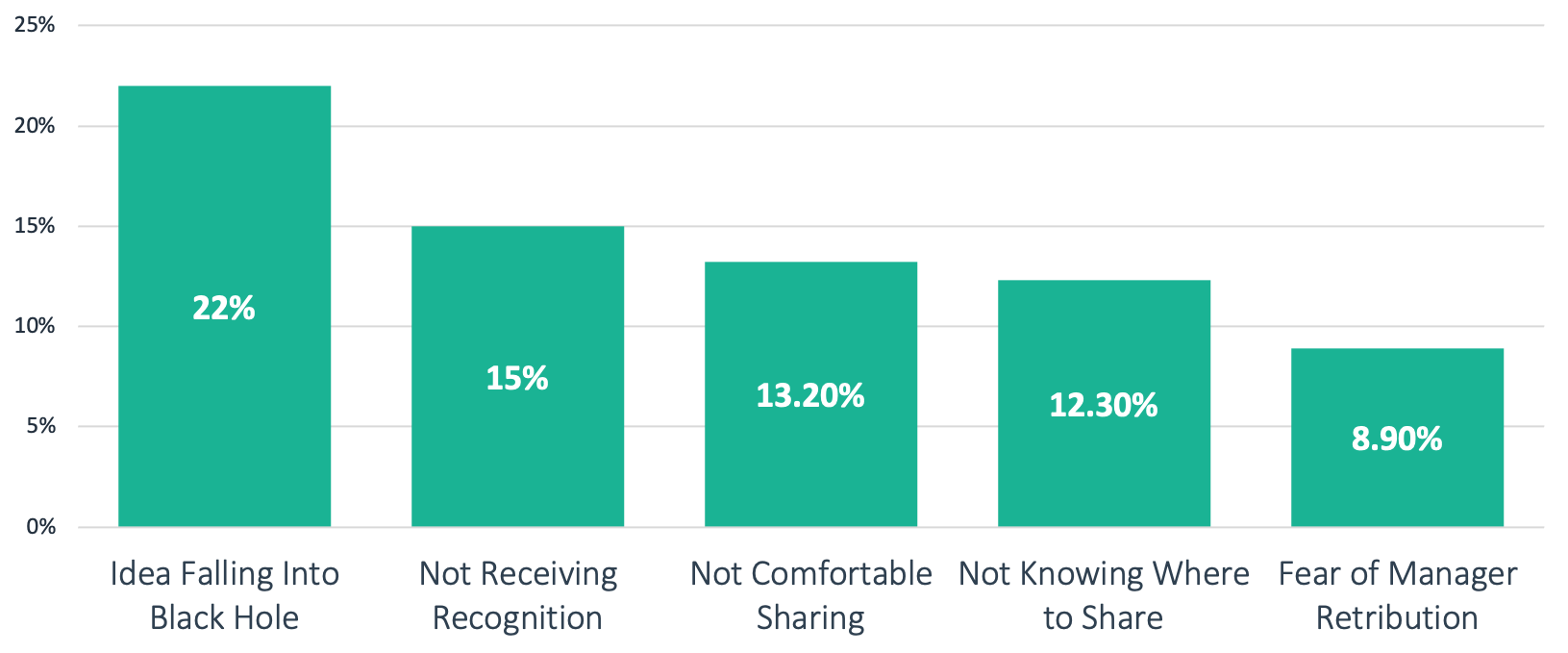
In Ideawake’s State of Employee Ideas in 2021, which surveyed over 700 employees across the United States on their opinions towards their employer’s ability to listen and take action on their ideas, one of the questions we asked was what prevented employees from sharing their ideas. Here are the top 5 reasons employees stop sharing ideas along with ways you can use Ideawake to alleviate each of them.
Ideas Falling Into a “Black Hole”
One in five (20.8%) of respondents said they stopped sharing ideas because they never heard back from previous ideas they shared. This demonstrates how critical it is to have a structured, formalized communication process in place before and after an idea is submitted.
Here are a few of the ways that Ideawake helps improve transparency and avoid employees getting the feeling that their ideas are falling into a black hole -
- Automated Status Change Emails - Keep idea submitters up to date with automated notifications whenever their idea changes status.
- Announcements – Post announcements to keep the community updated about your innovation initiatives and receive announcements as well as real time notifications in Ideawake and via email.
- Granular Activity Tracking for Submitters – Submitters can track the progress of their idea at every stage of the review and implementation process, helping drastically improve transparency over the most common methods like spreadsheets.
Want to Learn More or Test Drive Ideawake?
Start enabling a culture of improvement today. Start testing whether Ideawake is right for you in the next 5 minutes, or contact sales to schedule a demo.
Not Receiving Recognition for an Idea They Previously Shared
According to a study by OfficeTeam, a leading staffing service specializing in the placement of highly skilled administrative professionals, 29% of employees said that they’ve had their ideas stolen at work.
This directly correlates to our State of Employee Ideas Survey, in which 14.7% of respondents said they stopped sharing ideas because they didn’t receive recognition on an idea they previously shared. Ideawake aims to overcome the recognition gap by automating employee recognition through the following features -
- Prizes - Offer a wide variety of incentives to participate in your challenges. Examples include gift cards, lunch with the CEO, or 10 hours a week to test and implement a selected idea.
- Gamification – Incentivize participation by giving users points for completing value added activities to help move ideas forward.
- Timestamp and proof of Ownership – When an idea is submitted, it has a timestamp and a submitter associated with it, making it easy to track submitters of ideas over time.
Not Feeling Comfortable Sharing Ideas & Fear of Manager Retribution
According to a study by DecisionWise, 34% of employees in the US don’t speak up because of fear of retribution. Ideawake has a few features that help eliminate frontline team members fear of retribution and make them comfortable sharing their ideas to improve efficiency, reduce costs, and increase engagement –
- Anonymous Posting – Allow users to submit their ideas anonymously in order to prevent managers from knowing who is sharing an idea.
- Control Idea Visibility - Take full control of who can see submitted ideas, and when they become visible in your process. As an example, you can limit direct manager visibility of an idea until it has been reviewed by a supervisor.
- Smart Routing - Automatically route ideas that might be critical of a manager straight to their superior for review instead of having them go to the idea submitters direct manager.
Not Knowing Where to Share Ideas
With an ever expanding digital toolset, it’s no wonder why 12.3% of respondents said they didn’t know where to share their ideas. Ideawake enables you to bring innovation to where your teams already live with our Microsoft Teams integration, or leverage some of these other features to bake innovation into your organizations DNA -
- Submit Ideas Via Email - Email has stood the test of time, which is why Ideawake makes it easy to centrally collect ideas directly through your inbox.
- Integrate with Tools You Already Use – Bring Ideawake into the workflow your employees are already used to whether it’s Microsoft Teams, Slack, or Yammer - View Integrations.
- Mobile Friendly - Access Ideawake anytime, anywhere you have an internet connection by computer, smartphone or tablet.
Employees Are Too Busy to Share Ideas
With workloads constantly increasing, many employees feel they simply don't have time to contribute ideas—even if they're encouraged to. Innovation often feels like "extra work" that falls outside their core responsibilities.
Ideawake helps by embedding idea sharing into existing workflows, allowing employees to submit and interact with ideas without interrupting their day-to-day work. Integrations with tools like Microsoft Teams, Slack, and email ensure that innovation doesn’t become a burden—it becomes a seamless part of how work gets done.
Fear of Idea Theft or Being One-Upped
It’s not uncommon for employees to hesitate to share their best ideas out of fear that someone else will take credit—or build on it and overshadow their contribution. This erodes trust and discourages transparency.
Ideawake addresses this through timestamped submissions and proof of authorship, ensuring that idea ownership is always clear. Submitters receive recognition, visibility, and trackable activity history, helping to create a more trustworthy and equitable innovation culture.
Lack of Psychological Safety
If your organizational culture punishes risk or criticism, employees are unlikely to speak up with ideas that challenge the norm. Innovation thrives in environments where people feel safe to share—even if their ideas don’t get implemented.
Ideawake fosters a psychologically safe space by supporting anonymous idea submission, smart routing that bypasses direct managers, and optional control over visibility—all of which encourage honesty without fear of judgment or consequence.
Unclear Process or Too Much Friction
When the process for submitting ideas feels confusing or time-consuming, even the most motivated employees may hesitate. If they don't know what happens after they submit—or if they need to jump through hoops to participate—they’re less likely to contribute.
Ideawake simplifies the process of submitting, reviewing, and implementing ideas through intuitive interfaces, real-time updates, and automation. From initial submission to implementation, every step is easy to follow—reducing friction and increasing engagement.
Not Understanding the “Why” Behind Idea Sharing
Even when the tools and processes are in place, employees may still wonder: Why should I bother sharing ideas? What’s in it for me—or the company? Without clear alignment between individual contributions and broader goals, engagement drops.
Ideawake helps organizations connect employee ideas to strategic priorities by enabling challenge-based submissions, transparent impact tracking, and customizable communication. When employees see how their ideas contribute to company goals, they’re more motivated to participate.
Why Employees Stop Sharing Ideas Is More Common Than You Think
In today’s fast-paced and innovation-driven workplace, every organization talks about the importance of employee input. But despite encouragement from leadership, many employees stop sharing ideas altogether—and it’s more common than most realize.
According to various surveys and industry research:
Over 50% of employees feel their ideas are ignored or undervalued.
Around one-third avoid speaking up due to fear of criticism or repercussions.
Others believe their ideas won’t make a difference or don’t know how or where to share them.
While this behavior may seem passive on the surface, it’s often a reflection of deeper cultural and systemic issues—lack of trust, poor feedback loops, complicated processes, or a fear-driven work environment. Unfortunately, when employees disengage from idea sharing, companies lose more than just input—they lose innovation, morale, and competitive edge.
But here’s the flip side: organizations that build a strong culture of idea sharing see better collaboration, improved processes, higher retention, and even revenue growth. The key is to recognize the barriers—and remove them intentionally.
That’s why understanding the top reasons employees stop sharing ideas is not just an HR exercise—it’s a strategic priority.
Final Thoughts
Creating a workplace where employees feel empowered to share their ideas isn’t just a nice-to-have—it’s essential for long-term innovation and engagement. By removing the barriers that discourage idea-sharing and actively fostering a culture of openness, organizations can unlock the full creative potential of their teams. It starts with listening—and it pays off in growth.
FAQs
1. Why is it important for companies to encourage employees to share ideas?
Encouraging idea-sharing promotes innovation, boosts employee engagement, and helps organizations stay competitive by leveraging diverse perspectives.
2. How can leaders make employees feel more comfortable sharing their ideas?
Leaders can create psychological safety by showing openness to feedback, responding constructively, and recognizing contributions without judgment.
3. What are some common signs that employees have stopped sharing ideas?
Low participation in meetings, silence during brainstorming sessions, and a decline in suggestions or feedback are indicators employees may have disengaged.
4. How does a lack of idea-sharing impact business performance?
When employees stop speaking up, companies risk missing growth opportunities, process improvements, and innovative solutions that could give them a competitive edge.
5. What role does company culture play in idea-sharing?
A culture that values trust, recognition, and transparency encourages participation, while fear-driven or hierarchical cultures often discourage employees from contributing.
6. How can technology help improve idea-sharing at work?
Platforms like innovation management software streamline submissions, track progress, and ensure recognition, making it easier for employees to contribute.
7. What should managers do if employees are reluctant to share ideas?
Managers should actively solicit input, provide reassurance, demonstrate follow-through on past ideas, and create channels for anonymous feedback if needed.
8. Can anonymous idea-sharing really increase participation?
Yes. Allowing anonymity helps employees share more freely, especially when ideas involve challenging the status quo or addressing sensitive issues.