
Your frontline is sitting on a goldmine of operational efficiency, but if your current system is just a digital version of a wooden box, you’re throwing money away. Most organizations treat employee insights like junk mail, leaving high-value potential to rot in an unmonitored inbox while managers drown in manual sorting. If you don’t have a structured way to capture employee ideas, you aren’t just missing out on innovation; you’re actively draining your company’s competitive edge and fostering a culture of suggestion fatigue.
We understand that a suggestion box is a liability when it lacks a clear path to execution. This 2026 guide promises to transform your approach by replacing manual overhead with an automated, AI-driven pipeline that ensures every submission is either actioned or expertly archived. You’ll learn how to implement modern capture frameworks that drive engagement and provide the clear ROI data your leadership demands. We’ll break down the exact steps to move from a graveyard of spreadsheets to a high-performance engine that fuels measurable business value and organizational transformation.
Key Takeaways
- Transitioning from passive suggestion boxes to a systematic capture framework is critical for preventing the “idea graveyard” and maintaining long-term employee morale.
- Sustainable innovation requires a culture of psychological safety where every submission receives a transparent, leadership-backed response to combat suggestion fatigue.
- Leveraging AI allows organizations to capture employee ideas at scale by automating deduplication and solving the “signal-to-noise” problem inherent in high-volume environments.
- High-impact workflows rely on objective evaluation criteria—Feasibility, Desirability, and Viability—to move concepts from raw submission to measurable business value.
- Modern innovation management platforms significantly reduce administrative overhead while providing the precise ROI data needed to prove the financial impact of your program.
The Strategic Necessity of Capturing Employee Insights in 2026
The systematic effort to capture employee ideas is no longer an optional HR initiative or a “nice-to-have” culture builder. In 2026, it is a core business function. We define this process as a structured, repeatable pipeline for sourcing, evaluating, and implementing operational improvements and new product concepts directly from your workforce. Without a rigorous framework, your company is essentially operating with a blind spot. You’re ignoring the people who see your processes, customers, and product flaws every single day.
The cost of the “Idea Graveyard” is higher than most executives realize. When you ask for feedback but fail to act or even respond, you aren’t just losing a good idea; you’re actively destroying employee morale. This cycle of silence creates suggestion fatigue, where your most talented people simply stop trying. Statistics in organizational research suggest that companies with high-performing ideation programs can see up to 20% faster problem-solving by leveraging distributed knowledge rather than relying solely on top-down directives. Active strategic alignment ensures that every insight captured is a direct contribution to your bottom line.
Beyond the Digital Suggestion Box
Traditional, unstructured feedback methods fail to scale in enterprise environments because they lack a validation mechanism. Historically, employee suggestion systems were passive tools that often devolved into complaint collections. There is a massive difference between a platform that gathers grievances and one that facilitates strategic ideation. To move the needle, organizations must transition to a structured best idea management software that provides visibility across the entire innovation lifecycle. This shift ensures that ideas are categorized, ranked, and moved toward implementation rather than sitting in a stagnant database.
The Frontline Advantage: Identifying Operational Risks
Employees on the ground often identify efficiency leaks and operational risks months before they appear on a management dashboard. They see the friction in the supply chain and the bugs in the software interface in real-time. Capturing these incremental improvements can drive significant long-term OpEx savings that aggregate into substantial financial gains. The power of the frontline is perhaps best illustrated by the Flamin’ Hot Cheetos case study, where a janitor’s observation led to one of the most successful product lines in snack history. By building a system to capture employee ideas, you empower every member of your team to act as a catalyst for growth, turning localized insights into enterprise-wide advantages.
Creating a Culture of Continuous Idea Generation
Building a safe environment requires more than just an open-door policy. It demands transparent feedback loops where every submission receives a timely, constructive response. When employees understand the distinction between creativity vs innovation, they realize that while creativity is the generation of new ideas, innovation is the practical application of those ideas to create value. This clarity helps reduce the fear of rejection. If a concept isn’t viable, explaining the reason through a structured evaluation process maintains trust and encourages the next submission.
Leadership plays a non-negotiable role in this ecosystem. When executives actively participate in the platform, they validate the effort required to innovate. This top-down engagement signals that the organization values intellectual contribution as much as daily output. If you want to see how these cultural shifts look in practice, you can explore a modern innovation framework that automates these feedback loops and reduces administrative friction.
Incentives and Recognition Strategy
While monetary rewards are common, evidence suggests that public recognition and professional growth often provide more sustainable motivation. A well-designed system gives employees public credit for their contributions, potentially linking innovation performance to career advancement opportunities. Gamification elements like leaderboards and peer voting turn the act of sharing ideas into a social, engaging experience. These tools help maintain momentum and prevent the program from feeling like an extra chore for the frontline.
Using structured “Innovation Challenges” is another effective tactic to capture employee ideas with precision. By focusing the collective intelligence of your workforce on a specific problem for a limited time, you create a sense of urgency and purpose. This targeted approach prevents the system from becoming a catch-all for complaints. Instead, it aligns every captured idea with current strategic goals. Recognition in this context isn’t just a pat on the back. It is a verification of an employee’s expertise and their direct impact on the company’s future success.
Leveraging AI to Streamline Idea Collection and Evaluation
Capturing employee ideas at scale creates a unique paradox. The more successful your engagement efforts are, the more likely you are to be buried under a mountain of data. For global organizations, the “signal-to-noise” problem isn’t just a nuisance; it’s a structural barrier that prevents high-impact insights from reaching the right people. AI is the only viable solution for managing this volume without exploding your administrative overhead. By replacing manual sorting with intelligent automation, you ensure that the best concepts rise to the top instantly.
AI-Powered Deduplication: Maintaining a High-Signal Pipeline
Manual sorting is the primary reason innovation programs fail to scale. When you use Ideawake AI, the system automatically clusters similar concepts during the submission phase itself. If an employee starts typing an idea that has already been proposed, the platform surfaces the existing entry in real-time. This doesn’t just prevent duplicate work. It encourages contributors to collaborate on existing threads rather than competing for attention. By automating this initial sorting, organizations can reduce administrative time by up to 80%, allowing managers to focus on implementation rather than data entry.
Automated Routing and Expert Evaluation
The true value of an idea is often invisible to generalist managers. It requires the eyes of a subject matter expert. AI streamlines this by matching submissions to specific departmental leads based on historical data and keyword relevance. Instead of an idea sitting in a queue for weeks, it’s instantly routed to the person best equipped to judge its feasibility. By integrating these workflows with enterprise collaboration tools like Microsoft Teams, you ensure that evaluation becomes a natural part of the workday. This automation can shorten the evaluation lifecycle from several weeks to just a few days.
Beyond simple routing, Natural Language Processing (NLP) allows leadership to perform sentiment and trend analysis across thousands of submissions. You can identify emerging themes, such as recurring safety concerns or specific supply chain friction points, before they become critical failures. If these insights highlight a need for specialized safety management, you can visit Be-Safe Technologies Ltd to explore award-winning EHS digital platforms. This proactive approach transforms the way you capture employee ideas into a strategic intelligence tool that informs long-term decision-making. You aren’t just collecting suggestions; you’re harvesting actionable data that drives the company forward.
From Capture to Implementation: Building a High-Impact Workflow
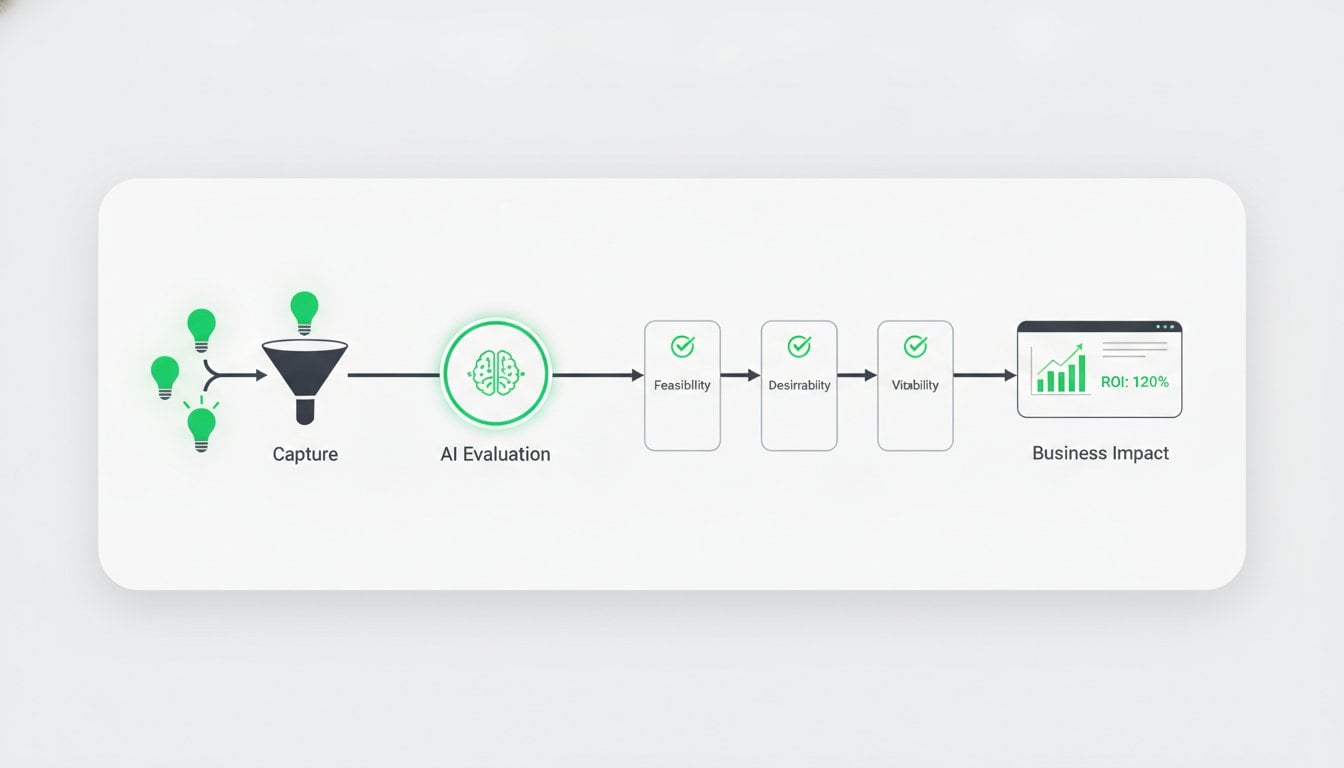
Capturing employee ideas is only the first step in a much larger value chain. Without a rigorous, transparent workflow to move those ideas from raw submission to executed reality, your innovation program will eventually stall. A high-impact pipeline requires more than just enthusiasm; it needs a standardized vetting process that filters out noise and prioritizes projects based on their actual business potential. By establishing clear ownership and an implementation roadmap, you ensure that “innovation” isn’t just a buzzword, but a repeatable driver of growth.
Developing Transparent Evaluation Criteria
Objectivity is the enemy of bias. To maintain trust in your program, you must utilize weighted scoring models that rank submissions against three core pillars: Feasibility, Desirability, and Viability. Standardizing the idea evaluation process ensures that every employee feels their contribution was judged fairly. When an idea is rejected, communicating “The Why” is just as important as the rejection itself. This transparency prevents resentment and educates the workforce on what constitutes a high-value concept, effectively training them to submit better insights in the future.
A multi-stage vetting process usually begins with peer-level crowd-voting to gauge desirability. This is followed by a deep-dive expert review where subject matter experts assess technical feasibility and financial viability. This tiered approach prevents your most expensive resources from wasting time on concepts that don’t have internal support. Once an idea clears these hurdles, it must be assigned a clear owner and integrated into a project roadmap with specific milestones and deadlines.
Measuring the ROI of Employee-Led Innovation
To secure long-term executive buy-in, you must translate creative output into financial data. Setting specific KPIs, such as direct cost savings, new revenue streams, or reduced time-to-market, allows you to quantify the impact of your program. Using a specialized ROI calculator helps innovation managers justify program expansion by showing the exact dollar value generated for every hour spent on ideation. This data-driven approach moves the conversation from “culture building” to “bottom-line impact.”
Beyond hard financial metrics, it’s vital to document the “soft” benefits of capturing employee ideas. Increased retention rates, higher engagement scores, and a more resilient corporate culture are tangible outcomes of a successful program. When you close the loop by communicating these results back to the original submitter, you reinforce the value of their contribution. This creates a virtuous cycle of participation that sustains the program long after the initial launch excitement has faded.
Ideawake: The Modern Standard for Capturing Employee Ideas
Legacy innovation tools are often where high-value insights go to die. They’re typically clunky, slow, and require excessive administrative maintenance just to keep the lights on. Ideawake represents a fundamental shift in how organizations capture employee ideas, replacing manual complexity with a streamlined, AI-driven architecture. A critical decision for modern leadership is the choice to build vs buy an ideation platform. While internal builds might seem attractive for customization, they frequently collapse under the weight of technical debt and lack the specialized AI capabilities required for deduplication and ROI tracking.
Choosing a purpose-built platform like Ideawake significantly reduces implementation time compared to legacy innovation software. Instead of months of configuration, organizations can launch high-impact challenges in days. This speed allows you to move quickly from identifying a problem to implementing a solution, ensuring that your innovation program delivers immediate, visible results to the executive suite.
Reducing Administrative Overhead with Smart Automation
The primary goal of any innovation manager should be implementing change, not managing paperwork. Ideawake is engineered to automate the “boring” parts of the innovation lifecycle. This level of scalability is vital; whether your team generates 100 ideas or 10,000, the administrative burden remains virtually unchanged thanks to AI-powered sorting and routing. We’ve found that a modern, intuitive UI is the single biggest factor in sustained frontline participation. If the tool feels like a natural part of the workday rather than an extra chore, adoption rates stay high, and your pipeline remains filled with actionable insights without the need for additional headcount.
Winning the Market with Strategic Innovation
Providing end-to-end visibility is what separates high-performance organizations from the rest. Ideawake allows you to track an idea from the first spark of inspiration through to the final ROI report, providing a clear audit trail of value creation. This transparency effectively transforms your entire workforce into a 24/7 R&D department, uncovering efficiency leaks and growth opportunities that traditional top-down management would never see. The long-term impact of employee ideation programs goes beyond simple cost-cutting; it fosters a culture of continuous improvement and radical accountability.
Stop settling for the mediocrity of spreadsheets and unmonitored inboxes. It’s time to leverage a platform that ensures every idea is either actioned or expertly archived while providing the hard data your leadership demands. Transforming your organization’s untapped potential into measurable business value requires the right technology and a results-driven partner.
Book a demo to see Ideawake in action
Transform Your Frontline into a Strategic Engine
The days of passive suggestion boxes and stagnant spreadsheets are over. To effectively capture employee ideas in 2026, organizations must deploy automated frameworks that bridge the gap between initial insight and final execution. By leveraging AI-driven deduplication, you can reduce administrative overhead by up to 80% while ensuring that high-signal concepts reach the right experts in days, not months.
This shift to a structured innovation pipeline separates market leaders from those stuck in mediocrity. With end-to-end ROI tracking and a platform trusted by Fortune 500 innovation leaders, you can finally prove the financial impact of your workforce’s creativity. The untapped potential within your frontline is your greatest competitive advantage. It’s time to stop letting it go to waste. Start building a high-impact engine for growth today.
Frequently Asked Questions
How do I encourage employees to share their ideas?
Encouraging participation starts with psychological safety and leadership visibility. You must create a culture where “half-baked” concepts are welcomed and refined through collaboration. Use specific “Innovation Challenges” to give employees a clear problem to solve; this prevents choice paralysis. When leadership actively participates by commenting or voting, it signals that the organization values intellectual contribution. Providing a user-friendly way to capture employee ideas ensures the process feels like a natural workflow.
What is the best way to evaluate a large volume of employee suggestions?
Implement a tiered evaluation framework that starts with peer-level crowd-voting. This identifies “desirability” before expensive subject matter experts are involved. Next, apply a weighted scoring model based on feasibility and viability. Using a digital platform allows you to automate this pipeline, ensuring that only the highest-potential concepts reach the final review stage. This structured approach prevents bottlenecks and ensures that every submission is processed fairly and efficiently without manual sorting.
Can AI really help in capturing and sorting employee ideas?
AI is essential for managing the “signal-to-noise” problem in large organizations. Modern platforms use natural language processing to identify and cluster similar submissions during the entry phase. This prevents redundant work and encourages collaboration on existing threads. Additionally, AI can automatically route ideas to the most relevant departmental experts based on historical data. This automation reduces administrative time by up to 80% and ensures a high-signal pipeline for every decision-maker.
How do I measure the financial impact of an employee idea program?
You must track the hard financial outcomes of every implemented project, such as direct cost savings, new revenue generated, or reduced time-to-market. Use a specialized ROI calculator to quantify these gains against the cost of the program. Beyond hard numbers, monitor “soft” metrics like employee retention and engagement scores. Documenting these results provides the evidence needed to justify program expansion and secure long-term executive buy-in for your innovation initiatives.
What are the common reasons why employee suggestion programs fail?
Most programs fail because they become an “Idea Graveyard” where suggestions go in but never come out. When employees don’t receive timely feedback, they quickly develop suggestion fatigue and stop participating. Other common failures include a lack of clear evaluation criteria and a failure to secure leadership commitment. Without a transparent process and a dedicated implementation roadmap, the program will be seen as a superficial HR initiative rather than a strategic driver.
Should I use a digital platform or a physical suggestion box?
Physical suggestion boxes are obsolete because they lack transparency, scalability, and data tracking. A digital platform provides a centralized hub where employees can collaborate, vote, and see the status of their submissions in real-time. Digital tools also allow for AI-powered sorting and automated feedback loops that are impossible with physical methods. To effectively capture employee ideas across distributed teams, a cloud-based system is required to maintain momentum and ensure end-to-end visibility.
How do I give feedback to employees whose ideas are not implemented?
Always provide clear, constructive reasons why an idea was not moved forward. Use your standardized evaluation criteria, feasibility, desirability, and viability, to explain the decision objectively. This transparency maintains trust and educates the employee on what makes a concept valuable to the organization. Closing the loop ensures that even rejected contributors feel heard, which prevents resentment and encourages them to refine their thinking for future submissions to the program.
What kind of rewards work best for employee innovation?
While monetary incentives are common, public recognition and career advancement opportunities often drive more sustainable engagement. Use leaderboards and peer voting to give contributors public credit for their expertise. Non-monetary rewards, such as presenting an idea to the executive board or receiving dedicated time to work on a pet project, validate the employee’s status as an innovator. A balanced reward strategy aligns individual achievements with the company’s long-term strategic transformation goals.