
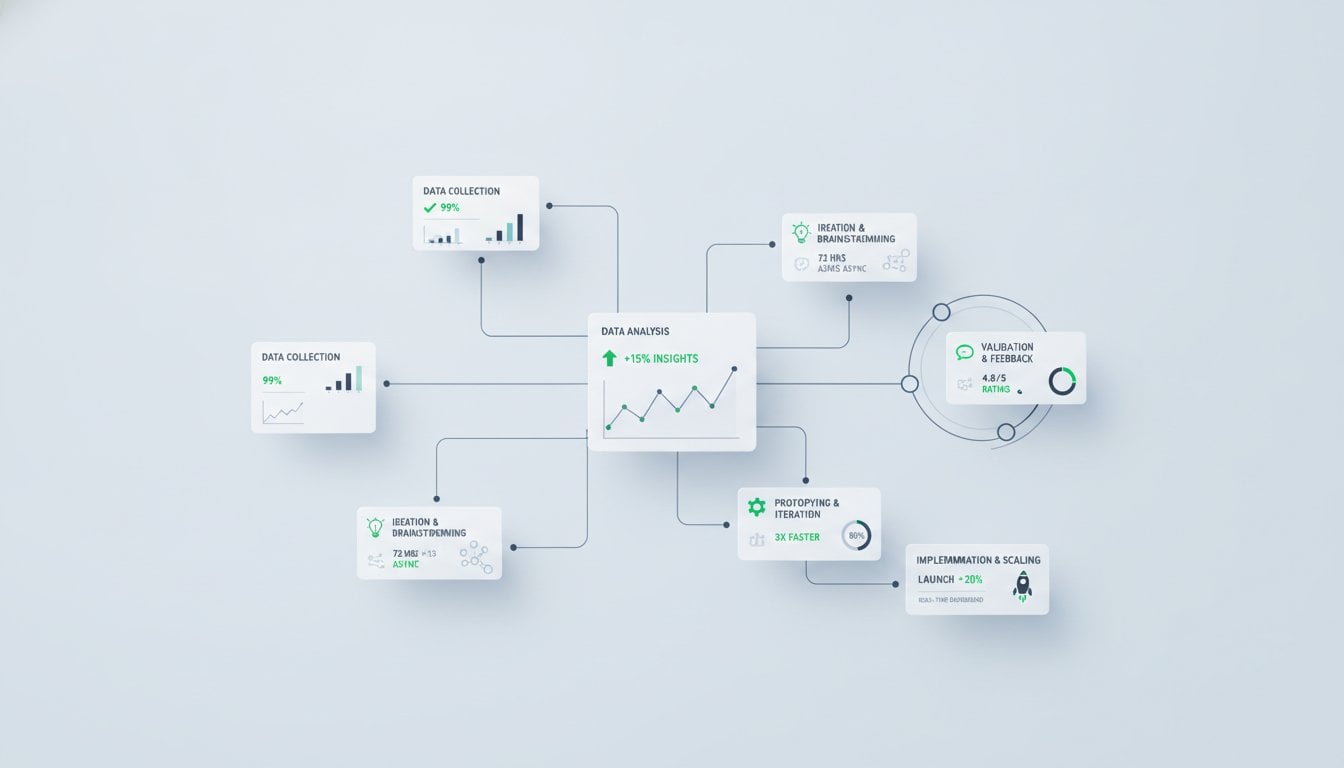
Organizations with well-managed remote and hybrid environments report productivity improvements of 10% to 20%, yet many enterprise leaders still struggle to capture a single breakthrough idea outside of a physical conference room. The reality is that innovation management for remote teams isn’t about recreating the office. It’s about building a superior, data-driven system that thrives on distribution.
You’ve likely felt Zoom fatigue stifle your team’s creative energy while the loss of spontaneous hallway conversations leaves your innovation pipeline feeling stagnant. Managing a creative lifecycle across multiple time zones shouldn’t feel like a logistical nightmare that yields little more than frustration. It’s a common hurdle, but it’s one that your competitors are likely failing to clear because they’re stuck using outdated, synchronous habits.
This guide provides the roadmap to solve these challenges by introducing asynchronous frameworks that turn global distribution into a creative engine. You’ll learn how to replace physical whiteboards with high-impact tools and implement methodologies to measure remote innovation ROI with total clarity. We’re moving past the “watercooler” myth to help you build a repeatable, scalable system for distributed creativity.
Key Takeaways
- Build a resilient framework for innovation management for remote teams that eliminates proximity bias and ensures the best ideas rise to the top, regardless of geography.
- Apply cognitive science principles to mitigate screen fatigue and “visual narrowing,” ensuring your distributed talent remains capable of high-level divergent thinking.
- Master a 5-stage asynchronous innovation lifecycle—Capture, Evaluate, Refine, Implement, and Measure—to maintain momentum without meeting-heavy schedules.
- Leverage targeted Innovation Challenges to focus your organization’s creative energy on solving high-priority business problems with measurable financial impact.
- Discover how to consolidate your innovation stack and reduce administrative overhead by up to 80% through specialized automation and tracking tools.
The Remote Innovation Paradox: Why Traditional Methods Fail in 2026
The traditional innovation model died the moment the office became optional. In 2026, hybrid work is the standard for 52% of remote-capable employees, yet many organizations still try to force 20th-century creativity into a 21st-century reality. This disconnect creates a paradox: remote work offers the focus needed for deep work, but it often kills the spontaneous spark that ignites new projects. Solving this requires a transition to formal innovation management for remote teams.
Effective innovation management for remote teams is the structured discipline of capturing, evaluating, and implementing ideas across distributed networks. It’s the move from accidental discovery to intentional systemization. We’ve moved past the “physical whiteboard” era. Those analog tools were messy, localized, and impossible to scale. Today, a digital-first mandate is required to ensure that a breakthrough idea in London isn’t lost because the decision-makers are in New York.
The Death of the Spontaneous Idea
The loss of “watercooler moments” isn’t just a cultural shift. It’s a data-backed threat to R&D pipelines. Research indicates that videoconferencing can reduce the number of creative ideas generated because it narrows the visual and cognitive field. When every interaction is a scheduled meeting, creativity feels like a chore. Scheduled “brainstorming calls” often backfire by fueling groupthink and screen fatigue. To counter this, teams need digital spaces for low-stakes idea sharing that exist outside of the calendar. This allows for the “slow hunch” to develop without the pressure of a ticking clock.
Overcoming Proximity Bias in Hybrid Settings
Proximity bias is the silent killer of remote R&D. It’s a cognitive shortcut where managers naturally favor ideas from the people they see in person. Remote employees are frequently sidelined during high-level innovation cycles because they aren’t “in the room.” This exclusion isn’t just a morale issue; it’s a strategic failure that ignores a significant portion of your intellectual capital. Overcoming this requires a shift to centralised idea management. By moving the process to a digital environment, you level the playing field through:
- Transparent Evaluation: Use standardized criteria that focus on data rather than the contributor’s location.
- Asynchronous Refinement: Allow team members to build on ideas across different time zones.
- Equitable Visibility: Ensure every submitted idea is tracked and visible to leadership, regardless of where it originated.
This approach ensures that merit, not geography, drives your innovation pipeline.
The Cognitive Science of Virtual Creativity and Screen Fatigue
Staring at a screen isn’t just tiring; it’s a biological barrier to breakthrough thinking. Research from 2025 indicates that “visual narrowing” caused by fixed monitor focus restricts peripheral awareness, which is the exact neurological state required for creative insight. Cognitive scope is the mental breadth of attention and associative capacity available for divergent thinking during a specific task. When this scope is restricted by the physical confines of a laptop screen, the brain naturally shifts into a detail-oriented, convergent mode that is excellent for spreadsheets but detrimental to ideation.
Why Video Calls Kill Divergent Thinking
Eye contact on a screen is a simulation that the brain recognizes as “uncanny,” leading to a constant state of low-level social anxiety. The presence of the “self-view” window acts like a digital mirror, triggering heightened self-consciousness. This makes participants more risk-averse and less likely to share unpolished or radical ideas, effectively sterilizing the creative process. Implementing “camera-off” sessions for the initial ideation phase can alleviate this pressure, allowing the brain to focus entirely on the problem at hand without the tax of social performance.
Leveraging Asynchronous Advantages
Asynchronous, text-based ideation often outperforms live sessions because it respects the “incubation period” required for deep thought. It allows team members to “sleep on it,” letting the subconscious mind process complex challenges away from the pressure of a live call. This structure also clarifies the difference between creativity vs innovation by giving contributors the time to move from a raw spark to a refined, viable concept.
Digital platforms provide a level of egalitarianism that physical rooms lack. By utilizing anonymous submission features, you remove the social friction that prevents junior staff from challenging established norms. This data-driven approach ensures that the most impactful ideas move forward based on their potential ROI rather than the charisma of the presenter. It’s a fundamental shift in innovation management for remote teams, prioritizing intellectual merit over social hierarchy. If you’re ready to move beyond the limitations of video calls, you can explore how modern platforms automate these creative workflows.
Building a High-Impact Asynchronous Innovation Lifecycle
Innovation management for remote teams isn’t a single event; it’s a continuous, data-driven cycle that operates independently of real-time presence. To move beyond the limitations of “visual narrowing” discussed previously, organizations must implement a structured 5-stage lifecycle: Capture, Evaluate, Refine, Implement, and Measure. This framework ensures that creativity isn’t left to chance but is instead systematized into a predictable engine for growth. By shifting to an asynchronous model, you eliminate the pressure of performing on-camera and allow the best ideas to mature at their own pace.
Stage 1 & 2: Distributed Capture and Evaluation
Capture must be frictionless. High-impact innovation often originates with frontline workers who aren’t sitting at a desk. Utilizing mobile-first platforms allows these team members to submit insights the moment they occur, preventing “idea decay.” Once captured, the process moves to evaluation. Implementing transparent idea evaluation criteria is critical to building trust within a remote workforce. When employees understand the “why” behind a decision, they remain invested in the system. Peer-voting mechanisms can then be used to surface high-potential concepts quickly, using the “wisdom of the crowd” to filter out noise before leadership intervention.
Stage 3 & 4: Virtual Refinement and Execution
Once an idea is validated, it moves into refinement. In a distributed setting, this is best handled by cross-functional “squads” working across time zones. These small, agile groups use digital collaboration tools to develop prototypes and business cases without the need for constant synchronous check-ins. It’s also where you must proactively manage innovation failures. In a transparent digital environment, a failed experiment isn’t a setback; it’s a data point that informs the next cycle. Streamlining the handoff from these innovation squads to implementation leads ensures that breakthroughs don’t stall in the “digital drawer” but move rapidly toward measurable ROI.
Essential Frameworks and Tools for Remote Innovation Managers
Follow this five-step framework to modernize your remote innovation stack:
- Step 1: Audit for Remote Compatibility. Review your current tools to see if they support asynchronous contribution. If your process relies on everyone being in a room at once, it’s not remote-compatible.
- Step 2: Implement a Dedicated Platform. Move beyond spreadsheets and chat threads. Use a specialized innovation management platform to centralize submissions, tracking, and evaluation in one transparent location.
- Step 3: Establish Virtual Hackathons. Drive short-term bursts of creativity by hosting 24 to 48-hour digital events. These provide the high-energy “sprints” needed to move from concept to prototype rapidly.
- Step 4: Deploy AI Clustering. Use machine learning to group similar ideas together automatically. This prevents your innovation managers from drowning in repetitive data.
- Step 5: Integrate Existing Workflows. Ensure your platform connects with tools like Jira or Slack. This meets employees where they already work, reducing the “app fatigue” that often hinders participation.
The Role of AI in Scaling Remote Idea Management
Measuring Success: Data Over Distance
You cannot manage what you do not measure. In a remote setting, physical presence is no longer a proxy for productivity. You must rely on hard metrics like participation rates, idea-to-implementation velocity, and projected financial impact. It’s critical to assess idea management ROI early to justify your program spend to stakeholders. Transparent leaderboards can also be used to drive healthy competition across time zones, rewarding the quality of contributions rather than just the volume. This data-driven approach replaces the “gut feel” of traditional management with objective proof of value. To see how these tools work in a live environment, you can book a free demo of our innovation platform.
Driving ROI with Ideawake: The Modern Remote Innovation Solution
The transition to a digital-first model isn’t a multi-year ordeal. The implementation process for global enterprises is designed for speed, ensuring that you can launch your first challenge and begin collecting data-backed insights in weeks, not months. This efficiency is what enables true employee-led innovation. When every team member, from the frontline to the C-suite, has an equitable platform to contribute, the organization becomes more resilient and better equipped to handle the shifting economic realities of 2026.
Why Ideawake Beats Spreadsheets for Remote Teams
Many organizations attempt to manage their R&D pipeline using static documents, but the hidden costs are staggering. Managing a growing list of ideas in a spreadsheet leads to “data silos” where transparency dies and proximity bias thrives. Comparing Ideawake vs spreadsheets reveals a fundamental difference in remote transparency. While a document is a passive record, a dedicated platform is an active ecosystem that uses real-time notifications and peer-voting to keep the momentum alive. We’ve seen remote teams find “The Next Big Thing” simply by opening the floor to digital crowdsourcing, surfacing ideas that would have otherwise been lost in a localized office conversation.
Ready to Scale Your Remote Innovation?
The paradox of remote work is that it can either isolate your best thinkers or provide them with the ultimate environment for deep work. The choice depends entirely on the systems you provide. If you’re ready to move past the limitations of screen fatigue and accidental ideation, it’s time to systematize your approach. You can explore our extensive library of innovation resources to see how other enterprise leaders are driving measurable ROI through employee engagement.
Don’t let your next breakthrough idea get lost in a meeting that should’ve been an asynchronous thread. Start your remote innovation journey with Ideawake today and turn your distributed workforce into your greatest competitive advantage.
The Future of Distributed R&D: Turning Geography into a Competitive Advantage
Transitioning to a high-performance model for innovation management for remote teams requires moving past the “virtual watercooler” myth and adopting a structured, asynchronous lifecycle. We’ve seen that divergent thinking thrives when teams have the cognitive space to work outside the visual narrowing of video calls. By replacing static documents with a centralized platform, you eliminate proximity bias and ensure that breakthrough ideas move from capture to implementation with total transparency.
Ideawake is trusted by global enterprises to manage thousands of ideas through AI-powered features that eliminate manual administrative work. It’s a proven system for increasing employee engagement in distributed environments while providing the hard metrics needed to justify every dollar of R&D spend. Book a demo to see how Ideawake powers innovation for the world’s leading remote teams. Your organization’s next breakthrough is already out there; it’s just waiting for the right system to bring it to life.
Frequently Asked Questions
How do you encourage innovation in a remote team?
You encourage innovation by shifting from accidental “watercooler” moments to structured, time-bound Innovation Challenges that target specific business goals. This creates a psychological “safe zone” for ideation that isn’t dependent on real-time presence. By gamifying the process with leaderboards and digital recognition, you maintain engagement across distributed networks. This ensures that innovation management for remote teams becomes a repeatable habit rather than a sporadic event.
What are the best tools for managing innovation remotely?
The best tools are those that separate real-time communication from long-term idea tracking and evaluation. While Slack and Microsoft Teams are excellent for daily chat, they lack the data structure needed for an R&D pipeline. You need a dedicated Idea Management Platform to house the 5-stage lifecycle of Capture, Evaluate, Refine, Implement, and Measure. Modern stacks also include AI-driven clustering tools to reduce administrative noise and mobile-first capture apps for frontline workers.
Can remote teams be as creative as in-person teams?
Remote teams can outperform in-person teams if they leverage asynchronous workflows to eliminate cognitive biases. Traditional brainstorming often rewards the loudest voice, but digital environments allow for anonymous submissions and “incubation periods” that improve idea quality. Research indicates that organizations with well-managed remote environments report productivity improvements of 10% to 20%. Success depends on mitigating screen fatigue and allowing for deep, divergent thinking away from the camera.
How do you measure the ROI of a remote innovation program?
Measuring ROI requires tracking hard metrics like pipeline velocity, participation rates, and the financial impact of implemented ideas. You should use a specialized calculator to assess the projected value of your innovation funnel against the cost of the program. Tracking “cost avoidance” and “revenue generation” from employee suggestions provides the objective proof needed to justify R&D spend. This data-driven approach replaces subjective “gut feels” with verifiable organizational transformation.
What is the biggest challenge for innovation in remote work?
The biggest challenge is proximity bias, where leaders unconsciously favor ideas from those they see in person. This often leaves remote workers excluded from high-level innovation cycles, leading to “innovation decay” and disengagement. Without a centralized system, spontaneous ideation also declines because it isn’t intentionally scheduled. Overcoming this requires a digital-first mandate that ensures every idea is evaluated on its merit rather than the contributor’s physical location.
How do virtual hackathons work for global companies?
Virtual hackathons work by gathering cross-functional “squads” in a time-bound digital environment to solve specific business problems. Participants use collaborative whiteboards and asynchronous threads to move from raw concepts to working prototypes within 24 to 48 hours. These events drive short-term bursts of creativity and help global companies bridge time zones. They’re a powerful tool for accelerating innovation management for remote teams by focusing collective intelligence on high-stakes objectives.
Is innovation management software necessary for small remote teams?
How does AI help in remote idea management?
AI helps by automating the deduplication and clustering of similar ideas, which reduces the administrative burden on innovation managers by up to 80%. Machine learning can identify patterns across global departments that human reviewers might miss, surfacing radical breakthroughs faster. Additionally, AI-assisted sentiment analysis monitors engagement levels within your challenges. This allows you to proactively address burnout and ensure your remote innovation pipeline remains active and high-performing.