
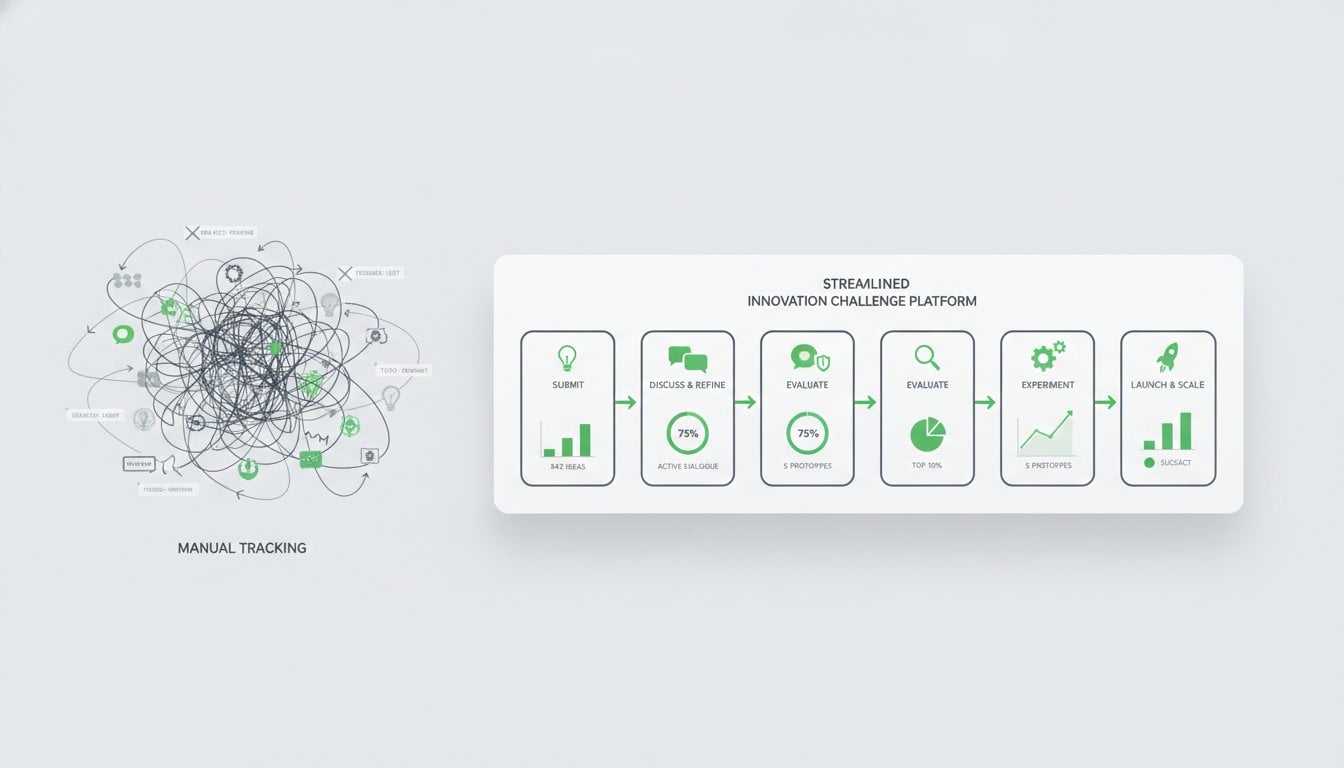
Most enterprise innovation programs fail because they treat creativity as a hobby rather than a measurable business asset. While over 65% of Fortune 500 companies have adopted formal innovation management solutions, many organizations still struggle with passive suggestion boxes that yield little more than administrative burnout. If you’re manually tracking ideas in spreadsheets, you aren’t running a program; you’re managing a bottleneck. Transitioning to a dedicated internal innovation challenge platform is no longer a luxury for the forward-thinking. It’s an operational necessity for any leader tasked with delivering documented financial impact in a market projected to reach over $3 billion by the end of 2026.
You likely recognize that the “post and pray” method of idea collection doesn’t work, yet finding the time to build a repeatable, automated system often feels out of reach. This guide changes that by providing a technical blueprint for launching challenges that scale without increasing your administrative workload. You’ll gain a comprehensive framework for automating evaluation workflows and generating the precise ROI reporting your executive stakeholders demand. We’ll explore how to move past the chaos of manual tracking and toward a system that turns internal insights into implemented, high-value results.
Key Takeaways
- Learn how to transition from passive suggestion boxes to an active internal innovation challenge platform that focuses on solving specific business bottlenecks.
- Master a repeatable 5-phase framework designed to move ideas from initial problem definition through to final implementation and ROI reporting.
- Discover how to leverage AI-driven insights to automate the deduplication and categorization of ideas, eliminating administrative burnout.
- Identify the critical difference between vanity metrics and impact metrics to provide executive stakeholders with clear evidence of financial gain.
- Understand the technical requirements for a modern innovation architecture that balances high employee engagement with structured evaluation workflows.
Beyond the Suggestion Box: Why Modern Enterprises Need an Internal Innovation Challenge Platform
The digital suggestion box is where good ideas go to die. For decades, organizations have relied on passive feedback loops that result in cluttered spreadsheets and ignored submissions. An internal innovation challenge platform represents a fundamental shift from this “post and pray” model to a structured engine for problem solving. It isn’t just about collecting ideas; it’s about defining high-value problems and using a modern framework to automate the path to implementation. This approach aligns with the broader principles of open innovation, where internal and external insights are leveraged to drive technological and operational advancement.
Innovation chaos carries a heavy price tag. When ideas are lost in email threads or buried in outdated portals, you don’t just lose potential revenue; you lose employee trust. Disengaged employees stop contributing, and R&D spend is frequently wasted on projects that don’t align with core business goals. As we move through 2026, enterprise leaders are shifting toward outcome-oriented innovation. Over 65% of Fortune 500 companies have already adopted formal innovation management solutions to ensure their crowdsourcing efforts are linked directly to strategic OpEx targets and measurable growth.
The Failure of Legacy Innovation Software
First-generation platforms often failed because they prioritized volume over value. They created massive administrative overhead, requiring dedicated teams just to sort through repetitive or low-quality submissions. This created a “black hole” effect where employees never heard back about their ideas, leading to a rapid drop in participation. Modern architecture has solved this bottleneck. By utilizing intelligent triage and automated workflows, organizations can now reduce implementation time from months to just a few weeks. It’s a move from high-friction maintenance to high-impact execution.
Driving Cultural Transformation Through Structured Events
Active challenges do more than solve technical problems; they break down the departmental silos that stifle enterprise growth. When you launch a targeted event, you invite cross-functional collaboration that rarely happens during daily operations. This visibility allows leadership to validate employee contributions in real time, which is one of the primary benefits of employee ideation programs. By leveraging an internal innovation challenge platform, you transform innovation from a mysterious corporate buzzword into a repeatable, transparent process that rewards performance and drives cultural change across the entire organization.
The 2026 Internal Innovation Challenge Template: A 5-Phase Framework for Success
Structure creates the freedom to innovate. Without a repeatable process, even the most advanced internal innovation challenge platform becomes a source of organizational noise. High-performing enterprises don’t just ask for ideas; they deploy a rigorous 5-phase framework to move from initial problem identification to measurable financial gain. This systematic approach ensures that every challenge remains aligned with corporate strategy and delivers a documented return on investment.
- Phase 1: Problem Definition – Move away from “give us your best ideas” toward “solve this specific operational bottleneck.” Precision is the primary driver of quality.
- Phase 2: Targeted Crowdsourcing – Use your platform to segment audiences. Engaging the right stakeholders at the right time prevents participant fatigue and increases the relevance of submissions.
- Phase 3: Collaborative Refinement – Raw concepts rarely survive contact with reality. Social features allow peers to build upon, critique, and strengthen initial ideas before they reach the evaluation stage.
- Phase 4: Multi-Stage Evaluation – Shift from gut-feel decisions to data-driven scoring. This model is used by organizations like Challenge.gov to ensure transparency and objective solution sourcing in high-stakes environments.
- Phase 5: Implementation and ROI Tracking – Close the loop. This final step transforms an idea from a digital submission into a verified business outcome.
Crafting the Perfect Challenge Statement
Success starts in the “Goldilocks Zone” of scope. If a challenge statement is too broad, you receive thousands of unactionable ideas. If it’s too narrow, you stifle creativity. Use a results-oriented formula: “How might we [action] for [stakeholder] to achieve [specific metric]?” This ensures every challenge aligns with your phases of continuous improvement, providing a clear path for executive buy-in and resource allocation.
Setting Evaluation Criteria That Predict Success
Transparency builds trust. Evaluate every submission based on three core pillars: feasibility (can we build it?), desirability (do users want it?), and viability (should we do it?). Providing a clear idea evaluation process and criteria prevents the “black hole” effect and keeps employees engaged for future events. If you’re ready to see how these automated evaluation phases look in practice, you can explore our platform's automated workflows to see how we remove the administrative burden from your team.
Essential Platform Features: The Technology Required to Scale Participation Without Chaos
Scaling an innovation program across a global enterprise requires more than just a good process; it requires a robust technical foundation. An internal innovation challenge platform must act as an intelligent filter rather than a simple bucket for raw data. Take NASA’s internal innovation challenge platform, NASA @ WORK, which has successfully sourced critical solutions since 2011. To achieve that level of longevity and impact, your technology must automate the heavy lifting that usually burns out innovation managers. Without the right features, you aren’t managing innovation; you’re just managing noise.
The Role of AI in Modern Innovation Management
Gamification: Why Competition Drives Participation
Engagement isn’t accidental; it’s engineered through social psychology. Gamification and incentives turn a corporate requirement into an engaging social experience. Leaderboards, digital badges, and voting mechanisms tap into the power of social proof. When employees see their peers participating and being recognized, they’re far more likely to contribute their own insights. For a deeper dive into these mechanics, see our guide on gamification for employee engagement to understand how to drive healthy competition. Remember that the most effective incentives often prioritize recognition and professional growth over simple monetary rewards.
Workflows and Security for the Global Enterprise
Flexibility and security are non-negotiable for modern organizations. Your internal innovation challenge platform must support custom stage-gate processes that adapt to the specific needs of different departments. A quick hackathon requires a different workflow than a multi-year R&D project. Finally, protect your internal intellectual property with enterprise-grade security. SOC 2 compliance and robust data protection ensure that your most valuable competitive advantages remain secure while still being accessible to the right internal stakeholders. This balance of transparency and security is what allows innovation to scale without compromising corporate integrity.
Measuring Impact: How to Quantify ROI and Long-Term Value from Internal Challenges
Stop measuring the wrong things. Many organizations fall into the trap of tracking “vanity metrics,” such as the total number of ideas submitted or the percentage of employees who logged in. While these numbers look good in a quarterly report, they don’t represent business value. A high-performance internal innovation challenge platform must prioritize “impact metrics” instead. These include verified cost savings, new revenue streams, and measurable improvements in operational efficiency. If your data doesn’t move the needle on your P&L statement, you aren’t measuring innovation; you’re measuring activity.
To provide a clear picture of success, you need an “Innovation Pipeline” view. This tracks the movement of concepts from the initial crowdsourcing phase through pilot testing and into final implementation. By monitoring this funnel, you can identify where ideas are stalling and address the “cost of inaction.” Calculating what your organization loses by ignoring a specific bottleneck often provides a more compelling case for executive stakeholders than the projected gains alone. Additionally, tracking year-over-year participation growth serves as a critical indicator of your organization’s cultural health and long-term commitment to problem-solving.
The Innovation ROI Calculator
Calculating the financial return of a single implemented idea requires a structured framework. Focus on tangible outcomes, such as the reduction of “Lean Waste” or the automation of manual tasks that previously consumed hundreds of labor hours. When you quantify these shifts, the value of your innovation program becomes undeniable. To simplify this process, you can access our idea management ROI calculator to determine the exact financial impact of your initiatives. Using data-backed calculations ensures your reporting remains authoritative and objective during budget reviews.
Closing the Loop: Feedback as a Retention Tool
Data shows that employees are significantly more engaged when they receive transparent feedback on their contributions. The “Implementation Gap,” which is the space between generating an idea and seeing it in action, is where most programs fail. Bridging this gap requires platform automation that keeps participants informed at every stage of the evaluation process. Failing to close this loop leads to the “black hole” effect mentioned earlier, which is one of the most common innovation failures seen in enterprise environments. When you demonstrate that employee insights lead to real change, you turn your innovation program into a powerful tool for talent retention.
Ready to transform your reporting from surface-level stats to deep financial insights? You can book a free demo today to see our ROI tracking and automated reporting features in action.
Why Ideawake is the Preferred Internal Innovation Challenge Platform for Modern Enterprises
Technology selection is the single most important factor in determining whether your innovation program survives its first year. Many legacy systems are essentially glorified databases that require months of configuration and extensive user training. Ideawake is engineered to eliminate this friction. Our internal innovation challenge platform is built for rapid deployment and high user adoption, ensuring that your team spends time solving problems rather than managing software. We provide a comprehensive, end-to-end solution that handles everything from the initial challenge launch to the final ROI measurement with surgical precision.
Choosing Ideawake means choosing a partnership for success. We recognize that software alone cannot fix a broken culture, which is why we provide the implementation support necessary to ensure your challenges actually deliver results. Our competitive edge is defined by three core outcomes: lower administrative overhead through automation, significantly higher employee participation rates, and a proven ability to document financial impact. We don’t just provide a portal; we provide a high-performance engine for organizational transformation.
Strategic Integration into Your Tech Stack
Innovation should not happen in a vacuum. To drive participation, your platform must fit seamlessly into the tools your employees already use every day. Ideawake facilitates this through a robust library of integrations, allowing ideas to flow between your innovation hub and your existing project management tools. We prioritize ease of access with Single Sign-On (SSO) and a mobile-first design that empowers frontline workers to contribute insights from the factory floor or the field. This commitment to accessibility is a primary reason why we are consistently ranked among the best innovation management software options for modern enterprises.
Taking the Next Step: Build vs. Buy
Many organizations initially attempt to build their own internal tools using generic platforms like SharePoint. This “build it yourself” approach often leads to the administrative chaos we have discussed in previous sections. Generic tools lack the specialized gamification, AI triage, and automated evaluation workflows that drive engagement. Research indicates that specialized platforms outperform generic internal builds by 10x in terms of employee participation and implemented ideas. Before committing internal R&D resources to a custom build, review our comprehensive build vs buy idea management software guide to understand the long-term total cost of ownership and the impact on your innovation ROI.
Transform Your Organization into a Problem-Solving Engine
Innovation is no longer a peripheral corporate activity; it’s a core operational discipline that requires a structured framework to succeed. By moving beyond the passive suggestion box and adopting a rigorous 5-phase template, you transform raw employee insights into implemented solutions that drive measurable growth. Integrating a dedicated internal innovation challenge platform ensures that your program scales without the administrative chaos of manual tracking or redundant submissions. You’ve seen how AI-driven triage and data-driven ROI reporting can bridge the implementation gap, turning potential ideas into verified financial assets.
Ideawake is SOC 2 Type II Certified and has been voted #1 for Ease of Use and Implementation by global enterprises that have used our system to drive millions in documented ROI. We provide the modern architecture and expert partnership necessary to help you outpace the competition and foster a high-performance culture of continuous improvement. Your organization’s next major breakthrough is likely already sitting in the minds of your frontline workers. It’s time to build the automated system that brings those insights to life and delivers the results your stakeholders demand.
Ready to launch your first challenge? Sign up for a demo of Ideawake today.
Frequently Asked Questions
What is an internal innovation challenge platform?
An internal innovation challenge platform is a structured software solution designed to crowdsource solutions to specific business problems from an organization’s own workforce. Unlike a passive suggestion box, it facilitates “active challenges” where leadership defines a clear problem statement and employees collaborate to solve it. It serves as a centralized engine for managing the entire lifecycle of an idea, from initial submission and peer refinement to final implementation and ROI tracking.
How do I choose the best platform for innovation challenges?
Prioritize three core pillars: ease of use, automation capabilities, and reporting depth. You need a solution that offers SOC 2 Type II security and integrates with your existing tech stack via SSO to ensure high adoption rates. A modern internal innovation challenge platform should also include AI-driven triage to handle high submission volumes without increasing your administrative workload. Focus on tools that offer a transparent evaluation process to maintain employee trust.
How long does it take to implement an innovation challenge platform?
Modern cloud-based solutions typically require two to four weeks for full deployment. While legacy enterprise software often demanded months of custom development and extensive training, current architectures allow for rapid onboarding and immediate challenge launching. This speed is critical because it allows organizations to respond to market shifts in real time. Implementation success is usually driven by how quickly you can move from software setup to your first live event.
Can we run a challenge without specialized software?
You can use spreadsheets or generic tools like SharePoint, but these methods often lead to administrative burnout and “innovation chaos.” Manual tracking lacks the automated evaluation workflows and gamification features that drive engagement, which often results in a 10x lower participation rate than specialized tools. Without a dedicated platform, you’ll likely struggle to prove the financial impact of your program to executive stakeholders, making it difficult to sustain long-term funding.
How do we motivate employees to participate in innovation challenges?
Motivation is driven by a combination of social recognition and transparent feedback loops. Use gamification elements like leaderboards and digital badges to tap into social proof and healthy competition. Research shows that employees are most engaged when they see their ideas move through a visible pipeline and receive direct acknowledgement from leadership. It’s about moving away from monetary rewards and toward professional growth and the opportunity to impact the company’s future.
What are the common pitfalls of internal innovation challenges?
The most frequent failure is the “black hole” effect, where employees never hear back about their submissions. This leads to immediate disengagement and a rapid drop in future participation. Other pitfalls include setting challenge statements that are too broad, failing to define evaluation criteria early, or ignoring the “cost of inaction” when reviewing potential solutions. Success requires closing the loop on every idea, whether it moves to implementation or not.
How does AI improve the innovation challenge process?
What is the typical ROI for an internal innovation challenge?
Typical ROI focuses on “impact metrics” such as verified cost savings, new revenue generation, and the reduction of lean waste. Organizations using a dedicated internal innovation challenge platform frequently document millions in returns by identifying operational bottlenecks that were previously invisible to leadership. With cloud-based solutions accounting for nearly 75% of deployments, the ability to track these financial gains in real time has become a standard requirement for any high-performing enterprise program.