
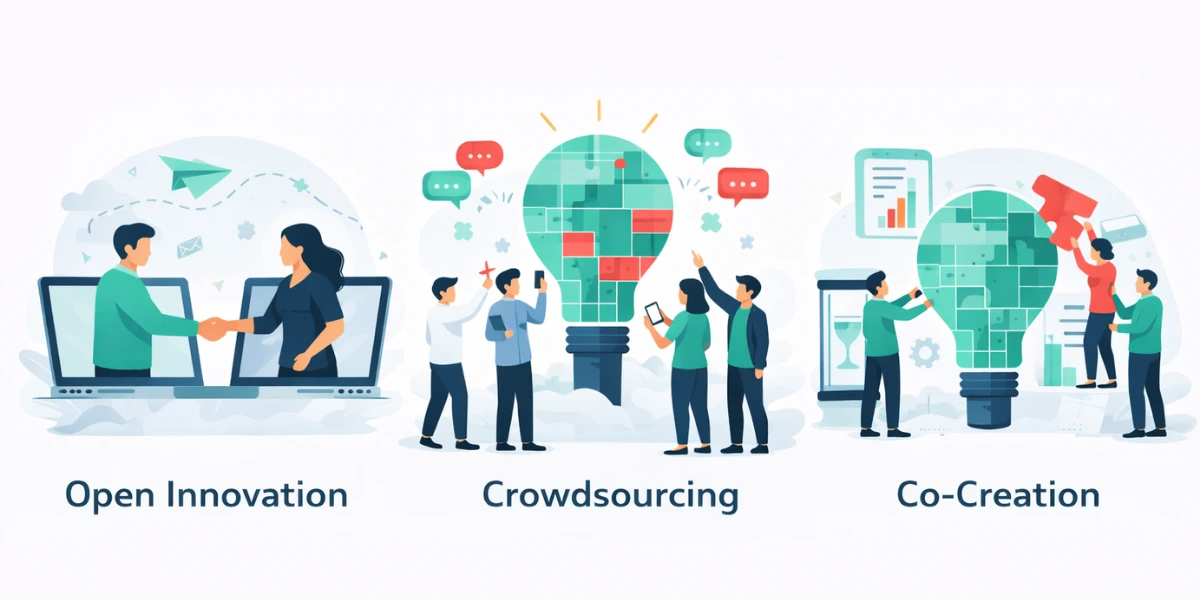
A lot of teams use these three terms as if they mean the same thing. They do not. They overlap, and they can absolutely support the same innovation pipeline, but they solve different problems and require different levels of structure, participation, and follow-through.
That distinction matters more than most teams realize. If you choose the wrong model, you can end up with shallow input when you needed real collaboration, or an overly heavy process when what you really needed was fast idea volume.
Why These Terms Get Mixed Up
All three approaches involve getting value from people beyond a small internal decision-making circle. That is why they are often grouped together in conversations about innovation, employee ideas, customer input, and digital transformation.
But the overlap stops there. Open innovation is the broad strategic mindset. Crowdsourcing is a way to gather ideas or solutions from a larger group. Co-creation is a deeper and more deliberate collaboration with specific stakeholders.
The Simple Way To Think About It
If you want the quickest possible distinction, think about it like this.
Open innovation is the umbrella. Crowdsourcing is one method under that umbrella. Co-creation is a more hands-on partnership model where selected participants help shape the outcome with you.
What Open Innovation Actually Means
Open innovation is the broadest of the three concepts. It is the practice of bringing outside knowledge, talent, ideas, and capabilities into your innovation process instead of relying only on internal teams.
That can include customers, suppliers, universities, startups, consultants, strategic partners, or even the general public. The point is not just to collect ideas. The point is to widen the organization’s innovation capacity and improve outcomes by tapping into valuable perspectives from outside the usual silos.
Why Organizations Use Open Innovation
Organizations use open innovation when they want to move faster, reduce blind spots, and avoid solving every problem alone. It is especially useful when internal teams do not have all the answers, or when innovation depends on ecosystem knowledge rather than one department’s expertise.
In practice, open innovation is less about a single campaign and more about a repeatable operating model. It helps organizations build stronger innovation pipelines, bring in useful expertise, and connect ideas to execution in a more deliberate way. That is also why many teams spend time comparing different open innovation models before deciding how broadly they want to involve external contributors.
What Crowdsourcing Means
Crowdsourcing is much more specific. It is the act of opening a problem, challenge, or request to a larger group in order to gather ideas, solutions, feedback, or contributions at scale.
The key word here is scale. Crowdsourcing is built for reach. You are not trying to work deeply with each participant. You are trying to get more voices, more input, and more fresh thinking than a small internal team could produce on its own.
Where Crowdsourcing Works Best
Crowdsourcing works well when you need a wide range of ideas quickly. It is ideal for innovation challenges, front-end idea collection, naming concepts, problem discovery, customer suggestions, or employee idea campaigns where participation matters.
It is also useful when you want diversity of thought. A crowd can surface ideas that leadership teams, product teams, or innovation committees might never think to ask for. For organizations trying to expand participation without creating more admin overhead, idea crowdsourcing can be a practical way to collect and organize input at scale.
What Co-Creation Means
Co-creation is more focused and more collaborative than crowdsourcing. Instead of issuing a broad call to a large group, you work directly with a defined set of participants to shape, refine, or build something together.
That group might include customers, employees, channel partners, suppliers, or subject matter experts. The defining feature is not simply who is involved. It is the depth of engagement.
What Makes Co-Creation Different
In co-creation, participants are not just submitting ideas and walking away. They are often involved in discussion, feedback loops, iteration, testing, and refinement. That deeper involvement usually leads to better alignment between what gets built and what stakeholders actually need.
This makes co-creation especially valuable when an organization wants stronger buy-in, better product-market fit, or a clearer understanding of user needs before moving into implementation. In many cases, value co-creation strengthens the innovation process by turning stakeholders into active contributors rather than passive idea sources.
The Biggest Difference In Practical Terms
The easiest way to separate these three ideas is to focus on strategy, scale, and depth.
Open innovation is your overall approach to bringing external input into innovation. Crowdsourcing is a scalable tactic for gathering broad input. Co-creation is the deeper collaborative approach for developing ideas with specific stakeholders.
The Real Operational Difference
If you are trying to collect a large number of suggestions from employees across multiple locations, that is usually crowdsourcing.
If you are working with selected customers to shape a new product or experience in real time, that is co-creation.
If your organization is building a wider system that consistently pulls in ideas, knowledge, and capabilities from beyond internal teams, that is open innovation.
When To Use Open Innovation
Open innovation makes the most sense when the problem is too complex, too cross-functional, or too externally shaped to solve in isolation.
That includes situations where market knowledge is distributed, technical expertise lives outside the business, or innovation depends on collaboration with customers, suppliers, startups, or other external groups.
Best-Fit Use Cases For Open Innovation
Use open innovation when you are building a long-term innovation strategy rather than running a one-off campaign. It is a strong fit for enterprise innovation programs, ecosystem partnerships, strategic transformation efforts, and initiatives where outside perspectives are critical to success.
It is also the right mindset when your organization wants to avoid idea graveyards and move toward a system that supports capture, evaluation, implementation, and measured impact.
When To Use Crowdsourcing
Crowdsourcing is usually the best choice when you need idea volume, participation, and speed.
It works particularly well when the challenge is broad enough for many people to contribute something useful, and when the organization benefits from surfacing patterns across many submissions rather than developing one concept in depth with a small group.
Best-Fit Use Cases For Crowdsourcing
This approach is a strong fit for employee innovation programs, customer idea collection, innovation challenges, cost-saving idea campaigns, and continuous improvement efforts where participation matters just as much as idea quality.
It is also effective when you want to create energy around innovation. A well-run crowdsourcing campaign can increase visibility, make participation easier, and bring more people into the process. If that is the route you are taking, studying innovation challenge examples and best practices can help you structure the campaign more effectively from the start.
When To Use Co-Creation
Co-creation is the better choice when the work requires more than a submission box. It is most useful when the value comes from back-and-forth collaboration, not just raw idea collection.
This often happens when organizations are refining a product, improving a process, validating assumptions, or building something that depends heavily on stakeholder insight and adoption.
Best-Fit Use Cases For Co-Creation
Use co-creation when the quality of interaction matters more than the quantity of submissions. It is well-suited to customer councils, pilot groups, partner workshops, user feedback communities, and focused cross-functional design efforts.
Because participants are more deeply involved, co-creation can also reduce the distance between idea generation and practical implementation. The people closest to the need help shape the solution from the start.
Where Teams Choose The Wrong Model
This is where a lot of innovation programs lose momentum. They start with the wrong structure for the job.
Some teams run a broad crowdsourcing campaign for a challenge that really needs deeper stakeholder collaboration. Others create a co-creation-heavy process for a problem that should have started with wider idea collection. In both cases, the process becomes a drag.
Common Mistakes To Avoid
One common mistake is using crowdsourcing when the topic is too sensitive, too technical, or too dependent on iteration. Another is using co-creation when speed and reach are more important than depth.
A third mistake is calling something open innovation without putting any operating discipline behind it. Without evaluation criteria, ownership, implementation stages, and measurement, even strong ideas can stall.
Why These Models Work Better Together
The smartest organizations do not always treat open innovation, crowdsourcing, and co-creation as separate lanes. They use them together.
That is often the strongest approach because each model supports a different stage of the innovation pipeline.
A Better Sequence For Many Organizations
Open innovation can define the strategic direction. Crowdsourcing can help source opportunities from employees, customers, or partners at scale. Co-creation can then help the organization develop the best ideas with the right stakeholders before implementation.
This is where the process becomes far more than an idea box. It becomes a structured system for sourcing, shaping, evaluating, and delivering real outcomes.
What This Means For Idea Management Teams
For innovation leaders, the real challenge is not just choosing the right model. It is running the process well after the ideas come in.
Once submissions start arriving, teams need a way to evaluate and prioritize ideas, reduce duplicates, route opportunities to the right people, keep contributors informed, and measure what happens next.
Why Execution Matters More Than Definitions
This is why so many organizations struggle with innovation, even when participation is strong. Gathering ideas is only the front end. The harder part is making fair decisions, assigning ownership, and turning selected ideas into measurable impact.
That is also why idea management software matters. The right platform helps organizations move from scattered input to a visible innovation pipeline with real accountability. Teams that want a stronger foundation often start by understanding how to build an effective idea management system before layering on larger innovation initiatives.
How Ideawake Supports All Three Approaches
Ideawake fits naturally into this conversation because the platform is built for real-world execution, not innovation theatre.
Organizations can use Ideawake to crowdsource ideas from employees, customers, or partners, run targeted innovation challenges, support collaborative evaluation, and move ideas through a structured workflow from capture to implementation to measurement.
Why This Matters In Practice
That matters because most organizations do not need just one model forever. They need flexibility. They need to gather ideas broadly in some cases, collaborate more deeply in others, and still maintain clear visibility into participation, progress, and ROI.
Ideawake supports that kind of operating model with configurable workflows, transparent evaluation, stronger participation, and better follow-through.
Instead of managing these approaches in disconnected tools, teams can run them in one place and keep the entire innovation pipeline visible.
Which One Should You Choose?
If you need the short answer, choose open innovation when you are shaping a broader innovation strategy that benefits from external knowledge and collaboration.
Choose crowdsourcing when you want fast, scalable input from a larger group.
Choose co-creation when you need deeper collaboration with defined stakeholders to shape better outcomes.
The Best Answer For Most Organizations
In reality, many organizations need all three at different points. The strongest innovation systems do not force one model onto every problem. They choose the right level of openness, scale, and collaboration for the initiative in front of them.
That is how innovation becomes more practical, more repeatable, and more measurable. And that is how ideas stop collecting dust and start creating impact.
FAQs
Is Crowdsourcing A Type Of Open Innovation?
Yes, in many cases it is. Open innovation is the broader strategy, while crowdsourcing is one method an organization can use to gather outside input at scale.
Is Co-Creation The Same As Crowdsourcing?
No. Crowdsourcing focuses on broad participation and larger-scale input. Co-creation involves deeper collaboration with a more defined group.
Which Model Is Best For Employee Ideas?
Crowdsourcing is often the best starting point for employee ideas because it helps organizations gather input broadly and increase participation. Co-creation can then help refine the most promising ideas.
Which Model Is Best For Customer Input?
It depends on the goal. If you want a high volume of suggestions, crowdsourcing may be the better fit. If you want to shape solutions directly with customers, co-creation is usually stronger.
Can One Organization Use All Three?
Yes. Many organizations use open innovation as the overall strategy, crowdsourcing for broad idea collection, and co-creation to develop selected ideas more deeply with the right stakeholders.