
Most organizations do not struggle because they lack ideas. They struggle because they treat every idea the same way.
A small process fix, a product enhancement, and a completely new business model should not move through one identical workflow. That is where innovation programs start to stall, teams lose trust, and promising ideas get buried.
Understanding incremental vs radical innovation helps leaders make better decisions about what to fund, how to evaluate ideas, and what kind of results to expect. It also helps organizations avoid a common mistake: chasing only big, flashy ideas while ignoring the steady improvements that drive real business impact.
For innovation leaders, operations teams, HR, and digital transformation stakeholders, this is not just a strategy conversation. It is a workflow conversation. The more clearly you separate these two types of innovation, the easier it becomes to build momentum, prioritize fairly, and measure results.
What Is Incremental Innovation?
Incremental innovation is the process of making small, meaningful improvements to what already exists. That could mean improving a product feature, simplifying a workflow, reducing costs, improving the customer experience, or removing friction for employees.
These changes are usually built on current systems, current capabilities, and current markets. They are not trying to reinvent the business overnight. They are trying to make the business work better than it did yesterday.
That is why incremental innovation is often the foundation of a healthy continuous improvement program. It is practical, repeatable, and easier to implement than more disruptive forms of change.
You can see this clearly in organizations that focus on efficiency, service delivery, quality, and frontline problem-solving.
What Incremental Innovation Usually Looks Like
Incremental innovation often comes from employees who are close to the work. They notice bottlenecks, duplicated effort, poor handoffs, confusing customer steps, or outdated internal processes.
In one department, it may be a new approval flow that cuts response time. In another, it may be a better intake form, a smarter scheduling process, or a small feature update that improves adoption.
These ideas may not make headlines, but they often produce the kind of steady gains that add up quickly across a large organization.
Why Incremental Innovation Matters
Incremental innovation matters because it improves the business while the business is still running. It helps teams fix what is slowing them down without waiting for a complete reinvention.
It is also easier to test, easier to fund, and easier to scale in many environments. That makes it especially valuable for companies that need visible wins, employee engagement, and measurable ROI in the near term.
This is one reason so many organizations tie innovation directly to operational excellence. A strong continuous improvement program often depends on a steady stream of incremental ideas that can be evaluated and implemented quickly.
Idea Management Made Simple
Turn Your Team’s Ideas Into Measurable Impact
Capture ideas, streamline evaluation with AI, and turn promising opportunities into action. See how Ideawake can support your innovation or continuous improvement program.
Free trial includes onboarding. No credit card required.
What Is Radical Innovation?
Radical innovation is a much bigger leap. It introduces a new way of solving a problem, serving a market, or creating value.
Instead of improving the current model, radical innovation changes the model itself. It may involve a new technology, a new business model, a new market opportunity, or a major shift in how people behave and buy.
That is why radical innovation tends to be less common and much more uncertain. It can create enormous upside, but it also comes with higher risk, longer timelines, and more internal resistance.
Organizations often talk about wanting breakthrough ideas, but far fewer are set up to evaluate and manage them well.
What Radical Innovation Usually Looks Like
Radical innovation often starts with a bigger question. Instead of asking, “How do we improve this process?” it asks, “What if we solved this problem in a completely different way?”
That could mean creating a new category, changing how revenue is generated, entering a new market with a new model, or replacing an old system with something fundamentally different.
These ideas usually need more exploration, more cross-functional input, and a different kind of leadership support. They do not fit neatly into a standard suggestion box or a simple cost-savings review.
Why Radical Innovation Matters
Radical innovation matters because incremental improvement alone will not always keep a company competitive. It can make the current business better, but it may not be enough when markets shift, customer expectations change, or technology creates a new standard.
Organizations need some capacity for radical innovation if they want to build future growth instead of only defending current performance.
That does not mean every company should bet the farm on high-risk ideas. It means companies should create room for larger, more strategic opportunities instead of letting day-to-day demands crowd them out.
Incremental Vs Radical Innovation: The Core Differences
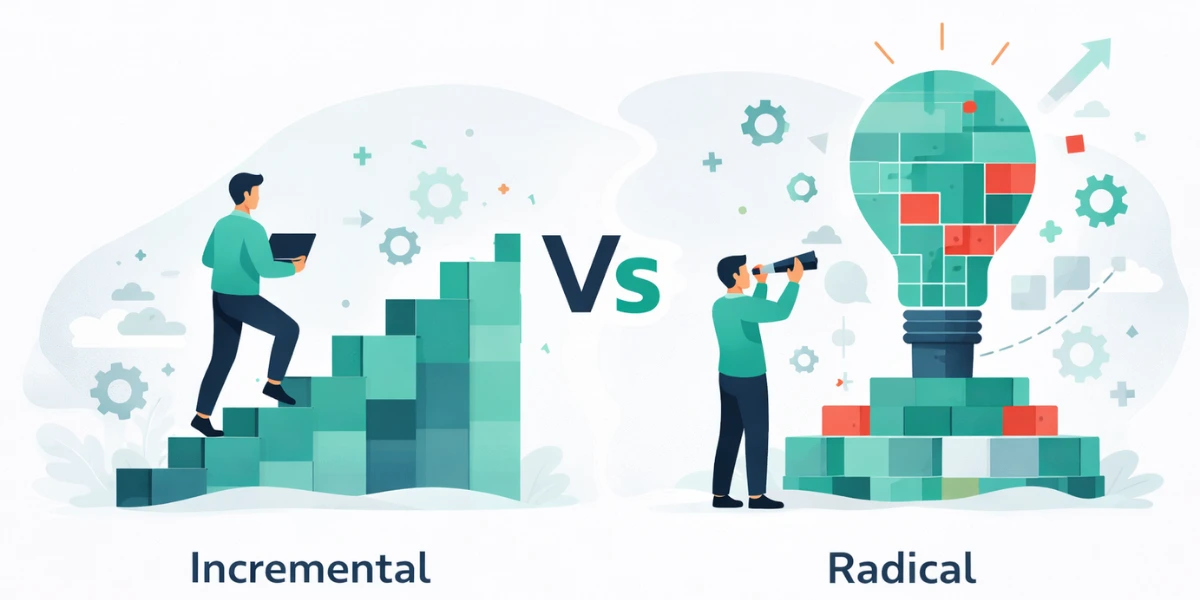
The simplest way to think about the difference is this: incremental innovation makes things better, while radical innovation makes things different.
Incremental innovation is usually lower risk. It tends to work within existing capabilities, and it usually aims for faster implementation and clearer short-term returns. Radical innovation is more uncertain. It often requires new capabilities, new assumptions, and more patience before results become visible.
The scope of change is also very different. Incremental ideas improve the current system. Radical ideas may replace the current system or open a path to something entirely new.
The evaluation approach should reflect that. If you use the same scoring model for both, you will likely reject bold ideas too early or waste time overanalyzing smaller improvements that should move fast.
This is where many organizations get stuck. They create one pipeline, one review process, and one set of criteria. Then they wonder why small ideas feel slow and big ideas never get traction.
The Gray Area Between The Two
Not every idea fits neatly into a clean category. Some ideas are clearly incremental. Some are clearly radical. Many sit somewhere in the middle.
A team may improve an existing product in a way that opens a new customer segment. A process automation project may begin as efficiency work but eventually change the operating model more broadly. A digital tool may start as a small fix and evolve into a bigger transformation.
That gray area is exactly why classification matters. Organizations do not need perfect labels, but they do need enough structure to route ideas appropriately.
If an idea has limited scope, proven feasibility, and near-term value, it should not wait behind a strategic moonshot. If an idea has major upside but high uncertainty, it should not be killed just because it lacks immediate payback.
Real-World Examples Of Both Types
Incremental innovation shows up in the everyday decisions that improve how a business runs. A manufacturer reduces scrap by changing a step in production. A hospital shortens discharge delays by redesigning a workflow. A software company improves adoption with a simpler user interface. A service team reduces rework with better intake questions.
Each of these changes improves performance without fundamentally changing the organization’s market or business model.
Radical innovation looks different. It changes how value is delivered or how the market behaves. It may involve a new product category, a new operating model, or a completely different customer experience that resets expectations.
The important point is not the label itself. The important point is the management approach behind it. Small improvements need speed. Bigger bets need space, evidence, and a different kind of governance.
Which Type Of Innovation Should Your Organization Prioritize?
The honest answer is both, but not in the same way and not for the same reasons.
If your organization needs faster efficiency gains, stronger employee engagement, better service delivery, or measurable short-term ROI, incremental innovation should be a major focus. It is often the quickest path to visible impact.
If your organization is trying to create new growth, respond to disruption, or build its next competitive advantage, radical innovation deserves dedicated attention. It may not deliver immediate wins, but it can shape where the business goes next.
The best organizations do not treat this as an either-or choice. They build an innovation portfolio that supports both. They keep the business improving today while exploring what may matter tomorrow.
That balance is hard to achieve without structure. It requires different workflows, different evaluation logic, and different expectations for success.
Why Companies Struggle To Balance Both
Many organizations say they want innovation, but their systems quietly favor only one type.
Some are built for incremental innovation only. They are good at collecting ideas for cost savings, process fixes, and practical improvements, but they have no real path for larger opportunities.
Others overcorrect and chase only big ideas. They launch innovation challenges, talk about transformation, and celebrate bold thinking, but they overlook the everyday ideas that employees can implement now.
Both approaches leave value on the table.
A better model creates visibility across the full idea pipeline. It gives employees a way to contribute meaningful improvements while also giving leaders a way to identify, develop, and evaluate larger opportunities without losing momentum.
This is where a strong idea management software platform becomes important. It helps organizations separate idea types, route them correctly, and make progress without forcing everything through the same bottleneck.
How To Manage Incremental And Radical Innovation In One Pipeline
The goal is not to create chaos with too many categories. The goal is to create enough structure so ideas get the right treatment.
Start by defining how ideas will be tagged or categorized. That can be by impact, risk, strategic horizon, business area, or expected complexity. The exact labels matter less than having a clear way to separate near-term improvements from more transformative bets.
Next, use different evaluation criteria. Incremental ideas should be assessed for feasibility, effort, speed, savings, quality improvement, and adoption potential. Radical ideas should be assessed for strategic fit, future upside, uncertainty, capability requirements, and learning value.
Ownership matters too. Smaller operational improvements may belong with frontline leaders, continuous improvement teams, or department heads. Bigger innovation bets may need executive sponsorship, cross-functional review, or a staged validation process.
Measurement should also differ. Incremental innovation should produce visible results quickly. Radical innovation often needs milestone-based tracking before the financial impact is fully clear. That does not mean it should be vague. It means the scorecard should match the nature of the idea.
If you want a more practical way to think about this, it helps to connect innovation to the broader idea pipeline and ask what kind of evidence each stage really needs.
Idea Management Made Simple
Turn Your Team’s Ideas Into Measurable Impact
Capture ideas, streamline evaluation with AI, and turn promising opportunities into action. See how Ideawake can support your innovation or continuous improvement program.
Free trial includes onboarding. No credit card required.
How Ideawake Supports Both Innovation Types
Ideawake is built for organizations that need more than a place to collect ideas. It helps teams capture, evaluate, implement, and measure ideas in a way that matches how real organizations operate.
That matters because incremental and radical innovation require different handling. One needs speed, participation, and operational clarity. The other needs visibility, collaboration, and a fair way to evaluate uncertain but high-potential opportunities.
With Ideawake, organizations can create structured workflows, route ideas to the right owners, use tailored evaluation criteria, and keep progress visible across the process. That reduces politics, prevents idea graveyards, and makes it easier to move from intake to implementation.
It also improves participation. When employees see that practical ideas actually move forward, they stay engaged. When leadership can see larger opportunities without losing track of smaller wins, the innovation program becomes more credible.
As AI becomes more useful in helping teams refine submissions and strengthen business cases, companies also need a smarter system for handling volume and quality. That is one reason AI-assisted innovation is becoming more relevant inside modern idea programs.
Common Mistakes To Avoid
One common mistake is using the same review process for every idea. That slows down small wins and unfairly filters out larger opportunities.
Another mistake is overvaluing novelty. Not every valuable idea needs to be revolutionary. Some of the highest-ROI ideas are simple fixes that solve recurring problems.
A third mistake is focusing only on intake. Capturing ideas is important, but capture without routing, ownership, implementation, and reporting creates frustration fast.
Companies also run into trouble when they under-communicate progress. If employees do not see what happens after submission, participation drops. If leaders cannot see outcomes, support fades.
Strong innovation programs avoid all of this by building for action, not just collection.
Final Thoughts
Incremental innovation and radical innovation both matter, but they serve different purposes.
Incremental innovation helps organizations improve performance, remove friction, and deliver measurable gains now. Radical innovation helps organizations prepare for bigger shifts, create new growth, and stay relevant over time.
The strongest organizations do not confuse the two, and they do not force both through the same process. They build a system that can support practical improvements and strategic breakthroughs at the same time.
That is how innovation becomes more than a campaign. It becomes an operating capability.
If your goal is not just to capture ideas but to move them through a clear, measurable process, it helps to build on practices that support continuous improvement at scale while still making room for bigger bets.
FAQs
What Is The Main Difference Between Incremental And Radical Innovation?
Incremental innovation improves existing products, services, or processes. Radical innovation creates a much larger shift through a new model, new capability, new market approach, or a combination of those changes.
Which Type Of Innovation Is Less Risky?
Incremental innovation is generally less risky because it works closer to current operations and existing capabilities. Radical innovation involves more uncertainty and usually requires more time, investment, and alignment.
Is Radical Innovation The Same As Disruptive Innovation?
Not always. Radical innovation refers to the scale of change, while disruptive innovation is usually about how a new approach changes the market and challenges existing players. They can overlap, but they are not identical.
Can A Company Pursue Both At The Same Time?
Yes, and most organizations should. Incremental innovation helps improve current performance, while radical innovation helps explore future growth. The key is managing them with different workflows and expectations.
How Do You Classify An Idea As Incremental Or Radical?
Start by looking at the scale of change, level of uncertainty, required investment, strategic horizon, and whether the idea improves the current model or creates a new one. If needed, create a middle category for ideas that do not fit neatly into either box.
Why Do Innovation Programs Often Fail To Balance Both?
They often rely on one intake process, one scoring system, and one decision path for everything. That makes small ideas too slow and bigger ideas too hard to evaluate fairly.
Why Is This Important For Idea Management Software?
Because software should do more than collect submissions. It should help organizations route different types of ideas correctly, apply the right criteria, assign ownership, track implementation, and measure results clearly.