

At a large organization, innovation rarely stalls because people lack ideas. It stalls when there’s no clear path from idea to launch. An innovation management process provides that path, moving ideas from generation through evaluation and development to implementation and market introduction.
That structure matters because enterprise innovation must connect promising ideas to business priorities without shutting down experimentation. You’ll learn what innovation management involves, how organizations collect and assess ideas, and how selected concepts move toward launch. This guide also explains how large organizations coordinate teams, decisions, and portfolios so innovation becomes repeatable rather than a collection of disconnected projects.
Key Takeaways
- Use clear evaluation criteria to compare ideas, surface risks early, and decide what should advance, pause, or be saved for later.
- Combine focused innovation challenges with ongoing idea submissions to capture both strategic opportunities and frontline insights.
- Move selected concepts toward launch through staged development, testing, coordinated implementation, and feedback.
- Track both early activity and business outcomes so innovation measures progress, not just the number of ideas collected.
- As innovation scales across a large organization, align governance and portfolio decisions with enough flexibility for teams to experiment.
Evaluating, validating, and launching ideas
Selection turns a broad set of ideas into projects with a clear path forward. Leaders need consistent criteria, evidence from validation, and launch plans that connect decisions to execution.
Idea Evaluation and Selection Criteria
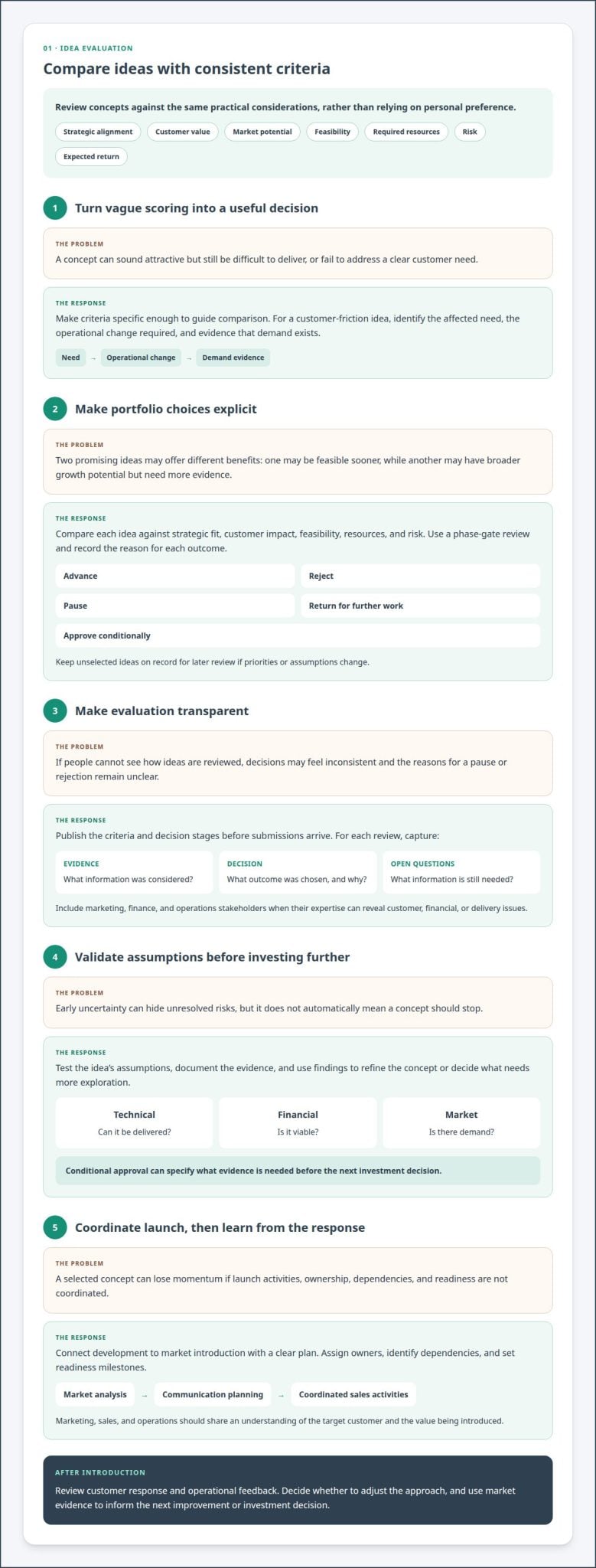
Idea evaluation and selection criteria are the standards used to compare concepts before committing resources. A practical review considers strategic alignment, customer value, market potential, feasibility, required resources, risk, and expected return. Together, these criteria help leaders distinguish promising ideas from attractive concepts that may be difficult to deliver.
Make the criteria specific enough to guide a decision. For example, a concept intended to reduce customer friction should identify the affected customer need, the operational change required, and the evidence that demand exists. A structured idea evaluation process helps reviewers apply the same questions across projects instead of relying on personal preference.
Prioritizing Innovations
Prioritizing innovations means comparing validated ideas with business goals and available capacity, then deciding which should advance. A phase-gate review gives each concept a decision point: advance, reject, pause, return for further work, or approve conditionally. Record the reason for each outcome and define the next step.
Consider two proposals: one improves an existing customer process, while another explores a new market. The first may be feasible sooner; the second may offer broader growth potential but need more evidence. Compare both against strategic fit, customer impact, feasibility, resources, and risk. Keep unselected ideas on record for later review, especially if priorities or assumptions change.
Transparent Evaluation Protocols
Transparent evaluation protocols explain who reviews ideas, which criteria apply, and how decisions are recorded. Publish the criteria and decision stages before submissions arrive. For each review, record the evidence considered, the decision and its rationale, and any information still needed.
Involve marketing, finance, and operations stakeholders when their expertise can reveal customer, financial, or delivery issues. For example, an operations reviewer can identify a workflow constraint before a concept enters development. Consistent records also help employees understand why an idea advanced or paused, supporting experimentation while preserving accountability.
Validate Before Investing Further
Validation tests an idea’s assumptions before a team commits to broader development. Examine technical feasibility, financial viability, and market demand, then record the evidence behind each conclusion. A customer-facing concept, for example, may need evidence of demand alongside an assessment of how it can be delivered.
Use the findings to refine the concept, identify unresolved risks, or return it for further exploration. Conditional approval can specify what evidence is needed before the next investment decision. This keeps the innovation management process evidence-led without treating early uncertainty as an automatic reason to stop.
Coordinate the Launch
A launch plan connects development to market introduction through market analysis, communication planning, and coordinated sales activities. Assign an owner to each activity, identify dependencies, and set readiness milestones. Marketing, sales, and operations should share an understanding of the target customer and the value being introduced.
Before launch, confirm that customer-facing messages reflect the tested value proposition and that delivery teams can support the offer. After introduction, review customer response and operational feedback, then decide whether to adjust the approach. Evaluation does not end at launch: market evidence informs the next improvement or investment decision.
Collecting employee ideas through challenges and open submissions
Employee ideas can come through focused challenges or an always-open channel, providing both targeted and unsolicited input. Common risks include vague prompts, low participation, duplicate submissions, biased screening, and ideas that receive no feedback or ownership.
Ideas-First and Needs-First Approaches
An ideas-first approach starts with a proposed solution, while a needs-first approach starts with a problem employees or customers experience. The distinction matters: a clever suggestion can miss the underlying need, while a clearly defined problem gives contributors room to explore different solutions.
Use open submissions to capture ideas employees notice in everyday work, then ask what problem each addresses. For example, a warehouse employee might suggest a new scheduling tool; follow-up could reveal that shift handoffs, not scheduling, cause delays. Focused challenges work well when leaders can define a need, such as reducing handoff errors or simplifying a service step.
A strong culture makes room for both approaches. Challenges create a shared focus, while open submissions can surface improvements beyond current priorities. Explain the challenge’s purpose, who can contribute, and how ideas will be reviewed. This helps employees connect their experience to organizational needs without forcing every suggestion into a predetermined solution.
Crowdsourced Feedback on Ideas
Crowdsourced feedback gathers reactions, refinements, and expertise from a group of employees rather than leaving screening to one reviewer. It matters because colleagues in different roles may identify implementation barriers or customer effects that the original contributor cannot see.
For useful feedback, present the problem, proposed idea, and specific prompts together. Ask colleagues to identify likely benefits, risks, missing information, or alternatives. A frontline employee may spot a workflow issue, while a customer-facing colleague may flag an unmet need. Make commenting and voting part of a clear evaluation process, not a popularity contest.
Advocacy can strengthen an idea’s case when supporters explain their reasoning and relevant experience. Still, leaders should distinguish enthusiasm from evidence. A screening step can group duplicates, clarify incomplete submissions, and route ideas to people with relevant knowledge. A structured employee ideation program can make participation and feedback part of ongoing improvement.
Recording and Sharing Ideas
Recording ideas means keeping each submission in a shared, searchable record with enough context for follow-up. Without one, ideas can disappear in email threads, meeting notes, or isolated forms, leaving teams unable to revisit useful suggestions.
Capture the problem, proposed change, affected team or customer, expected benefit, and supporting details. Add a status and owner so employees can see whether an idea needs clarification, is under review, or has moved forward. Share submissions with relevant colleagues, keeping discussion focused on useful feedback and next steps.
For example, a facilities team could record a recurring equipment issue and invite staff to suggest ways to reduce disruption. Related submissions can be grouped, discussed, and retained even if no immediate project proceeds. Close the loop by communicating decisions and reasons; otherwise, silence can weaken participation. To see how a digital approach can support this work, explore a guided platform walkthrough.
What is the Innovation Process?
The innovation process moves a concept from a defined opportunity toward development, implementation, and adoption. It gives teams a practical route from strategic intent to action.
Organizations fund and resource innovation projects by aligning them with strategic priorities, assigning people and budget, and releasing additional resources as evidence supports progress. Internal teams, external partners, and staged investment can each contribute, depending on a project’s needs.
Innovation Strategy Development
An innovation strategy defines the opportunities an organization will pursue, the outcomes it wants, and the capabilities it can commit. It matters because leaders must balance near-term improvements with longer-term concepts that could open new markets.
Start by connecting innovation goals to business priorities, such as improving customer experience or operational efficiency. Then clarify which teams, expertise, and funding can support each goal. A portfolio can combine incremental improvements with more exploratory projects, helping leaders avoid spending all available capacity on one kind of opportunity. The distinction between incremental and radical innovation can help frame that balance.
Concept Development and Prototyping
Concept development turns an opportunity into a defined proposal, while prototyping creates a simple representation that supports learning. These steps help teams expose unclear assumptions before committing to full development.
A product concept should identify its intended user, the problem it addresses, and the value it offers. A team exploring a faster service handoff, for example, might sketch the revised workflow before building new systems. Depending on the concept, a prototype could be a sketch, digital simulation, or physical model. Keep it focused on the question the team needs to answer, such as whether users understand the new process.
Concept Testing
Concept testing evaluates assumptions with relevant users, stakeholders, or operational evidence before broader implementation. It helps reveal whether a proposed benefit matters and whether delivery conditions support it.
Choose a test that matches the uncertainty. A customer-facing concept might be assessed through user reactions to its value proposition; an internal process change might be tried with the employees who do the work. Record the response, assumptions tested, and resulting changes. If findings expose a gap, refine the concept and test again rather than treating early feedback as a final verdict.
Innovation Development and Implementation
Development and implementation turn a tested concept into an operating product, service, or process. Even a strong concept needs clear ownership and coordinated delivery to create practical value.
Build an implementation plan that connects development tasks to people, resources, milestones, production needs, and launch activities. For a new service, operations may prepare delivery workflows while marketing develops customer communications. External partners can contribute needed capabilities, with responsibilities agreed before work begins. Track dependencies and unresolved risks, then coordinate the launch across relevant teams. After implementation, use customer and operational feedback to guide improvements and further development.
What is innovation management?
Innovation management connects initiatives to evidence, learning, and measurable outcomes. Common frameworks include Lean Startup’s build-measure-learn loop, design thinking, stage-gate reviews, roadmapping, and idea management.
Innovation Performance Measurement
Innovation performance measurement tracks whether innovation work produces learning and business outcomes. Idea counts alone cannot show whether initiatives solve customer problems or improve operations.
Choose measures that fit each initiative’s goal. A service improvement might track customer satisfaction and process quality, while a new offer might track adoption, revenue growth, or time-to-market. Compare results with the initiative’s original objective, not an unrelated portfolio target.
Review measures at decision points, including after launch. If adoption is weak, examine customer feedback, implementation barriers, and original assumptions before deciding whether to adjust or stop. A consistent approach to measuring innovation programs helps leaders connect project evidence with portfolio outcomes.
Input and Output Metrics
Input metrics measure the resources and activity committed to innovation; output metrics measure what those efforts produce. Track both, because high activity does not automatically mean successful results.
Inputs can include employee participation, ideas submitted, experiments completed, and resources assigned. Outputs can include concepts advanced, projects launched, customer response, revenue growth, or operational improvements. For example, strong participation but few tested concepts may signal a bottleneck between collection and evaluation.
Pair each input with a relevant output, then review the relationship over time. If experiments increase but customer learning does not, teams may need better test questions. If launches occur but adoption remains limited, examine whether the offering addresses an important need. Metrics should prompt investigation, not reward activity without impact.
Innovation Management Tools and Frameworks
Innovation tools and frameworks organize idea capture, experimentation, decisions, and learning. Choose them to fit the uncertainty and delivery needs of each initiative.
Lean Startup uses a build-measure-learn loop: build a testable version, measure how people respond, and use feedback to decide what to change. A team testing a new service feature could release a limited version, observe customer use, and refine the concept. The loop is iterative, allowing teams to revisit assumptions instead of treating a launch as proof of success.
Design thinking helps teams investigate user needs and develop potential solutions. Stage-gate reviews structure decisions between project phases, while roadmaps connect initiatives to strategic priorities. Idea management supports collecting and tracking proposals. Choose a framework based on the challenge: uncertain customer demand calls for testing and learning; a defined operational improvement may need milestones, owners, and delivery measures.
Innovation management in large organizations
Large organizations need shared priorities without centralizing every experiment. Governance, portfolio oversight, and clear ownership connect ideas generated across departments to organization-wide goals.
Accenture reported that 96 percent of executives said long-term success depends on developing new ideas. Accenture also found that 82 percent of respondents did not distinguish meaningfully between significant innovation and incremental performance gains. Its research further reported that 72 percent of companies let innovations languish without a formal process or organizational home. These findings point to a coordination challenge: ideas need sponsors, resources, and decisions. Accenture’s innovation research highlights the need to connect ambition with execution.
Give each initiative an accountable owner and a route to decision-makers. A central innovation lead can coordinate portfolio priorities, while business units assess operational fit and contribute expertise. For example, a customer-service suggestion may need input from operations, IT, finance, and customer-facing teams before it becomes a funded project.
Set governance around decision rights, not layers of approval. Define who can sponsor an idea, assess its fit, allocate resources, and pause work when evidence changes. Use stage reviews for investment decisions, but keep early exploration lightweight. Standardize records and reporting while allowing teams to test solutions suited to their work.
Portfolio oversight helps leaders balance near-term improvements with longer-term opportunities. Review initiatives together, considering strategic fit, expected outcomes, resources, and dependencies. If technology changes customer expectations, revisit priorities instead of protecting projects simply because they already have support. Stopping work that no longer fits frees capacity for stronger opportunities.
Culture matters too. A study by Strategyn involving 393 innovation leaders found recurring innovation problems across nearly every organization studied. Leaders can address ambiguity by defining each initiative’s intended scope and outcome. An operational efficiency project and a new-market exploration effort may both matter, but they need different evidence and review criteria.
Make participation practical across locations and roles. Invite employees to contribute through challenges and ongoing channels, then communicate decisions and next steps. Innovation Leader reported that over 82% of executives in large organizations surveyed had used the Lean Startup Methodology in some way. Experimentation can support learning, but enterprise teams still need clear ownership to turn learning into coordinated action.
For large organizations, the key is to centralize priorities and accountability while distributing exploration and learning. A consistent framework should make it easy to see who owns each initiative, what evidence supports it, and where the next decision lies.
Ideawake
Ideawake offers a cloud-based platform for collecting, evaluating, and implementing ideas. It may be relevant when employee, customer, or partner ideas are spread across teams and need a defined path into innovation initiatives. Its Innovation Management Platform and Idea Management Platform cover stages of the innovation lifecycle, alongside Continuous Improvement and Ideawake AI.
For large organizations, a shared platform can provide a place to capture proposals, involve contributors in evaluation, and track ideas as they progress. Voting, leaderboards, and prizes are possible ways to encourage participation, while structured workflows can help teams handle ideas consistently. These capabilities can support focused innovation efforts as well as ongoing improvement.
Contact Ideawake to discuss whether its platform fits your organization’s innovation processes.
Make the next decision count
Put your innovation management process to work by choosing one business priority that needs fresh thinking. Name an accountable sponsor, define the decision the initiative should inform, and agree on what evidence would justify moving forward. This creates a focused starting point without requiring the entire organization to change at once.
Then make learning visible. Give teams a clear way to share progress, surface barriers, and explain what they need from decision-makers. A useful review helps leaders decide whether to continue, adjust, or redirect effort. That discipline makes innovation a leadership practice, not a side project competing with everyday work.
Ideawake supports organizations with an Innovation Management Platform, an Idea Management Platform, and Continuous Improvement capabilities. If you’re ready to discuss how these offerings could support your organization’s priorities, take the next step.
Start with a meaningful opportunity, learn from the work, and build from there. Progress begins with a decision your teams can act on.
Frequently Asked Questions
Where is the Phase-Gate process used?
Phase-Gate is used to manage projects that need staged reviews and investment decisions. Organizations can apply it to product development or operational improvements when work can be divided into stages with evidence reviewed at each decision point. A team may advance a concept, pause it for more evidence, recycle its assumptions, or stop it. The approach is most useful when leaders need explicit control over commitments and clear accountability at each gate.
What is the innovation management process?
The innovation management process is the coordinated way an organization develops promising ideas into implemented changes. It connects opportunities to business priorities, assigns ownership, and gives teams a way to learn from evidence. For example, an operations leader could use it to move a recurring service issue from employee observation to a tested process change. Its value lies in making innovation work visible and actionable, not merely collecting suggestions.
What are the key stages of an innovation management process?
Key stages typically include generating ideas, selecting and evaluating them, developing concepts, implementing solutions, and introducing them to users or markets. Teams may revisit stages when new evidence changes an assumption. For example, customer feedback during a limited release could send a concept back for refinement. The sequence gives leaders a shared map while allowing initiatives to move at different speeds based on uncertainty and delivery needs.
How do organizations generate and prioritize innovation ideas?
Organizations generate ideas through employee submissions, focused challenges, customer input, and collaboration with external partners. To prioritize them, leaders can compare each proposal with strategic goals, customer or operational needs, feasibility, resource demands, and potential risk. For example, a service team may rank suggestions by how directly they address a recurring customer problem. Keep lower-priority proposals on record so teams can reconsider them when conditions or priorities change.
How do companies evaluate the feasibility and business value of innovations?
Companies assess feasibility by examining whether a concept can be delivered with available technical capabilities, operational capacity, and resources. They assess business value by considering strategic fit, customer benefit, market demand, and expected returns. A proposal to simplify a service process, for instance, should address both user value and the team’s ability to implement it. Record assumptions separately from supporting evidence so decision-makers can identify what still needs testing.
How are innovation projects tested, developed, and launched?
Teams test a project’s riskiest assumptions using a method suited to the concept, such as a sketch, simulation, pilot, or limited release. They use feedback to refine requirements before broader development. During implementation, assign owners for delivery, operations, and communications. Before launch, confirm that the product or process is ready for its intended users. Afterward, review actual use and feedback to identify adjustments, support needs, or further opportunities.
What metrics measure innovation management performance?
Useful measures connect innovation activity to learning and outcomes. Input indicators can include participation, submissions, experiments, and resources committed; output indicators can include concepts tested, projects implemented, customer response, time-to-market, revenue growth, or operational improvement. Select measures based on each initiative’s objective. For example, a process-improvement effort should track its targeted operational result, not rely only on how many ideas employees submitted.
How does innovation management differ across industries and company sizes?
Innovation management varies with customer needs, operating conditions, project risks, and organizational structure. A manufacturer may emphasize production feasibility, while a service organization may focus on customer experience and workflow changes. Smaller organizations may coordinate decisions through fewer roles; larger enterprises often need clearer governance across departments. In either setting, adapt review steps and evidence requirements to the initiative while keeping ownership, decision criteria, and outcomes clear.