
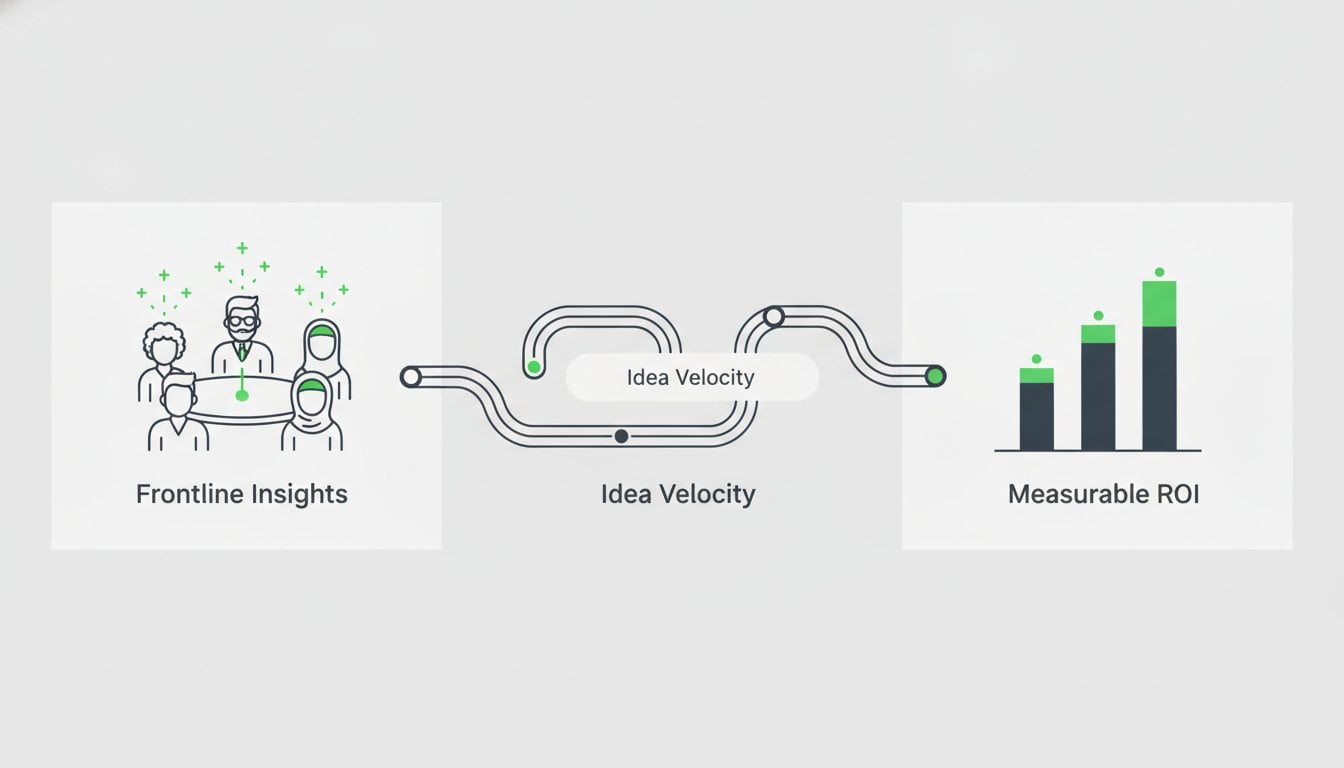
Gallup’s 2026 State of the Global Workplace report reveals that global employee engagement has stagnated at a mere 20%, a decline that costs the global economy an estimated $10 trillion in lost productivity. For most organizations, the disconnect between employee engagement and innovation isn’t just a cultural hurdle; it’s a structural failure that leaves high-value ideas trapped in the minds of frontline staff. You’ve likely seen the symptoms: low participation in outdated suggestion programs and an administrative burden that makes managing new ideas feel like a full-time job.
It’s time to stop treating engagement as a soft HR metric and start leveraging it as a high-performance engine for growth. Research shows that motivated employees are 29% more creative, yet traditional tools fail to turn that creativity into bottom-line results. In this article, you’ll discover a strategic framework to build a scalable system for capturing insights while driving higher retention through meaningful contribution. We’ll outline how to bridge the gap between frontline intelligence and executive strategy to ensure your innovation pipeline never runs dry.
Key Takeaways
- Learn to distinguish between passive job satisfaction and active innovation engagement to build a high-performance feedback loop that drives better decision-making.
- Master the four stages of engagement-led innovation, starting with using frontline insights to identify real-world friction points and operational waste.
- Identify the structural failures of traditional suggestion boxes that lead to the “black hole” effect and learn how to replace them with sustainable, enterprise-scale systems.
- Discover how to leverage AI and gamification to scale employee engagement and innovation while reducing the administrative burden of manual idea management.
- Streamline your entire innovation lifecycle by adopting modern platforms that track every idea from the initial brainstorming phase to measurable ROI.
Defining the Feedback Loop: Why Engagement and Innovation are Inseparable
The relationship between employee engagement and innovation is not a linear path; it’s a self-sustaining feedback loop. When employees actively participate in solving organizational challenges, they generate high-quality data that allows leadership to make informed, evidence-based decisions. This cycle creates a culture where contribution is rewarded with visibility, which in turn fuels further participation. Organizations that master this loop don’t just collect ideas; they build a strategic asset that compounds in value over time.
We must distinguish between passive job satisfaction and active innovation engagement. A satisfied employee is content with their current role and environment. In contrast, Employee engagement in an innovation context involves an active commitment to improving the business. According to Gallup’s 2026 data, while global engagement remains low, companies with high-engagement cultures see 20% higher productivity and a significant boost in creative output. Innovation is the highest form of engagement because it satisfies the three core human drivers: autonomy, mastery, and purpose.
The Psychological Safety Requirement
Employees won’t innovate if they don’t feel safe to fail. Psychological safety is the bedrock of any successful framework. You need transparent evaluation processes that show exactly how ideas are vetted to build long-term trust. When the workforce understands that “Micro-Innovation”, small, incremental improvements, is valued just as much as a major product launch, they become more willing to share insights. This builds a culture of continuous improvement where the fear of making a mistake is replaced by the drive to find a better way.
Engagement as a Leading Indicator of Innovation ROI
Tracking participation rates allows you to predict future product breakthroughs before they appear on a balance sheet. High-performing organizations have moved away from soft happiness surveys toward quantitative ideation metrics. By measuring how many employees are actively contributing to challenges, you can see the tangible benefits of employee ideation programs in real-time. This shift ensures that engagement is treated as a critical business metric rather than a secondary HR concern. It’s the difference between guessing at your company’s potential and measuring your engine’s actual horsepower.
The Four Stages of Engagement-Led Innovation
To transform the feedback loop into a repeatable engine, organizations must move beyond random acts of ideation. Research published by the National Institutes of Health highlights a clear link between employee engagement and innovative behavior, suggesting that when staff feel connected to their work, they naturally seek ways to improve it. This framework breaks that natural impulse into four distinct, manageable stages: Discovery, Ideation, Championing, and Implementation.
Discovery: Tapping into Frontline Intelligence
Once a problem is clearly defined, you move to Stage 2: Ideation. This involves crowdsourcing diverse perspectives from across the organization. By inviting different departments to solve a single identified friction point, you prevent siloed thinking and ensure the resulting solutions are robust and multi-dimensional.
Championing: From Suggestion to Ownership
The third stage is Championing, where the “suggester” transitions into an intrapreneur. It’s not enough to just have a good idea; employees need the innovation skills necessary to build a business case and pitch it to stakeholders. Rewarding these “Idea Champions” shouldn’t just be about financial bonuses. Recognition, increased autonomy, and professional development opportunities often carry more weight and sustain long-term commitment without triggering team friction. If you want to see how a structured system can bridge the gap between ideation and execution, you can explore our platform's championing tools.
Finally, Stage 4 is Implementation. This is where you turn validated ideas into operational reality. Many organizations suffer from a “Valley of Death” where ideas are approved but never executed due to lack of ownership or budget. Closing this loop is non-negotiable. If an idea is validated but never implemented, you’re not just losing ROI; you’re actively training your staff to stop participating. Successful implementation proves that employee engagement and innovation are two sides of the same coin, each driving the other toward measurable business outcomes.
Why Traditional Suggestion Boxes Kill Employee Engagement
The traditional suggestion box is a graveyard for great ideas. While it was once a staple of corporate life, it has become a symbol of administrative inefficiency and executive disconnect. In 2026, with a global workforce that is increasingly hybrid or remote, a physical box is practically invisible to over 60% of employees. Relying on these relics doesn’t just result in missed opportunities; it actively damages the relationship between employee engagement and innovation by creating what we call the “Black Hole” effect.
The Black Hole occurs when an employee submits a thoughtful insight and receives no feedback. Silence is a powerful message. It tells the contributor that their perspective is irrelevant to the company’s strategy. This leads to immediate disengagement. Beyond the cultural cost, there’s a heavy administrative tax. Managing ideas through manual email chains or paper forms is unsustainable for any enterprise. It creates a bottleneck where innovation managers spend more time on data entry than on actual strategy, leading to a system that is slow, biased, and prone to gatekeeping.
Traditional hierarchies often stifle the very “radical innovation” companies need to survive. When ideas must pass through multiple layers of middle management before reaching a decision-maker, the most transformative concepts are often diluted or discarded. A modern system bypasses these barriers, ensuring that every voice has a direct path to impact without the friction of legacy gatekeeping.
The Myth of “I Don’t Have Time to Innovate”
The most common objection to new initiatives is a perceived lack of time. Many leaders treat innovation as an “extra” task rather than a core function of the job. This is a fundamental misunderstanding. We must reframe innovation as a primary time-saver. By engaging employees in identifying efficiencies, you aren’t adding to their plate; you’re helping them clear it. While models like Google’s 20% time showed the power of dedicated creative space, they also serve as a warning. Without a structured platform to capture and evaluate that output, “free time” quickly turns into unguided chaos.
Legacy Software vs. Modern Idea Platforms
User adoption is the only metric that truly matters for long-term engagement. Many organizations are still tethered to complex, outdated innovation portals that feel like a chore to use. If the friction of submitting an idea is higher than the perceived benefit, employees simply won’t participate. When you compare Ideawake vs spreadsheets, the difference in velocity is clear. A modern UI reduces the “learning tax” and makes participation seamless—you can click here to see how AI-powered learning systems apply these same principles—ensuring that your innovation pipeline stays full without the administrative nightmare of manual tracking.
Strategies to Scale Engagement and Innovation in 2026
Scaling employee engagement and innovation across a global enterprise requires more than just a mandate from leadership. It demands a deliberate architecture that balances human creativity with automated efficiency. To move from a handful of participants to total workforce involvement, organizations must implement structures that reward contribution, provide instant feedback, and maintain absolute transparency throughout the ideation lifecycle. This shift ensures that innovation isn’t just an annual event but a continuous, high-performance habit.
Gamification: The Science of Participation
Gamification is often misunderstood as a superficial layer of points and badges. In reality, it’s a psychological framework designed to trigger both intrinsic and extrinsic motivation. By using leaderboards, voting mechanisms, and tangible prizes, you create a sense of healthy competition that drives sustained participation. However, to avoid “gamification fatigue,” these rewards must align with meaningful impact. Employees need to see that their points aren’t just digital tokens but markers of their contribution to the company’s success. For organizations looking to concentrate this energy into a short-term, high-intensity burst, The 2026 Guide to High-Impact Hackathons provides a blueprint for turning competitive spirit into rapid prototyping. To capture the energy of these events, using a platform like Bestever.pics to collect photos from guests and team members ensures that every moment of innovation is documented and shared.
Beyond gamification, the most effective way to scale is through targeted innovation challenges. Generic “suggestion boxes” fail because they’re too broad. By focusing engagement on specific business problems—such as reducing customer churn or optimizing supply chain logistics—you provide the constraints that actually fuel creativity. This ensures the ideas you receive are relevant, actionable, and directly tied to executive strategy.
AI-Driven Innovation: Scaling the Human Element
AI should act as a co-pilot, not a replacement for human judgment. It excels at the heavy lifting of data organization, freeing up human experts to focus on high-level strategy and implementation. When employees see their ideas moving through a transparent, automated workflow, their trust in the system grows. They can see exactly where their contribution sits in the pipeline, which reinforces the value of their input. If you’re ready to see how these automated workflows can transform your innovation output, you can schedule a demo of our innovation platform today.
The strategies we’ve discussed require a robust, enterprise-grade foundation to succeed. Ideawake provides the specialized infrastructure necessary to turn employee engagement and innovation from abstract concepts into a measurable competitive advantage. While general-purpose tools often fail due to high friction, our platform is built specifically to maximize adoption by reducing the “learning tax” that typically kills new initiatives. If the interface isn’t intuitive, your frontline staff won’t use it, and your innovation pipeline will remain empty.
We manage the entire innovation lifecycle within a single environment. This starts with the very first reverse brainstorming session, where teams identify potential failures before they happen, and continues through to full implementation. By consolidating these stages, you eliminate the data silos that prevent executive leadership from seeing the true value of employee insights. It’s a seamless transition from a raw idea to a tracked, operational reality.
When deciding how to deploy this architecture, many organizations face the build vs buy idea management software dilemma. While building an internal tool might seem cost-effective initially, it rarely matches the security, integrations, and specialized feature sets of a dedicated platform. Ideawake fits into your existing tech stack, ensuring that your data is secure while providing the specific tools innovation managers need to scale.
Measuring What Matters
You can’t manage what you don’t measure. To move beyond qualitative metrics, you must provide hard data on the financial impact of your engagement efforts. Using our idea management ROI calculator, you can quantify the exact value your innovation program generates. Our real-time dashboards provide a transparent view of the health of your innovation culture, showing participation rates and the progress of every validated idea. We also automate the feedback loop by sending “Thank You” and “Next Steps” messages, ensuring contributors never feel like they’re shouting into a void.
Ready to Transform Your Culture?
Engagement is a high-value asset you’ve already paid for through your payroll. It’s time to stop letting that potential go to waste and start unlocking its true value. Organizations that fail to adapt will continue to struggle with disengagement and stagnant growth, while those that embrace a structured framework will dominate their markets. Don’t settle for average results when a superior path is available. We invite you to see the power of our platform firsthand and sign up for a demo of Ideawake to begin your transformation.
Build a Culture That Outperforms the Competition
The gap between a stagnant organization and a market leader often comes down to how effectively they bridge the divide between employee engagement and innovation. We’ve established that traditional suggestion boxes are obsolete and that a structured framework is required to turn frontline insights into operational reality. By moving away from manual tracking and adopting a centralized architecture, you don’t just collect ideas; you empower your workforce to act as a force multiplier for organizational growth.
Ideawake is designed to support this transformation by reducing administrative overhead by up to 80% and managing the full lifecycle from submission to ROI. Our platform uses AI-driven insights to identify high-impact ideas faster, ensuring your team focuses on execution rather than data entry. It’s time to unlock the potential you’ve already paid for and build a system that rewards contribution with tangible impact. Your employees are ready to contribute. Give them the platform they deserve.
Book a Demo to See How Ideawake Drives Engaged Innovation
Frequently Asked Questions
How does employee engagement directly impact innovation ROI?
Employee engagement directly impacts innovation ROI by increasing the volume and quality of actionable insights available to leadership. When employees feel a deep connection to their work, they’re 29% more creative and likely to identify operational efficiencies. This participation creates a larger pool of data, allowing organizations to select high-impact projects with higher success rates. Without this active contribution, innovation becomes a guessing game played only by executive leadership.
Can innovation management software work for small teams?
Innovation management software provides small teams with a centralized architecture that prevents high-value ideas from disappearing into email threads or chat apps. Even for teams of ten, having a single source of truth for continuous improvement ensures that every insight is tracked and evaluated. Establishing these workflows early creates a scalable culture that maintains its innovative edge as the organization grows.
What are the best ways to reward employees for innovative ideas?
The most effective rewards for employee engagement and innovation balance tangible prizes with professional recognition. While financial bonuses are common, providing employees with greater autonomy or the chance to lead their own projects often drives deeper long-term commitment. Public recognition from senior leadership also validates the employee’s contribution, reinforcing their sense of purpose and encouraging a culture of healthy competition across the department.
How do you maintain engagement in a long-term innovation program?
Maintaining engagement requires a consistent commitment to transparent feedback and visible implementation. If employees don’t see their ideas moving through the pipeline, they’ll stop contributing. You must close the loop by showing exactly how previous submissions have improved the business. Regular innovation challenges and gamified leaderboards also help sustain momentum by giving staff new, specific problems to solve throughout the year.
What is the difference between an employee suggestion program and an innovation challenge?
An employee suggestion program is a passive, always-on mechanism, whereas an innovation challenge is a time-bound event focused on a specific business problem. Suggestion boxes often lead to a high volume of low-quality ideas that are difficult to manage. In contrast, challenges provide the constraints necessary to fuel targeted creativity, resulting in higher-quality submissions that align directly with current organizational priorities.
How can AI help scale employee engagement in large organizations?
AI scales engagement by removing the administrative bottleneck that typically delays feedback in large enterprises. Using employee engagement and innovation platforms powered by AI allows for instant clustering of similar ideas and automated duplicate removal. This ensures that even in a workforce of thousands, every contributor receives a response in seconds rather than weeks, effectively eliminating the “Black Hole” effect.
What are the most common failures in employee innovation programs?
The most common failure is the “Black Hole” effect, where ideas are submitted but never acknowledged or acted upon. When employees feel their insights aren’t valued, engagement levels drop immediately. Other failures include a lack of dedicated budget for implementation and complex submission portals that create too much friction. If the process is harder than the problem, your team simply won’t participate.
How do you measure the “health” of an innovation culture?
You measure the health of an innovation culture by tracking quantitative ideation metrics rather than relying on qualitative surveys. Key indicators include your participation rate, idea velocity, and the ratio of submitted ideas to those that reach implementation. A healthy culture shows steady growth in these areas, proving that employees trust the system and see a clear path from their initial insight to measurable ROI.