

Employee feedback matters most when it shapes how work gets done. The voice of the employee is the workforce’s collective feedback, opinions, and sentiment, shared through surveys, everyday conversations, and ideas for improvement. Collecting input is only the beginning. Its real value comes when leaders use it to make better decisions and improve the workplace.
Surveys are a familiar way to listen, but a survey alone can’t reveal every obstacle, opportunity, or practical idea employees encounter in their daily work. People need clear ways to speak up and to see that their input leads somewhere.
This article explains what employee voice means, where feedback comes from, and how to interpret survey findings so they don’t become another report left untouched. It also explores how employee ideas can surface improvements, strengthen innovation, and connect listening to action. The key is a deliberate loop: invite input, identify what matters, and show employees what changed.
Key Takeaways
- Collect feedback at meaningful points across the employee lifecycle to spot needs that a single survey may miss.
- Combine structured channels, such as surveys and focus groups, with everyday conversations to hear a broader range of perspectives.
- Recognize that employee voice includes concerns, suggestions, and ideas, shared individually or collectively.
- Turn survey findings into focused priorities by connecting employee comments to the changes leaders can make.
- Give employees a clear path to contribute ideas, then make progress visible so listening leads to action.
What is the Voice of the Employee (VoE)?
The voice of the employee is the workforce’s collective feedback, opinions, and sentiment. A strong program helps leaders improve engagement, retention, decision-making, inclusion, and workplace culture by acting on employee input.
Feedback Across the Employee Lifecycle
Collecting feedback across the employee lifecycle means inviting input at key moments, from onboarding through role changes and exit. Unlike an engagement or pulse survey, which measures selected questions at a point in time, VoE combines surveys with interviews, manager conversations, and employee ideas. For an enterprise team, onboarding feedback can reveal unclear training, while exit feedback may surface recurring barriers that routine surveys miss. Listening at each stage gives leaders a clearer view of how needs change over time.
Communication and Closing the Feedback Loop
A communication plan explains why input is being collected, who will review it, and how findings will inform decisions. Before launching a survey, tell employees its purpose and how their responses will be handled. After collecting feedback, share the main themes, identify what leaders will address, and explain any constraints affecting other requests. For example, if staff report confusing handoffs, managers can describe the process change, name its owner, and explain how they’ll assess whether it helped. Updates show employees that speaking up leads to consideration, not silence.
Bias, Trust, and Anonymity
Bias enters feedback when questions steer responses, certain groups are overlooked, or employees fear consequences for speaking honestly. Use neutral wording, offer more than one channel, and compare themes across roles and locations. Anonymity can make it easier to express concerns, but it cannot replace trust; employees may still hesitate if past feedback brought no visible response. CIPD research found a quarter of employees report high levels of silence at work. Leaders can address that barrier by explaining confidentiality clearly and responding consistently to concerns.
Analyzing and Prioritizing Feedback
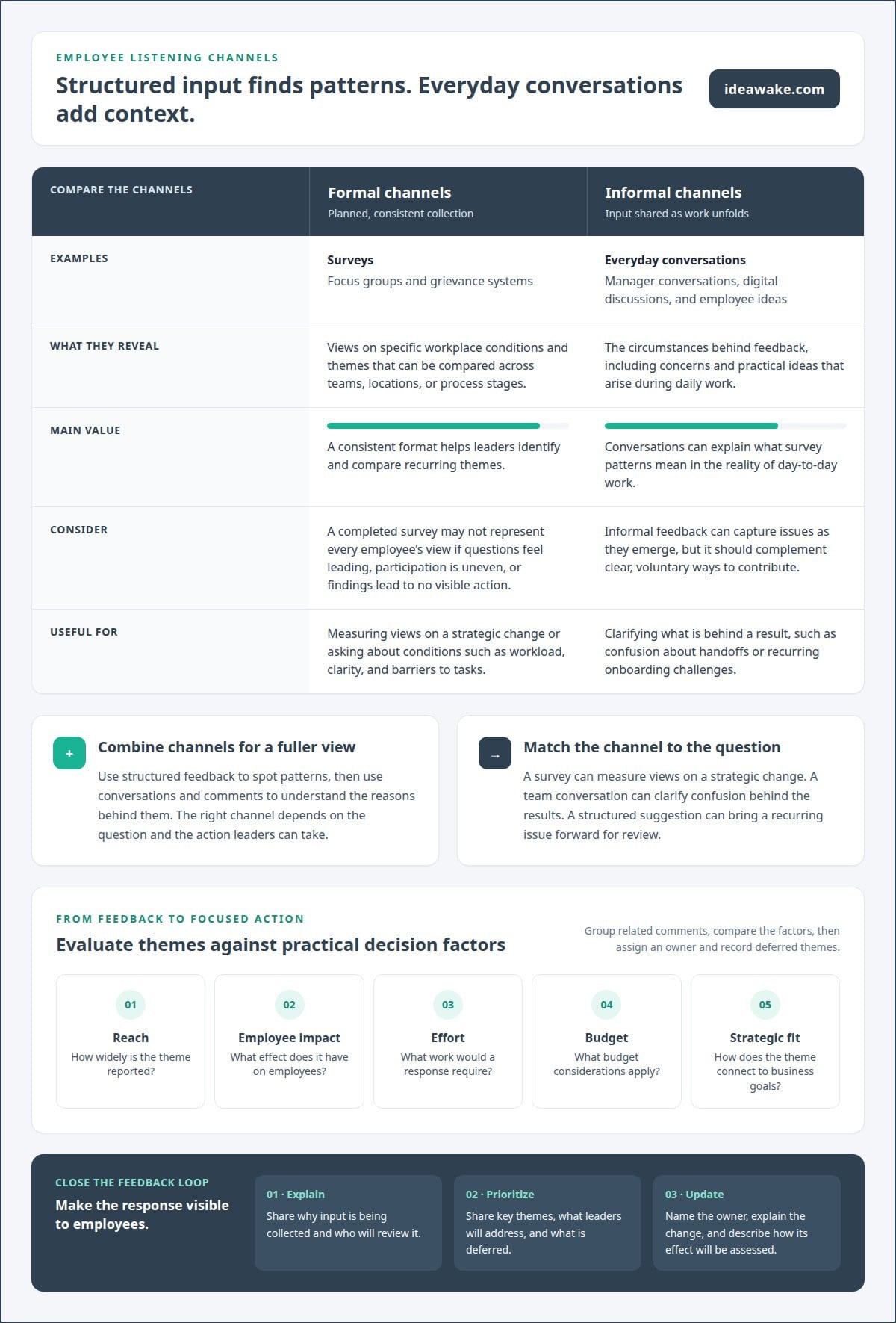
Analysis turns individual comments into themes leaders can evaluate against business goals. Group related feedback, such as repeated reports of approval delays, then compare its reach, employee impact, effort, budget, and strategic fit. Pairing survey trends with open-ended comments can reveal what lies behind a score. For example, a low rating for work processes may reflect unclear ownership rather than inadequate tools. Prioritize issues with meaningful impact and a practical path forward, assign an owner, and record why other themes are deferred.
A Culture That Welcomes Feedback
A feedback culture makes listening part of everyday work, not an event reserved for an annual survey or a crisis. Leaders and managers shape that culture through specific behaviors: invite dissent in team conversations, thank employees for raising concerns, and explain decisions even when a suggestion isn’t adopted. If staff flag repeated onboarding confusion, managers can discuss the pattern with new hires and review whether guidance is clear. Consistent responses help employees share ideas earlier, when teams have more opportunity to address them.
Formal and informal employee feedback channels
Formal channels create consistent ways to collect input, while informal channels capture concerns and ideas as work unfolds. Organizations need both: structured feedback can reveal patterns, and everyday conversations can explain what those patterns mean.
Structured Feedback Channels
Structured channels are planned methods for gathering employee input, including surveys, focus groups, and grievance systems. Their consistent format helps leaders compare themes across teams, locations, or stages of a process. Survey results can be useful to senior managers yet feel less relevant to employees unless the findings connect to workplace decisions. That gap points to a practical need: make findings useful to employees and managers alike.
Surveys can ask about specific workplace conditions, while focus groups let employees explain the reasons behind their responses. Grievance systems provide a formal route for raising concerns that need review. These channels work best when their purpose is clear and questions connect to decisions leaders can make. For example, an organization assessing a new scheduling process could ask about clarity, workload, and barriers to completing tasks.
A formal process doesn’t guarantee candid input. Employees may doubt that survey responses reflect their experiences if questions feel leading, participation is uneven, or results never lead to visible action. Treat that concern as a reason to examine question design, trust, and follow-through, rather than assuming a completed survey represents every employee’s view.
Tools and Platforms for VoE
Employee listening tools include survey platforms, focus-group tools, grievance systems, collaboration apps, and idea-management platforms. They help organizations gather input across locations and identify themes, but the right channel depends on the question and the action that may follow. A survey can measure views on a strategic change; a team conversation can clarify the confusion behind the results.
Remote and hybrid teams may share feedback through collaboration apps and digital conversations they already use. Passive listening in routine communication channels can supplement formal collection, but it shouldn’t replace clear, voluntary ways to contribute. For example, a distributed operations team could raise recurring handoff issues in a team discussion, then submit a structured suggestion for review. Keeping these routes visible helps employees choose a channel that fits their concern.
Choose channels by matching them to the input needed: surveys for comparable responses, focus groups for discussion, and suggestion systems for proposals. A dedicated employee suggestion program can give ideas a defined route for review. Survey data can have limited value if managers and employees cannot use it to identify a practical next step. A channel earns its place when it helps turn feedback into a clear decision or next step.
Definition and forms of employee voice
Employee voice describes how people share views, raise concerns, and contribute knowledge that can influence workplace decisions. It goes beyond survey answers: an employee who flags a safety risk, questions a process, or proposes a better handoff is also sharing a perspective leaders can use.
The distinction from employee engagement matters. Engagement describes an employee’s relationship with their work and organization; voice describes the act of communicating ideas, concerns, or preferences. The two can influence each other, but they aren’t interchangeable. For example, a team member may feel committed to a project and still stay silent about a flawed approval step if speaking up seems unwelcome.
Employee voice can take several forms, depending on what someone wants to communicate and who needs to hear it:
- Suggestions: An employee proposes a clearer customer handoff or a way to reduce duplicate data entry.
- Concerns: A worker flags a recurring safety issue, unclear expectations, or a process that prevents timely service.
- Constructive challenge: A team member questions an established practice and explains why another approach may work better.
- Shared or representative input: Employees raise common issues together, such as through a team discussion or employee representatives.
- Participation in decisions: Employees contribute operational knowledge before leaders choose a workflow or implement a change.
These forms can be direct or collective, formal or conversational. A warehouse employee might submit an equipment-layout idea through a suggestion process, while colleagues discuss the same bottleneck during a shift meeting. Both examples offer useful information, but each needs a suitable route for review. A concern may need prompt attention, while an improvement idea may require evaluation against feasibility and organizational priorities.
For enterprise leaders, the practical test is whether employees can contribute effectively and decision-makers can interpret their input in context. A comment about “slow approvals,” for instance, becomes more actionable when it identifies the affected workflow, the delay’s consequences, and a possible change. Not every employee proposal needs to be adopted. Leaders can explain decisions, recognize contributions, and use relevant knowledge to shape the work environment.
Employee voice reaches beyond employee relations. Frontline knowledge can expose barriers, strengthen decisions, and reveal opportunities central teams may not see. HR, operations, and innovation leaders can put that knowledge to use by giving employees a clear way to raise issues, connecting input to the people who can assess it, and considering it before finalizing decisions. This creates room for informed challenge and practical improvements to working methods.
Using survey findings to improve employee experience
Surveys become useful when leaders connect responses to a specific workplace decision. A clear process helps identify employee concerns, test possible changes, and measure whether those changes address the issues raised.
Success metrics should track both employee experience and the organization’s response. Useful measures include participation across teams, changes in engagement or satisfaction, recurring concerns resolved, and employee ideas reviewed or implemented. Choose measures that match the survey’s purpose. A survey about onboarding, for example, might track whether new hires understand their roles and can access the support they need.
Start with focused questions about observable workplace conditions. “I can find the information needed to serve customers” is more actionable than “Are you happy here?” Use neutral wording, avoid combining separate issues, and include a comment prompt for context. Scientifically validated survey templates can provide a consistent structure, but leaders still need to check that questions fit their workforce, language, and intended decision.
Surveys show patterns; interviews and focus groups help explain them. If responses point to unclear priorities, a facilitated discussion can reveal whether instructions conflict or change too often. Individual interviews can give employees space to describe sensitive concerns. Combine these methods deliberately, then compare comments with survey results rather than treating any single response as the whole story.
Automated survey deployment can coordinate invitations, reminders, and follow-up across departments or locations. Set the audience and purpose first, then schedule the survey around the decision it will inform. For example, after a policy rollout, a short survey can identify confusing steps while the change is still being implemented. Automation supports consistency, but leaders remain responsible for reviewing findings and communicating next steps.
Use historical results to assess whether actions changed employee experience. External benchmarks may offer context, but they can’t explain whether a particular organization’s own intervention worked. Compare similar questions over time, note which teams were affected, and record relevant changes, such as a revised onboarding process. A survey about employee surveys found 58% of respondents said the data did not or only slightly help managers identify behaviors or practices to change.
Follow-up determines whether measurement leads to action. PeopleMetrics research found employee engagement can drop when organizations survey employees but take no follow-up action. Share the themes, name the change leaders will make, and report progress against the chosen measures. If a concern can’t be addressed immediately, explain why and identify what will happen next. That closes the loop and makes the next survey more meaningful.
Employee ideas and innovation
Employees see operational friction that central teams may miss. A customer service representative handling repeated billing questions, for example, may spot a confusing form that drives avoidable contacts. Capturing that observation as an idea turns frontline knowledge into a potential improvement, not just a complaint. Employee voice can support innovation by connecting daily work with opportunities to change products, processes, and policies.
Ideas need a route from submission to decision. A useful process asks contributors to describe the problem, who experiences it, and what change they propose. Reviewers can then assess strategic fit, likely impact, feasibility, effort, and dependencies. For instance, a proposal to simplify shift handoffs may require coordination between operations, human resources, and information technology before a pilot can begin.
Keep evaluation distinct from popularity. Votes can show which problems resonate, but they don’t establish whether an idea is safe, practical, or aligned with organizational priorities. A review team can combine employee input with operational evidence, then explain its decision. If a proposal is deferred because another project must finish first, a clear reason helps contributors understand the outcome and refine their idea.
Innovation can also strengthen employee engagement when people see their expertise influence decisions. Participation in decision-making is associated with improved job satisfaction. Consider a distribution team that proposes a revised picking sequence: involving employees in testing can reveal workflow effects that a desk-based review might miss. The team can then use what it learns to decide whether to adopt or adjust the change.
For enterprise leaders, employee ideas can support continuous improvement and broader innovation. They may identify a local fix, such as removing a duplicate approval, or point toward a larger opportunity, such as redesigning a customer process. A clear employee ideation approach helps connect those contributions to organizational goals without assuming every suggestion will be implemented.
Track the process as well as the outcome. Useful indicators include where ideas originate, which themes recur, how decisions are communicated, and whether implemented changes address the original problem. Review those signals alongside employee satisfaction and turnover patterns, without assuming that one idea caused a change in either measure. If staff repeatedly flag policies that block routine work, leaders can investigate the policy, explain the decision, and show what happens next.
The takeaway: treat employee ideas as operational knowledge. Give each proposal a fair review, a decision owner, and a response employees can understand. That discipline turns suggestions into evidence for better decisions and gives the workforce a visible role in shaping change.
Ideawake: Innovation Management Platform
Ideawake’s Innovation Management Platform helps organizations capture, evaluate, and implement ideas from employees, customers, and partners. It gives employee suggestions a path beyond collection, helping teams organize contributions and move promising ideas through the innovation lifecycle. For organizations ready to connect employee input with practical improvement work, an Employee Suggestion Platform provides a structured route for ideas to be reviewed and developed.
Ideawake also offers Continuous Improvement and Ideawake AI, alongside idea management capabilities that use voting, leaderboards, and prizes to support participation. These tools help teams bring ideas into view and assess them against organizational priorities. To explore how Ideawake could support your approach, contact Ideawake or visit ideawake.com.
Make employee insight part of how work evolves
Make listening a working practice, not a separate initiative. Choose a business challenge employees experience directly, invite their ideas, and establish how leaders will review and respond. This connects the voice of the employee to decisions and helps teams learn which changes deserve attention.
Ideawake’s Innovation Management Platform and Idea Management Platform support capturing and evaluating ideas, while its Continuous Improvement offering helps organizations focus on practical workplace changes. The right approach starts with a defined challenge, clear ownership, and a visible way for employees to follow progress. Keep the process connected to organizational priorities, and employee insight can become a useful input to ongoing improvement.
Start with one meaningful opportunity, then build on what your workforce teaches you. Better work can begin with an idea someone is ready to share.
Frequently Asked Questions
What does voice of the employee (VoE) mean?
Voice of the employee means the collective views, feedback, and sentiment employees share about their work and organization. It goes beyond survey answers: an employee might flag a confusing customer handoff, raise a concern about a policy, or suggest a change to a routine process. Leaders can use these perspectives to understand workplace conditions and make decisions informed by employees’ day-to-day experience.
What are the main methods for collecting employee feedback?
Common methods include engagement surveys, pulse surveys, focus groups, individual interviews, grievance channels, manager conversations, and employee suggestion processes. Choose a method based on the input needed: a survey can compare views across departments, while interviews can explore why a new scheduling procedure creates problems. Informal team discussions can also surface issues quickly. Combining methods helps leaders hear both recurring patterns and the context behind individual comments.
How do companies design and implement a VoE program?
Start by defining the decision the program should inform, such as improving customer handoffs or clarifying promotion criteria. Select channels that suit the question, then explain who will review responses and how findings will be used. Assign owners to emerging themes, agree on how actions will be tracked, and report outcomes to employees. For example, HR and operations could jointly review recurring concerns about shift scheduling.
What are examples of effective voice of the employee programs?
An effective program might invite frontline employees to identify customer-service obstacles, then let a cross-functional team assess and test selected suggestions. Another could ask new hires to comment on specific onboarding materials, with managers reviewing patterns and updating unclear guidance. A third might give employees a structured way to flag recurring process friction. Each example connects a defined employee input channel to a decision owner and a visible response.
What are the risks and challenges of collecting employee feedback?
Low trust can produce guarded responses, while unclear questions may generate answers leaders can’t act on. Survey fatigue can also grow if organizations repeatedly request input without explaining its purpose or sharing outcomes. Another risk is treating the loudest comments as representative of every team. To reduce these problems, compare input across channels, review participation patterns, and distinguish individual reports from themes that appear across groups.
How can employers protect employee privacy and respond to feedback?
Explain how responses will be collected, who can access them, and whether comments are anonymous or identifiable. Limit access to people responsible for analysis, and avoid sharing details that could identify an employee through their role or circumstances. Respond by acknowledging themes, outlining decisions, and giving employees a way to raise follow-up concerns. If a proposed change isn’t adopted, communicate why and what will be considered next.