
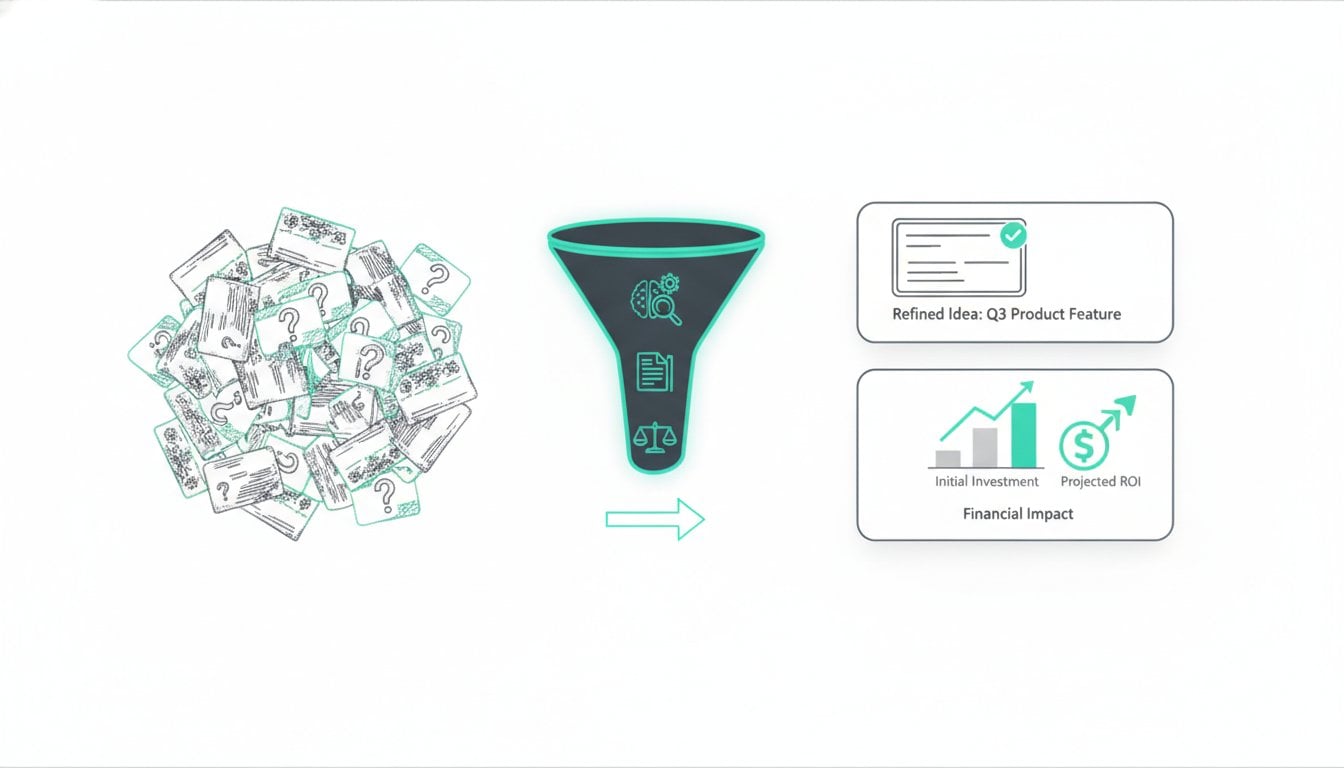
Collecting feedback is easy, but converting it into enterprise value is where most organizations fail. In 2026, the industry has moved beyond simple voting toward sophisticated systems that integrate directly with financial data from sources like Stripe. If you’re still relying on a passive suggestion box, you’re likely losing ground to competitors who treat feedback as a strategic asset. Selecting the right customer idea management platform is no longer about just listening. It’s about data-driven prioritization and measurable financial outcomes.
You likely recognize the administrative nightmare of manual evaluation and the struggle to link user requests to actual growth. It’s a common burden that leads to organizational stagnation. This article debunks the myth of the passive feedback loop and provides a framework for selecting a platform that converts raw suggestions into tangible ROI. We’ll examine the rise of AI-powered duplicate detection and the critical importance of pricing transparency in a market where seven out of twelve major vendors still hide their costs behind a sales wall. It’s time to stop guessing and start executing with precision.
Key Takeaways
- Differentiate between simple feedback collection and a comprehensive innovation lifecycle to ensure customer insights lead to actual product development.
- Utilize AI-driven signal detection to navigate high-volume feedback and eliminate the “noise” that typically causes administrative bottlenecks.
- Establish a clear ROI blueprint by connecting raw customer suggestions to financial performance metrics and strategic growth goals.
- Evaluate how a modern customer idea management platform uses automated workflows and gamification to increase participation while reducing manual oversight.
- Streamline the evaluation process with AI-assisted scoring models that cut administrative burden by as much as 90% compared to legacy tools.
What is a Customer Idea Management Platform (And What It Isn’t)?
A customer idea management platform is far more than a digital suggestion box. It’s a high-performance infrastructure designed to centralize the capture, evaluation, and implementation of external insights. While many organizations mistake a simple survey or a feedback form for an innovation strategy, a true platform acts as a bridge between a raw suggestion and measurable enterprise ROI. It manages the entire innovation lifecycle. This means it doesn’t just store data; it moves it through a structured workflow where ideas are refined, scored, and eventually turned into market-ready solutions.
Without this structured approach, organizations often fall into the trap of “passive listening.” They collect data but lack the mechanism to act on it. A dedicated platform provides the necessary framework to ensure that the most valuable ideas don’t just sit in a database. Instead, they’re routed to the right stakeholders for rapid validation and execution.
The Black Hole Myth: Why Listening Isn’t Enough
CRM vs. Idea Management: The Critical Difference
It’s easy to confuse a Customer Relationship Management (CRM) system with an innovation tool. CRMs excel at tracking interactions and managing the sales funnel. However, they’re fundamentally unequipped to track the evolution of value. Spreadsheets and CRMs inevitably fail to scale for collaborative business innovation because they lack the specialized features required for high-level ideation. While a CRM tells you who your customers are, an idea platform tells you what your company should become next.
A dedicated customer idea management platform provides specific tools that general software lacks:
- Collaborative Voting: Peer-driven prioritization that highlights the most impactful solutions.
- Gamification: Incentives that drive sustained engagement rather than a one-time burst of activity.
- Automated Workflows: Logic-based triggers that move ideas through evaluation stages without manual intervention.
By using a system built for the innovation lifecycle, you eliminate the administrative friction that kills great ideas before they can reach the market.
Debunking the “More is Better” Fallacy in Customer Ideation
Organizations often mistake a high volume of feedback for a successful innovation strategy. It’s a dangerous fallacy. While capturing hundreds of suggestions might look good on a quarterly report, unmanaged volume quickly creates “noise” that paralyzes decision-making. When your team is drowning in unorganized data, the “Cost of Noise” becomes a significant drain on your R&D budget. Every hour an engineer or product manager spends manually reviewing low-quality or duplicate ideas is an hour stolen from high-impact development. A high-performance customer idea management platform doesn’t just collect more data; it acts as a sophisticated filter that finds the needle in the haystack.
To move beyond this paralysis, enterprise leaders must shift their focus from raw quantity to actionable signal. Research in the innovation space shows that without automated filtering, the administrative burden of managing large-scale feedback loops can lead to a 50% drop in implementation rates. By implementing a structured evaluation process, you stop treating every suggestion as equal and start focusing on the insights that drive measurable financial outcomes.
AI-Powered Signal Detection: Filtering for Impact
Modern innovation leaders are turning to ai driven innovation software to solve the volume fatigue problem. These systems automate the deduplication of customer requests by identifying similar concepts even when the phrasing differs. Sentiment analysis and theme clustering allow teams to identify high-demand features and underlying pain points across thousands of submissions instantly. AI-driven idea clustering serves as a primary method for reducing administrative overhead by up to 80%. This automation ensures that your team only reviews the most relevant, unique insights, allowing you to see how automated filtering can reclaim your team's time.
The Quality Filter: Evaluation and Scoring Frameworks
The shift from “gut feeling” to data-driven decision-making requires standardized idea evaluation criteria. Relying on the loudest voice in the room or the most recent request leads to reactive product roadmaps. Instead, sophisticated platforms use multi-weighted scoring to balance three critical pillars:
- Feasibility: Can we actually build this with our current resources?
- Desirability: Do our customers actually want this, and how many?
- Viability: Does this align with our long-term business goals and revenue targets?
By integrating gamification elements like peer voting and leaderboards, you leverage the “wisdom of the crowd” to pre-filter ideas before they ever reach a manager’s desk. This collaborative approach ensures that only the most promising concepts move into the high-stakes stages of the innovation lifecycle.
Legacy Suggestion Boxes vs. Modern Customer Idea Platforms
Legacy suggestion boxes were built on a “set it and forget it” mentality. In contrast, a modern customer idea management platform operates as a dynamic execution engine. The primary difference lies in how data moves through the organization. In legacy systems, tracking is manual and disconnected. This creates silos where valuable insights are lost. Modern platforms centralize this data into idea management databases that provide real-time visibility to all stakeholders. Instead of hunting through email chains or disconnected files, leaders can see the entire innovation pipeline at a glance.
User adoption is another critical differentiator. Legacy interfaces are often clunky and uninspiring, serving as a barrier to participation. They feel like extra work. Modern platforms leverage gamified experiences and intuitive design to drive high engagement rates. They turn the act of submission and voting into a rewarding experience. Implementation has also shifted. While legacy on-premise solutions could take months to deploy and require heavy IT involvement, modern cloud-based architectures allow for rapid setup. Most organizations can move from procurement to launch in just a few weeks.
The “Build vs. Buy” Trap for Enterprises
Many enterprises fall into the trap of thinking an internal portal is the most cost-effective route. This is rarely the case. When you choose to build, you aren’t just paying for the initial development. You’re committing to ongoing security updates, feature requests, and the mounting weight of technical debt. Our build vs buy idea management software guide breaks down these hidden costs in detail. Choosing a specialized customer idea management platform ensures you have access to a dedicated roadmap of features without the internal resource drain. It allows your developers to focus on your core product rather than maintaining a custom feedback tool.
Administrative Complexity: The Hidden Innovation Killer
Administrative friction is the silent killer of corporate innovation. Legacy systems often require full-time staff just to manage basic workflows and manual status updates. This is a waste of human capital. Modern platforms use AI to automate innovation workflows, handling everything from idea routing to progress notifications. This “Modern Enterprise Edge” allows for low-touch management while delivering high-impact results. By automating the mundane tasks, your innovation managers can spend their time on high-value strategy and implementation rather than data entry. It’s the difference between managing a process and driving a result. According to the AI Driven Innovation Software: The 2026 Enterprise Trend Report, 67% of organizations are already increasing their investments in generative AI to eliminate exactly this kind of administrative overhead.
The ROI Blueprint: From Raw Customer Suggestion to Market Value
To move beyond the “listening” phase, organizations must integrate feedback directly into their innovation pipeline. A high-performance customer idea management platform serves as the engine that converts these external insights into measurable financial outcomes. This transition requires a disciplined, four-step blueprint that ensures no valuable suggestion is lost to administrative inertia.
- Step 1: Capture and Centralize. Every insight must enter a structured idea submission process. This eliminates the fragmentation of email threads and Slack messages, ensuring data is clean and actionable from the start.
- Step 2: Rapid Evaluation. Using AI-assisted scoring and peer voting, the platform surface-levels the highest-potential ideas. This objective filtering prevents personal bias from dictating the product roadmap.
- Step 3: Execution Tracking. Visibility is the antidote to “idea stall.” By tracking implementation milestones, stakeholders ensure that selected ideas actually reach the market rather than dying in a backlog.
- Step 4: ROI Measurement. The final stage involves linking implemented ideas to financial modeling and performance analytics. This closes the loop, proving the platform’s value to the C-suite.
By following this systematic approach, your organization stops guessing and starts executing with mathematical certainty. You can schedule a demo today to see this blueprint in action.
Measuring the Intangible: Beyond Direct Revenue
While direct revenue is the ultimate goal, a sophisticated customer idea management platform also captures “soft” ROI that is often overlooked. Customer retention and churn reduction are critical indicators of success. When users see their suggestions implemented, their lifetime value increases. Furthermore, balancing incremental vs radical innovation allows a company to protect its current market share while simultaneously exploring new revenue streams. Tracking “time-to-implementation” as a key performance indicator helps identify bottlenecks in your R&D process, allowing you to move faster than the competition.
The ROI Calculator: Hard Data for Stakeholders
Securing executive buy-in requires more than just optimism; it requires hard data. The Idea Management ROI Calculator provides a framework for quantifying the impact of your innovation efforts. One of the most significant cost savers is the ability to avoid “bad” product features. By validating ideas with real customer data before development begins, organizations save millions in wasted engineering hours. Industry research indicates that data-backed innovation processes can reduce the failure rate of new product launches by up to 50%. This level of precision transforms innovation from a risky gamble into a predictable driver of enterprise growth.
Ideawake: The High-Performance Customer Idea Management Solution
Ideawake is the modern architecture choice for organizations that prioritize speed and measurable results. While legacy systems often fail due to administrative friction, our customer idea management platform enables a 90% reduction in overhead compared to traditional methods. We achieve this by replacing manual tracking with AI-driven automation. Our system doesn’t just store feedback; it processes it. By automatically deduplicating submissions and clustering themes, Ideawake turns raw customer noise into a prioritized product roadmap. This end-to-end capability ensures that your organization maintains a clear line of sight from the initial suggestion through to final ROI measurement.
Efficiency is the core of our design. We understand that innovation managers shouldn’t spend their days as data entry clerks. A high-performance customer idea management platform acts as an extension of your team, identifying high-impact opportunities in minutes rather than weeks. This shift allows your brightest minds to focus on strategy and implementation, which are the true drivers of market value. It’s a results-driven approach for companies that refuse to settle for average outcomes.
Seamless Integration and Rapid Implementation
Enterprise tools only work if people actually use them. Ideawake integrates with existing stacks including Slack, Microsoft Teams, and Jira to meet your users exactly where they work. This native connectivity removes the barriers to entry that often kill engagement in specialized portals. Beyond software compatibility, our implementation support ensures a rapid transition. We’ve optimized the onboarding process to reduce go-live time from the industry average of several months to just a few weeks. The platform is built for scale, supporting everything from localized departmental pilots to global enterprise-wide deployments without a drop in performance.
Proven Success: Turning Ideas into Impact
The benefits of employee and customer ideation programs are well-documented, but execution remains the primary hurdle. Ideawake provides the structure needed to clear that hurdle every time. By utilizing innovation challenges like a structured enterprise hackathon, you can direct your crowd’s energy toward solving specific, high-priority customer pain points. This prevents the “suggestion box” stagnation and ensures that every submission is aligned with your current business objectives. It’s a proven method for turning collective intelligence into a sustainable competitive advantage.
Stop letting valuable insights slip through the cracks of unorganized spreadsheets. Sign up for a demo to see how Ideawake transforms your customer feedback loop into a powerful engine for growth and innovation.
Drive Measurable Impact with Data-Driven Innovation
Passive feedback loops are a relic of the past. To lead in 2026, organizations must treat customer suggestions as strategic assets that require structured execution. By moving away from manual suggestion boxes and adopting a sophisticated customer idea management platform, you eliminate the administrative bottlenecks that kill progress. Implementing AI-driven deduplication and clustering allows your team to focus on high-impact initiatives rather than drowning in repetitive data. This transition ensures that every insight is evaluated against financial goals rather than gut feelings.
The shift to modern innovation architecture provides a 90% reduction in administrative overhead while offering end-to-end ROI tracking to satisfy the most rigorous executive requirements. You have the blueprint for converting raw suggestions into market value; now it’s time to execute. Ready to turn customer insights into ROI? Book your Ideawake demo today. Embracing a results-driven approach is the fastest way to transform your customer feedback into a sustainable competitive advantage.
Frequently Asked Questions
How does a customer idea management platform differ from a standard suggestion box?
A customer idea management platform provides a structured, end-to-end lifecycle for feedback, whereas a suggestion box is a passive repository that often leads to data silos. The platform uses automated workflows, transparent status tracking, and collaborative scoring to move an idea from submission to market implementation. It replaces manual sorting with high-performance filters, ensuring that every high-impact suggestion is routed to the correct stakeholder for immediate action.
Can I integrate my existing CRM with an idea management platform?
Yes, modern platforms are designed to integrate with CRMs like Salesforce and HubSpot to enrich feedback with real-world financial data. This connection allows you to weigh ideas based on customer lifetime value or specific contract sizes. By turning qualitative feedback into quantitative business cases, your team can prioritize product features that drive the most revenue and prevent churn among high-value accounts.
What is the typical ROI for a customer-led innovation program?
The ROI for customer-led innovation is measured through increased retention rates, reduced development waste, and accelerated time-to-market. By validating features with actual user data before they enter the R&D pipeline, companies can reduce the failure rate of new product launches by up to 50%. This precision saves millions in engineering hours that would otherwise be spent on features that don’t align with market demand.
How does AI help in managing thousands of customer ideas?
AI manages high-volume feedback by automating deduplication and theme clustering across thousands of disparate submissions. Modern systems use natural language processing to identify similar ideas even when users use different terminology or phrasing. This automation reduces the administrative burden on your team by up to 90%, allowing innovation managers to focus on high-level strategy instead of manual data entry.
Is it better to build our own idea management portal or buy a specialized platform?
Buying a specialized customer idea management platform is almost always more cost-effective than building an internal portal due to the hidden costs of maintenance and technical debt. Building from scratch requires dedicated internal resources for security updates, feature requests, and API integrations. A specialized platform provides a ready-made, high-performance infrastructure that allows your developers to focus on your core product instead of internal tools.
How do we encourage customers to participate in our ideation challenges?
Encouraging participation requires a combination of transparency, gamification, and visible results. Customers participate more frequently when they see a clear status for their ideas and know their input has a real impact on the product roadmap. Using leaderboards, voting mechanisms, and public recognition creates a rewarding experience that drives sustained engagement and turns your user base into a collaborative partner.
How do you measure the success of an idea management initiative?
Success is measured through a mix of participation rates, the conversion rate of ideas to implementation, and tangible financial outcomes. Key performance indicators include “time-to-implementation” and the total revenue or cost savings generated from implemented ideas. Tracking these metrics allows you to demonstrate the clear value of the innovation program to executive stakeholders using hard data rather than anecdotal evidence.
What security standards should an enterprise-grade innovation platform meet?
An enterprise-grade platform must meet rigorous security standards like SOC 2 Type II and GDPR compliance to protect sensitive data. It should offer single sign-on (SSO) integration and role-based access controls to ensure data integrity across the organization. These standards protect both customer insights and internal strategic data from unauthorized access while ensuring your organization meets all global regulatory requirements. Organizations looking to extend these same principles internally should also explore how to stop losing employee ideas by applying structured capture and governance frameworks across their workforce.