
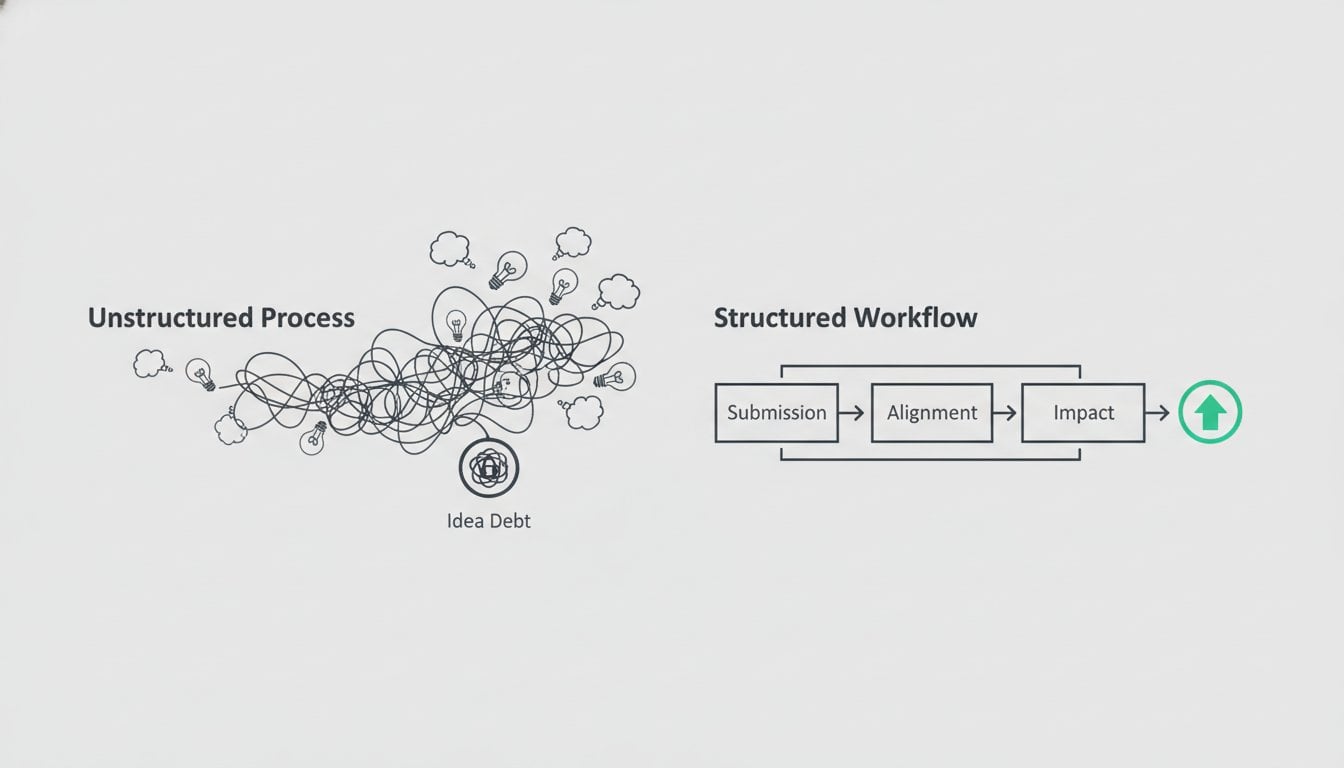
A 2026 survey of operations leaders found that while 85% believe they’re ahead of their peers in digital transformation, a staggering 89% state their technology investments haven’t actually delivered the promised results. It’s a sobering reality for enterprise leaders who find themselves buried under administrative “idea debt” from hundreds of irrelevant suggestions that lead nowhere. Without a structured idea submission process, your innovation efforts are likely just expensive noise that drains resources without moving the needle on your strategic objectives.
You probably recognize the frustration of watching high-potential employees stop contributing because their feedback feels like it’s entering a black hole. We’re going to help you fix that by mastering the “front door” of innovation with a framework designed for the 2026 landscape. You’ll learn how to build a submission workflow that filters out distractions, ensures every concept maps to a business need, and provides the clear data you need for ROI reporting. We’ll explore how to bridge the execution gap using the latest ISO 56001 standards to turn your innovation program into a disciplined, high-performance portfolio.
Key Takeaways
- Replace passive suggestion boxes with active workflows to eliminate the “idea debt” that stalls organizational momentum.
- Build a submission form that requires clear problem statements and early impact quantification to filter out irrelevant noise.
- Master a structured idea submission process by launching targeted innovation challenges that align employee creativity with strategic goals.
- Sustain participation by closing the feedback loop through automated updates, ensuring contributors never feel their ideas hit a “black hole.”
- Transition from spreadsheets to automated platforms like Ideawake AI to deduplicate entries and scale your innovation portfolio effectively.
Beyond the Suggestion Box: Why Your Submission Process Needs Structure
Enterprise innovation often stalls not because of a lack of creativity, but because of an inability to filter the intake. Traditional suggestion boxes act as an innovation graveyard where raw concepts are left to decay without review. This leads to “idea debt,” a state where a massive backlog of unreviewed submissions creates an administrative bottleneck that kills organizational momentum. Managing this requires a shift from a quantity-first to a quality-first mindset, ensuring that innovation management focuses on strategic value rather than just raw volume.
The psychological impact on your workforce is significant. When employees contribute and hear nothing back, they experience the “black hole” effect, which is the primary reason engagement levels drop after the initial launch of a program. This silence is rarely intentional; it’s usually caused by poor data quality in the intake phase that makes evaluation impossible. By establishing a structured idea submission process, you provide the data needed for quick, decisive feedback. This transparency is essential to realizing the long-term benefits of employee ideation programs and sustaining a culture of contribution.
The High Cost of Unstructured Data
Innovation committees often spend excessive hours reviewing vague or incomplete requests. Industry observations suggest that reviewing a single unstructured idea can cost 15 to 30 minutes of leadership time just to understand the basic intent. In a large enterprise, this administrative noise hides high-potential “black swan” ideas that could redefine your market position. Manual data entry and constant follow-ups for missing information are the enemies of growth. When your innovation managers act as data clerks, they aren’t driving the transformative shifts your organization needs to stay competitive.
Defining the “Structured” Advantage
Standardization acts as a catalyst for objective decision-making and faster implementation cycles. A structured idea submission process ensures every idea arrives with the specific context needed for a fast “yes” or “no” from stakeholders. This isn’t about adding unnecessary bureaucracy. It’s about building a high-performance culture that empowers staff to refine their concepts before they hit the submit button. When the criteria for success are visible at the point of entry, you naturally filter out distractions and focus your resources on the projects that deliver the highest ROI.
The Essential Checklist for a Structured Idea Submission Form
Your submission form is the filter that determines the purity of your innovation pipeline. To move beyond the administrative bottlenecks discussed earlier, you must design an intake process that forces contributors to think like business owners. This isn’t about creating barriers; it’s about following best practices for an employee suggestion program to ensure every entry is actionable. When the form is designed correctly, it serves as a self-selection tool that naturally discourages noise while elevating high-potential concepts.
A high-performance submission checklist must include these five pillars:
- The Problem Statement: Require submitters to articulate the specific pain point they’re addressing. If they can’t define the “why,” the “what” is irrelevant.
- Impact Quantification: Ask for estimated time savings, revenue growth, or cost reduction. This shifts the conversation from “this sounds interesting” to “this creates value.”
- Resource Requirements: Force a high-level look at what it takes to execute. Does it require a new software license or a shift in team priorities?
- Strategic Alignment Check: Use a simple dropdown to link the idea to a current corporate objective, such as “Sustainability” or “Operational Excellence.”
- Supporting Evidence: Allow for attachments or internal references to validate the claim. Data-backed ideas should always move to the front of the line.
If you’re ready to see how these forms look in practice, you can see a live example of a structured workflow that handles these requirements automatically.
Step 1: The Problem-Solution Fit
Innovation fails when we fall in love with solutions instead of problems. Every submission must address a specific “job to be done.” If a submitter can’t articulate the pain point, the idea isn’t ready for committee review. Use branching logic in your digital forms to guide the user. If they select “Operational Efficiency,” the form should automatically ask for estimated time savings. This keeps the experience focused and prevents “form fatigue” while gathering the deep data your leadership team needs to make informed decisions.
Step 2: Preliminary Impact Assessment
Don’t wait for the evaluation phase to score an idea. Force the submitter to perform a self-assessment during the intake. By standardizing the value fields, you can perform apples-to-apples comparisons across different departments. Integrating specific idea selection criteria for innovation directly into the intake form allows for pre-scoring. This empowers innovation managers to prioritize a structured idea submission process based on potential ROI rather than the seniority of the person who submitted it.
Strategic Alignment: Ensuring Submissions Move the Needle
Strategic alignment is the bridge between raw employee creativity and tangible corporate results. It’s the process of ensuring every submission, regardless of its origin, directly supports your organization’s “North Star” objectives. Without this connection, even a structured idea submission process risks becoming a playground for pet projects that don’t contribute to the bottom line. You must move beyond passive collection and start steering the creative energy of your workforce toward the high-stakes problems that leadership is actually trying to solve.
The most effective way to achieve this is through the implementation of Innovation Challenges. These are time-bound, goal-oriented sprints that focus on a specific business need, such as reducing customer churn or improving supply chain resilience. By narrowing the scope, you provide the constraints that foster more relevant creativity. This is where the Chief Innovation Officer plays a vital role. They are responsible for setting the parameters of these challenges, ensuring they reflect the current strategic roadmap and have the necessary executive sponsorship to succeed.
To handle the volume of ideas that these targeted challenges generate, automated tagging and categorization are essential. Your submission workflow should automatically route ideas to the relevant department based on the tags or categories selected during the intake. This prevents the administrative bottlenecks that kill momentum and ensures that subject matter experts are the ones reviewing the concepts. It transforms the “front door” of innovation into a high-performance sorting machine that prioritizes impact over volume.
Targeted Ideation vs. Open-Ended Collection
While an “Always On” portal is useful for capturing spontaneous improvements, it often results in lower-quality submissions compared to targeted challenges. When employees are given specific prompts rather than a general invitation to innovate, the relevance and implementation potential of those ideas increase significantly. A well-designed system will assign a “Strategic Fit” score to each submission. This allows you to automatically prioritize ideas that align with your quarterly OKRs, ensuring that your resources are always focused on the projects with the highest potential for strategic ROI.
Filtering for Incremental vs. Radical Innovation
Your submission process must be flexible enough to handle different risk profiles. A form designed for a “quick win” improvement shouldn’t be identical to one meant for a long-term moonshot. By distinguishing between incremental vs. radical innovation at the point of entry, you can adjust the evaluation criteria and resource requirements accordingly. This ensures the “Front Door” doesn’t accidentally slam shut on high-risk, high-reward concepts just because they don’t meet the immediate ROI requirements of a standard project.
Building a Feedback Loop to Sustain Long-Term Participation
The “black hole” effect is the primary reason enterprise innovation programs fail. When an employee spends time articulating a solution only to receive zero feedback, they don’t just feel ignored; they feel undervalued. This silence kills engagement faster than a lack of budget ever could. To maintain momentum, your structured idea submission process must include an automated feedback loop. By leveraging a structured workflow, you can trigger status updates at every stage of the evaluation funnel. This ensures that the submitter is never left wondering if their contribution was even opened.
Closing the loop is particularly critical when the answer is “No.” Communicating a rejection with clear, data-backed reasoning actually encourages future participation. It shows the employee that their idea was evaluated seriously against the defined criteria we established in the previous sections. This level of professional respect is what keeps the best talent engaged in the process. If you’re struggling to manage these communications manually, you can book a free demo of our automated workflow tools to see how to close the loop at scale without increasing your administrative burden.
Transparency as a Performance Driver
A public “Idea Board” transforms innovation from a private suggestion into a collective effort. When status changes are visible to the entire organization, it drives accountability for reviewers and confidence for submitters. This visibility also serves a practical purpose: it drastically reduces duplicate submissions. If a staff member sees a similar concept already in the pipeline, they can choose to collaborate rather than compete. Encouraging peers to comment and strengthen ideas before they reach the committee level creates a culture of collaborative refinement. This higher-quality data makes the eventual decision-making process significantly more efficient.
Incentives and Recognition Beyond the Prize
Scaling Success: Transitioning from Manual Processes to Automated Platforms
Manual systems like spreadsheets and email are the primary causes of administrative rot once an organization crosses the 50-employee threshold. At this scale, the sheer volume of data makes it impossible to maintain a structured idea submission process without dedicated tooling. You aren’t just managing suggestions; you’re managing a complex database that requires constant maintenance and oversight. Relying on legacy tools often leads to lost data, missed opportunities, and a complete lack of visibility for stakeholders. It’s a recipe for mediocrity that high-performance organizations can’t afford. Building a centralized idea management database is the foundational step that transforms this fragmented landscape into a single source of truth for your entire innovation portfolio.
This is where Ideawake AI becomes a strategic asset. Instead of innovation managers manually sifting through hundreds of entries to find duplicates, AI automatically clusters similar concepts and refines raw input into actionable business cases. To ensure maximum participation, your platform must live where your employees already work. Through integrations with Slack, Microsoft Teams, and Jira, you can capture insights the moment they occur. This reduces the friction at the “front door” and ensures your innovation pipeline is always full of high-potential concepts.
The Build vs. Buy Dilemma
Scaling success requires moving from qualitative “good ideas” to quantitative ROI. You need to set specific KPIs for the submission phase, including participation rates, idea quality scores, and the “time-to-first-review.” Using an ROI calculator is the most effective way to prove the financial value of your innovation program to the C-suite. By analyzing submission data, you can continuously refine your prompts and challenges for the next cycle. This data-driven approach ensures your innovation engine remains a high-performance vehicle for organizational growth.
Mastering the Front Door of Enterprise Growth
Transitioning from a passive suggestion box to a high-performance structured idea submission process is the difference between organizational stagnation and market leadership. By prioritizing quality-first intake forms and enforcing strategic alignment, you eliminate the administrative rot that stalls execution. We’ve seen that transparency and automated feedback loops are the only way to sustain employee engagement and prevent the feedback black hole that kills participation.
As you scale, manual spreadsheets simply won’t suffice. You need a modern architecture designed for 2026 performance standards. Trusted by global enterprises to scale innovation, Ideawake provides AI-driven deduplication and scoring to ensure your team focuses only on high-impact opportunities. Stop letting high-potential ideas die in unstructured inboxes. It’s time to build a disciplined portfolio that delivers measurable growth.
Ready to turn raw ideas into pure ROI? Discover the Ideawake platform today.
Frequently Asked Questions
What is a structured idea submission process?
A structured idea submission process is a standardized framework for capturing, evaluating, and routing employee suggestions. Unlike an open suggestion box, it requires specific data points like problem statements, impact metrics, and strategic tags at the point of entry. This structure ensures that every entry is actionable and aligned with corporate strategy from the moment of intake, preventing the administrative rot associated with unstructured data.
How do I encourage employees to follow a structured submission process?
Lead with transparency and demonstrate that structured ideas receive faster, more professional reviews. When staff see that following the framework leads to actual implementation and executive recognition, adoption rates increase naturally. You should also integrate the process into existing tools like Slack or Teams. This reduces friction and makes high-quality contribution a seamless part of the workday rather than an additional chore.
Will a structured process reduce the number of ideas we receive?
Yes, it typically reduces the volume of low-quality noise while increasing the caliber of actionable submissions. This is a positive outcome for enterprise innovation. By requiring more effort upfront, you ensure only serious, well-thought-out concepts reach your committee. This prevents the administrative bottlenecks and idea debt mentioned earlier, allowing your team to focus on projects that actually move the needle for the business.
What are the most important fields to include in an idea submission form?
You must include a clear problem statement, an estimated impact field, and a strategic alignment tag. These fields force the submitter to think about the “why” and the potential ROI before they hit submit. Adding a resource requirement section also helps evaluators understand the feasibility of the project. This data allows for an apples-to-apples comparison across different departments, making your evaluation phase significantly more objective.
How do I handle duplicate idea submissions in a structured system?
Use automated platforms that flag similar keywords or concepts during the intake phase. When a user starts typing their suggestion, the system should surface existing ideas to encourage collaboration instead of duplication. This keeps your pipeline clean and ensures that your innovation team isn’t wasting time reviewing the same concept multiple times. It also helps employees find peers who share their vision for specific improvements.
Should I use a different submission process for different types of innovation?
Absolutely, because a minor efficiency fix shouldn’t require the same business case as a radical new product line. You can use branching logic in your digital forms to adjust requirements based on the innovation category. This ensures that “quick wins” move fast while “moonshots” gather the deep data necessary for long-term strategic planning. It prevents your process from becoming a “one-size-fits-all” bottleneck that kills radical creativity.
How often should we update our idea submission criteria?
Review your criteria at least once a quarter to ensure alignment with your current OKRs. Strategic priorities shift quickly in the enterprise landscape, and your submission process needs to reflect those changes. If your organization is pivoting toward sustainability or AI integration, your intake forms must be updated to prioritize those specific themes. This ensures your innovation engine always points toward your current “North Star.”
How can AI improve the structured idea submission process?
AI automates the heavy lifting of deduplication, categorization, and initial scoring of submissions. It can refine raw employee input into professional business cases and identify patterns across different business units that humans might miss. This technology transforms the structured idea submission process from a manual administrative task into a high-performance engine for organizational growth. It allows innovation managers to spend more time on execution and less on data entry.