
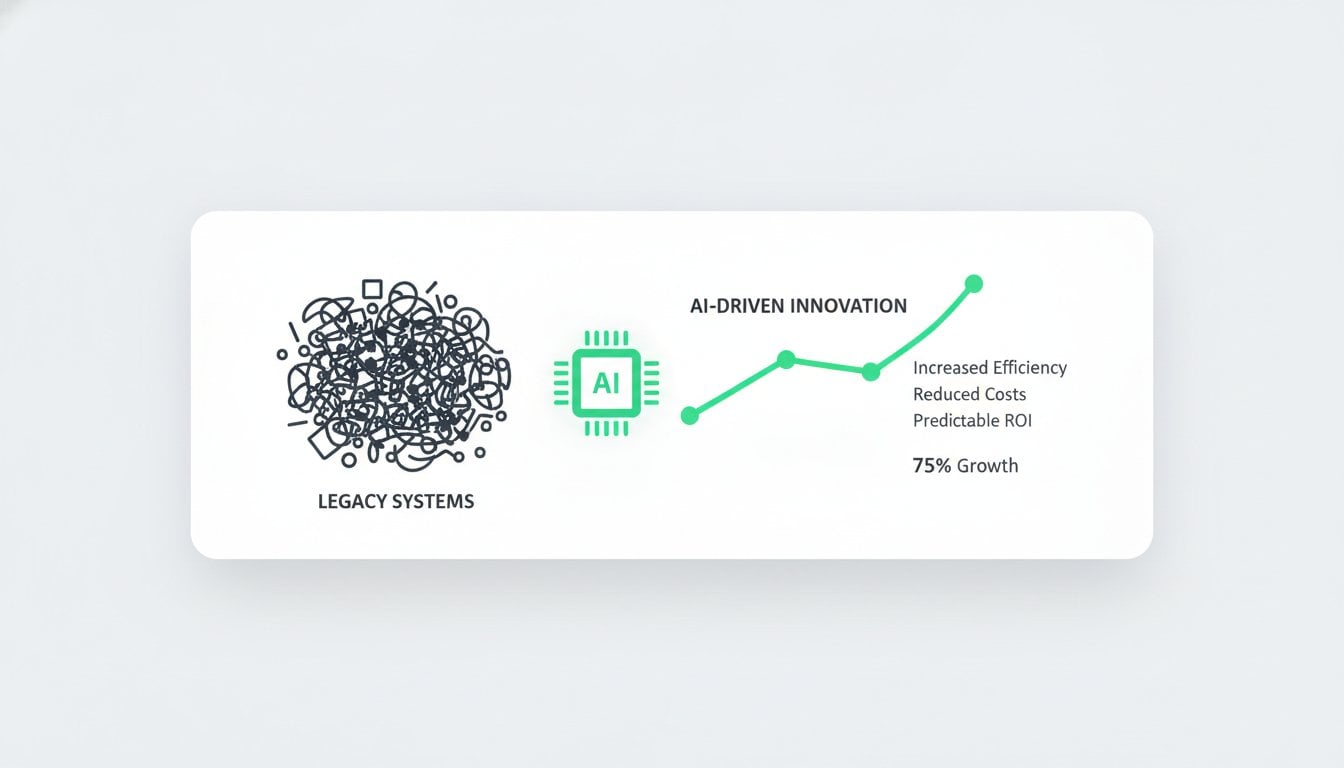
Recent research indicates that 67% of organizations are increasing their investments in generative AI, yet most leadership teams are still drowning in the administrative noise of legacy suggestion boxes. You likely know the frustration of watching high-potential concepts stall because your staff is busy filtering through thousands of duplicate entries. Without high-performance ai driven innovation software, your program risks becoming a cost center rather than a growth engine. It’s an innovation tax that drains resources and kills the momentum necessary for true transformation.
This report shows you exactly how to replace those outdated systems with AI-native platforms that turn organizational creativity into measurable ROI. We’ll demonstrate how 2026’s shift toward agentic workflows allows you to automate the administrative burden of evaluation and accurately predict which concepts will actually move the needle. You’ll learn how to reduce your time-to-market and finally secure the hard data required to prove the financial impact of your innovation programs to the board.
Key Takeaways
- Understand why transitioning from legacy suggestion boxes to an AI-native system is essential for eliminating the administrative bottlenecks that stall enterprise growth.
- Discover how modern ai driven innovation software leverages machine learning to automate the evaluation process and accurately forecast the ROI of new concepts.
- Identify the critical differences between true AI-native platforms and legacy wrappers to avoid technical debt and ensure long-term scalability.
- Master a tactical five-step deployment strategy that integrates AI as a creative partner while maintaining high levels of employee engagement and feedback.
- Learn how to leverage Ideawake AI to drastically reduce manual review time and accelerate the journey from initial concept to market-ready solution.
The Evolution of Corporate Creativity: Why AI Driven Innovation Software is Essential in 2026
Modern enterprise strategy has moved past the era of simply collecting ideas. By 2026, the standard for competitive success is defined by ai driven innovation software. This isn’t just a digital repository; it’s a centralized intelligence system that utilizes machine learning to orchestrate the entire innovation lifecycle from initial spark to market implementation. In the past, organizations relied on digital suggestion boxes that promised engagement but delivered administrative paralysis. These legacy systems lacked the analytical depth to handle high volumes of data, leading to a graveyard of unexecuted concepts. Research from McKinsey indicates that successful AI adoption can deliver a 15% to 20% reduction in operational costs by optimizing how resources are allocated to new initiatives. This shift marks the rise of “Innovation Intelligence,” where data, not intuition, dictates which projects receive funding and focus.
The Failure of Manual Feedback Loops
Manual review processes are the primary cause of innovation fatigue. When managers are forced to sift through thousands of entries, high-potential concepts inevitably get buried in fragmented documents. Research shows that relying on static spreadsheets leads to a significant drop in employee participation due to a lack of timely feedback. We’ve moved beyond the era where post-it notes and manual tallies sufficed. Today’s digital ecosystems must provide instant, automated responses to maintain momentum. Without this speed, the cost of missed opportunities becomes a silent drain on the balance sheet. Organizations that fail to automate these loops find themselves stuck in a cycle of administrative overhead that kills creativity before it can scale.
Bridging the Productivity Gap with Machine Intelligence
The The Evolution of Corporate Creativity is now driven by the ability to bridge the productivity gap. According to the IBM Global AI Adoption Index, organizations use AI to identify complex patterns in market data and internal feedback that human analysts often overlook. This transition allows leaders to move from qualitative guessing to quantitative predictive analytics. By leveraging an AI-native innovation platform, enterprises can reduce the time between idea generation and implementation by over 50%. Machine intelligence doesn’t just sort data; it predicts success. It evaluates the feasibility of a concept against historical performance metrics, ensuring that only the most viable ideas reach the implementation phase. This level of precision is no longer optional for companies aiming to lead their industries in 2026.
Core Capabilities of 2026 AI-Powered Innovation Tools
In 2026, the value of innovation management is no longer measured by the volume of submissions but by the velocity of execution. Modern ai driven innovation software has evolved from a passive database into an active collaborator that handles the complex processing of unstructured data. The Ideawake AI approach specifically targets the elimination of administrative overhead, allowing innovation leaders to shift their focus from clerical sorting to high-level strategy. By utilizing specialized AI tools for innovation managers, organizations can now automate the transition from raw ideation to a fully validated business case. This shift ensures that creativity is never stifled by the weight of its own success.
Automated Idea Deduplication and Clustering
Redundant submissions are a primary drain on enterprise resources. Semantic clustering allows the system to recognize the underlying intent and context of an idea, regardless of the specific terminology used by the submitter. If a technician in a manufacturing plant and a project manager in the corporate office propose similar workflow optimizations, the software identifies the overlap instantly. This capability prevents redundant work and provides a unified “big picture” of emerging organizational trends. Administrators can save hundreds of hours annually by removing the need to manually merge duplicate entries. It keeps the pipeline clean and ensures that high-potential concepts aren’t lost in a sea of repetition.
Predictive Scoring and Sentiment Analysis
These capabilities represent a massive leap forward for organizations tired of seeing great ideas stall in the evaluation phase. If you’re ready to see how these automated features can streamline your specific workflow, you might want to book a free demo to explore the platform’s full potential.
Evaluating the Landscape: AI-Native Platforms vs. Legacy Wrappers
Buyers often mistake a shiny interface for a robust engine. In 2026, the market for ai driven innovation software is split between platforms built for machine learning and legacy tools desperately bolting on third-party APIs. This architectural distinction is the difference between a system that actually understands your business and one that simply summarizes text. When evaluating vendors, you must decide whether to build or buy idea management software. While internal builds offer customization, they often lack the sophisticated, pre-trained models required to manage the full innovation lifecycle effectively. Modern architecture isn’t just a preference; it’s a requirement for organizations that refuse to settle for average results.
Use this checklist to evaluate vendor claims about their machine learning capabilities:
- Contextual Awareness: Does the AI have access to your full historical database, or is it just processing individual submissions in isolation?
- Explainable AI: Can the system explain why a specific idea received a high priority score?
- Data Freshness: Is the model updated in real time as new feedback enters the system?
- Security: Is the ai driven innovation software hosted in a private, SOC2-compliant environment that protects your intellectual property?
The Hidden Cost of “AI-Lite” Features
Be wary of “AI-Lite” features. These are typically legacy wrappers that add a ChatGPT window to a system still running on rigid, relational databases. These structures can’t provide the deep context AI needs to generate meaningful insights. It’s essentially putting a modern coat of paint on a crumbling foundation. For a clear look at why these outdated methods fail, consider the Ideawake vs spreadsheets comparison. Modern platforms use vector databases to connect disparate data points, creating a living map of your organization’s creative potential. Don’t let a superficial AI integration mask the inefficiency of an obsolete backend.
Real-Time ROI Tracking and Data Governance
Enterprise-grade innovation requires more than just good ideas; it demands accountability. AI-native platforms automate the tracking of a concept from the moment it’s submitted until it hits the bottom line. This level of transparency is only possible when data governance and security are baked into the core. You need a partner that treats your data as a high-value asset, not just a training set for a public model. To secure the necessary budget from the board, innovation managers can use innovation program ROI tracking frameworks to demonstrate the tangible financial impact of their programs. Proving value is easy when your software does the heavy lifting for you.
Strategic Implementation: Deploying AI Innovation Software Without Friction
Deploying ai driven innovation software requires more than a technical installation; it demands a strategic shift toward data-driven decision-making. To ensure a smooth transition, organizations should follow a tactical 90-day plan. First, audit your existing data to identify high-value historical inputs. Second, define clear KPIs, such as a target reduction in time-to-market. Third, integrate the platform with your current enterprise stack, including Microsoft Teams or Slack, to meet employees where they already work. Fourth, configure gamification elements like leaderboards and reward points to maintain high participation rates. Finally, launch a pilot program to refine your predictive models before a full-scale rollout. For a deeper look at how leading organizations are structuring these programs, the 2026 guide to modernizing your idea pipeline with enterprise innovation tools provides a comprehensive framework for execution.
Training the AI on Your Organizational Context
The effectiveness of machine learning depends entirely on the quality of its training data. Contextual AI differs from general-purpose models by learning your specific industry jargon and internal acronyms, which prevents the system from misinterpreting specialized feedback. By feeding historical data into your ai driven innovation software, you improve its predictive accuracy and ensure that recommendations align with your strategic goals. Many organizations struggle with this initial setup, which is why professional implementation services are vital for mapping your existing processes to the new digital ecosystem. This foundational work ensures the software understands the nuance of your business from day one.
The Human-in-the-Loop Model
A common concern among leadership is the fear that AI will replace the human element of creativity. In reality, the most successful enterprises utilize a “Human-in-the-Loop” (HITL) model. In this framework, AI acts as a co-pilot that handles the heavy lifting of deduplication and scoring while humans provide the final qualitative judgment. This balance is critical because while AI excels at identifying patterns, humans are still superior at recognizing the emotional and cultural impact of a concept. Understanding the creativity vs innovation distinction is essential here; AI manages the innovation pipeline, but humans provide the creative spark. This synergy prevents algorithmic bias and ensures that your program remains grounded in real-world feasibility. Organizations looking to generate rapid bursts of cross-functional ideas often complement this model with a structured hackathon framework that feeds directly into the AI-powered pipeline.
Executing this strategy correctly transforms your innovation program from a manual burden into an automated growth engine. If you’re ready to see how a structured rollout can maximize your ROI, you should book a free demo to walk through our proven implementation framework.
Future-Proofing Your Pipeline with Ideawake AI
Selecting the right partner for your innovation journey is a high-stakes decision that determines whether your program flourishes or fades into administrative obscurity. Ideawake is consistently recognized among the top innovation management solutions because it treats machine learning as a foundational architecture rather than a superficial add-on. By 2026, the gap between leaders and laggards is defined by the ability to convert raw employee insights into validated business cases at scale. Our ai driven innovation software provides the infrastructure necessary to bridge this gap, ensuring that every submission is evaluated with the same level of rigor and speed. It’s time to stop settling for average participation and start demanding high-performance results.
End-to-End Lifecycle Management
The true power of the platform lies in its ability to manage the full innovation lifecycle without the manual friction typical of legacy systems. From the initial spark of an idea to the final measurement of financial impact, every phase is optimized by specialized AI features. Automated summaries distill complex proposals into actionable briefs, while trend forecasting identifies emerging opportunities before they become obvious to your competitors. This level of automation ensures that your team focuses on high-value implementation rather than clerical sorting. “Ideawake isn’t just a tool; it’s the operating system for enterprise growth.” This perspective reflects our commitment to providing a comprehensive solution that handles the complexities of modern business transformation.
Scaling from Pilot to Enterprise-Wide Adoption
Flexibility is a non-negotiable requirement for multinational corporations operating in a volatile global market. Whether you’re running targeted hackathon challenges for a specific department or managing a continuous improvement program across twenty countries, the platform scales with you. Multi-language support and global data residency options ensure that your innovation ecosystem remains compliant and accessible to every employee, regardless of their location. This scalability allows you to move from a successful pilot to full enterprise-wide adoption without the technical debt associated with fragmented tools. Organizations that prioritize this level of integration find themselves better equipped to handle the rapid shifts in consumer demand and technological advancement. If you’re ready to see how ai driven innovation software can transform your organization’s creative output, sign up for a demo today and experience the future of enterprise growth.
Capitalize on the Future of Enterprise Innovation
The shift toward 2026’s high-performance standards requires a complete departure from the manual inefficiencies that once defined corporate feedback loops. Organizations that successfully deploy ai driven innovation software gain an immediate advantage by automating the tedious work of idea evaluation and focusing their creative resources on high-impact implementation. You now understand that AI-native architecture and a “Human-in-the-Loop” model create a scalable engine for growth that legacy wrappers simply cannot match. The era of the digital suggestion box is over; the era of Innovation Intelligence has arrived.
Ready to see how AI can transform your innovation pipeline? Book a Demo Today
Frequently Asked Questions
What is AI driven innovation software?
AI driven innovation software is a centralized enterprise platform that uses machine learning to manage the full lifecycle of an idea. Unlike traditional databases, these systems utilize vector search and large language models to understand the context and strategic intent behind every submission. This technology allows organizations to automate the collection, clustering, and initial evaluation of thousands of concepts simultaneously.
How does AI improve idea management compared to traditional software?
AI eliminates the administrative paralysis that typically kills corporate creativity. Traditional tools act as passive suggestion boxes that require manual sorting, often leading to massive backlogs and employee frustration. Modern AI-native platforms automate deduplication and provide instant, constructive feedback to submitters. This shift ensures that high-potential ideas move through the pipeline without getting stuck in human bottlenecks.
Can AI innovation software predict the ROI of a new idea?
Yes, advanced platforms use predictive analytics to estimate financial impact before a project begins. By comparing new submissions against historical success metrics and real-time market data, the software generates an objective feasibility score. This data-driven approach allows leadership to allocate capital with higher confidence, moving away from subjective “gut feelings” toward measurable performance forecasting. Organizations seeking a standardized methodology for reporting these returns can benefit from a dedicated innovation program ROI tracking reference guide aligned with the latest enterprise standards.
Is employee data safe in an AI-powered innovation platform?
Enterprise-grade platforms prioritize security through SOC2 Type II compliant architecture and private data instances. Your intellectual property and employee feedback are never used to train public models. This ensures that sensitive internal data remains within your organizational perimeter while still benefiting from the processing power of modern machine intelligence.
Does AI replace innovation managers or employees?
AI acts as a high-performance co-pilot rather than a replacement for human talent. It handles the low-value, repetitive tasks like tagging and sorting so that innovation managers can focus on high-stakes strategy and implementation. The system empowers employees by providing better tools to refine their concepts, ensuring that human creativity is amplified by machine efficiency.
What are the most important AI features to look for in 2026?
Look for agentic workflows, semantic clustering, and explainable AI scoring. Agentic features allow the system to take proactive steps in the evaluation process, while semantic clustering identifies deep patterns across different departments. Explainable AI is critical because it provides a transparent rationale for why certain ideas were prioritized over others, maintaining trust in the system.
How long does it take to implement an AI-driven innovation platform?
A standard enterprise rollout typically takes approximately 90 days. This timeframe includes auditing your historical data, training the AI on your specific industry jargon, and integrating the software with your existing tech stack. This structured approach ensures the system is fully optimized to provide accurate insights from the moment it goes live.