Category Archives: Innovation Culture

10 Innovative Product Examples That Changed The World And Their Evolution

Innovative Product Examples That Changed The World And Their Evolution

Some products do more than sell well. They change how people live, work, communicate, travel, and make decisions. A truly innovative product solves a real problem, creates new behavior, and often becomes the foundation for more innovation. The best examples are rarely finished on day one. They evolve through better design, stronger infrastructure, lower costs, and wider adoption. Below are 10 innovative product examples that changed the world, along with

Jamen K|
May 13, 2026
Continue Reading

Nike’s Innovation Process: 7 Lessons In Turning Athlete Insight Into Market-Ready Products

Nike Innovation Process

Nike is often described as an innovative brand, but that label can be a little too vague to be useful. Plenty of companies launch new products. What makes Nike worth studying is not just that it creates new things. It is that Nike has built a system for turning athlete insight into products that can survive testing, internal handoffs, manufacturing realities, and commercial pressure. That distinction matters for innovation leaders.

Jamen K|
April 28, 2026
Continue Reading

What AlphaGo Teaches Us About Building Breakthrough Innovation

What AlphaGo Teaches Us About Building Breakthrough Innovation

Ten years later, AlphaGo still matters for a reason that goes beyond AI history. It did not just beat Lee Sedol at Go in 2016. It showed the world that a well-designed system can search a huge possibility space, learn faster than expected, and produce a move experts did not see coming.  That is why AlphaGo remains one of the clearest modern examples of how breakthrough innovation actually happens. Most

Continue Reading

Open Innovation Vs Crowdsourcing Vs Co-Creation

Open Innovation Vs Crowdsourcing Vs Co-Creation

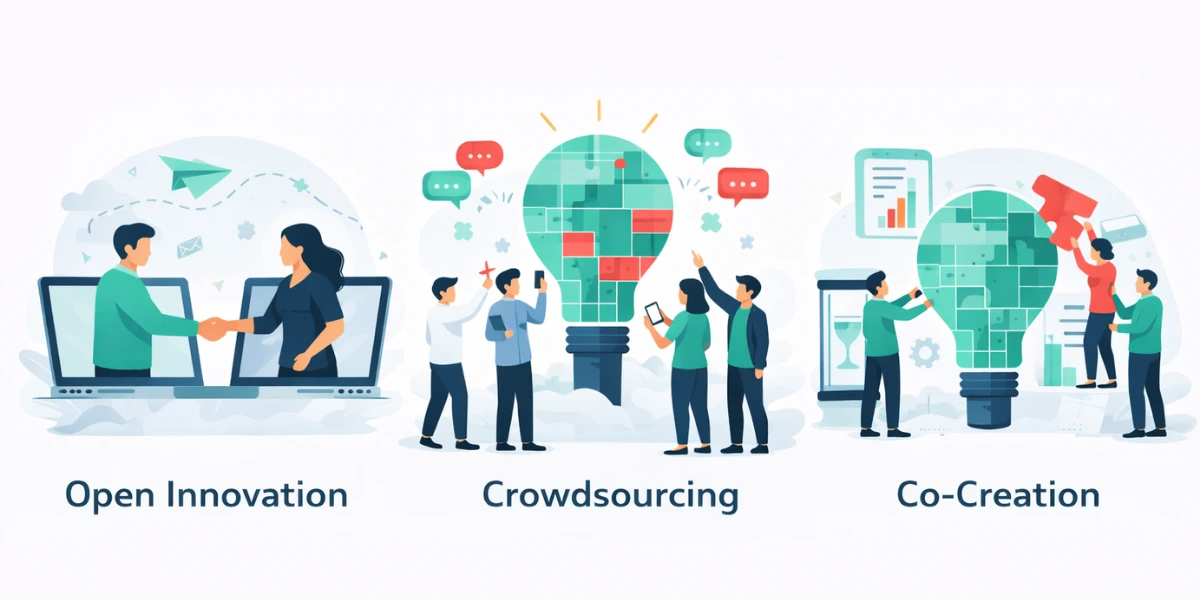
A lot of teams use these three terms as if they mean the same thing. They do not. They overlap, and they can absolutely support the same innovation pipeline, but they solve different problems and require different levels of structure, participation, and follow-through. That distinction matters more than most teams realize. If you choose the wrong model, you can end up with shallow input when you needed real collaboration, or

Jamen K|
April 6, 2026
Continue Reading

What Is Not Invented Here Syndrome And How Does It Impact Innovation Success?

What Is Not Invented Here Syndrome & Innovation Impact

Innovation today is no longer about building everything from scratch. The most successful companies are those that combine internal creativity with external ideas. Yet many organizations still fall into a silent trap that slows growth and limits progress. This trap is known as Not Invented Here syndrome, and it continues to impact innovation success across industries more than most leaders realize. Understanding Not Invented Here Syndrome (NIH) At its core,

Jamen K|
March 26, 2026
Continue Reading

5 Detailed Innovation Challenge Examples & Best Practices

5 Detailed Innovation Challenge Examples & Best Practices

Innovation challenges work for one reason: they create focus. Instead of asking for “any ideas,” you give people a clear problem, a time window, and a reason to participate. That structure turns scattered creativity into actionable proposals your organisation can evaluate and implement. But not every challenge delivers impact. Many generate a burst of activity, a lot of submissions, and then a quiet fade-out where nothing gets implemented. When that

Jamen K|
March 17, 2026
Continue Reading

How To Create An Impactful Innovation Environment

How To Create An Impactful Innovation Environment

Most companies don’t have an innovation problem. They have an environment problem. They hire smart people, host brainstorms, and talk about “thinking outside the box,” yet the same bottlenecks remain. Ideas get stuck in meetings. Employees stop sharing suggestions. And innovation becomes something leadership “wants,” but the organisation doesn’t actually produce. An impactful innovation environment is different. It makes idea-sharing normal, collaboration productive, and implementation predictable. It turns innovation into

Continue Reading

How Value Co-Creation Can Boost Your Innovation Process

How Value Co-Creation Can Boost Your Innovation Process

Most innovation teams don’t have an idea problem. They have a relevance problem. They build solutions in a bubble, then act surprised when adoption is slow, requirements keep changing, or the “big launch” doesn’t land. Value co-creation fixes that by bringing the right people into the innovation process early so you’re not guessing what matters. Co-creation is also one of the fastest ways to reduce innovation risk. You validate assumptions

Jamen K|
March 11, 2026
Continue Reading

Top Innovation Skills For Generating New Ideas At Work

If your organisation wants better ideas, it doesn’t need a once-a-year brainstorming session. It needs repeatable skills that make idea generation a normal part of work. Innovation isn’t “creative people being creative.” It’s a practical capability that teams can build, measure, and improve—just like sales, delivery, or customer support. The good news is that the skills behind strong ideas are learnable, and when you pair them with the right process to implement ideas, you can turn idea flow into real business impact. In this guide, we’ll break down the top innovation skills for generating new ideas, how to develop them inside real teams, and how to move from “good thought” to “implemented improvement” without ideas dying in a spreadsheet. What Innovation Skills Actually Are Innovation skills are the habits and abilities that help people discover opportunities, generate options, stress-test solutions, and turn the best ideas into action. They’re not only about creativity. They’re about thinking clearly, noticing patterns, challenging assumptions, and being willing to test. A lot of organisations accidentally treat innovation like a personality trait. They believe some employees “have it” and others don’t. But in high-performing teams, innovation is built into the operating system. People know what good ideas look like, how to shape them, and how to get them evaluated quickly. When you focus on innovation skills, you stop hoping for lightning strikes. You start building a pipeline of practical improvements and new opportunities that can be prioritised, implemented, and measured. The Discovery Skills That Generate Better Ideas The most reliable way to generate new ideas is to strengthen the skills that help people discover what’s possible. These are the skills that turn daily work into raw material for innovation. When teams practise these skills consistently, they stop waiting for inspiration. They start producing ideas on demand, because they’re trained to spot problems, patterns, and opportunities others miss. Questioning Assumptions The fastest way to generate a new idea is to challenge an old assumption. Questioning is the skill of asking “why” and “what if” in a way that reveals hidden constraints, outdated rules, and opportunities for improvement. In most workplaces, assumptions become invisible. “We’ve always done it this way” becomes a default setting. A strong innovator looks at a process and asks: Why does it exist? What problem did it solve originally? Is that problem still true today? What would happen if we removed this step, flipped the sequence, or redesigned it around a different goal? To build questioning as a team habit, run short “question sprints.” For 10 minutes, the only output is questions. No solutions allowed. The goal is to surface blind spots and reframe the problem before you jump into fixing it. Observing Friction And Patterns Great ideas often come from noticing small things that create big costs. Observation isn’t passive. It’s intentional attention to customer behaviour, frontline realities, and internal workflow friction. People doing the work every day are surrounded by signals—delays, workarounds, repeated complaints, broken handoffs, confusing tools. The best innovators train themselves to spot patterns: What gets repeated? Where does time disappear? Where do mistakes cluster? What do customers struggle with over and over? A simple practice is keeping an “observation log” for one week. Every time you hit a friction point, write it down. Don’t fix it yet. Just record what happened, what you had to do to work around it, and what the impact was. If you want extra fuel for this, use frontline insights to get ideas consistently from the people closest to the work. Associating Disparate Concepts Some of the most valuable ideas are combinations. Associating is the ability to connect two things that don’t normally belong together and produce something new. It’s how teams create breakthrough improvements, not by inventing from scratch, but by borrowing patterns from other industries, other departments, or other parts of life. Think of associating as “pattern transfer.” A team might take a concept from ecommerce and apply it to internal procurement. Or take a concept from customer success and apply it to employee onboarding. You can train associating with a simple exercise: pick a current challenge, then force connections with unrelated prompts. “How would a restaurant solve this?” “How would a hospital solve this?” “How would a logistics company solve this?” Those comparisons unlock creative constraints and fresh options. Networking For Better Inputs Ideas get stronger when inputs get broader. Networking isn’t about collecting contacts. It’s about exchanging perspectives with people who see the world differently. Many organisations become idea echo chambers, where teams talk only to their own function and validate their existing assumptions. When employees regularly talk to sales, support, finance, operations, and product, they discover new angles. They also find hidden constraints early, which makes ideas more implementable. A practical habit: build a “five conversations” routine. Once per month, talk to one person in a different department and ask two questions: What’s one problem you face weekly? What’s one improvement you wish existed? Those conversations become a steady stream of problem statements you can turn into idea campaigns. Experimenting To Refine Innovation isn’t the moment you think of something. It’s the moment you test it. Experimenting is the skill of turning ideas into small, low-risk tests that produce learning quickly. Many ideas fail because organisations demand certainty before action. But certainty is often only available after you try something. Teams that innovate consistently create “micro-experiments.” Short, time-boxed tests with a clear success metric. The point isn’t to prove you’re right. The point is to discover what’s true. If you want better idea generation, encourage people to build the habit of asking: What is the smallest test that would validate or invalidate this idea? When experimentation becomes normal, people generate more ideas because the cost of trying decreases. The Modern Skills That Turn Ideas Into Action Discovery skills generate options. Modern innovation skills help teams shape those options into decisions and outcomes. This is where many organisations stall: they collect ideas, but they don’t build the capability to select and implement the best ones. When you develop these skills, you don’t just get more ideas—you get more results. You also protect the organisation from idea overload, because you gain a clear way to converge on what matters. Divergent And Convergent Thinking Innovation requires two gears: expand and narrow. Divergent thinking generates a wide range of options. Convergent thinking selects the best option based on criteria. If you only diverge, you end up with endless brainstorming and no decisions. If you only converge, you become conservative and incremental. High-performing teams intentionally separate these phases. They create space to generate ideas, then switch into evaluation mode with a scorecard. This prevents the classic problem of killing ideas too early or keeping too many alive too long. A simple team practice is a “20-3-1.” Generate 20 ideas quickly. Choose the best 3 based on criteria. Then design 1 experiment to validate the top idea. This rhythm keeps creativity practical. Empathy And Active Listening Most “new ideas” aren’t new. They’re better solutions to old frustrations. Empathy is the ability to understand what someone is experiencing—customers, employees, partners—and to translate that experience into a clear problem worth solving. Active listening is the method that makes empathy useful: asking follow-ups, reflecting back what you heard, and focusing on the real pain point. If your organisation wants better ideas, it should spend less time guessing and more time listening. A few customer interviews can produce more valuable ideas than a full-day workshop. Inside the workplace, active listening also helps teams innovate across departments. Instead of arguing about opinions, people clarify needs and constraints. That makes ideas stronger and less political. Problem Framing And Critical Thinking A well-framed problem is half solved. Critical thinking helps teams identify root causes, avoid shallow fixes, and separate evidence from assumptions. Many “ideas” fail because they solve a symptom instead of the underlying issue. Problem framing is the skill of turning a messy situation into a clear statement: who is affected, what is happening, when it occurs, why it matters, and what success would look like. One of the simplest tools is the “five whys,” but the real value is in how you use it. Don’t ask “why” to blame someone. Ask “why” to find leverage points. When teams frame problems well, idea generation becomes easier because the target is clear. Storytelling And Influence The best idea can still lose if it can’t be communicated. Storytelling is not fluff. It’s the skill of explaining a problem and a solution in a way that creates clarity and buy-in. When an idea is vague, people reject it. When an idea is specific, tied to impact, and easy to understand, it gets traction. Good idea storytelling includes: the problem, the impact, what’s changing, who benefits, what it costs, and how success will be measured. It’s essentially a mini business case. When teams develop storytelling, idea evaluation becomes faster because decision makers don’t have to “translate” proposals. They can assess them directly. Collaboration That Improves Ideas Ideas rarely start perfect. They become valuable through refinement. Collaborative innovation is the skill of inviting input, responding to feedback, and improving the idea without turning the process into a debate. When collaboration works, ideas evolve into stronger versions of themselves. The key is to structure collaboration. Ask for specific feedback: “What risks do you see?” “What would make this easier to implement?” “What data would increase confidence?” That keeps the conversation productive and focused on merit. This also increases engagement. When people see that their feedback improves outcomes, they participate more. Data-Informed Thinking Innovation is not a popularity contest. Data-informed thinking helps teams evaluate ideas based on evidence: impact estimates, effort, cost, cycle time reduction, quality improvement, revenue potential, risk reduction. You don’t need perfect data. You need enough to compare options. If your organisation struggles with idea overload, add a few consistent metrics. For example: expected value, time to implement, complexity, and confidence level. That alone improves decision quality. When teams get comfortable using simple metrics, they generate better ideas because they understand what decision makers value. How To Build These Skills Inside Real Teams Innovation skill-building doesn’t require a new department. It requires routines. If you want idea generation to increase, you need repeated practice in small doses. Make it easy, predictable, and integrated into work. That’s how you avoid innovation becoming “extra work” that fades away. One practical approach is a weekly 30-minute idea rhythm. Rotate through the discovery skills: one week is questioning, one week is observation, one week is association, one week is experiments. Keep it short and consistent. To make this even easier to run at scale, many teams turn the rhythm into a structured idea challenge so participation stays high and focus stays tight. Then add a monthly “convergence” session where you evaluate the best ideas with a scorecard and decide what moves forward. This creates trust, because people see ideas progress instead of disappearing. Over time, the culture shifts. Employees start noticing opportunity naturally, because they know there’s a pathway for action. Turning Skills Into A Repeatable Idea Pipeline Many companies have talented people with strong innovation skills, but they still struggle because the system doesn’t support follow-through. Without a clear process, ideas pile up, decisions slow down, and participation drops. A simple idea pipeline keeps innovation organised and measurable. It also protects idea quality, because ideas get refined before they are judged. Start with five stages: capture, collaborate, evaluate, implement, measure. Each stage should have ownership, criteria, and an expected response time. That’s what prevents the “idea graveyard” problem. When employees trust the process, they contribute more. When decision makers trust the evaluation method, they approve faster. And when implementation is visible, the organisation builds momentum. How Ideawake Helps Teams Generate And Implement Better Ideas Ideawake is built for organisations that want to increase idea flow and turn the best ideas into measurable outcomes—without wasting time managing chaos. First, it supports targeted idea generation through challenges. That helps teams practise questioning and observation around real priorities, instead of collecting random suggestions that are hard to evaluate. Next, it enables collaboration and refinement so ideas improve before decision makers review them. Instead of judging rough drafts, reviewers get stronger proposals with clearer impact and feasibility. This is also how teams hit growth targets faster, because employee creativity stops being a vague goal and becomes a repeatable input to performance. Then, it supports structured evaluation with custom criteria and stakeholder input. That makes convergent thinking practical. Teams can compare ideas consistently, prioritise based on what matters, and reduce politics in the decision process. After that, it helps with implementation by assigning ownership and tracking progress. This is where many innovation efforts fail: ideas get approved, then disappear. A visible workflow keeps execution moving. Finally, it closes the loop with measurement. When organisations can track engagement and impact, they can prove ROI, improve program health, and keep participation high. In other words, Ideawake doesn’t just help people generate ideas. It helps organisations build the skills and system to make ideas happen. Frequently Asked Questions What Are The Most Important Innovation Skills For Generating New Ideas? The core skills are questioning assumptions, observing patterns and friction, associating unrelated concepts, networking for diverse input, and experimenting to refine ideas quickly. These skills consistently produce higher-quality ideas. Can Innovation Skills Be Taught To Employees? Yes. Innovation skills are behaviours and habits that improve with practice. Short routines like question sprints, observation logs, and micro-experiments build capability across teams. What Is The Difference Between Creativity And Innovation? Creativity is generating possibilities. Innovation is turning possibilities into value. Innovation requires evaluation, prioritisation, implementation, and measurement—not just ideation. How Do You Encourage Employees To Generate More Ideas? Make it safe to share, make it easy to contribute, and create visible follow-through. Participation rises when people see ideas evaluated quickly and implemented consistently. How Do You Choose Which Ideas To Implement First? Use clear criteria like value, effort, time-to-impact, risk, and confidence. A consistent scorecard makes decisions faster and reduces bias. How Do You Measure Innovation In The Workplace? Track participation rate, time-to-first-feedback, time-in-stage, implementation rate, and outcomes like cost saved, revenue gained, cycle time reduced, or customer satisfaction improvements. What Causes Idea Programs To Fail? Common causes include no clear evaluation process, slow feedback, lack of ownership for implementation, and poor visibility into what happens after submission. When ideas disappear, engagement collapses. Do You Need Software To Run An Innovation Program? Not always, but spreadsheets and basic forms typically struggle with scale, transparency, collaboration, prioritisation, and measurement. A structured platform helps keep idea flow organised and measurable. Make Idea Generation A Competitive Advantage The organisations that win aren’t the ones with the most creative brainstorms. They’re the ones that build innovation skills across teams and pair those skills with a clear process for execution. If you want better ideas, start by practising discovery skills consistently. If you want more impact, build the pipeline that turns ideas into outcomes. That’s how innovation becomes a repeatable advantage, not a random event. When you’re ready to scale idea generation and implementation across your organisation, Ideawake helps you capture, evaluate, implement, and measure ideas in a way that’s simple, fast, and ROI-focused.

If your organisation wants better ideas, it doesn’t need a once-a-year brainstorming session. It needs repeatable skills that make idea generation a normal part of work. Innovation isn’t “creative people being creative.” It’s a practical capability that teams can build, measure, and improve—just like sales, delivery, or customer support. The good news is that the skills behind strong ideas are learnable, and when you pair them with the right process

Jamen K|
March 4, 2026
Continue Reading

Innovation Goals For Business Leaders (With Examples + KPIs)

Innovation Goals for Leaders:

Innovation is one of those words that sounds great in boardrooms and town halls, but gets fuzzy the second you ask, “What exactly are we trying to achieve?” If your innovation goal is “be more innovative,” you don’t have a goal. You have a slogan. Real innovation goals are tied to business outcomes you can measure. They shape what ideas you collect, how you evaluate them, what you implement, and

Jamen K|
February 23, 2026
Continue Reading