
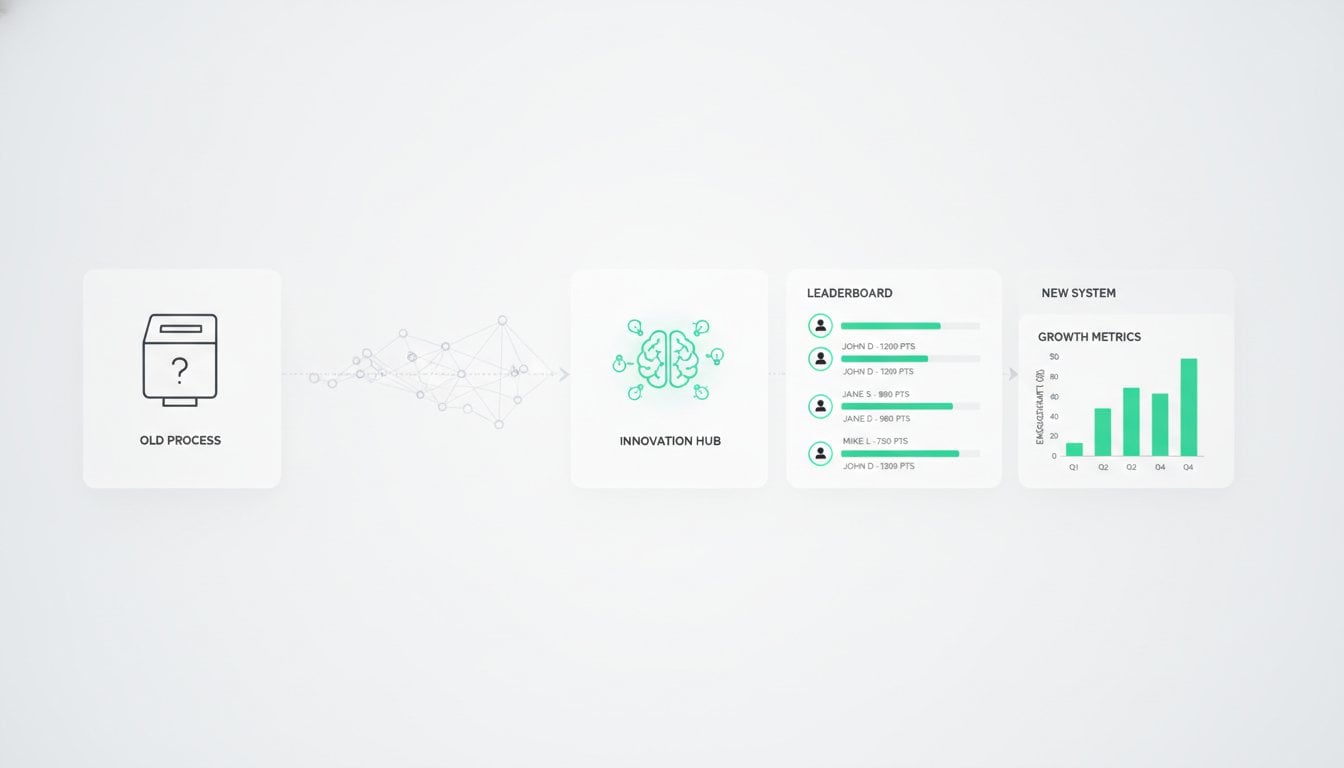
Recent research indicates that 90% of employees report that gamification makes them more productive at work, yet many leaders still struggle to implement effective gamification for employee engagement that actually moves the needle. You’ve likely felt the frustration of launching a challenge only to be met with silence or low-quality submissions that don’t solve core business problems. It’s difficult to justify the budget when you can’t link participation directly to financial growth. We know that burnout is real and traditional suggestion boxes are dead.
This guide will show you how to leverage behavioral psychology and gamified mechanics to transform passive staff into active innovators who drive measurable ROI. We’ll provide a structured framework for generating higher quality ideas and the clear metrics needed to prove the financial impact of your initiatives. It’s time to stop guessing and start building a culture where innovation is a high-performance habit rather than a one-off event.
Key Takeaways
- Understand how a centralized hub for crowdsourcing ideas replaces outdated suggestion boxes to build a high-performance culture.
- Learn how to apply Self-Determination Theory and the “Goldilocks zone” of rewards to optimize gamification for employee engagement.
- Discover a two-stage framework for gamifying the entire innovation lifecycle, from initial ideation to “Shark Tank” style evaluations.
- Identify critical data points like idea velocity and participation rates to prove the financial impact of your engagement initiatives.
- Explore how AI-driven insights and automated workflows reduce administrative friction while maximizing the quality of idea submissions.
What is a Gamified Innovation Platform? Defining the 2026 Standard
A gamified innovation platform functions as a centralized hub for managing idea crowdsourcing and evaluation at an enterprise scale. By 2026, these systems have moved beyond the “engagement theater” of previous years, specifically addressing the disengagement peak seen in 2022 where traditional methods failed to connect remote and office-based staff. High-performance cultures now rely on these platforms to transform passive feedback into a transparent, competitive environment where every contribution is tracked and valued. Unlike the static suggestion boxes that often lead to “idea graveyards” due to lack of feedback, a modern platform provides real-time visibility into the innovation process, ensuring that no valuable insight is lost in administrative silos.
To build a successful strategy, leaders must first understand What is Gamification? in a professional context. It’s not about turning the office into a playground or trivializing serious work; it’s the strategic use of game-design elements to solve complex business problems. Implementing gamification for employee engagement allows organizations to lower the psychological barriers that prevent staff from sharing high-stakes insights or challenging the status quo. By distinguishing between “play” as a mindset and “mechanics” as a tool, you can create a system that rewards meaningful progress and expert-level contributions rather than just superficial activity.
The Core Mechanics of Engagement
Why Enterprise Innovation Needs Structure
Engagement without alignment is a drain on resources. A structured employee suggestion program ensures that every challenge is tied to a specific KPI or strategic goal. Modern architecture reduces the administrative burden of managing thousands of ideas by using automated workflows to filter concepts. This structure is vital because the innovation lifecycle represents the entire journey from raw concept to implemented ROI, requiring a clear path for every submission to ensure it reaches its full potential.
The Psychology of Participation: Why Gamification Drives Results
Gamification isn’t a gimmick. It’s a calculated response to human psychology. While most engagement strategies fail because they treat employees like cogs in a machine, effective gamification for employee engagement leverages Self-Determination Theory (SDT) to tap into what actually drives human behavior. SDT suggests that for people to be truly motivated, they need to feel three things: autonomy, competence, and relatedness. A gamified platform satisfies these needs by giving staff the freedom to choose which challenges to tackle, the tools to master the innovation process, and a shared space to connect with their peers.
The key to long-term success lies in finding the “Goldilocks zone” between intrinsic and extrinsic motivation. Extrinsic rewards like prizes or points are excellent for sparking initial interest, but they can’t sustain a culture alone. If rewards are too high, people focus only on the prize; if they’re too low, the effort feels wasted. High-performance organizations use gamified mechanics to supplement intrinsic purpose, ensuring that the act of innovating is as rewarding as the recognition that follows. Research from 2026 shows that 72% of employees state that gamification inspires them to work harder because it makes their contributions visible and meaningful.
We also utilize the “Endowed Progress Effect” to maintain momentum. This psychological principle proves that people are more likely to complete a task if they feel they’ve already made a head start. By showing an employee they are already 20% finished with a challenge just by logging in or completing a profile, you drastically reduce the friction of the “blank page.” When combined with social proof, where seeing a colleague’s success triggers a desire to participate, you create a self-sustaining engine of adoption across the entire enterprise.
Tapping into Intrinsic Motivation
True engagement happens when you empower employees by giving them a direct voice in company strategy. Using idea crowdsourcing builds a powerful sense of belonging that traditional top-down management cannot replicate. There is a profound psychological impact when a staff member sees their raw concept move through the pipeline to actual implementation. It transforms their relationship with the company from a simple paycheck to a shared mission. If you want to see how this looks in practice, you can book a free demo to explore the platform architecture.
The Feedback Loop as a Reward
Instant feedback is significantly more motivating than a yearly bonus that arrives months after the effort was exerted. Gamified platforms use automated status updates to keep the “dopamine hit” consistent, ensuring employees don’t feel their ideas have fallen into a black hole. Peer recognition, such as “likes” and comments on a submission, provides immediate social validation. This real-time loop keeps the workforce focused and eager to contribute to the next challenge.
Gamifying the Innovation Lifecycle: From Submission to ROI
Gamification for employee engagement is frequently misapplied as a tool for general HR tasks like attendance or wellness. In a high-performance enterprise, however, it serves as the primary engine for the innovation lifecycle. This journey requires more than just a place to post ideas; it needs a structured path that guides a concept from a raw submission to a measurable return on investment. By gamifying each transition point, organizations can eliminate the “innovation valley of death” where good ideas typically go to die due to lack of momentum. This structured approach ensures that participation leads directly to business outcomes rather than just vanity metrics.
The lifecycle consists of four distinct stages. Stage 1 is Ideation, where challenges and hackathons spark initial creativity. Stage 2 focuses on Evaluation, turning the review process into a competitive, transparent ranking system. Stage 3 is Implementation, where the real work of development is recognized and rewarded. Finally, Stage 4 is Measurement, which tracks the long-term success of projects to prove financial impact. Each stage uses specific mechanics to ensure that the workforce remains focused on high-value problems rather than low-impact suggestions.
Innovation Challenges and Hackathons
Stage 1 relies on creating a sense of urgency. Instead of a permanent suggestion box that employees eventually ignore, leaders should set time-bound goals. Using prize dynamics—where rewards are scaled based on the complexity of the problem—attracts diverse talent from different departments who might not otherwise collaborate. For organizations looking to execute intensive, high-impact events, our Hackathon: The 2026 Enterprise Guide provides the necessary framework for success. These events move the needle by forcing teams to prototype and validate ideas in a high-energy environment.
Collaborative Evaluation Mechanics
Stage 2 addresses the “messy middle” of innovation. Traditional review boards are often slow and prone to internal bias. Gamifying the idea evaluation process through crowdvoting or prediction markets allows the “wisdom of the crowd” to rank the most promising concepts. This “Shark Tank” style review process keeps subject matter experts engaged by turning the evaluation task into a transparent, visual ranking system. It builds trust because employees can see exactly why an idea was moved forward or archived, maintaining the integrity of the gamification for employee engagement strategy. This transparency is what separates 2026 high-performance cultures from the opaque management styles of the past. For a complete technical blueprint on structuring these challenges at scale, the internal innovation challenge platform enterprise launch template provides a repeatable, automated system for leaders tasked with delivering documented financial impact.
Measuring Success: Data-Driven KPIs for Gamified Engagement
Stop treating engagement like an abstract sentiment. In a high-performance culture, engagement is a measurable asset that directly impacts the bottom line. While competitors often cite vague profitability increases, we focus on the hard data that proves your strategy is working. The first baseline is your participation rate. Companies implementing gamification see a 36% increase in employee engagement rates on average. This isn’t just about log-ins; it’s about the percentage of your workforce actively contributing to challenges and peer reviews. If your participation is stagnant, your mechanics aren’t aligned with employee motivations.
The second critical metric is idea velocity. This tracks the speed at which a concept moves from initial submission to the final implementation stage. A slow pipeline is a silent killer of innovation; it signals to employees that their effort doesn’t lead to action. By monitoring velocity, you can identify exactly where bottlenecks occur, whether in the evaluation phase or during technical feasibility checks. We balance this speed with a strict focus on quality vs. quantity. Using standardized scoring rubrics within your gamification for employee engagement strategy ensures that only high-impact concepts receive resources, preventing your team from chasing low-value distractions.
The ROI of Employee Ideation
The true power of a gamified platform lies in its ability to capture “incremental innovation.” These are the small, daily improvements suggested by thousands of employees that, when aggregated, result in massive cost savings or new revenue streams. To move beyond guesswork, you should use our idea management ROI calculator to forecast the potential value of your program based on your specific headcount and industry benchmarks. Beyond the financial wins, you must also track “soft” benefits like improved employee retention and cultural alignment. When staff feel their expertise is recognized through gamified rewards, they are less likely to seek opportunities elsewhere.
Continuous Improvement Metrics
Gamification is the perfect engine for driving the various phases of continuous improvement. It keeps the workforce focused on iterative gains rather than waiting for a single “eureka” moment. By analyzing engagement data, you can see which departments are leading the charge and which require more support or better-defined challenges. Reporting these successes to stakeholders becomes a seamless process with automated analytics that link participation directly to project milestones. If you are ready to see how data-driven mechanics can transform your organization, book a free demo to explore our reporting suite.
The Ideawake Advantage: Modern Gamification for High-Performance Cultures
Choosing the right platform is the difference between a failed experiment and a transformative business engine. Ideawake provides a specific advantage by combining AI-driven insights with intuitive mechanics that actually lower the barrier to entry for your staff. Most tools focus on the “fun” of badges, but we prioritize a “relevance-first” approach. This ensures every interaction is tied to a strategic goal, reducing the administrative complexity that often kills large-scale initiatives. Whether you’re managing a small team of 50 or a global enterprise with thousands of users, the platform scales to meet your specific security and workflow requirements.
Our approach to gamification for employee engagement isn’t just about rewards; it’s about reducing the friction of innovation. By automating the “messy” parts of the process, your leadership team can focus on implementation rather than spreadsheet management. This efficiency is why 70% of Global 2000 companies now use some form of gamification to stay competitive. We don’t just provide software. We provide a high-performance partnership that ensures your innovation program produces tangible, data-backed results.
AI-Enhanced Innovation
The integration of Ideawake AI is a game-changer for maintaining long-term momentum. One of the biggest killers of engagement is “submission fatigue,” where employees feel overwhelmed by the effort required to draft a proposal. Our AI assists users in refining their ideas in real-time. This improves the quality of submissions before they even reach a reviewer. Additionally, the system uses automated feedback loops to keep the gamified engine running 24/7. It categorizes and scores ideas based on your specific criteria, providing instant validation that acts as a psychological reward. This ensures your gamification for employee engagement strategy remains active even when your managers are offline.
Getting Started with Gamified Innovation
Many organizations face the “Build vs Buy” debate when considering new tech. While custom development seems attractive, the ongoing maintenance and lack of specialized features often lead to failure. We recommend reviewing the pros and cons in our guide on build vs buy idea management software to see why a purpose-built platform is more cost-effective. A typical implementation timeline takes about 90 days to see full cultural adoption. During the first month, we focus on setting your strategic challenges; by day 60, your evaluation mechanics are live; and by day 90, you’re tracking implemented ROI. Stop settling for average participation. Start driving high-impact innovation. To see the platform in action, sign up for a free trial or book a personalized demo today.
Building a High-Performance Innovation Engine for 2026
The shift toward high-performance cultures requires more than just better tools; it requires a fundamental understanding of human motivation. By leveraging gamification for employee engagement, organizations can bridge the gap between passive ideation and implemented ROI. We’ve explored how behavioral psychology drives participation and why a structured innovation lifecycle is essential for capturing high-value concepts. The data is clear: when you align game mechanics with business objectives, you don’t just increase participation; you accelerate growth.
Ideawake is trusted by global enterprises to manage thousands of ideas through a modern architecture designed for 2026 performance standards. With built-in ROI tracking and AI-driven evaluation, the platform removes the administrative friction that typically stalls innovation initiatives. It’s time to move past outdated suggestion boxes and embrace a system that turns every employee into a potential innovator. Your organization’s next breakthrough is already sitting in the minds of your workforce, waiting for the right framework to bring it to life.
Ready to see how gamification can drive your innovation ROI? Sign up for a demo of Ideawake today.
The potential within your workforce is massive. Let’s start building your future together.
Frequently Asked Questions
What is the difference between gamification and playfulness in the workplace?
Gamification is the strategic application of game-design elements to non-game contexts to drive specific, measurable business results. Playfulness is a general mindset or attitude that lacks a structured framework or defined goals. While playfulness might improve office morale, gamification provides the rigorous architecture needed to track participation and ensure that employee efforts lead to tangible outcomes like higher quality idea submissions.
Can gamification actually improve long-term employee engagement?
Research indicates that gamification sustains commitment by tapping into intrinsic motivators like autonomy, mastery, and purpose. Effective gamification for employee engagement creates a continuous feedback loop that makes individual contributions visible across the organization. This prevents the “engagement cliff” typical of one-off initiatives by ensuring employees feel a sense of progress as their concepts move from submission to implementation.
What are the most effective gamification mechanics for innovation?
Innovation thrives on collaborative mechanics such as time-bound challenges, hackathons, and prediction markets. These tools utilize the “wisdom of the crowd” to evaluate and rank concepts based on their potential impact. Unlike standard leaderboards that reward individual tasks, innovation-focused mechanics prioritize peer review and cross-departmental collaboration to ensure the most promising ideas receive the resources they need to succeed.
How do I prevent “gaming the system” in a leaderboard-based platform?
You prevent system abuse by shifting the focus from submission volume to submission value through weighted scoring and expert validation. Points shouldn’t be awarded for the quantity of ideas alone; instead, reward participants when their ideas pass through specific evaluation gates. Implementing a “relevance-first” approach ensures that only ideas aligned with strategic company challenges earn high-tier rewards, discouraging low-effort participation.
Does gamification work for remote and hybrid teams?
How do I calculate the ROI of a gamified innovation program?
ROI is calculated by linking implemented ideas to specific financial outcomes like cost reductions, process efficiencies, or new revenue streams. You should also factor in “soft” ROI metrics such as improved employee retention and reduced administrative overhead. A data-driven approach to gamification for employee engagement allows you to track the exact journey of an idea from a raw concept to its final financial impact.
What kind of rewards work best for employee suggestion programs?
The most effective programs balance extrinsic prizes with intrinsic recognition. While tangible rewards like bonuses or gift cards can spark initial interest, employees are often more motivated by seeing their ideas implemented or receiving professional development opportunities. Recognition badges that highlight specialized expertise also play a critical role in identifying high-performers and fostering a culture where mastery is valued as much as the result.
Is gamification suitable for highly regulated or conservative industries?
Gamification is highly effective in regulated sectors because it provides a transparent and auditable trail of the entire innovation process. It adds a layer of structure that traditional brainstorming lacks, ensuring that all ideas are evaluated against strict compliance and feasibility criteria. This methodical approach allows conservative organizations to innovate safely while maintaining the high levels of accountability required by their specific industry standards.