
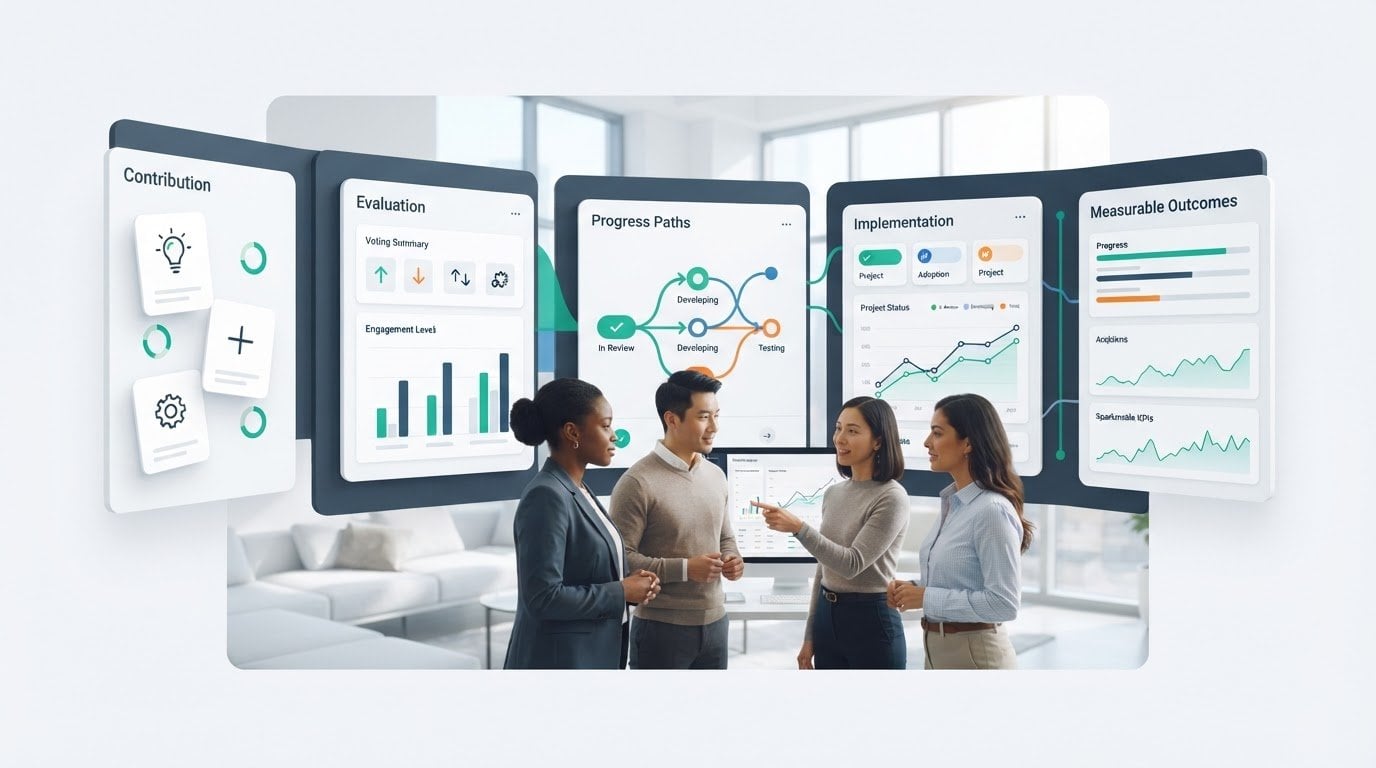
What if the best measure of gamification isn’t how many people earn points, but how many ideas make it into practice? Gamification innovation software can make it easier to contribute, but points and prizes alone won’t show whether an idea is useful or what happens after submission.
Organizations often face the same challenges: participation fades, contributors don’t hear how their ideas progress, and activity metrics look healthy without showing business impact. The answer isn’t to remove game mechanics. It’s to connect them to a clear innovation process, so recognition encourages meaningful contributions and helps ideas move forward.
This article explains how to evaluate gamification innovation software, choose mechanics that fit your goals, and assess engagement alongside idea quality and realized value. You’ll also learn what to look for in a platform that connects idea submission, evaluation, implementation, and outcome tracking. The goal is to reward participation in ways that support progress, not just leaderboard activity.
Key Takeaways
- Evaluate gamification innovation software by how well it supports idea progression, not just participation and rewards.
- Use voting to surface interest, then apply clear evaluation criteria to guide decisions.
- Compare platforms on workflow coverage, reporting, evaluation tools, and administrative effort.
- Set transparent rules for eligibility, ownership, and follow-up before launching a challenge.
- Track engagement alongside idea quality, implementation progress, and outcomes to understand what the program achieves.
What Gamification Innovation Software Does Beyond Points and Prizes
Gamification innovation software applies game mechanics, such as voting, recognition, or rewards, to a structured process for submitting, evaluating, and advancing ideas. Gamification can make participation more engaging, but it isn’t the innovation workflow itself. A contest may attract entries; a complete program also clarifies how ideas are reviewed, selected, implemented, and followed up. The broader concept of gamification covers game-design techniques used outside games. In an innovation program, those techniques should support progress toward a business question, not become the goal.
Activity and outcomes are different measures. Submission counts, comments, and votes show whether people are participating, but they don’t establish whether ideas are feasible, selected, or implemented. To understand a program’s value, assess contributions and track what happens to them after the initial activity.
Which innovation challenges does gamified software address?
Employees may hesitate to contribute when a challenge prompt is unclear, feedback is limited, or their idea disappears after submission. Software can make the process more visible by showing an idea’s status and communicating what comes next, such as discussion, evaluation, or a decision. This helps contributors understand what to expect and gives them a reason to stay involved. Gamification may encourage participation, but it can’t guarantee more ideas or stronger outcomes. Those depend on the challenge, review process, and follow-through.
Which capabilities belong in an innovation software platform?
A useful platform supports distinct stages rather than treating every action as a score. Idea submission captures contributions in response to a defined prompt. Comments let people clarify or build on ideas. Voting can surface interest, while structured evaluation applies consistent criteria. Decision-making identifies which proposals move forward, and implementation tracking records progress after selection.
Leaderboards and prizes are optional participation mechanics. They can recognize contributions, but they shouldn’t replace fair evaluation or give popularity the final say. A highly voted idea, for example, may still need review for feasibility, strategic fit, or expected value. The right innovation management platform connects engagement features to the broader workflow and helps administrators see where ideas stand, who owns the next step, and whether selected ideas are progressing. That’s the difference between rewarding activity and managing innovation.
How Gamification Mechanics Work Across an Innovation Workflow
Consider a challenge asking employees how to reduce delays in a routine process. A gamified program can make each step visible, but the mechanics should serve the work. The prompt gives people a clear focus, submissions capture suggestions, and discussion helps clarify how an idea might work. Reviewers then assess proposals against agreed criteria, make a decision, and communicate what happens next.
Engagement signals show how people interact with a program; validated innovation outcomes show which ideas were selected, implemented, and produced measurable value. This distinction keeps gamification innovation software from mistaking clicks or votes for proof of impact. It also anchors the program in a practical definition of innovation: ideas must progress toward useful change, not simply attract attention.
How do voting, leaderboards, and prizes affect participation?
Voting can reveal which suggestions resonate with peers and help reviewers spot ideas worth examining. It can’t establish feasibility, strategic fit, or business value. Leaderboards offer visible recognition, but set clear rules for what earns recognition and don’t let rankings dictate which ideas advance. Prizes are optional incentives. Use them only when they support the challenge’s purpose and don’t overshadow thoughtful contributions.
How does feedback keep contributors engaged after submission?
A status update can tell a contributor whether an idea is under review, needs clarification, has been selected, or won’t proceed. A brief explanation of the decision adds context and helps make the process credible. Assign someone to review submissions and communicate next steps, so follow-up doesn’t depend on informal reminders. Teams considering a gamified innovation platform can also consider how competition may shape participation while keeping evaluation grounded in consistent criteria.
Keep the mechanics tied to the challenge. If the goal is to improve a process, recognize useful collaboration and thoughtful proposals, not just high submission volume. Then track selected ideas through implementation and review outcomes against the original business question. To see how a platform can support this kind of idea workflow, explore an Ideawake platform walkthrough.
How to Evaluate Gamification Innovation Software Without Rewarding Activity Alone
A platform can generate submissions, votes, and leaderboard activity without helping an organization understand which ideas advance or why. Evaluate gamification innovation software by whether it supports participation and the work that follows: review, decisions, implementation, and measurement. The right fit makes progress visible without treating activity as a proxy for value.
Which engagement and workflow criteria should buyers compare?
Start with the program you plan to run. Check whether the software can present focused challenge prompts, collect submissions, support discussion and voting, and communicate updates. Then consider who needs to participate, whether the process is accessible to those contributors, and how much effort administrators will spend managing activity and follow-up. Choose a platform that fits the stakeholders and formats your organization actually expects to use.
Use a comparison table to assess vendors against the same requirements:
| Criterion | What to assess | Useful question |
|---|---|---|
| Mechanics | Voting, recognition, leaderboards, or prizes | Can mechanics be aligned with program goals? |
| Workflow coverage | Submission through decision and implementation | Can teams see an idea’s status after it’s submitted? |
| Evaluation | Criteria and review steps | Can reviewers assess ideas consistently beyond popularity? |
| Reporting | Participation, progress, and outcomes | Can reports distinguish activity from implementation? |
| Administration | Ownership, updates, and program setup | Can the team manage the process and communicate next steps? |
For a broader selection framework, see this guide on how to choose innovation management software.
How can buyers assess reporting and measurable outcomes?
Ask for a walkthrough of the reporting process, not just a dashboard preview. Can the team distinguish submissions and participation from evaluation progress, decisions, and ideas implemented? Can it record the measures your organization uses to assess results, such as adoption or realized value? Confirm who can access that information and how administrators can follow an idea through its lifecycle.
Keep the measures separate. Participation indicates engagement; evaluation records how ideas fare against criteria; adoption and realized value reflect what happens after a decision. Software can help organize this evidence, but a reported outcome alone doesn’t prove that a leaderboard, prize, or other mechanic caused it. Compare results with your program’s goals and context before drawing conclusions. This helps keep evaluation focused on progress, not just activity.
How to Design a Gamified Innovation Program That Stays Fair and Useful
A fair program starts before anyone earns points. Define the business question, decide how ideas will be handled, and make the rules visible before inviting people to participate. This gives contributors a clear reason to engage and reviewers a consistent basis for decisions. Gamification innovation software can support the process, but program governance determines whether participation leads to useful progress.
How should an organization set challenge goals and participation rules?
Use a focused rollout that connects the challenge to a real organizational need:
- 1. Define the business question. State the problem to solve and what kinds of ideas are in scope. For example, ask for ways to reduce handoffs in a particular process rather than inviting ideas on an undefined topic.
- 2. Set rules before launch. Explain who can participate, what submissions should include, whether and how voting works, and how recognition will be awarded. Publish the review criteria, timeline, and decision owner so contributors know what to expect.
- 3. Launch a focused challenge. Use a prompt that makes the desired contribution clear. Choose recognition mechanics that fit the purpose, and avoid implying that participation or submission guarantees selection or a prize.
- 4. Review consistently. Assign reviewers in advance and apply the stated criteria to submissions. Peer interest may inform review, but it shouldn’t replace evaluation.
- 5. Communicate and learn. Share decisions and next steps, then review both participation and workflow progress. Look at who contributed and how ideas advanced, separately from implementation and realized value.
How can teams review ideas and close the feedback loop?
Before submissions arrive, identify who screens ideas, who evaluates them, and who communicates decisions. Consistent idea evaluation criteria help reviewers explain why a proposal advances, needs clarification, or isn’t selected. Give contributors a status update and a concise explanation, including when the answer is no. Clear follow-up respects the effort people invested and helps them understand how to participate in future challenges.
After the review, check whether the program followed its published rules, whether contributors received updates, and where ideas stand in the workflow. Treat submissions, votes, and comments as participation measures. Track evaluation decisions and implementation separately, then compare results with the business question the challenge was designed to address. This keeps a lively program accountable without claiming that activity alone proves impact.
Where Ideawake Fits in a Gamified Innovation Software Strategy
Once you’ve defined what your program needs from its mechanics, workflow, administration, and measurement, assess platforms against those criteria. Ideawake is one option to consider: its cloud-based innovation management software supports idea capture, evaluation, and implementation, with gamification features to support participation in challenges and other idea programs.
Voting, leaderboards, and prizes can encourage participation, but their value depends on how they fit the broader process. Ideawake supports the innovation lifecycle from initial submission through ROI measurement, helping teams consider not just engagement but also how ideas progress and what results they deliver. For a broader overview of platform capabilities and selection considerations, explore this guide to an innovation management platform.
How does Ideawake connect engagement with idea progression?
Teams can use voting to surface peer interest, leaderboards to recognize participation, and prizes as an optional incentive within an innovation challenge. These mechanics sit alongside idea evaluation and implementation support rather than replacing them. Ideawake also includes AI-driven insights. Organizations can assess how those capabilities fit their review and measurement needs as part of their platform evaluation.
For buyers, the practical question is whether a platform can support the stages their program requires and make progress visible to the people involved. Consider how ideas are captured, how evaluation is managed, and how teams can follow selected proposals toward implementation and ROI measurement. This end-to-end view keeps gamification innovation software focused on advancing ideas, not simply recording activity.
What should teams clarify before evaluating a platform demo?
Bring a real challenge to the conversation. Identify the intended participants, the problem the challenge should address, and the obstacles in your current process. Then ask how the platform could support review ownership, contributor updates, and the outcomes your organization wants to measure. Specific questions make it easier to judge practical fit rather than relying on a feature list.
If the workflow and capabilities align with your requirements, examine how they could support your program in practice.
Turn Engagement Into Ideas That Move Forward
Effective gamification innovation software connects participation to a well-managed idea process. Voting, leaderboards, and prizes can encourage involvement, but they shouldn’t replace clear evaluation, accountable follow-up, or outcome measurement. Track engagement alongside idea quality, implementation progress, and realized value to see whether your program is creating meaningful progress.
Ideawake supports the innovation lifecycle from idea submission through ROI measurement, with gamification features including voting, leaderboards, and prizes. Assess how those capabilities fit your goals, workflows, and contributors, then build a program that makes the next step clear.
Start with one focused challenge, set transparent expectations, and give promising ideas a clear path forward. Your next useful idea could begin with a better invitation to participate.
Frequently Asked Questions
What is gamification innovation software?
Gamification innovation software applies game mechanics, such as voting, recognition, or prizes, to a structured idea process. It can encourage people to participate in challenges and contribute suggestions, while the broader workflow supports reviewing, selecting, and implementing ideas. A leaderboard or reward campaign alone isn’t a complete innovation process. Look for tools that connect participation features to the stages ideas must pass through to produce useful change.
Does gamification improve employee innovation?
Gamification can encourage participation, but it doesn’t guarantee more ideas or better innovation outcomes. Its usefulness depends on a clear challenge, mechanics that fit the goal, and feedback about what happens to submitted ideas. Voting may show which suggestions attract interest, for example, while reviewers still need to assess feasibility and value. Judge the program by engagement and idea progress, not activity counts alone.
Which gamification features should innovation software include?
Choose features that suit your workflow rather than selecting mechanics for their novelty. Useful capabilities may include challenge prompts, idea submission, discussion, voting, and status updates, supported by evaluation and implementation tracking. Leaderboards and prizes can provide optional recognition, but they shouldn’t replace consistent review criteria. Reporting should distinguish participation from decisions and implemented ideas, while administration tools should make it practical to manage reviews and communicate next steps.
Can leaderboards make an idea program less fair?
Yes. Leaderboards can make a program feel less fair if rankings determine which ideas advance or reward only visible activity. Popularity may reflect peer interest, but it doesn’t establish feasibility, strategic fit, or business value. Set clear rules for what the leaderboard recognizes, explain how votes will be used, and keep idea evaluation separate. Reviewers should apply consistent criteria so quieter contributors and less widely supported ideas still receive appropriate consideration.
How do you measure ROI from gamified innovation software?
Measure ROI by tracking selected ideas through implementation and assessing their results against the organization’s chosen business measures. Keep that evidence separate from engagement indicators such as submissions, comments, or votes. A high vote count shows interest, not realized value. Define how outcomes will be recorded before launching the program, and avoid assuming that a software report proves a game mechanic caused a business result.
Is gamification software the same as idea management software?
No. Gamification describes the use of mechanics such as voting, leaderboards, and prizes to encourage participation. Idea management software supports capturing and evaluating ideas, and may also help teams follow them toward implementation. A platform can include both, but the terms describe different things: one refers to engagement techniques, the other to managing ideas. Assess whether the software connects those mechanics to the workflow your program needs.
How do you choose gamification innovation software?
Start by defining the challenge, intended participants, and steps ideas must follow from submission through decision and implementation. Then compare gamification innovation software on workflow coverage, evaluation, contributor updates, reporting, and administrative effort. Ask how it separates engagement metrics from implemented ideas and realized value. A practical demonstration using a real challenge can help your team assess whether the mechanics and workflow fit its goals.