
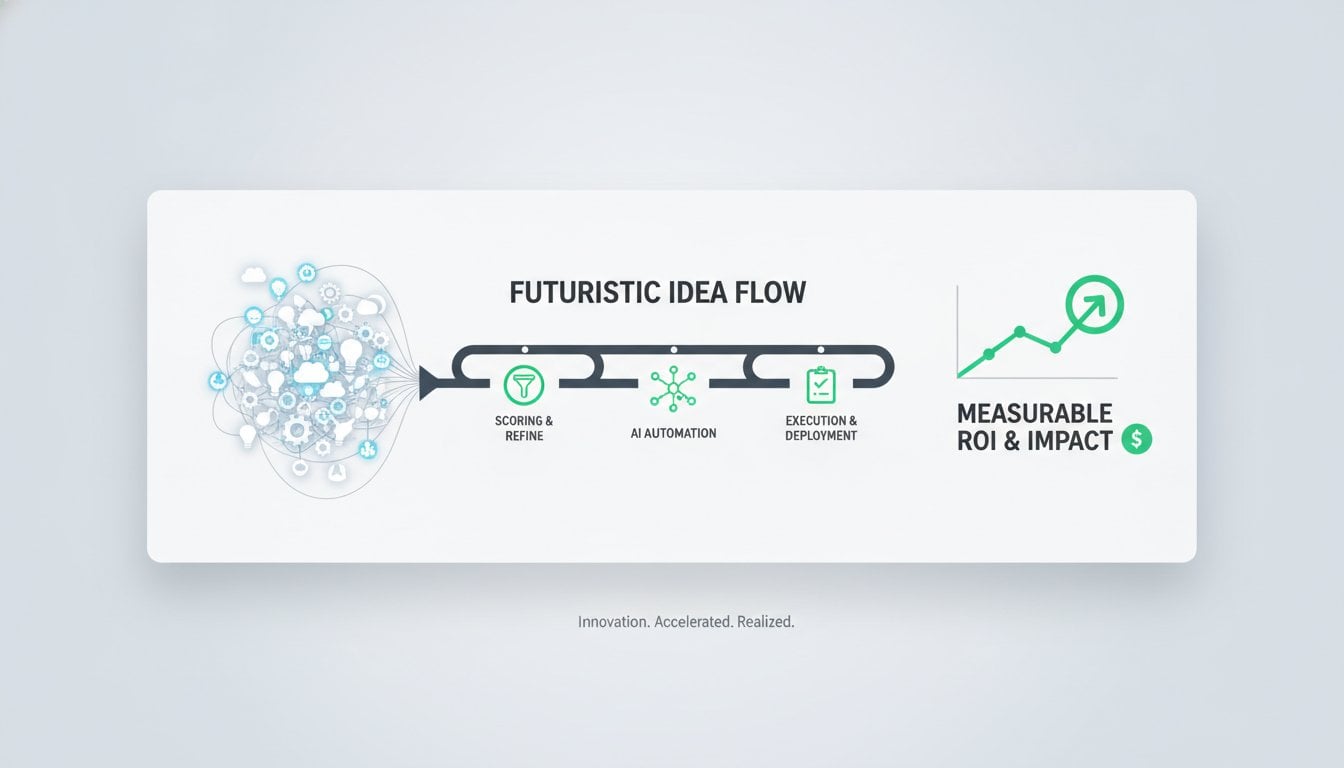
Most enterprise innovation programs are little more than expensive suggestion boxes where high-impact ideas go to retire. While 64% of organizations have integrated AI into their operations as of early 2026, the majority still struggle to move beyond surface-level experimentation. You’ve likely seen brilliant concepts stall in endless review meetings because there’s no clear path to funding or because your team lacks the specialized expertise to evaluate technical submissions. It’s a waste of human capital that keeps your time-to-market sluggish.
We’re here to change that narrative. You’ll learn the exact framework to streamline idea implementation process workflows, effectively bridging the gap between ideation and execution while stripping away administrative friction. By leveraging the latest ISO 56001:2024 certification standards, you can stop guessing and start delivering measurable results. This guide previews a system that decouples evaluation from execution, ensures clear ROI tracking for every dollar of innovation spend, and slashes the overhead that currently bogs down your most creative minds.
Key Takeaways
- Close the “Implementation Gap” by shifting organizational focus from high-volume ideation to a structured, high-velocity execution framework.
- Discover how to streamline idea implementation process workflows by adopting decentralized intake models that bypass traditional administrative bottlenecks.
- Replace subjective decision-making with objective, weighted scoring systems that prioritize ideas based on strategic alignment, feasibility, and impact.
- Leverage AI-driven automation to intelligently route technical submissions to the correct subject matter experts, slashing review times and friction.
- Establish clear accountability by tracking critical innovation metrics, including time-to-market, implementation rates, and verified financial ROI.
The Implementation Gap: Why Enterprise Ideas Stagnate
Innovation theater is a chronic condition in the modern enterprise. It’s the practice of hosting high-energy workshops and collecting thousands of employee suggestions while lacking the infrastructure to move a single concept to production. This creates a massive Implementation Gap: the stark disconnect between high-volume ideation and low-volume execution. While organizations are often proficient at the creative side of the house, industry research consistently indicates that 70% to 90% of innovations fail not because the ideas were poor, but because of execution failures. This failure occurs in the “Valley of Death,” the precarious transition point where a validated idea loses its momentum during the hand-off from innovation teams to operational departments.
The foundational definition of implementation focuses on the realization of an application or execution of a plan. In an enterprise setting, this requires more than just enthusiasm; it requires an engineered workflow. To truly streamline idea implementation process cycles, leaders must stop treating execution as an afterthought and start treating it as a core competency. Failing to do so ensures that your innovation program remains a cost center rather than a growth engine. Engineering a way to streamline idea implementation process steps is no longer optional in a landscape where speed is the ultimate competitive advantage.
Common Barriers to Execution Velocity
Execution doesn’t stall by accident. It’s usually the result of three specific friction points. First, administrative friction creates a bottleneck where endless committee reviews kill employee enthusiasm. If an idea takes six months to clear a compliance check, the market has already moved on. Second, resource misalignment ensures that even the best ideas die without a dedicated implementation budget. Most departments are incentivized to maintain the status quo, leaving no room for non-core projects. Finally, an expertise deficit often prevents innovation managers from effectively evaluating specialized technical ideas, leading to “safe” but mediocre choices.
The Cost of Inaction
The price of a broken process is higher than most executives realize. Idea decay doesn’t just result in lost revenue; it actively erodes employee engagement. When staff see their contributions vanish into a black hole, they stop contributing. This leads to a talent drain as your most innovative thinkers move to competitors who can actually ship products. In a high-velocity 2026 market where AI-driven competitors move at light speed, a slow implementation rate is a terminal risk. Adopting a structured idea implementation framework is the only way to mitigate these risks and ensure your organization remains relevant.
5 Steps to Streamline Your Idea Implementation Process
Bridging the gap between a validated concept and a funded project requires more than a simple workflow. It demands a lean, modern execution framework engineered for speed and scalability. To effectively streamline idea implementation process cycles, organizations must move beyond the static “suggestion box” model and adopt a dynamic, five-step pipeline that prioritizes impact over volume. This system ensures that resources aren’t wasted on low-value experiments while accelerating the journey for high-potential winners.
- Step 1: Decentralized Intake. Move away from a single, generic suggestion box. Use category-specific challenges to ensure ideas are pre-aligned with business needs.
- Step 2: Automated Screening. With 64% of organizations already utilizing AI in operations, use automated filters to remove duplicates and low-feasibility submissions instantly.
- Step 3: Collaborative Refinement. Harness internal crowdsourcing to strengthen ideas. Peer feedback identifies technical gaps before a formal review even begins.
- Step 4: Rapid Prototyping and Validation. Test core assumptions through minimal viable experiments. In 2026, low-code technologies allow teams to build and test 70% of new applications without heavy IT involvement.
- Step 5: Structured Hand-off. Transfer validated concepts to business units with comprehensive documentation and clear ownership.
Phase 1: Filtering for High-Potential Winners
The first hurdle in any innovation program is the noise. Using AI-driven insights allows innovation managers to spot duplicates or low-feasibility concepts in seconds, preventing them from clogging the pipeline. Objectivity is maintained through the use of idea evaluation and scoring tools, which shift the focus from popularity to strategic value. Instead of simple “voting” systems that favor the most charismatic submitter, weighted scoring ensures that every idea is judged on its feasibility, impact, and alignment with corporate goals. If you want to see how this looks in practice, you can schedule a personalized walkthrough of these automated workflows.
Phase 2: Validation and the Hand-off
Once an idea is filtered, it enters the validation stage. This is where “micro-pilots” prove value without requiring massive capital expenditure. These small-scale tests provide the data needed to secure buy-in from department heads. To streamline idea implementation process hand-offs, create a standardized “Implementation Package” that includes technical requirements, projected ROI, and resource needs. This documentation removes the ambiguity that often leads to projects stalling at the departmental level. Finally, ensure accountability by assigning a clear owner at the moment of transfer, preventing the idea from being lost during the transition.
Scoring and Prioritization: The Engine of Faster Execution
Subjectivity is the silent killer of enterprise progress. When projects are selected based on the loudest voice in the room or a vague “gut feeling,” the result is a clogged pipeline of mediocre initiatives. To streamline idea implementation process workflows, you must replace intuition with a mathematical engine. A weighted scoring system provides the necessary objectivity to filter out noise and focus resources on the high-impact opportunities that align with your 2026 strategic objectives.
The most effective scoring models evaluate three core pillars: Strategic Alignment, Feasibility, and Impact. Alignment ensures the idea supports your current mission. Feasibility accounts for technical hurdles and regulatory constraints, such as the EU AI Act transparency requirements effective August 2, 2026. Impact measures the potential for efficiency gains or revenue growth. However, a one-size-fits-all approach is a mistake. You must utilize distinct scoring criteria for incremental vs radical innovation to ensure that low-risk improvements don’t starve high-reward breakthroughs of capital.
The RICE Framework for Innovation Managers
Adapting the RICE framework allows for a granular comparison of disparate ideas. Start with Reach: how many employees or customers will this implementation actually touch? Next, calculate Impact: will it deliver a slight productivity bump or a shift in performance? According to a June 2026 Deloitte report, 66% of organizations are seeing efficiency gains from AI, but only 20% report revenue growth. Your Confidence score should reflect how certain you are about these projections based on pilot data. Finally, factor in Effort: the total requirement of time, money, and labor. This calculation gives you a single, comparable score for every submission.
Balancing the Innovation Portfolio
A streamlined process requires a healthy mix of “Quick Wins” and “Big Bets.” High-impact, low-effort projects provide the immediate momentum needed to sustain program funding. Conversely, transformative bets ensure long-term market relevance. If your portfolio is 100% safe, you’re falling behind. Use your scoring data to justify resource allocation to skeptical executive stakeholders, proving that your roadmap is built on empirical evidence rather than speculation. This transparency builds the trust necessary to secure the budgets required for large-scale implementation.
Leveraging AI and Automation to Remove Implementation Friction
Automation also serves as the primary defense against “idea decay.” When a submission enters the pipeline, automated notification triggers keep stakeholders accountable, while scheduled status updates ensure the submitter remains engaged. This transparency eliminates the “black hole” syndrome that historically plagues employee suggestion programs. By integrating your innovation pipeline directly with execution tools like Jira, Trello, or Microsoft Teams, you ensure that a validated idea becomes a trackable ticket in your existing project management ecosystem without a single manual data entry step.
Beyond Spreadsheets: Why Legacy Tools Fail
Many organizations still attempt to manage innovation through Excel or SharePoint, but these legacy tools lack the scalability required for high-volume execution. When you compare Ideawake vs Spreadsheets, the difference in audit trails and data integrity is stark. Spreadsheets are static and prone to human error, whereas specialized platforms provide a centralized source of truth. Research indicates that switching to a dedicated innovation management system can reduce administrative time by up to 80% by automating repetitive tasks like reporting and scoring aggregation. This reclaimed time allows your team to focus on high-value validation rather than document management.
The Smart Integration Ecosystem
A truly streamlined process doesn’t exist in a vacuum. With the average enterprise now utilizing 897 separate applications, integration is the only way to prevent data silos. Ideawake’s integrations bridge the gap between “Idea” and “Project” by allowing real-time data flow between your innovation pipeline and your ERP or CRM. This connectivity ensures that when an idea is moved to the implementation stage, all relevant financial and customer data is already present. This level of technical cohesion is exactly what’s required to scale AI from pilot to production in a fragmented regulatory environment. To see these automated workflows in action, you can book a free demo and explore how we connect your innovation strategy to your tech stack.
Measuring Impact: From Implementation to Tangible ROI
Measurement isn’t just an administrative chore; it’s the ultimate accountability mechanism for any innovation program. Without empirical data, you aren’t innovating; you’re just spending. Implementation is only successful if it delivers measurable value back to the business. To truly streamline idea implementation process cycles, you must move beyond vanity metrics like “number of ideas submitted” and focus on the hard data that executive stakeholders demand. Success isn’t defined by how many ideas you start, but by the tangible value they generate upon completion.
Key performance indicators should center on three specific areas. First, Time-to-Market measures the speed at which an idea travels from validation to production. Second, the Implementation Rate tracks the percentage of validated concepts that actually reach the finish line. Finally, Financial ROI provides the ultimate justification for your budget. Don’t ignore “Soft ROI” either. Tracking improvements in employee engagement and cultural transformation is vital, as these factors directly impact your firm’s ability to retain top-tier talent in a competitive 2026 market. According to a June 2026 Deloitte report, 66% of organizations are seeing efficiency gains from AI, and tracking these specific productivity bumps is a critical part of proving your program’s worth.
Calculating the Hard Numbers
Projecting returns early in the lifecycle is the best way to secure continued funding. You can use an Idea Management ROI Calculator to model potential gains before committing significant resources. It’s important to distinguish between cost savings generated by continuous improvement initiatives and the new revenue streams created by radical product innovations. Linking these innovation KPIs to broader organizational growth goals ensures that your program remains a strategic priority rather than a line-item expense. This data-backed approach builds the credibility needed to scale your efforts across the entire enterprise.
Continuous Optimization of the Process
The most successful organizations don’t treat their workflow as static. They treat their implementation process as a product that requires constant iteration. Use your implementation data to identify specific bottlenecks, such as a department head who consistently stalls project hand-offs or a technical review stage that takes too long. A Post-Implementation Audit allows your team to refine future workflows based on what actually happened during execution. This cycle of feedback and adjustment is the only way to maintain a lean, effective pipeline. If you’re ready to stop settling for average results and start shipping high-impact solutions, it’s time to execute faster with Ideawake’s modern innovation platform.
Mastering the Art of Enterprise Execution
Maintaining a competitive edge in 2026 requires more than a high volume of suggestions; it demands a rigorous, engineered path to production. You’ve seen how bridging the “Implementation Gap” requires a shift from subjective voting to objective, data-backed scoring models like RICE. By leveraging AI-driven automation to route technical reviews and integrating your pipeline with existing execution tools, you can finally eliminate the administrative friction that stalls progress. It’s time to stop treating innovation as a creative exercise and start treating it as a core operational discipline.
To effectively streamline idea implementation process workflows, your organization needs a platform built on modern architecture that handles everything from initial submission to final ROI measurement. Ideawake provides these end-to-end capabilities, using AI-driven insights to boost engagement and drastically reduce administrative complexity. This technical cohesion ensures that your most promising concepts don’t just sit in a database but actually reach the market where they can deliver measurable value.
Your next breakthrough is waiting; you just need the right engine to bring it to life.
Frequently Asked Questions
What is the difference between idea management and idea implementation?
Idea management focuses on the front-end capture, categorization, and initial evaluation of concepts, while idea implementation is the operational execution that transforms those concepts into tangible products or process improvements. Think of management as the “what” and implementation as the “how.” To successfully streamline idea implementation process cycles, you must bridge these two phases with a structured hand-off that includes technical validation and resource allocation.
How long should the idea implementation process take in a large enterprise?
In a large enterprise, the timeline varies by complexity, but a streamlined “Quick Win” should move from submission to pilot in under 30 days. Radical innovations often require 6 to 18 months depending on regulatory hurdles like the EU AI Act requirements. The goal is to reduce “wait time” between stages, ensuring that no idea sits in a review queue for more than 72 hours without an automated status update.
Why do most employee ideas fail to get implemented?
Most ideas fail due to execution bottlenecks rather than a lack of creativity, with research suggesting 70% to 90% of innovations stall during the hand-off to operational departments. This “Valley of Death” occurs when there is no dedicated implementation budget or when the idea lacks a clear owner to drive it through technical hurdles. Without a structured framework, even high-potential concepts are eventually abandoned as administrative friction kills initial momentum.
How can I measure the ROI of a streamlined idea implementation process?
ROI is measured by comparing the total cost of implementation against the verified financial gains, such as increased revenue or operational cost savings. Use hard data from a ROI calculator to track these figures. You should also factor in “Soft ROI,” including improvements in employee retention and engagement, which are critical metrics for high-performing 2026 organizations that prioritize a culture of continuous improvement.
Should we use Jira or a specialized innovation platform for implementation?
Jira is an excellent project management tool, but it lacks the front-end engagement, crowdsourcing, and automated scoring capabilities of a specialized innovation platform. While Jira handles the “Build” phase, a dedicated platform is necessary to streamline idea implementation process workflows by managing the “Evaluate” and “Validate” stages. The best approach is to integrate the two, allowing validated ideas to flow automatically into your technical team’s existing backlog.
How do I get executive buy-in for a new idea implementation framework?
Secure executive buy-in by presenting a data-backed business case that links innovation to specific organizational growth goals. Focus on the cost of inaction, such as the risk of falling behind AI-driven competitors or losing top talent to more agile firms. Show them a pilot plan with clear, weighted scoring criteria that proves you are prioritizing financial impact over vanity metrics.
What role does AI play in streamlining the innovation lifecycle in 2026?
AI has evolved into an orchestration engine that automatically routes technical submissions to the correct subject matter experts for rapid review. By early 2026, 64% of organizations were already using AI to drive operational efficiency. In the innovation lifecycle, AI identifies duplicate ideas, predicts implementation feasibility based on historical data, and automates status communications to keep the entire workforce engaged without increasing administrative overhead.
How do I handle “failed” implementations without discouraging employees?
Treat every failed implementation as a paid research project that provides data for the next iteration. Conduct a Post-Implementation Audit to document exactly why the project stalled, whether it was a technical hurdle, a market shift, or a resource gap. Communicate these findings transparently to the submitter to maintain trust. This approach transforms “failure” into a learning asset that refines your future selection criteria and strengthens the overall innovation culture.