Tag Archives: data-driven innovation

Innovation Pipeline Management: A Data-Driven Guide to Maximizing ROI in 2026

Innovation Pipeline Management: A Data-Driven Guide to Maximizing ROI in 2026
Coby Skonord|
August 30, 2026

Did you know that 55% of innovation management platforms have already integrated AI to automate idea evaluation, yet many organizations still struggle to generate a tangible return on their investments? According to Business Research Insights, while 70% of enterprises prioritize an innovation culture, the gap between ideation and implementation remains a significant hurdle. You’ve likely felt the frustration of information silos and the heavy administrative burden of manually vetting thousands of submissions. Without a structured innovation pipeline management strategy, these ideas often become a source of friction rather than a driver of growth.

It’s difficult to justify budgets when you can’t point to a direct financial impact. This guide will show you how to replace chaotic suggestion boxes with a high-performance engine for measurable ROI. You’ll learn how to build a repeatable process for vetting ideas and capture the clear data required to prove your program’s value to stakeholders. We’ll explore how modern architecture and AI insights can eliminate evaluation bottlenecks, drive higher employee participation, and finally deliver the results your organization demands in 2026.

Key Takeaways

  • Learn how to transition from a passive suggestion box to a structured innovation pipeline management system that treats ideas as measurable financial assets.
  • Discover the five essential stages of the innovation lifecycle, from aligning idea generation with specific business challenges to leveraging internal crowdsourcing for faster refinement.
  • Identify the administrative bottlenecks inherent in legacy spreadsheets and learn how modern, cloud-based architectures reduce overhead through automated workflows.
  • Master data-driven metrics like Pipeline Velocity and Yield Ratio to provide clear evidence of your innovation program’s performance and justify future budgets.
  • Explore how AI-driven tools can automate the scoring and duplicate detection process, allowing your team to focus on high-impact implementation rather than manual evaluation.

The Architecture of a High-Impact Innovation Pipeline

Innovation pipeline management is the systematic process of converting raw concepts into implemented solutions that deliver measurable ROI. It’s the engine room of modern innovation management. In 2026, market leaders have largely abandoned the traditional “suggestion box” model. While a suggestion box is a passive repository that often leads to employee disengagement, a managed pipeline is an active, data-driven workflow. Research indicates that approximately 55% of platforms now use AI to improve evaluation, reflecting a shift toward objective decision making. Modern architecture is no longer optional. It’s essential for reducing the administrative friction that typically kills great ideas before they ever reach the prototype stage. Large enterprises, which hold nearly 78% of the market share, utilize these systems to ensure their innovation budgets are backed by hard data rather than optimistic speculation.

Why Pipeline Management is the Backbone of Corporate Growth

The Consequences of a Clogged or Leaky Pipeline

Pipelines fail when they become either “clogged” or “leaky.” A clog occurs when a small team of evaluators is overwhelmed by thousands of unranked ideas, leading to burnout and stagnation. This administrative burden stalls progress and discourages future participation. Conversely, a leaky pipeline loses high-potential projects due to poor evaluation criteria or a lack of stakeholder buy-in. Most innovation failures don’t happen because the ideas were bad. They happen because the pipeline couldn’t support the weight of the evaluation process or failed to provide transparency to the contributors. By 2026, effective innovation pipeline management relies on automated scoring and AI-driven insights to patch these leaks. This ensures that the most viable, data-backed concepts move toward implementation while administrative overhead remains manageable.

The 5 Essential Stages of Innovation Pipeline Management

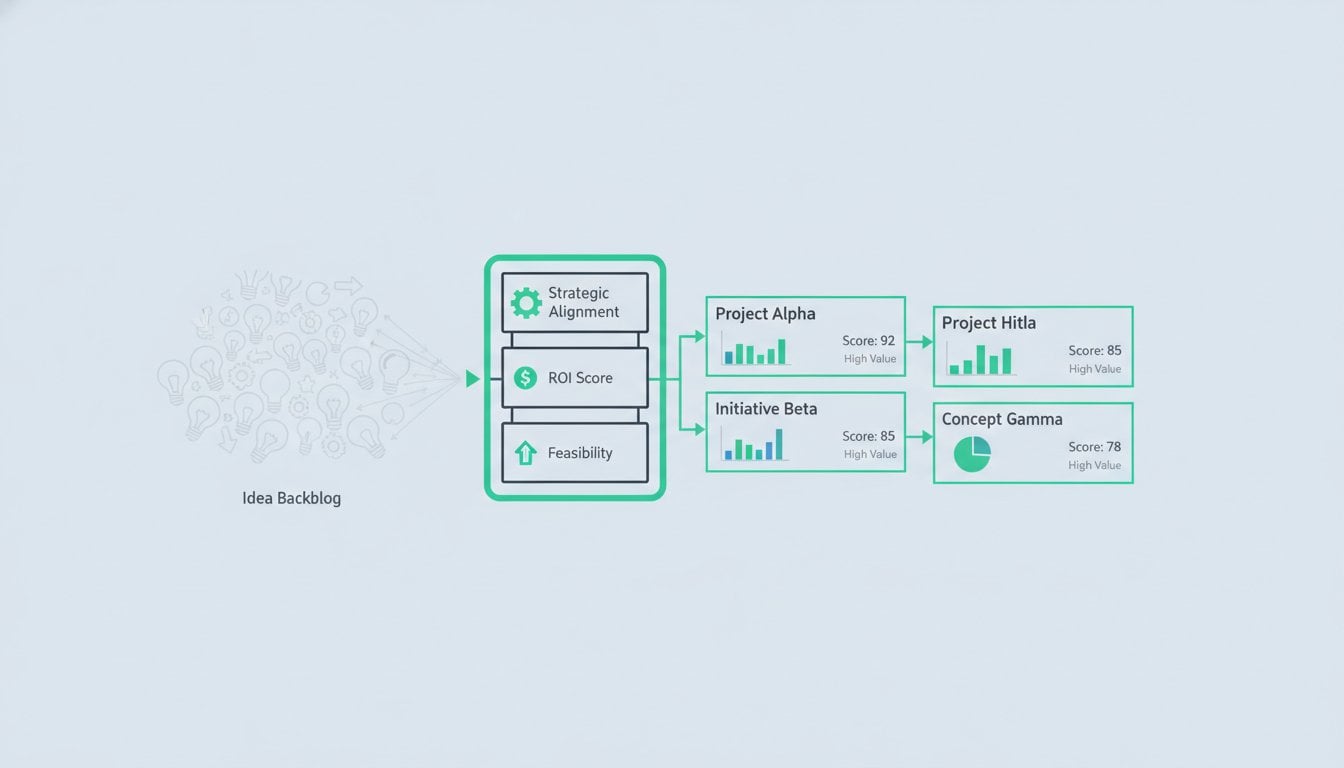
To achieve a measurable financial impact, your innovation pipeline management strategy must follow a disciplined, five-stage lifecycle. This journey begins with Strategic Alignment and ends with operational Implementation, ensuring every dollar spent is tied to a verified business outcome. By treating the pipeline as a series of rigorous filters, you can move away from the chaos of unvetted ideas and toward a predictable engine of growth.

Stage 1 & 2: Moving from Capture to Collaboration

The final stage, Implementation and ROI Measurement, is where the transition to operational reality occurs. Success here requires end-to-end lifecycle tracking to prove that the initial investment yielded the promised results. If you want to see how these stages can be automated for your team, you can book a free demo to explore modern pipeline workflows and start maximizing your innovation returns.

Legacy Systems vs. Modern Platforms: Identifying Your Bottlenecks

Many organizations attempt to manage their innovation efforts using general-purpose tools like Excel or SharePoint. While these might work for small teams, they fail to scale in a complex enterprise environment. Manual innovation pipeline management often leads to a massive administrative burden, consuming hundreds of hours that should be spent on execution. When you contrast the manual approach with automated platforms, the difference in efficiency is staggering. Legacy systems lack the real-time data flow needed to keep pace with market changes. This creates bottlenecks that stall high-potential projects and waste precious resources.

The Hidden Costs of Manual Pipeline Management

The true cost of using outdated tools isn’t just the software license fee. It’s the idea decay that occurs when slow response times kill momentum. According to the Ideawake vs Spreadsheets analysis, organizations using manual methods lose significant time on data entry and status tracking. This lack of speed results in lost ROI as competitors beat you to market. Beyond the financial impact, manual systems damage employee morale. When contributors don’t see progress or receive feedback, they stop participating. Transparency is the antidote to disengagement, and legacy tools simply cannot provide the visibility required to keep a workforce inspired.

Modern Features That Drive Pipeline Velocity

Switching to a specialized platform changes the equation by automating the most tedious parts of the lifecycle. For example, AI tools for innovation managers can instantly categorize submissions and identify duplicates, which significantly reduces the workload for review committees. A centralized idea board serves as a single source of truth, ensuring that every stakeholder has access to the same data. This visibility is enhanced by mobile-first submission features, allowing frontline workers to contribute insights the moment they occur. When these platforms include integrations with MS Teams or Slack, innovation becomes part of the daily workflow rather than an occasional extracurricular activity.

The build vs buy dilemma often haunts IT departments, but custom-built solutions rarely keep up with the pace of AI advancement. Choosing to buy idea management software allows your team to leverage modern architecture and pre-built security protocols immediately. This path minimizes implementation time and ensures your organization is using a battle-tested engine designed specifically for maximizing innovation ROI. It’s the difference between struggling with a static list and managing a high-performance growth engine.

Data-Driven Metrics: How to Measure Pipeline Velocity and ROI

Effective innovation pipeline management requires more than just counting the number of ideas collected. You must treat your pipeline as a financial instrument where every stage has a measurable cost and a projected return. One of the most critical metrics to track is Pipeline Velocity. This is the average time an idea takes to move from the initial submission to a fully realized implementation. Organizations that fail to monitor velocity often see their most promising concepts die in committee. A slow pipeline is a leaky pipeline, as market conditions shift faster than your internal processes can react.

Another vital indicator is the Yield Ratio. This calculation compares the number of successful implementations against the total number of submissions. A low yield ratio might suggest that your strategic alignment is off or that your evaluation criteria are too broad. To balance your portfolio, you should also adopt “Innovation Accounting.” This framework is designed for high-uncertainty projects where traditional financial metrics don’t apply early on. It allows you to track progress through learning milestones and pivot points before you commit significant capital. Balancing these with non-financial metrics like employee engagement ensures the long-term health of your innovation ecosystem.

The ROI of Employee Ideation Programs

The benefits of employee ideation programs extend far beyond cultural improvements. They provide a direct path to operational savings and new revenue streams. However, many leaders ignore the “cost of inaction.” When a valid, cost-saving idea is ignored for six months, the organization effectively pays a penalty in lost efficiency. To get a precise understanding of the potential impact on your bottom line, you should use an idea management ROI calculator. This tool helps you quantify the specific financial gains your organization can expect by professionalizing its innovation workflows.

KPIs for Every Stage of the Funnel

To identify bottlenecks, you must track performance across the entire funnel. Each stage requires specific KPIs to ensure the engine is running smoothly:

  • Submission Metrics: Monitor the participation rate and idea diversity across different departments to ensure you aren’t stuck in an information silo.
  • Evaluation Metrics: Track the time-to-decision and evaluator throughput to prevent administrative clogs that stall momentum.
  • Outcome Metrics: Measure the final implementation rate and the realized net savings or revenue generated by each project.

Ideawake: Streamlining Your Innovation Lifecycle from Submission to ROI

Ideawake is specifically engineered to eliminate the administrative complexity that often paralyzes corporate growth. In a landscape where 55% of platforms now leverage AI, Ideawake leads by integrating advanced features that automate the most tedious parts of the lifecycle. By using Ideawake AI, your team can instantly handle duplicate detection and initial scoring, ensuring that reviewers only spend time on high-potential concepts. This transition from manual filtering to automated intelligence is the cornerstone of effective innovation pipeline management. Whether your organization is running high-impact hackathons or steady continuous improvement programs, the platform provides a unified environment to track every idea from the initial spark to the final financial outcome.

The implementation process is designed for speed, significantly reducing the time-to-value for large enterprises. Many legacy tools require months of configuration, but Ideawake’s modern architecture allows for a rapid rollout that starts delivering insights within weeks. This efficiency is critical for maintaining the momentum of your innovation culture and ensuring that employee engagement doesn’t wither during a long setup phase.

Why Modern Architecture Matters for Scalability

Scaling an innovation program across thousands of employees shouldn’t increase the burden on your innovation leads. Ideawake is built on a cloud-first architecture that supports massive user bases while maintaining enterprise-grade security. This makes it a premier choice for innovation management software. Managers can launch targeted Innovation Challenges to solve urgent problems, using structured workflows to ensure quality as participation grows.

Getting Started: From Chaos to Clarity

The journey from a chaotic suggestion box to a structured engine of growth is straightforward. The process is clear: Capture, Evaluate, Implement, and Measure. Each step is supported by real-time data and automated tracking to ensure no ROI is left on the table. If you’re ready to see this architecture in action, you can sign-up for a personalized demo. Don’t settle for manual tracking. Compare Ideawake to legacy tools to see the difference in ROI.

Building the High-Performance Innovation Engine of 2026

Effective innovation pipeline management is the bridge between a creative workforce and a growing bottom line. By moving away from legacy tools and embracing a structured, AI-driven approach, you eliminate the administrative friction that stalls organizational progress. You’ve seen how modern architecture reduces manual evaluation time by over 50%, enabling your team to focus on high-impact implementation rather than data entry. Trusted by global enterprises to drive ROI, this data-backed strategy provides the transparency needed to keep employees engaged and stakeholders informed.

The end-to-end lifecycle tracking offered by modern platforms ensures that no viable idea is lost to information silos or slow response times. Stop settling for average results. It’s time to build a high-performance innovation engine that delivers year-over-year value. Execution is everything. Your organization’s future depends on its ability to execute with precision.

The path from a chaotic suggestion box to a streamlined growth engine is shorter than you think. Start maximizing your organization’s untapped potential today.

Frequently Asked Questions

What is innovation pipeline management?

Innovation pipeline management is the systematic process of moving ideas from raw concepts to measurable ROI. It involves capturing, evaluating, and implementing ideas through a structured workflow. Unlike a passive suggestion box, it actively manages the lifecycle of an idea to ensure it delivers value. This process is essential for organizations that want to turn employee creativity into tangible financial gains without getting bogged down by administrative complexity.

How is an innovation pipeline different from a traditional project management funnel?

While project management focuses on executing defined tasks, an innovation pipeline manages uncertainty and high-potential concepts before they become projects. It starts with a broader intake of raw ideas and uses specific evaluation criteria to filter for feasibility and strategic alignment. A traditional funnel often lacks the front-end ideation and crowdsourcing elements that define effective innovation pipeline management. It’s about vetting the “what” before the project manager handles the “how.”

What are the most common bottlenecks in an innovation pipeline?

What are the most common bottlenecks in an innovation pipeline?

AI automates the heavy lifting of categorization, duplicate detection, and initial scoring. According to research from Business Research Insights, approximately 55% of platforms have integrated AI as of 2026 to improve evaluation. Tools like Ideawake AI use sentiment analysis and machine learning to surface high-potential concepts based on peer feedback. This ensures that human evaluators focus on the most viable ideas, significantly increasing the capacity of the review team.

How do you measure the ROI of an innovation pipeline?

You measure ROI by tracking realized net savings or revenue generated from implemented ideas against the total cost of the program. Organizations should also monitor “Pipeline Velocity,” which is the time an idea takes to move from submission to execution. Key KPIs include:

  • Participation rate across departments
  • Realized net savings or revenue

Tracking these metrics provides the hard data needed to justify innovation budgets.

Is innovation pipeline software better than using spreadsheets?

Specialized software is significantly more efficient than spreadsheets for large-scale enterprise innovation. Spreadsheets are static, prone to error, and lack the automated workflows required to manage thousands of submissions. They create significant time loss in data entry and status tracking. Modern platforms like Ideawake provide a centralized “single source of truth,” offering real-time transparency and automated reporting that manual tools simply cannot replicate. This shift allows teams to focus on implementation rather than spreadsheet maintenance.

How long does it take to implement an innovation management platform?

Implementation times vary based on organizational size, but modern cloud-based platforms are designed for rapid rollout. Because they use a modern architecture, these systems reduce the technical barriers that once made enterprise software deployments take months. Most organizations can launch their first innovation challenge within a few weeks. This fast time-to-value is critical for maintaining momentum and proving the program’s worth to stakeholders early in the process.

Can frontline employees participate in innovation pipeline management?

Frontline employees are often the most valuable contributors because they are closest to operational inefficiencies. Modern platforms utilize mobile-first submission and gamification features like leaderboards to encourage participation from all levels of the organization. By lowering the barrier to entry, companies can tap into the collective intelligence of their entire workforce. This inclusive approach to innovation pipeline management drives higher engagement and surfaces practical solutions that leadership might otherwise overlook.
AI for Innovation ROI: A Data-Driven Guide for 2026

AI for Innovation ROI: A Data-Driven Guide for 2026
Coby Skonord|
August 9, 2026

While 78% of organizations have integrated AI into their business functions, a staggering 61% still cannot attribute a single dollar of EBIT impact to these investments. For most innovation leaders, the process remains a black hole where capital enters and vague cultural shifts come out. You’ve likely spent hours wrestling with manual spreadsheets or trying to explain to a skeptical CFO why a failed pilot was actually a success. It’s frustrating to watch high-potential ideas wither because you lack the data to defend their budget. Using AI to measure innovation ROI changes this dynamic by replacing guesswork with real-time, predictive analytics.

This guide provides a definitive framework to transform your innovation department into a high-performance engine of measurable growth. You’ll learn how to automate reporting that satisfies strict financial requirements and gain the confidence to allocate capital where it generates the highest impact. We’ll also cover how to stay compliant with the 2026 regulatory landscape, including the EU AI Act and other emerging data transparency regulations. It’s time to stop treating innovation as a luxury and start managing it as a predictable driver of your bottom line.

Key Takeaways

  • Replace manual tracking with automated systems to prevent the 30% data decay rate common in traditional innovation spreadsheets.
  • Discover how using AI to measure innovation ROI allows you to quantify “soft” benefits like employee engagement through automated sentiment analysis.
  • Transition from historical reporting to predictive value forecasting by utilizing Monte Carlo simulations to assess project success probabilities.
  • Implement a five-step framework to centralize your innovation data and establish a single source of truth for all financial reporting.
  • Utilize real-time dashboards to translate raw ideas into boardroom-ready impact reports that align with strict 2026 regulatory standards.

The Challenge of Quantifying Innovation in the Modern Enterprise

Innovation departments often operate as financial black holes. Management sees the creative spark but rarely sees the resulting cash flow. This disconnect creates the “innovation gap,” where brilliant ideas fail to receive funding because their value isn’t proven. Most leaders still rely on manual spreadsheets to bridge this gap. However, industry benchmarks suggest that legacy tracking methods lead to a 30% data decay rate as information gets lost across departments. Manual entry is slow; it’s prone to human error; it’s fundamentally unscalable. Using AI to measure innovation ROI solves this by aggregating fragmented data from every business unit into a single, actionable stream.

The corporate world is moving away from “soft” metrics like participation rates. In 2026, the only metric that matters is EBITDA impact. Using AI to measure innovation ROI allows you to track this impact from the moment an idea is submitted to its final implementation. By centralizing your data, you eliminate the silos that prevent a holistic view of your innovation portfolio’s health.

The Limitations of Historical ROI Reporting

Looking backward is a strategic death sentence. Traditional Return on Investment (ROI) reporting usually occurs months after a project concludes. By then, the opportunity for agile resource reallocation has passed. Market volatility in 2026 demands faster, more aggressive reporting cycles. If you rely on vanity metrics or historical post-mortems, you’ll likely continue funding “zombie projects” that drain capital without delivering value. Real-time visibility is the only way to remain competitive in a landscape where 42% of companies abandoned their AI initiatives in 2025 due to poor tracking.

Bridging the Gap Between Creativity and the Balance Sheet

Financial validation requires a clear understanding of the difference between creativity vs. innovation. While creativity generates the raw material, innovation is the process of turning that material into profit. Effective data capture must span the four main types of business collaboration to ensure no value is missed. This complexity is why the role of the Chief Innovation Officer has become essential for standardizing measurement. They serve as the critical link between creative output and the balance sheet, ensuring every project is held accountable to the bottom line through standardized, AI-driven reporting.

How AI Automates the Innovation ROI Lifecycle

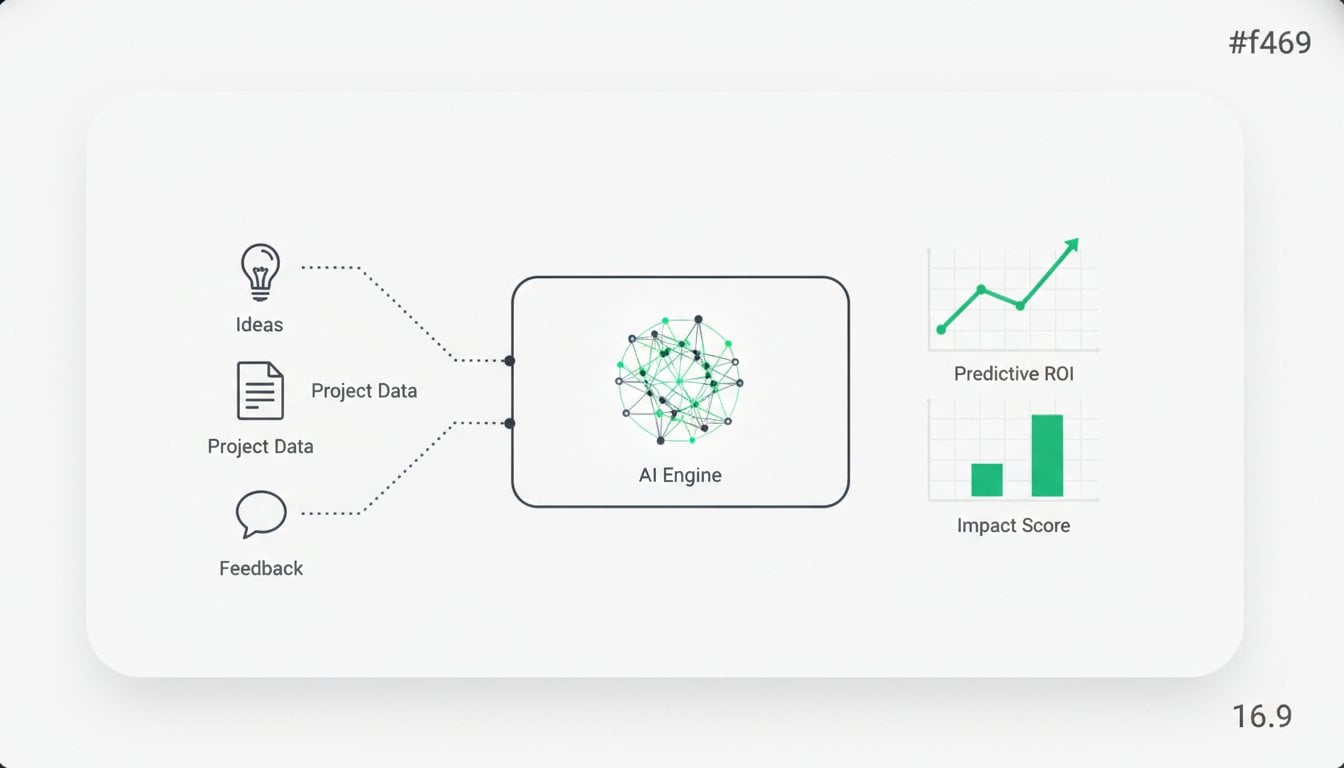
The technical mechanism behind this involves continuous data synchronization. Instead of waiting for quarterly reviews, machine learning models analyze thousands of historical data points to identify patterns in successful projects. They recognize team compositions or initial budget allocations that typically lead to high returns. This predictive capability ensures that resources are directed toward projects with the highest statistical probability of delivering a return, effectively using AI to measure innovation ROI before a project even leaves the ideation phase.

Automated Data Capture for Idea Management

Manual data entry is the primary cause of the data decay that plagues legacy systems. Modern AI tools for innovation managers bypass this by pulling data directly from the source. Through seamless integrations with ERP and CRM systems, these platforms track implementation costs against projected savings in real time. This creates a closed-loop system where financial data flows automatically, ensuring that the Chief Innovation Officer always has a live view of the portfolio’s performance. It’s a significant shift from the static reports that once gathered dust in management folders.

Standardizing the Idea Evaluation Process

Subjectivity often kills great ideas because human evaluators are prone to internal politics or risk aversion. Algorithmic weighting helps reduce the cognitive bias that typically plagues manual reviews. By applying a standardized idea evaluation and scoring model, AI identifies “hidden gems” that might be overlooked by human evaluators focused solely on short-term gains. This objective approach is a key component of a broader 5-Step Framework for Measuring Innovation, which emphasizes the need for consistent, data-backed metrics across the entire organization. If you’re still relying on manual scoring, you’re likely missing out on significant value. You can schedule a personalized platform walkthrough to see how automated scoring can refine your pipeline.

Predictive Analytics: Moving from Post-Mortems to Value Forecasting

Historical reporting is an autopsy. It tells you why a project died but does nothing to save the patient. Predictive analytics shifts the focus from what happened to what is likely to occur. By using AI to measure innovation ROI, organizations move beyond static spreadsheets into dynamic forecasting. One powerful method involves Monte Carlo simulations, which run thousands of “what-if” scenarios to predict the probability of a project’s success based on variables like market saturation and resource availability. This approach provides a robust framework for measuring AI ROI by identifying potential financial outcomes before significant capital is committed.

This shift helps eliminate “Technical Debt.” When you can see a project’s declining probability of success in real time, you can kill low-value initiatives before they drain your budget. Modern AI driven innovation software acts as a filter, highlighting market winners while flagging projects that no longer align with strategic goals. It’s a proactive way to manage your portfolio that ensures every dollar spent is backed by data-driven confidence.

Forecasting Financial Impact Before Implementation

Predictive modeling requires different benchmarks for incremental vs. radical innovation. Incremental projects often have higher success probabilities but lower returns, while radical shifts carry more risk. AI models account for these differences by simulating various budget allocation scenarios. This real-time forecasting builds stakeholder confidence because it replaces gut feelings with statistical evidence. When you can show a CFO a 75% probability of a specific return based on live data, securing additional funding becomes a conversation about math rather than faith.

Identifying and Mitigating Innovation Failures

Failure is an expensive teacher. However, by analyzing past innovation failures, AI models learn the early warning signs of a project in distress. These systems act as a tripwire for projects that exceed their ROI payback period or fail to hit key milestones. Using AI to measure innovation ROI creates an early warning system that protects your capital. Predictive ROI is a risk-mitigation tool that protects your capital by providing objective data to pivot or stop projects that are statistically unlikely to succeed. It ensures that your innovation portfolio isn’t just a list of ideas, but a curated set of high-probability financial assets.

A 5-Step Framework for Implementing AI-Driven ROI Tracking

Accountability in innovation isn’t accidental. It requires a rigorous, five-phase approach to ensure every idea is tracked from its inception to its final impact on the balance sheet. Phase 1 starts with centralizing your innovation database to create a “Single Source of Truth.” This eliminates the data silos that typically obscure the true cost of development. Phase 2 involves defining your Hard and Soft ROI KPIs within your AI model, ensuring you capture both direct financial gains and indirect cultural benefits. Using AI to measure innovation ROI effectively requires this level of foundational clarity before any analysis begins.

Phase 3 integrates these measurement parameters into the idea submission process, allowing the system to perform automated value tagging from the start. Phase 4 establishes a feedback loop where implementation data is fed back into the AI engine to refine future predictions. Finally, Phase 5 involves scaling this framework across the entire enterprise to ensure every business unit speaks the same financial language. This systematic approach ensures that your innovation portfolio remains lean, focused, and consistently profitable.

Laying the Data Foundation

The choice between ideawake vs. spreadsheets is a choice between growth and stagnation. Spreadsheets lack the version control and real-time synchronization required for modern enterprise reporting. By mapping diverse data sources, from frontline employee suggestions to operational savings, you create a robust environment for AI to operate. Security is paramount here; you must ensure your system maintains strict data privacy standards while aggregating these high-value insights.

Defining High-Impact ROI Metrics

Precision is everything. You must move beyond surface-level participation rates and focus on calculating labor cost reductions through automation while measuring the benefits of employee ideation programs on employee retention. These metrics provide a holistic view of value that satisfies both the CFO and HR. Using AI to measure innovation ROI allows you to plug these variables into an ROI calculator for automated, real-time tracking that proves the worth of your innovation pipeline.

Ideawake: The Modern Engine for Real-Time Innovation ROI

Ideawake is engineered to eliminate the administrative complexity that traditionally suffocates innovation departments. Its modern architecture provides a unified environment where high-velocity measurement isn’t just possible; it’s the standard. By using AI to measure innovation ROI, the platform transforms thousands of raw submissions into a prioritized list of financial assets. Real-time dashboards provide an immediate translation of employee activity into hard financial impact reports, giving leadership the visibility they’ve lacked for decades. This level of transparency ensures that innovation is managed with the same financial rigor as any other core business function.

Administrative overhead is one of the biggest silent killers of innovation ROI. Ideawake addresses this by offering automated workflows that reduce manual tasks by 40%. This efficiency allows innovation managers to focus on high-value strategy rather than chasing data in spreadsheets. Using AI to measure innovation ROI allows you to maintain a lean operation while scaling your output. These data-backed implementation strategies ensure that once an idea is validated, the path to market is clear and statistically optimized for success.

Beyond the Suggestion Box: A Strategic Partner

Most legacy innovation software alternatives function as digital graveyards for ideas. They capture content but fail to provide the analytical depth required to justify continued investment. Ideawake is different. It’s a strategic partner committed to results-driven management that prioritizes financial accountability. Ideawake bridges the gap between raw ideas and pure ROI by providing a transparent, end-to-end framework for value creation. This transparency is vital for maintaining stakeholder trust in an era where 59% of companies are investing at least $1 million annually in AI technology and demand clear evidence of impact. To build the production-ready solutions required for such results, many organizations collaborate with Omdena to access a global network of vetted AI engineers.

Take Control of Your Innovation Pipeline

Success in 2026 requires more than just a collection of good thoughts. It demands a structured implementation process that tracks every dollar from submission to savings. Ideawake provides the tools to move beyond the experimentation phase and into a state of predictable growth. You can start with a data-driven trial to see how these predictive tools can refine your specific pipeline and reduce your risk profile. Don’t let your best ideas get lost in the noise of manual reporting.

Standardizing Financial Accountability in Innovation

The transition from manual, error-prone spreadsheets to automated data capture is no longer optional. Organizations that fail to adapt are essentially operating in the dark, losing critical insights to data decay and administrative friction. By using AI to measure innovation ROI, you transform your pipeline from a series of high-stakes guesses into a predictable financial engine. Predictive analytics allow you to identify and kill low-value projects early, preserving capital for high-impact initiatives that drive genuine EBITDA growth.

Ideawake provides the end-to-end visibility required to satisfy strict 2026 financial requirements. It’s a platform built to track millions in OpEx savings while ensuring every employee suggestion is evaluated with objective, algorithmic precision. You don’t have to settle for “soft” metrics when hard financial data is within reach. It’s time to leverage the tools that turn raw creativity into a measurable balance sheet asset.

Take control of your innovation destiny and stop treating organizational growth as a happy accident. With the right data-driven framework, your next breakthrough is a matter of math, not luck.

Frequently Asked Questions

How does AI actually calculate the ROI of an idea before it is implemented?

AI calculates pre-implementation ROI by correlating current idea attributes with historical success data. It uses machine learning to identify patterns in team composition, project scope, and initial budget that previously led to profitable outcomes. By running Monte Carlo simulations, the system assigns a probability score to the projected financial impact. This allows leaders to prioritize initiatives based on statistical likelihood rather than subjective intuition.

What is the difference between “Hard ROI” and “Soft ROI” in innovation management?

Hard ROI refers to tangible financial gains such as EBITDA growth, OpEx savings, or direct revenue from new products. Soft ROI encompasses intangible benefits like improved employee engagement, cultural shifts toward experimentation, and talent retention. While traditional methods struggle to quantify the latter, modern platforms use sentiment analysis and engagement metrics to assign a data-backed value to these cultural improvements, ensuring they aren’t ignored during budget reviews.

Can AI accurately measure ROI for incremental innovations like process improvements?

AI is exceptionally effective at measuring ROI for incremental innovations because these projects often have clear, existing benchmarks. By analyzing process data before and after an improvement, the system calculates precise labor cost reductions or waste elimination. Using AI to measure innovation ROI in these process improvements provides a closed-loop reporting system that tracks minor efficiency gains that usually go unnoticed in manual spreadsheets.

Do I need a large data set to start using AI for innovation measurement?

You don’t need decades of data to begin. Most platforms use pre-trained models and industry benchmarks to provide initial insights while your specific organizational data matures. As you feed more implementation results back into the system, the predictive accuracy increases through a continuous feedback loop. Starting early allows the engine to begin identifying patterns in your specific business environment, eventually creating a highly customized ROI forecasting model.

How does AI-driven ROI tracking help with innovation budget approval?

Using AI to measure innovation ROI replaces speculative pitches with data-backed financial forecasts that satisfy strict CFO requirements. It provides real-time visibility into the innovation funnel, showing exactly how much value is being generated at each stage. When you can present a report showing a high probability of a specific return based on historical performance, budget approval transitions from a negotiation into a logical capital allocation decision.

Is AI measurement more accurate than traditional financial reporting for innovation?

AI measurement is significantly more accurate because it eliminates the data decay rate associated with manual entry and human error. Traditional financial reporting is often a retrospective analysis that looks backward. In contrast, AI provides real-time, objective analysis that reduces cognitive bias in project scoring. It creates a single source of truth that captures every dollar of impact, ensuring that no value is lost across departmental silos.

What are the most important KPIs to track using AI in an innovation program?

The most critical KPIs include total pipeline value, implementation velocity, and projected vs. actual OpEx savings. AI also allows you to track project success probability and “Time to Value,” which measures how quickly an idea moves from submission to financial impact. By monitoring these metrics through an automated dashboard, leadership can maintain an agile portfolio that reallocates resources away from underperforming projects toward those with the highest verified potential.

How can I integrate my existing finance tools with an AI-driven innovation platform?

Improving Corporate Innovation Culture: A Data-Driven Execution Guide

Improving Corporate Innovation Culture: A Data-Driven Execution Guide
Coby Skonord|
July 7, 2026

Only 39% of organizations effectively track the return on investment of their innovation initiatives, according to recent research. This leaves a staggering majority of companies stuck in “innovation theater,” where activity is high but tangible outcomes are non-existent. If you’ve struggled with improving corporate innovation culture, you’ve likely faced the same wall: low participation rates, crushing administrative bottlenecks, and a lack of executive buy-in for anything that doesn’t show immediate profit.

It’s exhausting to manage ideation programs that produce more noise than value. You know that creativity isn’t the problem; it’s the lack of a structured system to capture, triage, and evaluate it. You’ll discover how to operationalize innovation by moving beyond random brainstorming into a world of structured processes and psychological safety. This guide provides a data-driven execution framework that leverages modern AI tools to reduce administrative overhead and ensure every idea is measured against its potential for real-world impact.

Key Takeaways

  • Contrast “Innovation Theater” against a results-driven execution model that treats culture as a systematic framework of habits and tools.
  • Identify the critical link between psychological safety and radical innovation to eliminate leadership behaviors that act as “innovation killers.”
  • Transition to a “Challenge-Led” model for improving corporate innovation culture by aligning employee creativity with specific business needs and North Star metrics.
  • Utilize modern AI tools to automate administrative tasks like sentiment analysis, allowing innovation leads to focus on high-value strategic execution.
  • Implement a dual-metric tracking system that measures both participation inputs and hard output data like Innovation Velocity and ROI.

The Anatomy of a High-Performance Innovation Culture

Innovation culture isn’t a byproduct of casual Fridays or colorful furniture. It’s a repeatable, systematic framework composed of specific habits, digital tools, and leadership behaviors. For leaders focused on improving corporate innovation culture, the first step is distinguishing between “Innovation Theater” and “Innovation Execution.” Theater is purely performative. It involves high-profile hackathons that result in press releases but zero actual product launches. Execution is results-driven, focusing on measurable outcomes that impact the bottom line. McKinsey research indicates that organizational health is the strongest predictor of long-term enterprise survival, yet many firms treat it as a secondary concern. This structural foundation is the Anatomy of a High-Performance Innovation Culture.

The Four Pillars of Cultural Maturity

Why Passive Suggestion Boxes Kill Culture

The traditional “suggestion box” is where good ideas go to die. This “Black Hole” effect occurs when employees submit thoughts but never hear back, leading to immediate disengagement and a decline in future participation. Passive systems also suffer from a lack of strategic alignment. Asking for “any idea” usually produces low-value noise that clogs the evaluation pipeline and frustrates managers. To drive real growth, organizations must move toward a structured idea submission process. This shift moves the company from top-down directives to a bottom-up model where the people closest to the problems are empowered to solve them. By focusing creativity on specific business challenges, you ensure that improving corporate innovation culture leads directly to operational excellence and measurable ROI.

Step 1: Establishing Psychological Safety and Inclusivity

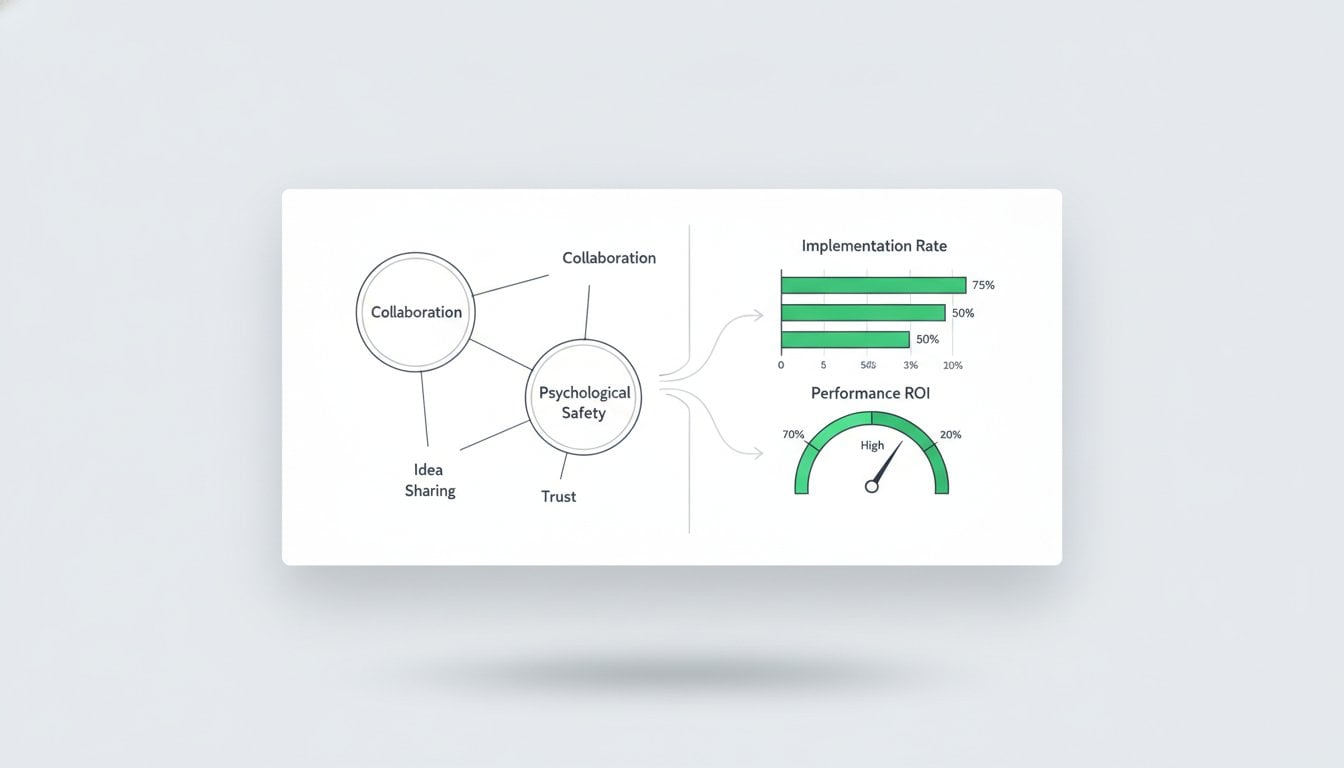
Psychological safety is the bedrock of any high-performance team. Without it, the fear of professional embarrassment kills radical ideas before they ever reach a whiteboard. Data consistently shows that psychological safety directly correlates with the volume of high-impact, non-incremental ideas generated by a workforce. When leaders prioritize Creating a Culture of Innovation, they effectively neutralize “Innovation Killers” like micromanagement and extreme risk-aversion. These behaviors signal to the workforce that only “safe” or “perfect” ideas are welcome, which effectively shuts down the innovation pipeline and keeps the organization stuck in the status quo.

True progress in improving corporate innovation culture happens when you treat every employee as an intrapreneurial stakeholder in company growth. Inclusivity isn’t just a social metric; it’s a strategic necessity that expands the cognitive diversity of your innovation pipeline by bringing in perspectives from different departments, backgrounds, and hierarchies. By empowering everyone to contribute, you move from a “Boss-led” model to an “Employee-led” engine of growth. This shift ensures that the people closest to the problems are the ones tasked with solving them.

Building Trust Through Transparency

Transparency is the ultimate antidote to disengagement. Many organizations fail because they reject ideas without explanation, creating a “black hole” where employee enthusiasm disappears. Using objective scorecards to provide feedback on rejected concepts shows employees that their contributions were taken seriously, even if they aren’t moving to a pilot phase. “Fail-Forward” sessions further de-stigmatize unsuccessful projects by treating them as vital data-gathering exercises rather than personal failures. This level of cultural openness is one of the primary benefits of employee ideation programs, as it builds a resilient environment where experimentation is celebrated rather than feared.

Empowering the Frontline

Frontline employees often identify the most valuable opportunities for incremental innovation and lean waste reduction. They see the daily operational friction that executives often miss. A classic example of this is the Flamin’ Hot Cheetos story, where a janitor’s observation about a product gap transformed an entire food category. Managers should actively solicit ideas during standard workflows rather than waiting for a formal annual meeting. To capture these insights effectively, consider these practical steps:

  • Integrate “innovation minutes” into daily stand-ups or huddles.
  • Provide mobile-friendly submission tools for workers who don’t work at a desk.
  • Publicly recognize small, incremental wins to build momentum for larger cultural shifts.

If you’re ready to see how a structured platform can facilitate this trust and drive participation, you can schedule a personalized demo to explore the impact on your organization’s bottom line.

Step 2: Transitioning to Structured Innovation Challenges

Broad, open-ended suggestion boxes are where momentum dies. To succeed in improving corporate innovation culture, you must shift to a “Challenge-Led” model. This approach focuses employee creativity on specific, high-priority business problems rather than vague requests for “innovation.” By narrowing the scope, you provide the constraints necessary for truly actionable ideas to emerge. Transitioning to this structured model isn’t just a trend; it aligns with the ISO 56001:2024 standard, which provides the first certifiable framework for innovation management systems. It forces the organization to stop guessing and start solving.

Each campaign should have a “North Star” metric. Are you looking for a 10% reduction in churn or a new revenue stream from an adjacent market? Defining these goals upfront is essential for Fostering Successful Innovation that actually moves the needle. Without clear targets, you’re just collecting noise. Urgency is another powerful catalyst. Programs that stay open indefinitely lose steam. Instead, use time-bound events lasting four to six weeks. This creates a focused window for participation and prevents the initiative from fading into the background of daily operations.

Gamification elements like leaderboards and peer voting boost engagement levels significantly. These aren’t just toys; they are social proof mechanisms that encourage employees to contribute and refine each other’s work. When people see their colleagues participating and receiving recognition, they’re more likely to jump in themselves. This creates a self-sustaining cycle of engagement that transforms innovation from a top-down directive into a shared cultural habit.

Designing a High-Impact Challenge

Effective challenges start by distinguishing between “Pain Points” and “Opportunities.” Pain points focus on fixing existing inefficiencies, while opportunities explore untapped market potential. Both are valid, but they require different evaluation criteria. Set these criteria before you launch. When employees know exactly how their ideas will be judged, the quality of submissions increases. Use cross-functional teams to refine raw ideas. This ensures that a great concept from marketing is vetted for technical feasibility by engineering early in the process, reducing the risk of pursuing unworkable projects.

Scaling Participation Without Chaos

High participation is a win, but it can quickly lead to an “Administrative Wall” if not managed correctly. Collaborative filtering allows the community to help triage submissions, highlighting the most promising concepts through peer review and sentiment analysis. This prevents “Idea Fatigue” by ensuring managers only spend time on high-potential leads rather than wading through hundreds of duplicate or low-value entries. To execute this at scale, organizations often look for the best innovation management software to automate the workflow. These tools handle the logistics of improving corporate innovation culture, so you can focus on the strategy of execution across the entire enterprise.

Step 3: Leveraging AI to Remove Administrative Friction

The “Administrative Wall” is the primary reason why even the most enthusiastic managers eventually stop supporting innovation programs. When an ideation campaign is successful, it often generates hundreds of submissions, creating a crushing workload for the people responsible for evaluating them. Without the right technology, improving corporate innovation culture becomes a burden rather than a benefit. AI solves this by automating the most tedious parts of the process, such as idea deduplication and initial sentiment analysis.

Instead of reviewing ten variations of the same suggestion, AI clusters related entries into “Super-Ideas” that carry higher impact and clearer implementation paths. This allows innovation leads to stop acting like data entry clerks and start acting like strategists. AI-driven insights provide a bird’s-eye view of the innovation landscape, highlighting trends and gaps that would be impossible to spot manually. It transforms a chaotic pile of suggestions into a prioritized roadmap for growth.

AI-Enhanced Evaluation

Modern AI tools for innovation managers can now score ideas against specific strategic goals with remarkable accuracy. This objective scoring ensures that the most relevant concepts rise to the top of the pile immediately. AI also automates the feedback loop, ensuring that every employee receives a response without requiring a manual email from a manager. This keeps the “black hole” effect mentioned earlier at bay. Ideawake AI further accelerates the process by identifying potential resource requirements and technical hurdles during the initial submission phase, significantly reducing the time it takes to move from a concept to a pilot.

Reducing the Cost of Innovation

The financial impact of AI integration is measurable in hours saved. By automating the triage and review phases, organizations can reduce the administrative overhead of innovation programs by as much as 80%. This reduction in cognitive load is especially vital for subject matter experts who are often called upon to vet technical ideas on top of their regular duties. AI bridges the gap between raw creativity and practical implementation by providing the structure needed to move fast. It transforms improving corporate innovation culture from an expensive experiment into a lean, efficient engine of growth.

To see how these automated workflows can revolutionize your internal processes, you can book a free demo of the Ideawake platform today.

Step 4: Measuring Cultural Maturity and Innovation ROI

Culture is often dismissed as a “soft” metric, but in high-performance organizations, it’s treated with the same analytical rigor as a quarterly earnings report. When you’re focused on improving corporate innovation culture, you must distinguish between input metrics and output metrics. Input metrics, like the number of ideas submitted or employee participation rates, measure engagement and initial buy-in. Output metrics, however, track the actual financial impact on the organization. It’s the difference between being busy and being profitable. If you aren’t measuring the dollar value of your culture, you aren’t managing it.

One of the most critical KPIs to track is Innovation Velocity. This measures the total time elapsed from the moment an idea is submitted to the launch of a pilot program. Slow velocity indicates bureaucratic friction that kills employee enthusiasm. You should also monitor your Cultural Net Promoter Score (cNPS). This metric asks employees how likely they are to recommend your organization’s innovation process to a peer. High cNPS scores correlate directly with reduced recruitment costs and improved employee retention. People don’t leave companies where they feel empowered to build the future. It transforms a standard job into a mission with visible impact.

Hard Metrics for Executive Buy-In

To secure long-term executive buy-in, you need hard data. You can’t rely on anecdotes about “creativity” or “synergy.” Instead, focus on calculating the ROI of idea management by tracking cost savings from continuous improvement initiatives and revenue generated from new product lines. When you can show that a single internal challenge resulted in $500,000 in operational savings, the conversation shifts from “culture” to “competitive advantage.” These figures provide the accountability that leadership demands, proving that culture is a driver of the bottom line rather than a cost center.

The Innovation Maturity Scale

Organizations typically move through an Innovation Maturity Scale, ranging from Level 1 (Ad-hoc and reactive) to Level 5 (Optimized and embedded). Level 1 organizations only innovate when a crisis hits, while Level 5 firms have innovation in their DNA. To move up this ladder, conduct quarterly “Culture Audits” to identify bottlenecks like slow approval times or lack of manager feedback. As your program scales, your technological needs will evolve. Developing a clear roadmap for how to choose the best innovation management software ensures that your infrastructure can support a Level 5 culture. This isn’t just about improving corporate innovation culture today; it’s about building a permanent, results-driven engine for enterprise growth.

Transforming Your Innovation Strategy Into a Competitive Engine

The transition from performative “innovation theater” to a results-driven culture requires more than just good intentions. It demands a systematic approach that combines psychological safety with structured, time-bound challenges. By focusing employee creativity on specific business problems and providing transparent feedback, you ensure that improving corporate innovation culture becomes a repeatable process rather than a random occurrence. The goal is to move up the maturity scale until innovation is embedded in your organization’s DNA.

Technology is the catalyst that makes this scale possible without drowning your managers in paperwork. Modern tools reduce administrative complexity by up to 80% through automated triage and AI-driven insights. This efficiency allows your team to focus on high-value strategic execution and end-to-end lifecycle management from the first submission to final ROI tracking. If you’re ready to operationalize your creativity and see tangible financial impact, book a free demo of Ideawake's platform today. It’s time to stop guessing and start building the future of your enterprise with data-backed confidence.

Frequently Asked Questions

What is the most effective way to start improving corporate innovation culture?

The most effective starting point is launching a narrow, high-impact pilot challenge rather than attempting a company-wide cultural overhaul. By focusing on a specific business problem that frontline employees can solve within a few weeks, you demonstrate immediate value. This builds the necessary momentum and social proof to justify larger cultural shifts and executive investment in the future.

How do you measure the success of an innovation culture shift?

Success is measured through a combination of Innovation Velocity and the Cultural Net Promoter Score (cNPS). Innovation Velocity tracks the time from idea submission to the launch of a pilot, revealing how much bureaucratic friction exists. A rising cNPS indicates that employees feel more empowered and psychologically safe, which is a leading indicator of long-term participation and radical idea generation.

Why do most corporate innovation programs fail within the first two years?

Most programs collapse because they hit the “Administrative Wall.” When managers are overwhelmed by manual triage and employees don’t see their ideas move toward implementation, engagement disappears. Without a structured system to manage the lifecycle of an idea, the program becomes perceived as “Innovation Theater,” leading executives to withdraw support when they don’t see a clear ROI.

How can AI help in building a more innovative culture?

AI removes the administrative friction that kills momentum by automating deduplication and initial sentiment analysis. It ensures that every employee receives prompt, data-backed feedback on their submissions. This responsiveness is critical for improving corporate innovation culture because it proves to the workforce that their contributions are valued and evaluated against objective strategic goals rather than subjective opinions.

Does a culture of innovation require a large budget?

A robust culture is built on psychological safety and structured processes rather than massive capital expenditure. While investing in an execution platform is necessary for scale, the cost of “Innovation Theater” and lost productivity far exceeds the price of modern tools. Most radical innovations come from better utilizing the existing cognitive diversity of your workforce rather than spending on physical prototyping labs.

How do you encourage employees to participate in ideation without offering cash prizes?

Intrinsic motivators like autonomy, peer recognition, and the opportunity to lead a project are more effective than cash. Gamification elements such as leaderboards and voting systems create a sense of community and social proof. Employees are most motivated when they see their ideas actually implemented, as it gives them a sense of ownership over the company’s future growth.

What role does psychological safety play in corporate innovation?

Psychological safety is the prerequisite for any non-incremental growth. If employees fear professional embarrassment or career repercussions for a failed experiment, they’ll only submit “safe” or obvious ideas. Safety creates an environment where “failing forward” is treated as a data-gathering exercise. This openness is a cornerstone of improving corporate innovation culture and driving radical breakthroughs that challenge the status quo.

How often should a company run innovation challenges to maintain culture?

A quarterly rhythm is ideal for maintaining momentum without causing “Idea Fatigue” among your staff. This schedule provides enough time to evaluate and pilot the winning ideas from the previous cycle while keeping innovation top-of-mind. Regular, time-bound events create a healthy sense of urgency and ensure that the innovation process is viewed as a permanent system rather than a one-off initiative.

How to Measure Innovation Culture: A Data-Driven Guide for Enterprise Leaders

How to Measure Innovation Culture: A Data-Driven Guide for Enterprise Leaders
Coby Skonord|
July 6, 2026

Innovation culture is not a “feeling” your HR team surveys once a year; it is the measurable efficiency with which your organization converts raw human potential into implemented ROI. Most enterprise leaders understand that a stagnant culture kills growth, yet they struggle to prove it to a skeptical board when the only data available comes from low-participation suggestion boxes. It’s difficult to justify cultural initiatives when you can’t connect them to the bottom line. This guide provides the exact framework you need to learn how to measure innovation culture using hard data that turns subjective sentiment into a concrete driver of performance. A 2026 global survey revealed that 21 new entrants joined the list of the Top 100 global innovators, proving that the competitive landscape is shifting rapidly for those who can’t quantify their creative output. You’ll gain a repeatable audit process and the specific KPIs required to prove that cultural shifts lead directly to higher implementation rates. We’re moving beyond “vibes” to establish an evidence-driven system that secures your competitive advantage.

Key Takeaways

  • Move beyond subjective “vibes” by defining innovation culture as a set of observable behaviors that directly accelerate your idea-to-value lifecycle.
  • Learn how to measure innovation culture by distinguishing between leading indicators like psychological safety and lagging indicators like financial ROI.
  • Execute a repeatable five-step audit process to map your organization’s idea journey and identify the specific friction points that stall progress.
  • Discover why shifting from spreadsheets to a dedicated innovation management platform is a critical step in scaling a high-performance culture.
  • Use AI-powered tools to eliminate the “culture tax” of manual administration and provide the real-time visibility required for executive buy-in.

Defining Innovation Culture: Why “Vibes” Aren’t Enough in 2026

Innovation culture is often mistakenly reduced to employee perks or creative office layouts. In reality, it’s the specific set of organizational behaviors that either accelerate or obstruct the journey from a raw concept to realized market value. As we move through 2026, the era of “theatrical innovation,” characterized by aesthetic brainstorming sessions and sticky notes, has ended. Enterprise standards now demand structural innovation. This requires moving toward data-backed systems that treat culture as a measurable asset rather than an abstract feeling. Understanding how to measure innovation culture involves adopting “Innovation Accounting,” a framework that bridges the gap between cultural health and financial performance. By grounding these efforts in the principles of innovation management, leaders can stop relying on intuition and start calculating impact.

The Financial Risk of an Unmeasured Culture

When culture remains unmeasured, organizations suffer from “innovation leaks.” These are the critical points where high-value ideas perish due to middle management bottlenecks or a lack of clear feedback loops. This isn’t just a morale issue; it’s a significant financial drain on the organization. Research into the benefits of employee ideation programs shows that structured engagement reduces turnover and optimizes operational efficiency. Without measurement, you also risk funding “zombie projects.” These are initiatives that persist purely because the culture lacks the psychological safety to admit failure and cut losses. A measured culture provides the data necessary to kill these drains on resources before they impact the bottom line.

Innovation as an Outcome of Internal Systems

Think of your culture as the “operating system” and your digital tools as the hardware. High-performance hardware is useless if the underlying OS is riddled with bugs. To fix this, leaders must distinguish between creativity vs. innovation. Creativity is the act of generating ideas. Innovation is the successful implementation of those ideas to create tangible value. Truly knowing how to measure innovation culture involves auditing the systems that support this transition. This requires a structured idea submission process that tracks every concept from inception to impact. When the process is visible and structured, culture becomes a predictable engine for growth rather than a series of happy accidents.

The 3 Core Pillars of a Measurable Innovation Culture

Culture is not a monolith. It is a high-performance engine built on three quantifiable pillars that dictate your organization’s ability to evolve. When enterprise leaders ask how to measure innovation culture, they must look beyond employee satisfaction scores. You need to analyze the specific behaviors that drive the High-Performance Innovation Loop: the continuous cycle of ideation, validation, and implementation. Without these pillars, your innovation strategy is just a collection of expensive slides. By measuring psychological safety, resource accessibility, and leadership responsiveness, you transform culture into a predictable driver of ROI.

Measuring Psychological Safety and Risk Tolerance

Psychological safety is the bedrock of any creative organization. It is not about being “nice”; it is about the freedom to fail without career-ending repercussions. We track this through the “Failure Rate” as a positive cultural metric. In a healthy ecosystem, innovation failures are not sunk costs; they are high-value learning data points that prevent future mistakes. Psychological safety is the primary predictor of success for both incremental vs. radical innovation. If your team only submits “safe” ideas, your culture is effectively stalled. You must measure the frequency of “risky” or “radical” ideas submitted to gauge the true level of trust within your workforce.

Resource Accessibility and the “20% Time” Myth

Intent is nothing without access. Many firms claim to support new ideas but provide zero budget or time for employees to explore them. Google’s 20% time program serves as a legendary benchmark for resource allocation, yet many enterprises fail to implement the underlying mechanics. To truly understand how to measure innovation culture, you must track “Time-to-Resource” as a critical KPI. This measures how quickly a validated idea receives the necessary funding or headcount. This prevents the stagnation found in the 8 forms of lean waste, specifically the waste of underutilized human talent. If your team cannot access resources without a 12-month committee review, you don’t have an innovation culture; you have a bureaucracy.

Leadership responsiveness completes the loop. Transparency in decision-making builds the trust required for high-volume participation. If feedback takes six months, the momentum dies. Measuring the velocity of the “Yes/No” decision is critical for cultural health. If you want to see how these metrics look in a real-world environment, schedule a platform walkthrough to explore our data-driven dashboards.

Quantitative vs. Qualitative: Choosing Your Innovation Metrics

Distinguishing between what we can count and what we can feel is the most significant challenge when determining how to measure innovation culture. Leading indicators act as early warning systems, predicting future success based on current engagement levels. These include the volume of active contributors and the frequency of structured sessions like reverse brainstorming. Conversely, lagging indicators such as implementation rates and time-to-market reflect the historical performance of your systems. A 2026 European benchmark study of over 100 innovation teams is currently formalizing these KPIs to help organizations move from activity-based reporting to impact-based results. A holistic “Culture Scorecard” weights these metrics to ensure that high activity actually translates into commercial value.

Hard Metrics: Participation Rates and Pipeline Velocity

Soft Metrics: Sentiment Analysis and Collaborative Diversity

A 5-Step Process to Audit Your Organization’s Innovation Health

Enterprise leaders often get lost in the theoretical “how” of cultural transformation. To master how to measure innovation culture, you need a repeatable audit process that exposes the hidden friction in your operations. This audit isn’t a one-time event; it is a systematic review of how ideas flow or stall within your existing hierarchy. By following a structured five-step approach, you can identify precisely where your organization is leaking value. It’s about moving from anecdotal evidence to a rigorous, data-driven assessment of your innovation health.

  • Step 1: Establish a Baseline. Run a blinded cultural assessment to identify perceived bottlenecks.
  • Step 2: Map the Idea Journey. Track a single concept from the initial employee suggestion through to implementation.
  • Step 3: Analyze Collaborative Reach. Measure the depth of cross-departmental involvement in a single project.
  • Step 4: Audit Feedback Loops. Calculate the Mean Time to Feedback (MTTF) provided by management.
  • Step 5: Review Implementation Success. Compare the rate of implemented ideas against baseline cultural sentiment scores.

Establishing a Baseline with Employee Surveys

The first step requires radical honesty. You must ask questions that target “permission to fail” and “clarity of strategy.” For example, ask employees if they feel safe proposing an idea that contradicts current business units or if they understand the specific criteria for a “winning” project. It’s also vital to assess innovation skills alongside attitude. A willing team without the right skills will still fail to execute. This baseline measurement provides the starting point for the phases of continuous improvement, ensuring you aren’t building on a fractured foundation.

Analyzing the Idea Pipeline for Cultural Friction

Once you have a baseline, you must look at the pipeline itself. Ideas frequently stall during the idea evaluation process because of opaque decision-making or excessive bureaucracy. This is where the “Innovation Friction Coefficient” comes into play. The Innovation Friction Coefficient is the ratio of submitted ideas to those that receive a formal evaluation. High friction indicates a culture that discourages participation through silence. Utilizing a centralized idea management database makes this audit possible by providing a single source of truth for every interaction. It allows you to see where momentum dies and which managers are acting as catalysts rather than gatekeepers.

Auditing these five steps reveals the true state of your organization’s creative health. If your MTTF is over 30 days, your culture will inevitably stagnate regardless of your vision. If you’re ready to stop guessing and start measuring these metrics in real-time, schedule a platform demo to see our automated audit dashboards in action.

Scaling Culture with Modern Innovation Management Platforms

Scaling a high-performance culture across a global enterprise is impossible when using manual, disconnected tools. The decision between Ideawake vs. Spreadsheets is more than a technical preference; it’s a critical cultural choice. Spreadsheets are static and siloed, often acting as the place where engagement and visibility go to die. In contrast, a modern platform provides the transparency required to understand how to measure innovation culture at every level of the hierarchy. By automating the administrative burden, AI tools for innovation managers eliminate the “culture tax” that often prevents middle management from buying into new initiatives. To ensure long-term adoption, deep integrations with existing communication stacks keep innovation within the daily workflow, making participation as natural as sending a message.

Leveraging AI for Real-Time Cultural Mapping

The real power of a digital-first approach lies in predictive analysis. Using Ideawake AI, leaders can identify emerging cultural trends and potential bottlenecks before they manifest as significant performance drops. This technology monitors the sentiment of cross-departmental collaboration, providing a real-time heat map of organizational health. Gamification elements, such as peer voting and reward systems, maintain long-term engagement by recognizing contributions publicly and fairly. Additionally, structured idea evaluation tools help remove human bias from the selection process. This ensures that ideas are judged on their objective merit rather than the departmental rank of the submitter, fostering a truly meritocratic environment.

Implementation: Moving from Data to Action

Transitioning to a data-driven system requires a clear implementation roadmap. It begins with setting specific baseline KPIs and then rolling out the platform to pilot groups to gather initial sentiment data. The ultimate goal is to foster the kind of environment that produced the 10 innovative product examples that have defined market leadership in recent years. Culture is a powerful competitive edge, but it requires a modern platform to sustain and scale. If you’re ready to stop managing innovation through guesswork and start seeing the hard data behind your creative output, sign up for a demonstration to see your cultural metrics in action.

Transforming Cultural Insight into Measurable Performance

The era of treating organizational culture as a nebulous “vibe” has been replaced by a demand for rigorous, evidence-based management. You now have the framework to move beyond subjective surveys and implement a system where psychological safety and resource accessibility are tracked with the same precision as financial OpEx. By mastering how to measure innovation culture, you empower your organization to identify “innovation leaks” and bridge the gap between raw creativity and realized market value. Success in the competitive environment of 2026 requires more than just good intentions. It demands an infrastructure that makes the intangible tangible. Ideawake is trusted by enterprise leaders to manage the full innovation lifecycle by providing built-in AI sentiment analysis for cultural health tracking. With proven ROI measurement tools for C-suite reporting, you can finally demonstrate the direct link between cultural health and the bottom line. It’s time to stop guessing and start leading with data.

Ready to see your innovation metrics in real-time? Book a demo of Ideawake today.

Your organization’s untapped potential is waiting for a system that can finally prove its value. By taking these steps, you aren’t just measuring a culture; you’re building a resilient engine for future growth.

Frequently Asked Questions

Is innovation culture really measurable or is it just a buzzword?

Innovation culture is a measurable asset defined by observable behaviors rather than a vague corporate buzzword. You can quantify it by tracking specific interactions within your idea pipeline, such as the frequency of cross-departmental contributions and the speed of resource allocation. When you treat culture as a data set, you move from subjective sentiment to objective performance tracking that identifies exactly where your organization is leaking potential.

What are the most important KPIs for measuring innovation culture?

The most effective KPIs for determining how to measure innovation culture include leading indicators like the percentage of active contributors and the volume of radical versus incremental ideas. You should also track lagging indicators such as your idea conversion rate and the total ROI per implemented project. These metrics provide a holistic view of your innovation health by connecting employee engagement directly to financial outcomes.

How often should an organization audit its innovation culture?

Organizations should perform deep-dive audits annually while maintaining real-time pulse checks through their innovation management platform. Continuous data collection allows you to spot cultural friction as it happens rather than waiting for a yearly report to reveal a drop in engagement. This proactive approach ensures your innovation engine remains optimized and your teams stay aligned with strategic business objectives throughout the fiscal year.

Can software like Ideawake actually improve our company culture?

Software provides the necessary infrastructure to scale the behaviors you want to see in your organization. Ideawake improves culture by providing a transparent, meritocratic environment where every employee sees their ideas evaluated through a structured, bias-free process. This visibility builds the trust required for high-volume participation and eliminates the administrative bottlenecks that typically discourage employees from sharing their best concepts.

What is the difference between an engagement survey and an innovation culture audit?

Engagement surveys measure general employee satisfaction and morale, whereas an innovation culture audit measures the efficiency of your idea-to-value lifecycle. While an employee might be happy at work, they may still feel the organization is too risk-averse to support new initiatives. An audit specifically targets the systems, feedback loops, and resource access points that dictate your company’s actual capacity for change and growth.

How do we measure psychological safety in a corporate environment?

You can measure psychological safety by analyzing the ratio of “risky” or radical ideas submitted compared to safe, incremental suggestions. Another critical metric is the participation rate following a failed project; if engagement drops after a failure, it indicates a lack of safety. High-performance cultures show steady participation levels because employees know that well-managed risk is a valued part of the learning process.

Should we reward employees for ideas that fail?

You should reward the rigor of the process and the data gathered rather than the failure itself. Celebrating the “smart failure” of a well-tested hypothesis encourages risk-taking and helps kill zombie projects before they drain excessive resources. This cultural shift ensures that employees focus on high-impact experimentation without fear of career repercussions, which is a core component of how to measure innovation culture effectively.

How do we connect cultural metrics to financial ROI?

Connecting culture to ROI requires tracking how improvements in engagement and feedback velocity lead to higher implementation rates. By reducing your “Innovation Friction Coefficient,” you increase the volume of ideas that reach the market, which directly impacts your bottom line. Use an ROI calculator to assign dollar values to the time saved through automated triage and the revenue generated from employee-led continuous improvement initiatives.

Idea Selection Criteria for Innovation: The 2026 Framework for Data-Driven Scoring

Idea Selection Criteria for Innovation: The 2026 Framework for Data-Driven Scoring
Coby Skonord|
June 28, 2026

While global AI spending is projected to hit $2.52 trillion in 2026, a January 2026 PwC survey revealed that 56% of CEOs have seen zero revenue growth or cost savings from these significant investments. The problem isn’t a lack of technology; it’s a failure of selection. Most innovation pipelines are currently clogged with low-value “pet projects” that survive on executive whim rather than data-backed potential. You’ve likely felt the frustration of watching high-potential concepts stall while mediocre ideas drain your resources and damage your credibility with the board.

It’s time to move beyond the “gut-feel” voting that turns innovation into a gamble. You’ll master the objective idea selection criteria for innovation and the weighted scoring tools necessary to filter noise and identify the high-impact ideas that drive measurable enterprise ROI. We’ll break down the 2026 framework for multi-dimensional evaluation, ensuring your process aligns with the new ISO 56001:2024 certifiable standards while removing the subjective bias that kills performance. By the end of this guide, you’ll have a repeatable system to transform your pipeline from a chaotic backlog into a strategic driver for growth.

Key Takeaways

  • Solve the “signal-to-noise” problem by identifying the high-impact concepts that deliver measurable enterprise value rather than just volume.
  • Establish objective idea selection criteria for innovation to eliminate executive bias and ensure every project aligns with your 2026 corporate objectives.
  • Master weighted scoring mechanics to objectively rank ideas based on their potential ROI versus the technical complexity of implementation.
  • Replace error-prone spreadsheets with dedicated scoring tools that provide real-time visibility and automated reporting across your entire innovation pipeline.
  • Leverage AI-enhanced evaluation to automatically detect duplicates and predict implementation success based on historical performance data.

What is Idea Selection Criteria and Why Does It Matter in 2026?

In 2026, the primary bottleneck for enterprise growth isn’t a lack of ideas; it’s the inability to identify the winners. Idea selection criteria for innovation are the objective benchmarks used to assess the viability, scalability, and strategic value of a concept before a single dollar is committed to development. Without these filters, organizations fall into the “Signal-to-Noise” trap. While AI tools have made it easier to generate thousands of suggestions, a high volume of ideas often leads to less actual innovation because the truly transformative concepts get buried under a mountain of low-value noise.

Successful enterprises have abandoned popularity-based voting systems. Likes and comments are social metrics, not business ones. Instead, high-performing leaders now rely on evidence-based scoring that requires a structured idea submission process to ensure every entry contains the data points necessary for a rigorous evaluation. This transition turns the selection engine from a black box into a transparent, high-performance filter that prioritizes outcomes over optics.

The High Cost of Subjective Innovation

When selection is left to intuition, the “HiPPO” (Highest Paid Person’s Opinion) effect dominates the room. This hierarchy-driven decision making silences diverse perspectives and favors “safe” projects that align with an executive’s personal preferences rather than market reality. Research into organizational behavior consistently shows that cognitive biases lead teams to choose incremental improvements over radical breakthroughs because they feel less risky. This subjectivity is expensive. The Innovation Gap is the measurable distance between the volume of ideas generated and the percentage of those ideas that successfully reach implementation.

Transitioning from Intuition to Data-Driven Decisions

The Weighted Scoring Model: A Framework for Objective Evaluation

Stop treating every metric as if it carries the same weight. In a high-performance innovation ecosystem, an idea’s potential market impact must always outweigh its ease of implementation. If you prioritize “low-hanging fruit” simply because it’s easy to do, you’ll inevitably build a portfolio of mediocrity that fails to move the needle on corporate strategy. A weighted scoring model corrects this by assigning a percentage of importance to each of your idea selection criteria for innovation, ensuring that the most transformative concepts rise to the top.

The mechanics are straightforward but powerful. For every idea, evaluators provide a raw score for specific criteria, which is then multiplied by a predetermined weight (Score x Weight = Total Value). This mathematical approach creates a single, undeniable ranking of your pipeline. To maintain high standards, organizations should implement a “Threshold” concept. This is a minimum aggregate score an idea must achieve to move from the discovery phase into prototyping. If a concept doesn’t hit the mark, it’s archived, preventing your team from wasting cycles on projects that lack the “DNA” of a winner. Tracking these scores requires a centralized innovation database rather than disconnected documents to ensure historical data informs future decisions.

Defining Your Evaluation Scales

Precision starts with your scale. While a 10-point scale offers more nuance, it often leads to “score creep” where evaluators struggle to distinguish a 7 from an 8. A 5-point scale is typically the sweet spot for enterprise evaluation because it forces more decisive choices. To ensure consistency across different departments, you must define “anchor points.” For example, a “5” in Strategic Alignment should mean the idea directly addresses a top-three corporate KPI for the current fiscal year. Choosing an odd-numbered scale like 1 to 5 allows for a middle ground, but be careful. Including “Neutral” options in evaluation scales often leads to decision paralysis because it allows stakeholders to avoid taking a definitive stance on high-potential risks.

Balancing Qualitative and Quantitative Inputs

Numbers provide the structure, but expert commentary provides the soul. A robust framework integrates numerical scores with qualitative feedback to give leadership a holistic view of an idea’s potential. This is particularly important when weighing “Strategic Alignment” against “Technical Feasibility.” An idea might score perfectly on alignment but poorly on feasibility; the qualitative input explains whether that feasibility gap is a temporary resource issue or a permanent technological barrier. Remember that evaluation is a multi-stage process. You shouldn’t demand a detailed ROI projection in the early funnel. Use broader criteria for initial screening and save the intensive, data-heavy scoring for the final few candidates. To see how these models look in action, you can explore a live evaluation framework designed for enterprise scale.

Idea Evaluation and Scoring Tool: Spreadsheets vs. Dedicated Platforms

Many organizations start their innovation journey with a spreadsheet. It’s accessible and familiar. However, once your pipeline expands beyond a handful of concepts, manual tracking becomes a primary driver of “Innovation Overhead.” Spreadsheets suffer from chronic version control issues and lack the real-time collaboration required for cross-functional teams. When your idea selection criteria for innovation are trapped in a static document, the process slows to a crawl, often leading to the very “pet projects” you’re trying to avoid. Manual data entry isn’t just tedious; it’s a liability that introduces human error into your most critical investment decisions.

Transitioning to a dedicated idea evaluation and scoring tool changes the game. These platforms automate the complex math and reporting that consume hours of administrative time. By shifting from manual calculations to automated systems, innovation managers can focus on strategy rather than logistics. Data from the Ideawake vs Spreadsheets comparison shows that organizations can reduce the time spent on administrative tasks by up to 80%, allowing teams to move from submission to implementation at a significantly faster pace.

The Hidden Complexity of Manual Scoring

Manual tools fail the moment you scale. Handling 100 or more ideas from diverse departments creates a logistical nightmare in Excel. Data silos form quickly, as insights from one evaluator are rarely visible to another in a meaningful way. Legacy innovation software often replicates these silos by offering rigid structures that don’t adapt to your specific needs. Modern platforms solve this by enabling “Blind Scoring.” This feature hides the identity of the idea submitter and other evaluators’ scores until the process is complete, which is a critical step in neutralizing the cognitive biases discussed earlier. For organizations ready to move beyond these limitations, a collaborative idea management platform provides the cross-functional visibility and structured workflows needed to evaluate ideas at enterprise scale.

Features to Look for in a Modern Scoring Platform

5 Essential Idea Selection Criteria for Maximum ROI in 2026

  • Strategic Alignment: Does the idea directly solve a problem identified in your 2026 corporate roadmap?
  • Customer/Market Impact: Will this fundamentally solve a pain point for the end-user, or is it just a “nice-to-have” feature?
  • Technical & Financial Feasibility: Do we possess the internal expertise to execute this, and is the cost-to-benefit ratio favorable?
  • Scalability: Can this solution be expanded across other departments or global markets without a linear increase in resource consumption?
  • Risk Level: What are the regulatory hurdles, and could a failure cause significant reputational or financial damage?

Strategic Alignment: The Ultimate Filter

Alignment is the difference between genuine progress and “Innovation Theater.” You will frequently encounter “great” ideas that are technically brilliant but completely irrelevant to your company’s current focus. You must have the discipline to reject these. Pursuing projects that look good on paper but lack strategic depth drains your resources and creates a “drift” that confuses stakeholders and investors. To quantify the value of staying on track, use an Ideawake ROI calculator to model how tight alignment correlates with long-term financial outcomes.

Feasibility vs. Desirability

The “Sweet Spot” of innovation exists where high user desirability intersects with organizational capability. If you find an idea that customers crave but your team cannot build, it is a hallucination. Conversely, building something your team excels at that no one actually wants is a waste of capital. Use a 2×2 matrix to visualize your pipeline, separating “Low Hanging Fruit” from “Big Bets.” Involve your technical leads early in the feasibility scoring phase to prevent “zombie projects” from eating your budget before they’re even prototyped. To see how these idea selection criteria for innovation are built into a high-performance workflow, you can book a free demo of our evaluation framework today.

Beyond Human Bias: Leveraging AI in the Selection Process

The human element is both the greatest asset and the largest liability in the evaluation process. Even with the most robust idea selection criteria for innovation, human reviewers are susceptible to fatigue, departmental favoritism, and subconscious “safe” choices. By 2026, the pivot toward AI accountability requires more than just human intuition to justify capital allocation. Integrating Ideawake AI into your workflow provides a neutral layer of analysis that identifies patterns humans often miss. Automated duplicate detection immediately flags redundant concepts, while sentiment analysis helps gauge the underlying enthusiasm or skepticism within the workforce before a project is even greenlit.

These AI tools for innovation managers serve as a force multiplier for stretched teams. They can summarize thousand-word proposals into actionable executive briefs, allowing for a faster review of complex technical concepts. However, it’s vital to remember that AI is designed to assist, not replace, the final human decision. The technology provides the data-backed “why,” but leadership provides the strategic “how.” By using machine learning to cross-reference new ideas with historical data, organizations can better predict implementation success and avoid the ROI disconnect that currently plagues 56% of enterprise AI investments.

Mitigating Cognitive Bias with Machine Learning

Machine learning models excel at identifying the subtle patterns of bias that skew human scoring. Whether it is a preference for certain departments or a gender-based tilt in project approval, AI can audit historical scoring data to flag inconsistencies. This ensures that your idea selection criteria for innovation are applied with total objectivity across the entire enterprise. Looking ahead, “Predictive Scoring” is becoming the standard. By cross-referencing new submissions with real-time market trends and internal performance metrics, AI can predict implementation success with higher accuracy than a traditional committee. It can even suggest diverse “Review Committees” by identifying subject matter experts across the organization who possess the specific knowledge required to evaluate a niche concept.

Accelerating the Review Cycle

The traditional innovation funnel is often where high-potential concepts go to die. Slow decision-making kills enthusiasm and allows competitors to move first. Leveraging automated workflows can reduce the time-to-decision from months to mere days. When an idea is submitted, the system can provide instant feedback or request missing data points immediately, maintaining a high-energy culture of participation. This speed isn’t just about efficiency; it’s about competitive survival. In a market where 57% of leaders report AI is already embedded in core processes, the ability to filter and fund winners faster than the competition is the ultimate differentiator. Ready to see data-driven selection in action? Sign up for a demo of Ideawake and transform your innovation pipeline today.

Transforming Your Pipeline into a Strategic Growth Engine

The era of “innovation theater” is over. Success in 2026 requires a shift from gut-feel voting to rigorous, weighted scoring models. By establishing objective idea selection criteria for innovation, you eliminate the cognitive biases that lead to mediocre “safe” projects and instead prioritize concepts with the highest potential for enterprise ROI. Moving beyond manual spreadsheets allows your organization to scale without the administrative burden that typically stalls early-stage concepts. It’s time to stop gambling on intuition and start investing in proven winners.

Ideawake provides an end-to-end platform used by Fortune 500 companies to transform their innovation culture into a measurable financial driver. Our AI-driven insights reduce administrative overhead by 80%; this allows your team to focus on implementation rather than data entry. Master your innovation pipeline with Ideawake’s evaluation tools and secure your organization’s competitive edge. Your next breakthrough is waiting for a better filter.

Frequently Asked Questions

What are the most common idea selection criteria for enterprise innovation?

The most common criteria include strategic alignment, customer impact, technical feasibility, scalability, and financial risk. These benchmarks ensure that a concept isn’t just creative but actually viable within the organization’s current resource constraints. By using these five pillars, leaders can filter out noise and focus on concepts that deliver a measurable return on investment.

How do you weigh different criteria in an innovation scoring model?

You weigh criteria by assigning a percentage value to each category based on your current corporate priorities. For example, a growth-focused firm might weight “Market Impact” at 40% while keeping “Ease of Implementation” at 10%. This ensures that high-impact ideas aren’t penalized simply because they require more effort to execute. The total weight across all categories must always equal 100%.

Can an idea management platform really remove human bias?

While no tool can eliminate human bias entirely, a dedicated platform significantly mitigates it through features like “Blind Scoring” and AI-driven sentiment analysis. These tools hide the identity of the submitter and prevent evaluators from seeing each other’s scores until the process is complete. This forces reviewers to focus on the objective data rather than personal or departmental favoritism.

What is the difference between idea evaluation and idea selection?

Idea evaluation is the analytical process of scoring a concept against specific benchmarks; selection is the final decision to allocate resources or fund the project. Evaluation provides the data-backed evidence needed to make an informed choice. Selection is the strategic action that moves an idea from the “Value Pipeline” into active development or prototyping.

How many people should be involved in the scoring process?

Most high-performing organizations involve 3 to 5 subject matter experts per idea to ensure a balanced perspective. Including too few reviewers increases the risk of individual bias; including more than five often leads to administrative bottlenecks and decision paralysis. The goal is to gather diverse insights from technical, financial, and market-facing leads without stalling the review cycle.

Why is strategic alignment considered the most important criterion?

Strategic alignment is the most critical idea selection criteria for innovation because it ensures that every project directly supports the organization’s long-term roadmap. Even a technically brilliant idea is a waste of capital if it doesn’t solve a problem the company is actually trying to fix. Alignment prevents the “Innovation Theater” that drains budgets without producing a strategic advantage.

How often should we update our selection criteria?

You should review and update your selection criteria at least once a year or whenever your corporate strategy undergoes a major shift. As market conditions change, what was considered a “high impact” project last year might be irrelevant today. Keeping your filters updated ensures your innovation pipeline remains responsive to new competitive threats and market opportunities.

What is the “weighted scoring” method exactly?

The weighted scoring method is a mathematical formula where you multiply a raw score by a predetermined weight to reach a final value. If “Strategic Alignment” has a weight of 0.5 and the idea scores an 8, the weighted value is 4. This method provides a clear, numerical ranking that makes it impossible for subjective opinions to override your data-backed priorities.