
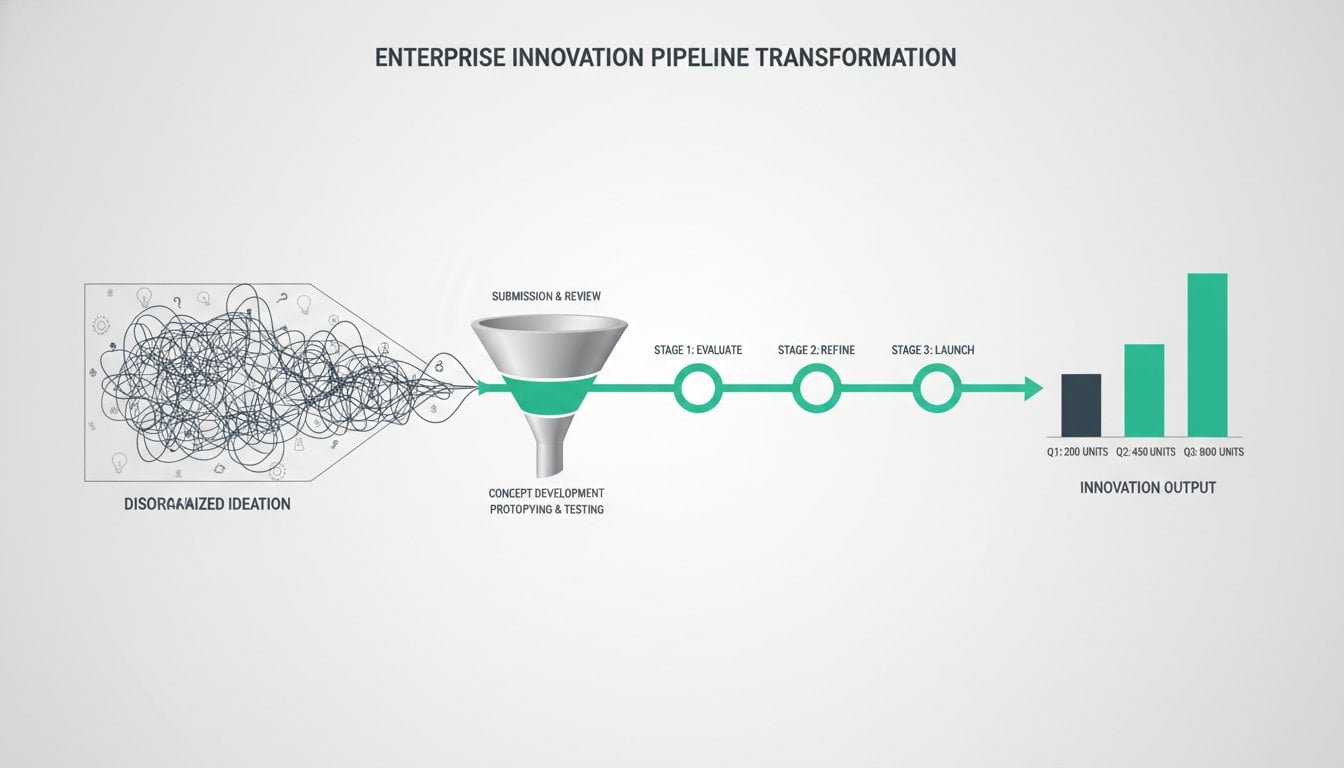
Why do 50% of enterprises fail to launch a single innovation over a multi-year period? According to the OECD, this was the median reality for organizations between 2020 and 2022. This stagnation isn’t caused by a lack of creativity; it’s a failure of infrastructure. Most organizations are trapped in “innovation theater,” using outdated suggestion boxes that create administrative bottlenecks and leave executive leadership questioning the ROI. To break this cycle, you need enterprise innovation tools designed for execution rather than just ideation.
You’ve likely felt the frustration of low employee participation and the weight of evaluating thousands of ideas manually. It’s time to stop settling for average results and start building a pipeline that delivers tangible financial gain. This guide will show you how to modernize your approach by leveraging AI-powered automation, gamification, and structured workflows. We’ll explore the 2026 landscape of innovation management, providing you with a clear framework to select a platform that transforms your culture and proves its value to the board.
Key Takeaways
- Identify the structural flaws in traditional “suggestion boxes” and learn how to replace passive collection with an active, high-participation pipeline.
- Explore how AI-driven screening and gamification engines work together to eliminate administrative delays and maintain long-term employee engagement.
- Use our TCO framework to evaluate enterprise innovation tools, ensuring your choice integrates with critical systems like your CRM and ERP.
- Shift your focus from simple ideation to measurable impact by implementing stage-gate automation and ROI-focused tracking metrics.
Why Traditional Enterprise Innovation Tools Fail in 2026
Most legacy systems were built as glorified digital suggestion boxes. They focus entirely on the top of the funnel while ignoring the execution phase. This passive collection model is a primary reason why many enterprise innovation tools fail to deliver long-term results. When an organization treats ideation as a standalone event, engagement naturally decays. Employees quickly realize their contributions are entering a feedback black hole where transparency is nonexistent. Without clear routing and visibility, the motivation to participate evaporates, leaving the program stagnant and the pipeline empty.
Manual idea screening is a silent killer of momentum. When a small team of managers has to sort through hundreds of submissions without automation, the time-to-feedback can stretch into months. This delay doesn’t just frustrate employees; it carries a significant financial cost in the form of lost productivity and missed market windows. If your team is spending 20 hours a week on administrative routing, they aren’t spending that time on high-value strategic execution. Legacy platforms that lack automated scoring mechanisms essentially force your most expensive talent to act as data entry clerks.
Data silos present another critical failure point. When innovation data is disconnected from core business metrics, it’s impossible to prove ROI to executive leadership. If your innovation tool doesn’t talk to your CRM or ERP, you’re flying blind. You can’t see how a specific idea improved customer retention or reduced supply chain costs. This lack of integration makes innovation feel like a side project rather than a core business driver. To scale, innovation must be treated as a measurable financial asset, not a vague cultural goal.
The Shift from Ideation to Implementation
Research suggests that nearly 70% of enterprise innovation programs fail within their first two years. This high rate of innovation failures often stems from a lack of structured innovation lifecycle management. Modern organizations must move beyond simple creativity toward the paradigm of open innovation, which integrates internal and external insights into a repeatable operational framework. Success in 2026 requires a shift from having ideas to executing them with precision.
Administrative Complexity vs. Scalability
Scaling a program to manage over 1,000 ideas manually is impossible. The administrative burden of screening, routing, and scoring concepts without automation creates massive bottlenecks. Legacy enterprise innovation tools often add to technical debt rather than reducing it, requiring constant IT oversight. A modern architecture is essential for global, cross-functional teams to collaborate without being slowed down by manual data entry or disconnected silos that hide the true cost of implementation.
Essential Features of a Modern Innovation Management Ecosystem
To stay competitive in 2026, organizations must adopt a structural approach to modern innovation management. A high-performance ecosystem moves beyond the passive collection of ideas. It acts as a force multiplier for your team. Efficiency is the new benchmark. By leveraging AI-augmented evaluation, organizations can reduce manual screening time by up to 80%. This allows managers to focus their energy on high-potential concepts rather than getting buried in administrative noise. Modern enterprise innovation tools must also include dynamic load management to ensure that innovation tasks don’t overwhelm daily operational duties.
AI-Driven Insights and Automation
Gamification and Cultural Engagement
Integration is the final piece of the puzzle. Your innovation stack cannot exist in a vacuum. It must communicate with your CRM and ERP systems to provide a holistic view of performance. Integrated ROI calculators allow leadership to track financial and strategic impact in real time, moving the conversation from “what if” to “what’s next.” If you are ready to see how these features can transform your pipeline, you can book a free demo to explore these capabilities in a live environment.
Evaluating Your Options: Build vs. Buy and Vendor Comparison
Selecting the right infrastructure is a high-stakes decision for any CIO. When evaluating enterprise innovation tools, the first hurdle is often deciding whether to develop a custom solution internally or partner with a specialized vendor. This choice dictates your long-term agility and fiscal responsibility. A custom innovation portal might seem attractive for its perceived flexibility. However, the hidden costs of maintenance, security updates, and feature development often lead to technical obsolescence within 24 months. You don’t want to be stuck with a legacy system that can’t keep pace with the market.
The Build vs. Buy Dilemma
Assessing the building vs buying idea management software debate requires a rigorous look at Total Cost of Ownership (TCO). Internal builds consume valuable engineering resources that should be directed toward customer-facing products. Beyond the initial launch, you must account for the ongoing labor of supporting global users and maintaining compliance. Specialized vendors spread these development costs across their entire customer base. This provides you with a more robust, future-proof platform at a fraction of the internal resource cost.
Key Selection Criteria for Global Enterprises
Scalability is non-negotiable for organizations with 10,000 or more users. Your platform must handle high-volume traffic across multiple time zones without latency. Look for tools that offer flexible, decentralized workflows. Different business units have different needs; a manufacturing plant’s continuous improvement process looks very different from a software division’s R&D sprint. The user experience must be intuitive enough to reduce the learning cliff for frontline employees, ensuring high adoption from day one.
Security and compliance are the bedrock of enterprise partnerships. In 2026, SOC2 Type II and GDPR compliance are mandatory baselines. As high-risk AI obligations under the EU AI Act become effective in August 2026, your enterprise innovation tools must support rigorous documentation and risk classification for any AI-driven features. Additionally, your stack is only as strong as its connections. Integration with your CRM and ERP systems ensures that innovation data flows seamlessly into your core business reporting, allowing you to track the real-world impact of every implemented idea.
Implementation timelines are a critical differentiator. A legacy rollout can take six to twelve months, killing momentum before the first idea is even submitted. High-performance vendors prioritize rapid deployment, often moving from kickoff to organization-wide rollout in weeks. This speed is supported by dedicated implementation teams that provide structured onboarding. These experts ensure your internal champions are equipped to drive cultural transformation immediately. Don’t settle for a vendor that treats your success as an afterthought.
Maximizing ROI: Moving from Concept to Measurable Impact
Innovation without measurable impact is just an expensive hobby. To justify the investment in enterprise innovation tools, you must move beyond vanity metrics like “number of ideas submitted.” Real ROI is found in the execution of concepts that reduce operational costs or open new revenue streams. Stage-gate automation acts as the engine for this transition. It ensures that winning ideas move through the pipeline without getting stuck in middle-management purgatory. By automating the transition between developmental phases, you can significantly decrease your Time to Value. This ensures that resources aren’t wasted on stagnant projects that fail to reach implementation.
Structuring the Idea Evaluation Process
Removing human bias is the first step toward objective resource allocation. A structured idea evaluation process utilizes weighted scoring models to rank submissions based on strategic fit, technical feasibility, and projected financial impact. Involving multiple stakeholders from different departments ensures that an idea isn’t just good on paper but is actually implementable. Organizations often use targeted Innovation Challenges to focus this collective intelligence on specific business problems. This approach ensures that the best ideas get the funding and attention they deserve while filtering out noise early in the lifecycle.
Measuring Program Success with Data
Executive leadership requires hard data to continue supporting innovation initiatives. You can use an idea management ROI calculator to translate raw concepts into projected and actual financial gains for your reporting. Beyond the balance sheet, you should track soft metrics that indicate long-term organizational health. High-performance enterprise innovation tools provide data on employee retention rates and cultural sentiment, which often improve when staff feel their contributions are valued. This data-driven approach moves innovation from a vague cultural goal to a core business driver. For a comprehensive framework on standardizing these financial returns, our innovation program ROI tracking reference guide provides the tiered data architectures and automated workflows needed to satisfy executive scrutiny.
Post-implementation tracking is where most programs fail. It’s not enough to simply launch a new process; you must measure its performance over time to ensure it meets its initial projections. This rigorous follow-through allows you to refine your selection criteria for future cycles and proves the long-term value of your program. If you want to see how data-driven workflows can accelerate your results, you can book a free demo to see these ROI tracking features in action. Resource allocation becomes a science rather than a guessing game when you have the right infrastructure in place.
Ideawake: The High-Performance Alternative to Legacy Software
Legacy platforms often struggle with the weight of their own complexity, creating a barrier to entry for the very employees they are meant to engage. Ideawake provides a modern architecture designed for rapid deployment and high user adoption. Unlike standard enterprise innovation tools that require months of configuration and constant IT oversight, our platform is built for speed and autonomy. We take a partner-led approach to implementation and cultural change. This ensures your transition isn’t just a software installation but a fundamental shift in how your organization operates. Organizations utilizing our platform consistently report a proven track record of reducing administrative overhead by 50%, freeing up leadership to focus on high-value strategy rather than manual data entry.
Reducing Time-to-Implementation
The gap between a great idea and an active project is the “valley of death” for corporate innovation. Ideawake eliminates this friction by automating the most labor-intensive parts of the innovation lifecycle. Our 2026 roadmap focuses on Ideawake AI, which acts as a force multiplier for your team. It handles everything from initial categorization to duplicate detection with surgical precision. This isn’t just about saving time; it’s about accuracy. By identifying high-potential concepts early, global enterprise clients have successfully turned raw employee suggestions into profitable initiatives in record time. We provide the infrastructure needed to ensure that every viable concept has a clear path to execution without getting lost in the shuffle.
Getting Started with Your Transformation
Transformation doesn’t have to be a multi-year project with uncertain outcomes. We offer a structured 30-day rollout plan designed to drive enterprise-wide engagement from day one. This framework ensures you build momentum quickly and maintain it through gamification and transparent feedback loops that keep employees motivated. You can access our full library of innovation resources to learn best practices from industry leaders who have already modernized their pipelines. It’s time to stop settling for mediocre results and start driving measurable impact. If you’re ready to see how our platform can transform your organization, you can book a demo to see the platform in action and discover why we are the preferred choice for forward-thinking enterprises.
Modernize Your Pipeline for a Results-Driven 2026
Modernizing your idea pipeline is no longer a luxury; it’s a fundamental requirement for organizational survival. We’ve explored how shifting from passive collection to active, automated execution eliminates the “feedback black hole” that typically kills employee engagement. By selecting enterprise innovation tools that prioritize end-to-end visibility and cross-functional collaboration, you transform innovation from a vague cultural goal into a repeatable business process. It’s time to move beyond the limitations of legacy systems that prioritize ideation over actual implementation.
The evidence is clear. High-performance platforms reduce administrative overhead by up to 50%, allowing your leadership team to focus on strategic growth rather than manual data entry. With AI-driven insights and a structured lifecycle approach, you can finally bridge the gap between a raw concept and measurable ROI. Don’t settle for average participation rates when you can drive a massive shift in performance. Your organization’s untapped potential is waiting for a superior path forward.
Ready to see the future of innovation? Schedule your Ideawake demo today.
Your journey toward a more efficient, high-impact innovation culture starts now. We’re ready to help you unlock the scale of change your business deserves.
Frequently Asked Questions
What are the best enterprise innovation tools for large companies in 2026?
Top-tier options in 2026 include Ideawake and other specialized platforms that prioritize high user adoption over the complex, rigid architecture found in legacy suites. When evaluating enterprise innovation tools, you should look for solutions that offer native AI features and a proven ability to scale to thousands of users. Ideawake is frequently recognized for its focus on measurable ROI and its capacity to sustain long-term employee engagement through transparent feedback loops.
How do I choose between building an internal tool or buying a platform?
The decision should be based on Total Cost of Ownership and long-term agility. Building an internal tool often results in technical debt and diverts engineering resources from your core products. Buying a specialized platform provides immediate access to advanced features like AI and gamification. Partnering with a vendor ensures your infrastructure remains compliant with evolving regulations without requiring constant internal maintenance or costly manual updates.
Can innovation management software integrate with Microsoft Teams or Slack?
Yes, modern platforms are designed to integrate seamlessly with standard collaboration suites. Meeting employees where they already work is critical for maintaining high engagement. Ideawake and other leading solutions offer deep integrations with Microsoft Teams, Slack, and Jira. This allows staff to submit ideas and receive updates without leaving their primary communication channels, effectively removing the friction that often stalls progress.
How much does enterprise innovation management software typically cost?
Pricing structures vary based on user count, feature sets, and deployment models. Most vendors offer tiered subscriptions or hybrid models that include usage-based components. While entry-level options exist for smaller teams, comprehensive enterprise solutions involve significant annual investments. It’s important to evaluate the potential ROI and administrative savings when reviewing these costs to ensure the platform pays for itself through implemented improvements.
What is the average ROI for an employee-led innovation program?
ROI is measured through a combination of financial gains and strategic value. High-performing programs often see a 5x to 10x return on their software investment through cost-saving process improvements and new revenue streams. According to the OECD, the median share of enterprises introducing innovations is close to 50%, and those with structured tools see significantly higher implementation rates.
How does AI improve the innovation management process?
AI acts as a force multiplier by automating time-consuming administrative tasks. In 2026, enterprise innovation tools leverage AI for duplicate detection, sentiment analysis, and automated idea routing. These features can reduce manual screening time by up to 80%. AI also assists in prior art analysis and patentability scoring, allowing innovation managers to make faster, data-backed decisions on which concepts to move into the implementation phase.
What are the security requirements for enterprise innovation platforms?
Enterprise platforms must adhere to SOC2 Type II and GDPR standards to protect sensitive intellectual property. In August 2026, compliance with the EU AI Act becomes mandatory for high-risk applications, as noted by Proudlionstudios. This requires tools to support rigorous documentation and risk classification. You should also ensure the platform offers single sign-on (SSO) and robust data encryption.
How long does it take to implement an innovation management tool?
Implementation timelines range from 30 days to several months depending on organizational complexity. A modern, user-friendly platform can often be rolled out to an entire enterprise within a month. Legacy systems typically require longer configuration periods and extensive IT involvement. Success depends on having a clear rollout plan and internal champions who can drive adoption during the initial kickoff phase to ensure long-term momentum.