
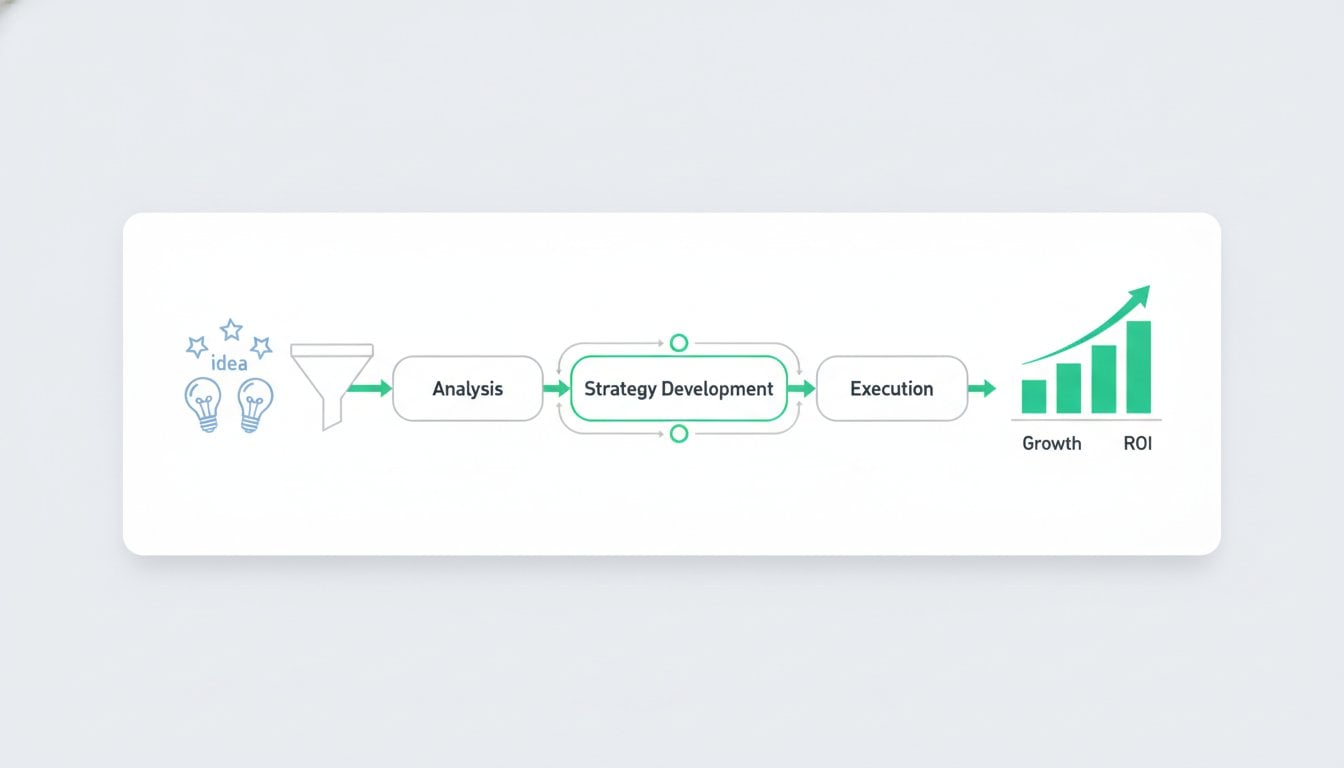
Your organization is likely leaking its most valuable asset every single day: the untapped intelligence of your frontline workforce. While the global innovation management software market is projected to grow to $5.76 billion by 2026, most companies remain trapped in “innovation theater” where ideas are captured but never executed. It’s a recipe for stagnation. If you want to drive organizational growth through ideas, you must move beyond the passive suggestion box. You need a high-impact system that transforms raw insights into a scalable engine for revenue and operational efficiency.
We know it’s frustrating to watch R&D spending rise while organic growth stays flat. You’re likely tired of seeing top talent leave because they don’t feel their insights actually matter to the bottom line. This article provides the evidence-based framework you need to bridge that gap. We’ll show you how to implement a repeatable process for identifying high-value ideas and using AI-driven workflows to reduce implementation time by over 50%. You’ll learn how to replace guesswork with data and finally secure a quantifiable ROI from your internal innovation programs.
Key Takeaways
- Learn how to drive organizational growth through ideas by replacing passive suggestion boxes with a high-impact framework designed for rapid execution.
- Understand the “Cost of Ignored Ideas” and why compounding incremental innovations often yields a higher, more sustainable ROI than high-risk radical bets.
- Discover how to leverage the “wisdom of the crowd” and diverse groups to solve complex business challenges faster than isolated experts.
- Follow a proven five-step roadmap to align frontline ideation with specific strategic objectives, ensuring every insight serves your core business goals.
- See how AI-native innovation management platforms eliminate administrative overhead and accelerate the transition from raw concept to measurable financial gain.
Understanding Idea-Driven Growth: Beyond the Suggestion Box
Idea-driven growth is the systematic capture and execution of stakeholder insights to improve the bottom line. It’s not a nebulous concept; it’s a measurable business discipline. In the 2026 economy, the capacity to drive organizational growth through ideas has become a critical differentiator. While growth through acquisition is often slow and fraught with cultural risk, organic growth powered by internal insights is inherently sustainable. Most organizations sit on a “Cognitive Surplus,” an untapped reserve of intellectual energy from employees who see inefficiencies every day. Leaders who fail to harvest this surplus are leaving a primary financial asset on the table.
The Evolution of Corporate Ideation
Corporate ideation has traveled a long road from the 1950s physical wooden box to the 2026 AI-augmented innovation ecosystem. Early attempts at “suggestion programs” were often passive and lacked a clear path to execution, leading to what we now call innovation theater. You can spot innovation theater by its symptoms: ideas are collected in a vacuum, review cycles take months, and there’s no dedicated budget for implementation. This creates innovation fatigue, where the most creative employees simply stop speaking up. Modern innovation management has shifted toward a decentralized model. It moves the power of change from a centralized R&D lab directly to the frontline, where problems are actually solved in real-time.
Why Employee Ideas Are Your Most Undervalued Asset
Your frontline workforce sees what executives cannot. They’re the ones encountering “Lean Waste” in every shift, identifying overproduction, unnecessary motion, or process bottlenecks that never show up in a high-level report. In manufacturing and healthcare, the ROI of employee-led initiatives frequently outperforms top-down strategic shifts because the solutions are grounded in operational reality. When organizations formalize this process, they unlock the benefits of employee ideation programs, which extend far beyond simple cost-cutting. These programs improve employee retention by providing a sense of agency and purpose. If you’re only using your employees’ hands and not their heads, you’re paying for their full shift but only utilizing a fraction of their value. Transitioning to an idea-driven model ensures you’re capturing the full spectrum of your human capital to drive organizational growth through ideas and fuel long-term expansion.
The Economics of Innovation: How Ideas Scale Growth
Growth is a mathematical certainty when you treat ideas as capital rather than mere suggestions. Most executives obsess over “big bets,” yet the real engine to drive organizational growth through ideas lies in the compounding effect of the innovation funnel. By running a high volume of low-cost experiments, you effectively mitigate risk and diversify your intellectual assets. You aren’t gambling on one radical shift that might fail; you’re building a robust portfolio where small, incremental wins consistently fund the high-value breakthroughs of tomorrow. This structured approach transforms innovation from a series of lucky strikes into a repeatable, financial process.
There’s also a silent predator in your balance sheet: the “Cost of Ignored Ideas.” When frontline insights are dismissed, the price isn’t just a missed efficiency. It’s the compounding expense of employee disengagement, lower productivity, and rising turnover rates. Leadership is responsible for Fostering Successful Innovation by creating a culture where contribution is expected and rewarded. Ignoring this cognitive surplus leads to a specific type of organizational stagnation that no amount of R&D spending can fix. It’s an invisible tax on your potential that competitors will eventually exploit.
Incremental vs. Radical Innovation: Balancing the Portfolio
A healthy growth strategy follows the 70-20-10 rule for resource allocation. Allocate 70% of your efforts to incremental innovations that optimize current operations, 20% to adjacent opportunities in related markets, and 10% to radical, market-creating breakthroughs. Incremental ideas are the workhorses of your strategy; they provide the immediate cash flow and operational stability needed to drive organizational growth through ideas in the short term. Meanwhile, radical ideas secure your position in the markets of 2026 and beyond. Balancing this portfolio ensures you aren’t just surviving today but actively dominating your industry. For a deeper dive into these categories, explore the technical nuances of incremental vs radical innovation.
Calculating the ROI of an Idea Management Program
Measuring success requires moving beyond vanity metrics like “number of ideas submitted.” The hard ROI formula is straightforward: (Value of Implemented Ideas – Program Costs) / Program Costs. However, elite organizations also track “soft” ROI, such as cultural agility and the reduction of “Lean Waste” identified by the frontline. These factors are leading indicators of long-term financial health and organizational resilience. You can validate your program’s potential by using a dedicated ROI calculator to project tangible gains based on your specific headcount and industry benchmarks. If your current system doesn’t provide this level of transparency, it’s worth considering how a structured platform can automate this tracking.
The “Genius in the Corner Office” model is a relic of the 20th century. Relying solely on executive intuition to steer a global enterprise is not just risky; it’s inefficient. To effectively drive organizational growth through ideas, leaders must pivot toward the “Wisdom of the Crowds.” This approach recognizes that the collective intelligence of an entire workforce will always outperform a handful of specialists. Diverse, heterogeneous groups bring a variety of perspectives that help identify market shifts and operational bottlenecks much faster than isolated experts.
Top-down strategies are frequently paralyzed by cognitive biases and the “Not Invented Here” (NIH) syndrome. This cultural barrier causes management to reject high-value insights simply because they didn’t originate within the traditional hierarchy. Crowdsourcing acts as a powerful antidote to this stagnation. It creates a meritocracy where data determines an idea’s worth, stripping away the political friction that often kills innovation before it starts.
The Power of Internal Crowdsourcing
In an enterprise context, idea crowdsourcing is the practice of soliciting solutions and insights from your entire workforce rather than just specific departments. It’s a proven method for uncovering “black swan” opportunities. Consider the story of Flamin’ Hot Cheetos; this multi-billion dollar product line didn’t come from a lab, but from the mind of a janitor who saw an opportunity others missed. To reach participation rates above 50%, elite organizations use gamification elements like voting and leaderboards. These tools turn innovation into a social, engaging experience that captures the collective attention of the frontline.
Overcoming the Administrative Bottleneck
The greatest threat to a successful crowdsourcing initiative is administrative friction. Managing hundreds of insights in static spreadsheets or fragmented email threads is a guaranteed way to fail. It leads to slow response times and employee disillusionment. Modern platforms solve this by automating the evaluation process. By using AI-driven scoring and centralized hubs, you can filter through thousands of submissions to find the highest-value opportunities in a fraction of the time. Comparing Ideawake vs Spreadsheets reveals that automation isn’t just about convenience; it’s about the speed required to drive organizational growth through ideas in a competitive market.
5 Steps to Establish a Sustainable Idea-to-Growth Pipeline
To drive organizational growth through ideas, you need a disciplined workflow that converts raw concepts into tangible results. Most programs stall because they lack a clear roadmap for execution. A sustainable pipeline isn’t a passive collection point; it’s an active filter designed to isolate and accelerate the highest-value insights. By following a structured five-step process, you can transform a chaotic stream of suggestions into a predictable engine for revenue and efficiency.
- Step 1: Define Strategic Challenges. Innovation is most effective when it solves specific, pre-defined business problems such as reducing customer churn or optimizing supply chain costs.
- Step 2: Transparent Capture. Using a centralized hub ensures every voice is heard and prevents high-value insights from being lost in fragmented email threads.
- Step 3: Collaborative Refinement. Raw ideas are rarely perfect; use the “crowd” to improve them through structured comments and peer voting before they reach the evaluation stage.
- Step 4: Objective Evaluation. Apply a standardized rubric to identify “winners” based on their potential impact and feasibility rather than the seniority of the person who suggested them.
- Step 5: Rapid Implementation. Use the “Build-Measure-Learn” loop to execute the highest-scoring ideas quickly, gathering real-world data to validate your assumptions.
The Idea Evaluation Process
Establishing rigorous evaluation criteria is the only way to prevent “pet projects” from draining your resources. Evaluation should be objective, using a standardized rubric that scores ideas based on strategic fit, technical feasibility, and projected financial impact. Subject matter experts play a vital role here, providing the final vetting stage to ensure that the highest-scoring ideas are actually viable in a live environment. Modern systems now utilize AI to identify duplicate ideas and cluster similar themes automatically, which saves hundreds of hours of manual administrative labor.
Moving from Idea to Implementation
The “Implementation Gap” is the primary reason 90% of innovation programs fail; it’s the disconnect between having a great concept and actually executing it in a live environment. Bridging this gap requires a commitment to a rapid execution loop where ideas are tested in small batches to validate assumptions before a full-scale rollout. When implementing innovative ideas, the goal is to integrate them smoothly without disrupting daily operations. Enterprises that want to streamline idea implementation process workflows can significantly reduce time-to-market by decoupling evaluation from execution and applying clear ROI tracking at every stage. You must also close the feedback loop by telling contributors exactly why their idea was or was not moved forward. This transparency builds the trust necessary to drive organizational growth through ideas over the long term. If you’re ready to see how a structured pipeline can transform your bottom line, book a free demo of our innovation platform today.
Scaling Growth with an AI-Driven Innovation Management Platform
Scaling a global innovation program without dedicated infrastructure is a logistical nightmare. While the five-step pipeline discussed earlier provides the logic, an AI-driven platform provides the engine. By 2026, the global Artificial Intelligence Platform market is forecasted to reach $38.5 billion, reflecting a significant shift toward automated decision-making in the enterprise. For innovation leaders, this means moving away from manual data entry and toward high-impact oversight. An AI-native platform can reduce the time between idea generation and implementation by over 50%, allowing you to drive organizational growth through ideas at a pace that manual systems simply cannot match.
A modern architecture ensures fast user adoption and low administrative overhead. Instead of chasing down status updates, your team can focus on high-level strategy. Integrated ROI tracking is the final piece of the puzzle. It shifts the perception of your innovation department from a discretionary “cost center” to a measurable “profit center.” By providing real-time transparency into the financial impact of every implemented insight, the platform becomes the essential infrastructure for any Continuous Improvement initiative.
Why “Build vs. Buy” is the Wrong Question
Many organizations mistakenly believe that building an internal tool is the most cost-effective path. This oversight ignores the hidden expenses of ongoing maintenance, security compliance, and the lack of feature parity with specialized tools. Professional idea management software typically pays for itself within the first few challenges by providing best-practice workflows and high user adoption rates from day one. You aren’t just buying a database; you’re investing in a refined system designed to maximize participation and minimize friction. Building internally often results in a “zombie” platform that lacks the engagement features necessary to sustain a long-term innovation culture.
Future-Proofing Growth with Ideawake AI
The next frontier of innovation lies in predictive analytics. With Ideawake AI, the platform assists in generating, summarizing, and scoring ideas based on historical success data. This removes human bias and identifies which concepts have the highest probability of success before you commit significant capital. AI-native platforms are built for machine learning and can better understand your specific business needs compared to legacy tools with bolted-on features. In 2026, the competitive edge belongs to those who can operationalize creativity at the speed of software. By leveraging these tools, you ensure your organization doesn’t just collect ideas but actually executes them to drive organizational growth through ideas and secure long-term market dominance.
Mastering the 2026 Innovation Landscape
The ability to drive organizational growth through ideas is no longer a luxury; it’s a fundamental requirement for survival in a software-driven economy. We’ve seen that shifting from a legacy “genius in the corner office” model to a decentralized, crowdsourced pipeline creates a more resilient and profitable enterprise. By implementing a structured five-step framework and leveraging AI-native infrastructure, you can finally eliminate the administrative bottlenecks that once killed promising innovation programs. The transition from a cost center to a profit center is achievable when you prioritize transparency and objective evaluation.
Ideawake is trusted by global enterprises to manage thousands of ideas while providing end-to-end ROI tracking from submission to implementation. Our platform uses AI-powered insights that reduce administrative work by 80%, allowing your team to focus on high-value execution rather than manual data entry. It’s time to stop settling for “innovation theater” and start building a high-impact engine for continuous improvement. Ready to turn your team’s ideas into measurable ROI? Book a demo with Ideawake today. We’re excited to help you unlock the full potential of your workforce and lead your industry into the future.
Frequently Asked Questions
How do you foster a culture where employees feel safe sharing ideas?
Psychological safety is established by closing the feedback loop and ensuring every contributor receives a transparent response. When employees see that their insights are evaluated against objective rubrics rather than executive whims, trust grows. You must celebrate the act of submission itself, not just the “winning” ideas, to prevent innovation fatigue and maintain a steady flow of frontline intelligence.
What are the best metrics to track for an idea-driven growth program?
Hard ROI and implementation velocity are the most critical metrics for measuring success. You should track the financial value of implemented ideas minus the total program costs to determine the net gain. Leading indicators like participation rates and the time it takes to move from capture to execution provide a clear picture of your innovation health.
How much time should employees spend on innovation vs. their core jobs?
Elite organizations typically allocate between 10% and 20% of employee time to structured ideation and refinement. This isn’t about reducing productivity on core tasks; it’s a strategic investment to drive organizational growth through ideas that solve long-term problems. Dedicated “innovation hours” or hackathons ensure that creative thinking doesn’t get buried under daily operational fires.
Can a small company drive growth through ideas as effectively as an enterprise?
What is the difference between creativity and innovation in a business context?
Creativity is the generation of novel concepts, while innovation is the successful execution of those concepts to deliver measurable business value. In a corporate environment, creativity without execution is just a hobby. True innovation requires a disciplined pipeline that filters raw imagination through the lens of feasibility, strategic alignment, and projected financial impact.
How do you handle “bad” ideas without discouraging the contributor?
Reframe “bad” ideas as “not a current strategic fit” and provide specific, data-backed reasoning for the rejection. Using a standardized rubric allows you to point to concrete factors like cost, technical feasibility, or lack of alignment with current goals. This transparency ensures the employee feels heard and understands the criteria for future success, keeping them engaged in the process.
What role does a Chief Innovation Officer play in driving organizational growth?
The Chief Innovation Officer acts as the architect of the innovation ecosystem, ensuring that decentralized ideation aligns with high-level corporate strategy. They are responsible for removing internal roadblocks and securing the resources needed for implementation. By directing the “Cognitive Surplus” toward specific strategic challenges, they transform innovation from a sporadic event into a repeatable profit center.
How can AI help in the idea management process?
AI eliminates the administrative friction that traditionally stalls large-scale programs by automating the clustering and summarization of thousands of submissions. Modern platforms use machine learning to predict success probabilities based on historical data and technical feasibility scores. This allows leadership to drive organizational growth through ideas by focusing their energy on execution rather than manual data entry. Organizations looking to maximize these gains should also evaluate purpose-built continuous improvement software to ensure their operational workflows keep pace with the volume of insights being generated.